India has reportedly paused the acquisition of six additional Boeing P-8I maritime patrol aircraft due to cost escalation driven by the US tariffs, global inflation and supply chain issues. Maybe it is a strategic response to US trade policies and tariff war. If the US imposes a second round of tariffs and sanctions on military hardware, can the operations of Anti-submarine Warfare (ASW) P-8I aircraft be affected, or do we have any alternate sonobuoys for the Indian Navy?
Currently, we are pursuing the co-production of sonobuoys to equip the P-8I fleet. Bharat Dynamics Limited (BDL) is going to manufacture P-8I sonobuoys under license from the US company Ultra Maritime, at a new facility in Visakhapatnam, slated to be operational by 2027. This agreement aims to ensure a steady and indigenous supply of sonobuoys for P-8I ASW operations under the “Make in India” Initiative. But this product is designed and developed by the US company Ultra Maritime; it may not be sustainable if the US slaps military sanctions. Concurrently, a partnership is established between Adani Defence & Aerospace and Sparton (USA) to make the first private company to offer indigenized sonobuoy solutions. This collaboration leverages Sparton’s advanced ASW (anti-submarine warfare) technology and Adani’s manufacturing expertise to support local production and sustainment for the Indian Navy. But how soon can indigenous design and development of sonobuoys happen?
Why are Sonobuoys Relevant?
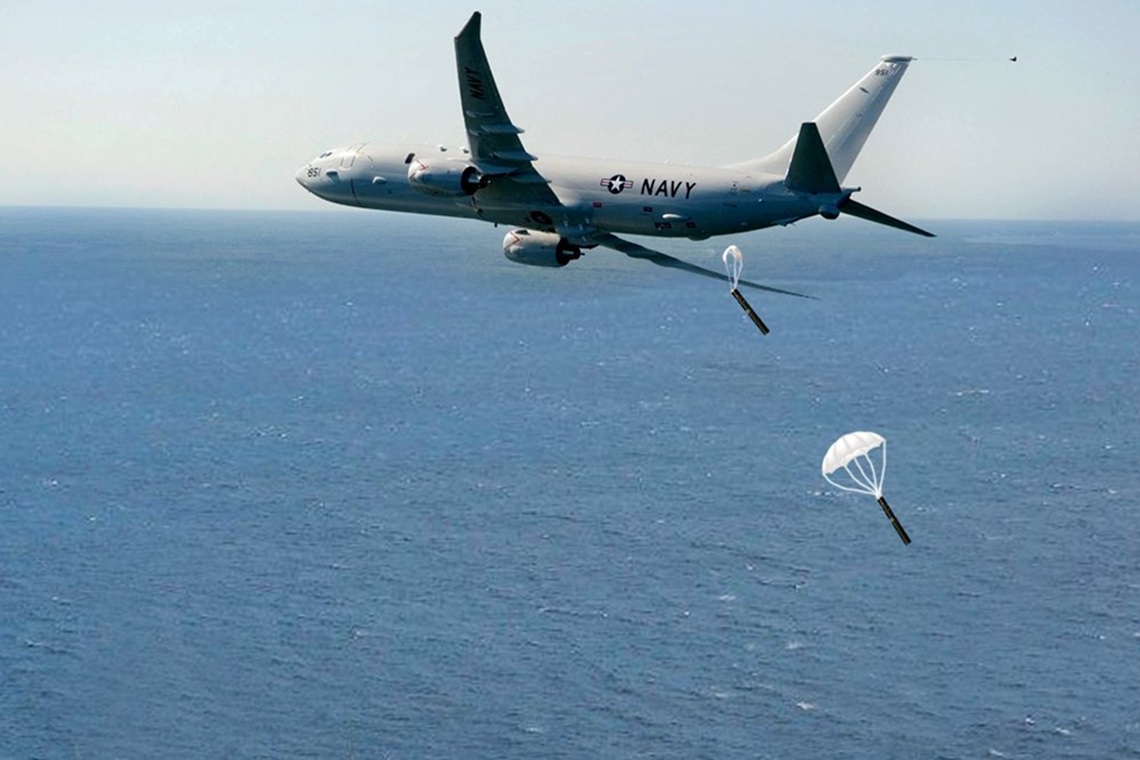
A sonobuoy is an expendable, floating electronic device that can be dropped from an aircraft to detect and analyse underwater sounds, primarily to locate and track submarines and other underwater vessels. It consists of a battery-operated radio-equipped surface float and a hydrophone that sinks to a set depth to capture acoustic signals, which are then transmitted in the RF spectrum to a monitoring platform like a P-8I aircraft for analysis. Variants of both active and passive sonobuoys with varied sonar ranges are essential in capturing acoustic signals corresponding to enemy submarines in ASW operations.
Submarines are crucial for strategic offence and defence due to their stealthy characteristics in naval warfare. They provide covert reconnaissance, strategic deterrence and can unleash a nuclear second-strike from unknown locations. Long-range airborne ASW aircraft like P-8I are the only effective deterrence available for India for early detection of enemy submarines. Airdroppable sonobuoys are the eyes and ears of airborne ASW aircraft and are essential elements in ASW operations. They are superior to the dipping sonars being operated from helicopters. Air droppable sonobuoys are designed specifically for the on-board airborne ASW platform, and hence interoperability with composite airborne platforms is nearly impossible.
Sonobuoy Deployment for ASW operations
The fundamental difference between airdropped passive and active sonobuoys lies in whether they generate their own sound to detect targets or merely listen to existing sounds. Both types are launched in conjunction, in a pattern from ASW aircraft over a large expanse of ocean, say 100 square kilometres, at calculated positions to encircle the suspected submarine locations. After the deployment at sea, sonobuoys relay acoustic data back to the hovering aircraft via radio transmission, enabling a real-time analysis towards locating enemy submarines. Onboard ASW computers, knowing the sonobuoy release patterns, extract the sonar intelligence and calculate estimated position, speed and future positions of hostile submarines. Once deployed, sonobuoys float on the surface with a radio transmitter while their underwater sensors descend to preset depths.
Smart and Intelligent Sonobuoys
New generation sonobuoys can be embedded with digital signal processors (DSPs) that can facilitate automated detection, classification and tracking of underwater threats. They can do real-time noise filtering, echo discrimination, and even target detection. They are more autonomous and can change modes from passive to active, if certain thresholds are met, and do data compression and optimise the available bandwidth while transmitting the data to friendly platforms. These buoys can be networked and programmed in a swarm mode and can perform data fusion after sensing sonar data before RF transmission. The whole purpose of autonomy is to reduce operator workload on board ASW systems and improve data quality in noisy environments. The autonomy of sonobuoys is governed by a range of algorithms stated below.
Algorithms to Control Power Consumption
Algorithms to control power consumption of sonobuoys focus on optimising transmission, data processing and sensor activation schedules without compromising sonar detection capabilities. Modern approaches leverage machine learning, adaptive duty cycles, event-driven transmission, signal compression, and sensor scheduling for the preservation of power. The Kalman filters can do noise filtering and prediction of targets, thereby reducing the number of sonar transmissions required for target tracking.
Autonomous Drift Management
These capabilities allow the GPS-integrated sonobuoys to optimise their positioning, adapt to environmental conditions and maintain operational efficiency in dynamic maritime environments. Predictive drift modelling and networked swarm coordination can achieve autonomous repositioning of sonobuoys. Sonobuoys can physically shift their positions against ocean currents to an extent, using small actuators or ballast systems.
Algorithms to Identify and Filter out Noises
Underwater noise clutter is a big challenge for the detection of submarines. Incorporating an ML-based sonobuoy detection model would facilitate the detection of targets from noise clutter. The processing system typically employs techniques in a cascade, starting with simple static filters and progressing to more complex adaptive or spectral methods and deep learning networks like Convolutional Neural Networks (CNNs) and Recurrent Neural Networks (RNNs) for signal processing.
Swarm Coordinated Sonobuoys
Swarm coordination of deployed sonobuoys is an emerging concept that leverages advanced networking and autonomy to transform disposable sonobuoy sensors into an integrated, self-optimising sensor network. The goal is to maximise target detection and tracking accuracy while minimising the number of buoys needed by effective coordination. This concept moves beyond the traditional fixed-pattern deployment to create a coherent, adaptive array in the ocean.
New Generation Battery Technology
Battery technology has evolved a lot after the advent of Electric Vehicles. The charge density has improved considerably. Sonobuoy batteries can have increased energy density, higher power capability, longer operational life and enhanced safety compared to traditional technologies. Lithium–thionyl chloride, Lithium-seawater, Solid-state primary lithium, Silver-zinc/zinc-air, thermal (reserve) batteries and Hybrid cell technology combining battery and super-capacitor can be explored for long endurance.
Renewable Energy from Oceans for Charging Deployed Sonobuoys
Sourcing power post-deployment from renewable sources at sea is a concept that can be adapted easily for long-endurance operations. For very long-duration or heavy-duty applications, we can integrate multiple power sources like current ocean turbines, solar panels, wind turbines and fuel cells alongside high-capacity batteries. Improvements in the sonobuoys’ overall electronics and sensor systems, such as the incorporation of automated sleep mode and low-power components, are needed to maximise the life of the existing battery technology.
Recycled and Reusable Sonobuoys
Traditionally, sonobuoys are designed as disposable and cannot be reused once the battery becomes discharged post-deployment. Their operational life is typically limited by their internal non-rechargeable primary batteries and mission requirements, lasting from a few hours to several days. Even the recovery of the buoys using ships is laborious and cost-effective. However, research is going on to make it a recoverable and reusable platform to reduce cost and environmental impact. Research is also on to facilitate biodegradable or environmentally friendly materials for sonobuoy production to reduce waste.
Modular Designs for Sonobuoys
The modular design of sonobuoys is an evolving concept aimed at enhancing flexibility, ease of integration, production, operational sustainability of buoys and economy of scale. By incorporating interchangeable components, smart and intelligent sonobuoys can be customised for specific tasks, such as passive or active sonar, multi-static networking, or even for interoperability with varied airborne platforms while maintaining compatibility with existing platforms. Modular designs also reduce costs, simplify upgrades and support rapid deployment in contested maritime environments, directly enhancing ASW effectiveness. A single sonobuoy integrating both active and passive sensors is a prime example of achieving functional modularity within a standard physical form factor.
Autonomous Surface Vessels (ASV) for Supporting Deployed Sonobuoys
The deployment of Autonomous Surface Vessels (ASVs), also known as Unmanned Surface Vehicles (USVs), is a transformative shift in the operational use and effectiveness of sonobuoys in ASW and maritime surveillance. Their role can be broken down into two primary functions. One is sonobuoy management, and the other is data re-transmission to nearby friendly platforms. USVs have long energy endurance and can support sonobuoys with a networked surveillance system, maximising the value of every deployed sonobuoy. The most critical function of a USV is to act as a persistent communication gateway by establishing line-of-sight (LOS) with sonobuoys and routing data to friendly aircraft or ships, preserving the energy and avoiding data loss.
Way Ahead
The geopolitical situation worldwide is unpredictable. The indigenous development of sonobuoys is a major strategic priority for navies seeking to enhance their Anti-Submarine Warfare (ASW) capabilities and achieve greater self-reliance. India’s Ministry of Defence and Indian Navy have prioritised sonobuoys for domestic manufacturing. They are among the 29 items on India’s indigenisation plan for naval technologies. The time has come for the Indian Navy to revive the indigenous air-launched sonobuoy project by designing and developing native sonobuoys with the support of DRDO, Adani Defence & Aerospace and the prevailing startup ecosystem.
Title Image Courtesy: Indian Navy
Disclaimer: The views and opinions expressed by the author do not necessarily reflect the views of the Government of India and the Defence Research and Studies
Article Courtesy: Raksha Anirveda