The recent evolution of NATO’s strategic doctrine, marked by open discussions of preventive strikes against Russia, has reignited debates about France’s position within the Alliance. While France has been a founding member of NATO since 1949, its relationship with the organisation has been historically complex, oscillating between full participation and deliberate distancing. The decision taken in 2009 by President Nicolas Sarkozy to reintegrate France into NATO’s integrated military command represented a turning point, effectively ending the Gaullist tradition of strategic autonomy that had prevailed since 1966.
This choice, initially justified as a means of enhancing France’s influence within the Alliance, now appears fraught with risk. By binding itself more closely to NATO’s military structures, France has reduced its capacity to act independently in defence and foreign policy. In the current climate of escalating tensions between NATO and Russia, this integration exposes France to the possibility of direct involvement in a high-intensity conflict against a nuclear power with which it shares deep historical, cultural, and economic ties.
The purpose of this paper is to critically examine how Sarkozy’s decision has reshaped France’s strategic posture, to assess the implications of NATO’s doctrinal shift toward offensive measures, and to highlight the contradictions between France’s historical relationship with Russia and its present alignment within the Alliance. Ultimately, this analysis seeks to demonstrate that France’s reintegration into NATO’s command structure has placed the nation at greater risk of war, undermining both its autonomy and its longstanding tradition of balancing East and West.
France and NATO: A Complex Relationship
Founding Membership and Early Commitment
France’s relationship with NATO began at the Alliance’s inception. In 1949, Paris stood among the twelve founding members of the North Atlantic Treaty, signing onto a collective defence pact designed to deter Soviet expansion in post-war Europe. For France, NATO represented not only a military shield but also a political instrument to anchor the country firmly within the Western bloc at a time when Europe was still reeling from the devastation of World War II.
The early years of French participation were marked by enthusiasm and active engagement. French forces were integrated into NATO’s command structures, and Paris hosted key institutions, including the headquarters of the Supreme Headquarters Allied Powers Europe (SHAPE) in Rocquencourt. This positioning underscored France’s central role in the Alliance and reflected its ambition to be a leading power in shaping Western security.
Yet, even in these formative years, tensions emerged between France’s desire for autonomy and NATO’s increasingly American-led orientation. The United States, by virtue of its military and economic dominance, quickly assumed a preeminent role in the Alliance. For French leaders, particularly Charles de Gaulle, this imbalance raised concerns about sovereignty and the risk of subordinating national defence to Washington’s strategic priorities.
By the late 1950s, these concerns had crystallised into a broader critique of NATO’s structure. De Gaulle argued that France’s nuclear deterrent and its global interests required a more independent posture. He feared that NATO’s integrated command system left France vulnerable to decisions made in Washington or London without sufficient regard for French national interests. This tension set the stage for the dramatic rupture of 1966, when France withdrew from NATO’s integrated military command while remaining a political member of the Alliance.
De Gaulle’s Withdrawal and the Doctrine of Independence
The rupture of 1966 remains one of the most defining episodes in France’s relationship with NATO. Confronted with what he perceived as an excessive American dominance over the Alliance, President Charles de Gaulle announced that France would withdraw from NATO’s integrated military command. This decision was not a rejection of NATO itself—France remained a political member of the Alliance and committed to collective defence under Article 5 of the North Atlantic Treaty—but rather a deliberate assertion of national sovereignty in military affairs.
De Gaulle’s rationale was rooted in a broader vision of France as an independent global power. He believed that the integrated command structure subordinated French military decisions to Washington and London, thereby undermining France’s capacity to act autonomously in defence of its own interests. For De Gaulle, the credibility of France’s nuclear deterrent, the force de frappe, depended on its independence from NATO’s centralised command. Only by maintaining full control over its nuclear arsenal and military planning could France ensure that its strategic posture was not dictated by foreign powers.
The withdrawal had both symbolic and practical consequences. Symbolically, it marked France’s determination to chart its own course in international affairs, reinforcing the Gaullist doctrine of grandeur and independence. Practically, it led to the relocation of NATO’s headquarters from Paris to Brussels and the removal of NATO forces from French soil. France established its own national command structures while continuing to cooperate with NATO allies through bilateral and multilateral arrangements.
This doctrine of independence was not merely a matter of military organisation; it reflected a deeper philosophy of international relations. De Gaulle envisioned France as a mediator between East and West, capable of engaging with both the United States and the Soviet Union without being bound by the rigid bipolarity of the Cold War. His famous policy of “détente, entente, coopération” sought to reduce tensions with Moscow and to position France as a bridge-builder in Europe. In this sense, the withdrawal from NATO’s integrated command was part of a larger strategy to preserve France’s freedom of action and to cultivate a distinctive diplomatic identity.
Critics at the time argued that De Gaulle’s decision weakened NATO’s cohesion and reduced France’s influence within the Alliance. Yet supporters contended that it enhanced France’s credibility as an independent actor and safeguarded its national interests. The doctrine of independence became a cornerstone of French foreign policy, shaping the country’s approach to NATO for more than four decades. Successive presidents, from Georges Pompidou to Jacques Chirac, maintained this posture, balancing cooperation with NATO against the preservation of strategic autonomy.
By the end of the Cold War, France’s position had evolved but remained consistent with Gaullist principles. While Paris participated in NATO operations and contributed to collective defence, it continued to operate outside the integrated command structure. This arrangement allowed France to engage with NATO on its own terms, preserving the flexibility to pursue independent initiatives in Europe, Africa, and beyond.
Thus, the withdrawal of 1966 was not a temporary divergence but a long-term redefinition of France’s role within NATO. It established a precedent of cautious engagement, one that underscored the tension between alliance solidarity and national sovereignty. This precedent would later be challenged in 2009, when President Nicolas Sarkozy reversed De Gaulle’s decision and brought France back into the integrated command—a move that fundamentally altered the balance between autonomy and alliance.
Sarkozy’s Reintegration in 2009: The End of the Gaullist Exception
The year 2009 marked a decisive rupture in France’s long-standing posture of strategic independence. President Nicolas Sarkozy announced that France would fully reintegrate into NATO’s integrated military command, thereby reversing the decision taken by Charles de Gaulle in 1966. This move was presented as a pragmatic adaptation to the realities of the post-Cold War world, yet it carried profound symbolic and strategic implications.
Sarkozy justified the reintegration on several grounds. First, he argued that France’s absence from the integrated command had become an anomaly, limiting its influence within the Alliance. While France remained politically active in NATO and contributed troops to operations in the Balkans, Afghanistan, and elsewhere, its exclusion from the command structure meant that it had little say in the planning and execution of military operations. Sarkozy contended that by returning to the integrated command, France would gain a stronger voice in shaping NATO’s strategy and decisions.
Second, Sarkozy framed the decision as a means of modernising France’s defence posture. In his view, the rigid Gaullist doctrine of independence no longer corresponded to the realities of globalisation, terrorism, and new forms of warfare. He argued that France could maintain its nuclear deterrent and sovereign decision-making while still participating fully in NATO’s structures. Reintegration was thus presented as compatible with autonomy, a way of combining independence with influence.
Third, Sarkozy emphasised the diplomatic benefits of reintegration. He sought to strengthen France’s relationship with the United States, which had been strained during the Iraq War under Jacques Chirac. By rejoining NATO’s command, Sarkozy signalled a willingness to align more closely with Washington, thereby reinforcing transatlantic solidarity. This gesture was also intended to reassure European allies that France was committed to collective defence at a time when NATO was redefining its role in the post-Cold War era.
The decision was ratified at the Strasbourg-Kehl summit in April 2009, where France formally resumed its place in the integrated command. Yet the move provoked intense debate within France. Critics argued that Sarkozy had abandoned a cornerstone of French foreign policy without sufficient justification. For many, the Gaullist tradition of independence was not merely a relic of the Cold War but a vital safeguard of national sovereignty. Reintegration, they warned, would reduce France to a subordinate role within an American-led alliance, undermining its capacity to act as an autonomous power.
The parliamentary debates of 2009 reflected this tension. Opponents of reintegration, including figures from across the political spectrum, accused Sarkozy of sacrificing independence for influence. They questioned whether France would truly gain a stronger voice within NATO or whether it would simply be compelled to follow Washington’s lead. Some warned that reintegration would entangle France in conflicts that did not serve its national interests, exposing it to risks of war far from its borders.
Supporters, however, maintained that reintegration was a pragmatic step that enhanced France’s credibility and influence. They argued that France could no longer afford to remain outside the structures of an alliance that was central to European security. By participating fully, France could shape NATO’s evolution and ensure that its interests were represented.
In retrospect, Sarkozy’s decision can be seen as a turning point in France’s strategic identity. It marked the end of the Gaullist exception and the embrace of a more conventional alliance posture. While France retained its nuclear deterrent and the theoretical capacity to act independently, its reintegration bound it more tightly to NATO’s collective decisions. This shift has become particularly significant in the current context, as NATO moves toward a more offensive doctrine vis-à-vis Russia.
The reintegration of 2009 thus laid the groundwork for France’s present dilemma. By rejoining the integrated command, France accepted a deeper level of military solidarity with its allies. In times of crisis, this solidarity translates into automatic involvement in NATO’s strategic choices, including the possibility of preventive strikes against Russia. What Sarkozy presented as a pragmatic modernisation has, in practice, constrained France’s autonomy and increased its exposure to risks that De Gaulle had sought to avoid.
France and Russia: Historical, Cultural, and Economic Bonds
The Franco‑Russian Alliance in Historical Perspective
France’s relationship with Russia has long been marked by alternating phases of rivalry and alliance, but the enduring theme is one of mutual recognition and cooperation. In the late 19th century, the Franco‑Russian Alliance of 1892 was a cornerstone of European diplomacy. It provided France with a counterweight to German power and offered Russia a Western partner against Austro‑Hungarian and German ambitions. This alliance was not merely a military pact; it symbolised a convergence of interests between two nations seeking stability in a volatile Europe.
During the First World War, French and Russian soldiers fought side by side against the Central Powers. The alliance was tested by the strains of war and ultimately disrupted by the Russian Revolution of 1917, but the memory of shared sacrifice remained a powerful symbol of solidarity. Even in the interwar years, when ideological differences widened, French intellectuals and diplomats continued to engage with Russia, reflecting a deep cultural curiosity and respect.
De Gaulle’s Vision of Franco‑Russian Cooperation
Charles de Gaulle revived this tradition of engagement in the 1960s. His policy of détente, entente, coopération was designed to reduce Cold War tensions and to position France as a mediator between East and West. De Gaulle’s visits to Moscow in 1966 and his emphasis on dialogue with the Soviet Union underscored his belief that Europe could not be stable without Russia.
For De Gaulle, Franco‑Russian relations were not a tactical manoeuvre but a strategic necessity. He saw Russia as an integral part of Europe’s destiny, a nation whose history, culture, and geography made it indispensable to the continent’s equilibrium. This vision reinforced the idea that France should maintain a special relationship with Russia, even while remaining a member of NATO.
Cultural and Intellectual Exchanges
Beyond diplomacy, Franco‑Russian ties have been enriched by cultural and intellectual exchanges. Russian literature, music, and art have profoundly influenced French intellectual life. Writers such as Tolstoy, Dostoevsky, and Pushkin found eager audiences in France, while French thinkers and artists were celebrated in Russia. Ballet, opera, and painting became bridges between the two cultures, fostering mutual admiration and dialogue.
Academic and scientific cooperation also flourished. French universities welcomed Russian scholars, while French scientists collaborated with Russian counterparts in fields ranging from physics to medicine. These exchanges reinforced the perception of Russia not as an adversary but as a partner in the pursuit of knowledge and cultural enrichment.
Economic and Energy Relations
Economically, France and Russia have maintained significant ties, particularly in the energy sector. French companies such as TotalEnergies have invested heavily in Russian oil and gas projects, while Russia has been a major supplier of energy to Europe. Agricultural trade, industrial cooperation, and tourism have further strengthened economic interdependence.
These economic links underscore the practical dimension of Franco‑Russian relations. For France, access to Russian energy and markets has been vital to its economic stability. For Russia, French investment and technology have contributed to modernisation and integration into global markets.
The Spiritual Dimension
There is also a spiritual dimension to Franco‑Russian ties. The dialogue between Catholicism and Orthodoxy has fostered mutual respect and understanding. Religious exchanges, pilgrimages, and theological dialogues have contributed to a sense of shared heritage, reinforcing the cultural bonds between the two nations.
Contradictions with NATO’s Offensive Doctrine
Against this backdrop, NATO’s current trajectory toward preventive strikes against Russia appears profoundly contradictory. France, a nation with deep historical, cultural, and economic ties to Russia, is now bound by alliance commitments that position Moscow as an existential enemy. This alignment undermines France’s ability to act as a mediator and erodes the foundations of its special relationship with Russia.
The reintegration into NATO’s integrated command in 2009 has exacerbated this contradiction. France no longer has the flexibility to distance itself from NATO’s offensive posture. Instead, it risks being drawn into a confrontation that runs counter to its historical identity and its long‑standing tradition of engagement with Russia.
Bonds at Risk
The Franco‑Russian relationship is more than a diplomatic convenience; it is a tapestry woven from history, culture, economics, and spirituality. These bonds have shaped France’s identity and its vision of Europe. Yet today, they are threatened by NATO’s doctrinal shift and by France’s reintegration into the Alliance’s military command.
The danger is not only military but civilizational. By aligning itself with a strategy of confrontation, France risks severing ties that have sustained its cultural richness and diplomatic balance for over a century. The challenge for France is to reconcile its commitments to NATO with its enduring relationship to Russia—a task made increasingly difficult by the Alliance’s offensive turn.
The Consequences for France
Military Risks: Exposure to High‑Intensity Conflict
The most immediate consequence of France’s reintegration into NATO’s integrated command is military exposure. By binding itself to the Alliance’s collective planning structures, France has reduced its ability to opt out of operations that may not serve its national interests. In the current climate, where NATO officials openly discuss preventive strikes against Russia, this integration means that France could be automatically implicated in a confrontation with a nuclear power.
Unlike interventions in Afghanistan or the Balkans, a war with Russia would not be peripheral but existential. It would involve large‑scale mobilisation, the risk of escalation to nuclear exchanges, and the possibility of direct attacks on French territory. The Gaullist safeguard of independence—designed precisely to avoid such entanglement—has been dismantled. France now faces the prospect of being drawn into a conflict that threatens its survival, not by its own choice but by collective alliance commitments.
Economic Risks: Energy, Trade, and Sanctions
The economic consequences are equally severe. France has long relied on Russian energy supplies, particularly natural gas, as part of its broader European energy mix. A confrontation with Russia would sever these links, forcing France to seek alternative sources at higher costs. The resulting energy insecurity would ripple through the economy, affecting industry, agriculture, and households.
Trade relations would also collapse. French companies with investments in Russia—ranging from energy giants like TotalEnergies to luxury brands and agricultural exporters—would face losses. Sanctions and counter‑sanctions would further isolate France from Russian markets, undermining economic stability. In a globalised economy, the disruption of Franco‑Russian trade would reverberate across Europe, compounding the economic risks of war.
Diplomatic Risks: Loss of Autonomy and Credibility
Diplomatically, France’s reintegration into NATO’s command has eroded its capacity to act as an independent power. For decades, France cultivated a reputation as a mediator, capable of engaging with both East and West. De Gaulle’s policy of détente and subsequent French initiatives reinforced this identity. Today, however, France’s alignment with NATO’s offensive doctrine undermines its credibility as a bridge‑builder.
In the eyes of Russia, France is no longer an autonomous actor but a subordinate participant in an American‑led alliance. This perception diminishes France’s ability to negotiate, mediate, or propose alternative solutions to crises. It also weakens France’s standing in the broader international community, where independence and balance have long been hallmarks of its diplomatic identity.
Societal Risks: Fear, Division, and Cohesion
The societal consequences of this alignment are often overlooked but no less significant. The prospect of confrontation with Russia generates fear among the French population, eroding confidence in national security. Public opinion is divided: some support NATO solidarity, while others lament the loss of independence and warn against entanglement in foreign conflicts.
This division threatens national cohesion. In times of crisis, unity is essential, yet France’s current posture risks polarising society. Debates over NATO, sovereignty, and relations with Russia could deepen political fractures, undermining the stability of the Republic. The fear of war, combined with economic hardship and diplomatic isolation, could fuel discontent and weaken trust in institutions.
Strategic Identity at Risk
Ultimately, the consequences of reintegration and NATO’s offensive turn strike at the heart of France’s strategic identity. For centuries, France has sought to balance alliances with autonomy, cultivating a distinctive role in international affairs. The Gaullist doctrine of independence embodied this tradition, ensuring that France could act freely in defence of its interests.
By rejoining NATO’s integrated command, France has compromised this identity. It has traded autonomy for influence, but the influence gained is limited, while the risks incurred are immense. France is now positioned not as an independent power but as a participant in a strategy of confrontation that threatens its survival and undermines its historical ties to Russia.
A Dangerous Alignment
The consequences for France are multifaceted—military, economic, diplomatic, and societal—but they converge on a single point: vulnerability. Reintegration into NATO’s command has exposed France to risks that De Gaulle sought to avoid, while NATO’s doctrinal shift toward preventive strikes has magnified those risks.
France now faces the prospect of war with Russia, economic disruption, diplomatic marginalisation, and societal division. The decision of 2009, once framed as pragmatic modernisation, has become a source of danger. The challenge for France is to reassess its alignment, to reclaim its autonomy, and to reconcile its commitments to NATO with its enduring identity as an independent power and a nation with deep ties to Russia.
Conclusion
France at the Crossroads of Autonomy and Alliance
The trajectory of France’s relationship with NATO reveals a profound tension between autonomy and alliance, a tension that has defined French strategic identity for more than half a century. From the founding membership of 1949 to De Gaulle’s withdrawal from the integrated command in 1966, France consistently sought to balance its commitment to collective defence with its determination to preserve sovereignty. This balance was not merely a matter of institutional design; it was a reflection of France’s broader vision of itself as an independent power, capable of shaping its own destiny and contributing to global stability on its own terms.
The decision of Nicolas Sarkozy in 2009 to reintegrate France into NATO’s military command marked a decisive rupture with this tradition. Presented as a pragmatic modernisation, the move was justified in terms of influence, solidarity, and adaptation to new threats. Yet in practice, it dismantled the safeguard of independence that had protected France from entanglement in conflicts dictated by external powers. By rejoining the integrated command, France accepted a deeper level of military solidarity, one that now binds it to NATO’s evolving doctrine of confrontation with Russia.
This doctrinal evolution—from a defensive alliance to one contemplating preventive strikes—has magnified the risks of Sarkozy’s decision. France, once able to stand apart from NATO’s military structures, is now fully implicated in strategies that threaten direct conflict with a nuclear power. The Gaullist vision of France as a mediator between East and West has been replaced by a posture of alignment with an alliance increasingly defined by hostility toward Russia.
The consequences of this alignment are not abstract. They manifest in military exposure, economic vulnerability, diplomatic marginalisation, and societal division. France faces the prospect of being drawn into a war that threatens its survival, of losing access to vital energy and trade, of forfeiting its credibility as an independent actor, and of polarising its society in the face of fear and uncertainty.
At this crossroads, France must confront a fundamental question: is the pursuit of influence within NATO worth the sacrifice of autonomy, identity, and security? The answer will determine not only France’s future but also the stability of Europe as a whole.
Civilizational Bonds and the Threat of Rupture
France’s predicament within NATO cannot be understood solely in terms of military doctrine or alliance politics. It must also be viewed through the lens of civilizational bonds, the deep historical, cultural, and spiritual connections that have long linked France and Russia. These ties are not incidental; they form part of the fabric of European identity and have shaped France’s vision of its role in the world.
From the Franco‑Russian alliance of the late 19th century to the shared sacrifices of the First World War, France and Russia have repeatedly discovered common ground in moments of crisis. These alliances were not merely tactical arrangements but reflections of a deeper recognition: that the destinies of the two nations are intertwined. Even during the Cold War, when ideological divisions were stark, French leaders such as Charles de Gaulle insisted on maintaining dialogue with Moscow, affirming that Europe could not be whole without Russia.
Culturally, the exchange between France and Russia has been profound. Russian literature, music, and art have enriched French intellectual life, while French philosophy, science, and aesthetics have found eager audiences in Russia. These exchanges have fostered mutual admiration and respect, reinforcing the perception of Russia not as an adversary but as a partner in the pursuit of knowledge, beauty, and human progress.
Economically, the relationship has been equally significant. French companies have invested in Russian energy and industry, while Russian resources have sustained European economies. These ties have created interdependence, binding the two nations together in ways that transcend politics.
The doctrine of preventive strikes, now contemplated by NATO, threatens to rupture these bonds. By positioning Russia as an existential enemy, NATO compels France to abandon a tradition of engagement that has defined its identity for more than a century. The reintegration into NATO’s military command in 2009 has stripped France of the flexibility to resist this posture. France is no longer free to cultivate its special relationship with Russia; it is bound to a strategy of confrontation that undermines its civilizational heritage.
This rupture carries consequences beyond diplomacy. It risks severing cultural exchanges, disrupting economic ties, and eroding the spiritual dialogue between Catholicism and Orthodoxy. It threatens to reduce France’s role in Europe from that of a mediator and bridge‑builder to that of a participant in a conflict that divides the continent. In doing so, it undermines not only France’s strategic autonomy but also its civilizational mission.
At stake is more than national security; it is the preservation of France’s identity as a nation that balances East and West, that seeks dialogue rather than confrontation, and that values cultural and spiritual bonds as much as military alliances. The offensive doctrine of NATO, combined with France’s reintegration into its command structures, jeopardises this identity, exposing France to a dangerous alignment that contradicts its history and its values.
Reclaiming Autonomy and Redefining France’s Role in Europe
The analysis of France’s trajectory within NATO, its civilizational bonds with Russia, and the multifaceted consequences of reintegration into the Alliance’s military command culminate in a stark realisation: France stands at a decisive historical juncture. The choice made in 2009 to abandon the Gaullist safeguard of independence has bound the nation to a strategy that now threatens its security, its economy, its diplomacy, and its identity. The doctrine of preventive strikes against Russia, openly contemplated by NATO, magnifies these dangers to an existential level.
At this juncture, France must confront the fundamental question of its strategic destiny. Will it continue to subordinate its autonomy to an alliance increasingly defined by confrontation, or will it reclaim the independence that has long been the hallmark of its foreign policy? The answer will shape not only France’s future but also the trajectory of Europe as a whole.
Reclaiming autonomy does not mean abandoning alliances or retreating into isolation. It means reasserting the principle that France’s participation in collective defence must be compatible with its national interests, its civilizational heritage, and its role as a mediator in Europe. It means resisting doctrines that compel France to treat Russia as an existential enemy, when history, culture, and economics suggest that dialogue and cooperation are both possible and necessary.
Redefining France’s role in Europe requires courage and vision. It demands that France revive the Gaullist tradition of independence, not as nostalgia but as a pragmatic response to the dangers of entanglement. It calls for a renewed emphasis on diplomacy, cultural exchange, and economic cooperation, even in the face of geopolitical tensions. It requires France to articulate a vision of Europe that includes Russia, rather than one that seeks to exclude or confront it.
The stakes are immense. A France that remains bound to NATO’s offensive doctrine risks being drawn into a war that threatens its survival. A France that reclaims autonomy can instead position itself as a stabilising force, a nation that balances alliances with independence and that seeks to preserve peace through dialogue rather than confrontation.
In this sense, the challenge before France is not merely strategic but civilizational. It is a question of identity, of whether France will continue to embody the values of independence, balance, and cultural richness that have defined its history, or whether it will surrender these values to the logic of confrontation. The decision will determine whether France remains a sovereign actor in world affairs or becomes a subordinate participant in strategies that threaten its very existence.
The time has come for France to reassess, to reclaim, and to redefine. At this crossroads, the path of autonomy offers not only security but dignity, not only survival but greatness. It is the path that honours France’s history, preserves its identity, and secures its future in a Europe that must learn once again to balance power with dialogue and confrontation with cooperation.
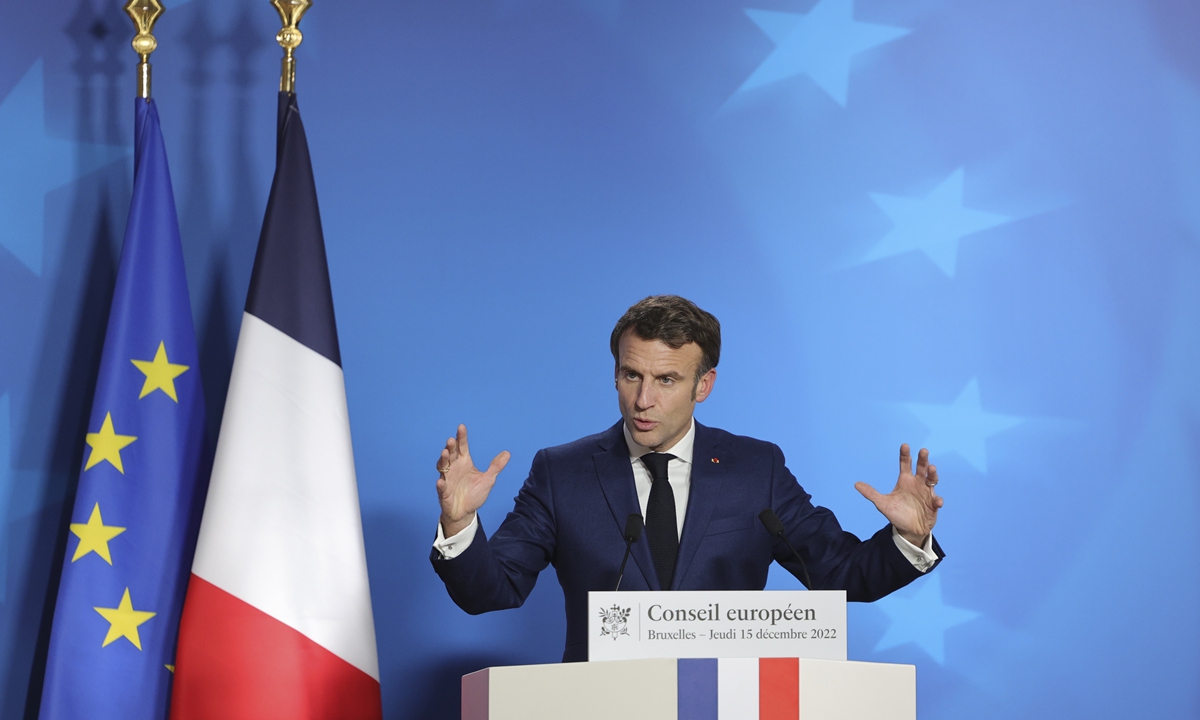
Title Image Courtesy: Global Times
Disclaimer: The views and opinions expressed by the author do not necessarily reflect the views of the Government of India and the Defence Research and Studies