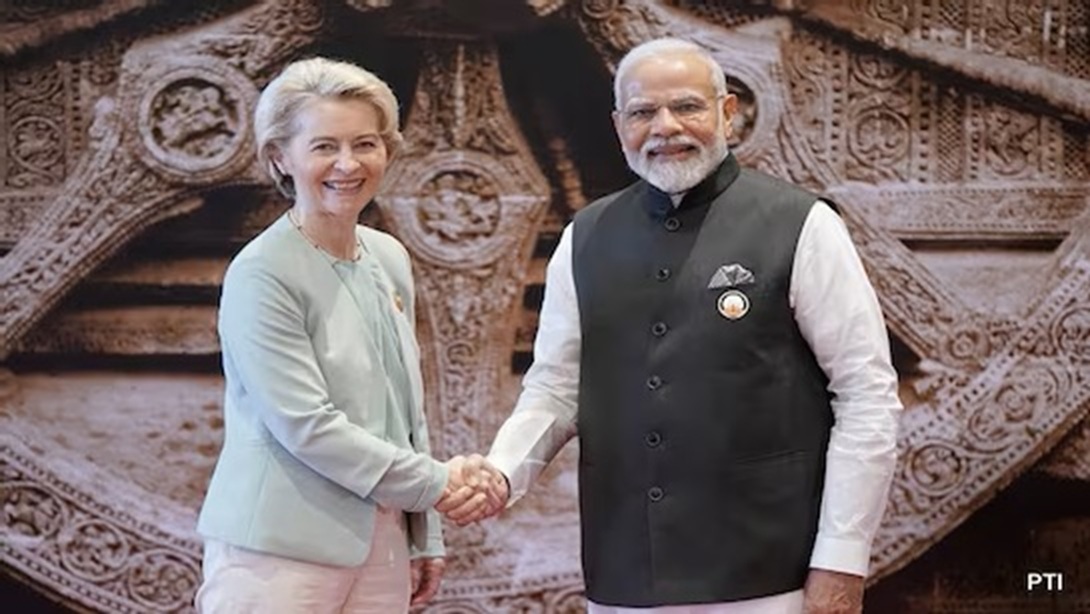
When European Commission President Ursula von der Leyen described the newly concluded India–European Union Free Trade Agreement as the “mother of all deals”, it was not rhetorical excess. After nearly two decades of stalled negotiations, the pact represents one of the most consequential trade alignments of this decade, economically expansive, geopolitically charged, and globally consequential.
At a time when global trade is fragmenting under the weight of protectionism, sanctions and strategic distrust, the India–EU agreement stands out as a deliberate attempt to anchor economic cooperation between two large democratic blocs. It is less a routine trade deal and more a statement of intent about how power, partnerships and prosperity will be shaped in the coming years.
What the Deal Entails?
At its core, the India–EU agreement is a comprehensive Free Trade Agreement covering goods, services, investment, regulatory cooperation and supply chain integration. Once fully implemented, tariffs on over 90 per cent of traded goods by value will be reduced or eliminated in a phased manner, making it one of the most ambitious trade agreements the EU has ever negotiated.
For India, the immediate gains are clear. European tariffs will be lowered on exports such as textiles, leather, gems and jewellery, chemicals, engineering goods and pharmaceuticals. These are sectors that generate large-scale employment and export earnings. For the European Union, India will gradually reduce duties on automobiles, wines and spirits, industrial machinery, medical equipment and high-end manufactured goods, while continuing to protect politically sensitive areas such as dairy and select agricultural products.
The agreement still requires ratification by the European Parliament, EU member states and the Indian government, with implementation expected around 2027. Yet even before it comes into force, markets and policymakers are responding to what it signals: a recalibration of global economic alignments.
What Does it Mean for The US?
From Washington’s perspective, the India–EU deal is not antagonistic, but it is strategically uncomfortable. Together, India and the EU account for roughly a quarter of global GDP and close to one-third of world trade. A closer integration between these two economies reduces reliance on US-centric trade frameworks and regulatory dominance.
The timing matters. As American trade policy has become more inward-looking and tariff-oriented in recent years, partners have increasingly sought alternatives that provide stability and predictability. The India–EU agreement serves precisely that purpose. It offers a rules-based economic partnership that is less vulnerable to electoral cycles and abrupt policy shifts.
American companies will continue to operate in both markets, but they will now face a more competitive environment. Preferential access enjoyed by European firms in India and Indian firms in Europe will reshape supply chains, pricing structures and investment flows. For the United States, this is not a loss of influence, but it is a reminder that influence must now be actively maintained rather than assumed.
China’s Likely Response
China is unlikely to react loudly, but it will read the deal carefully. From Beijing’s viewpoint, the India–EU agreement fits into a broader trend of supply chain diversification away from China-centric manufacturing and trade routes. An integrated economic corridor linking Europe with India’s vast consumer base and growing manufacturing capacity offers global companies a viable alternative.
This does not amount to containment, but it does represent competition by design. China will respond pragmatically, strengthening partnerships across ASEAN, Africa and the Middle East, accelerating domestic innovation, and reinforcing its push for self-reliance in critical technologies. Beijing will also closely track regulatory standards emerging from the India–EU framework, particularly in digital trade, sustainability and data governance, since these are likely to influence global norms.
Russia’s Quieter Discomfort
Russia’s position is more awkward. The agreement does not target Moscow directly, yet it subtly weakens its economic leverage. India’s deeper integration with the European economy reduces long-term dependence on traditional energy and defence relationships. Europe, meanwhile, continues to diversify away from politically risky dependencies.
For Russia, already constrained by sanctions and geopolitical isolation, the deal reinforces a shifting reality. Global economic gravity is moving in directions where Moscow has limited influence. Russia is unlikely to oppose the agreement publicly, but it will adjust by strengthening ties with alternative partners across Asia, the Middle East and the Global South.
Why Does This Deal Matter?
What makes this agreement the “mother of all deals” is not its headline tariff cuts, but its symbolism. It reflects a world where trade is no longer neutral, where supply chains double as strategic assets, and where economic partnerships increasingly mirror political values.
The India–EU pact signals that large democracies are opting for collaboration over fragmentation, even as the global order becomes increasingly contested. It suggests that economic convergence can still act as a stabilising force, provided it is anchored in long-term intent rather than short-term gain.
Whether the agreement ultimately fulfils its promise will depend on execution, regulatory coherence and political will on both sides. But its significance is already clear. This is not just a trade deal. It is a recalibration of how influence is built and exercised in the twenty-first century. And that is why the world is watching.
Title Image Courtesy: Reuters
Disclaimer: The views and opinions expressed by the author do not necessarily reflect the views of the Government of India and the Defence Research and Studies. This opinion is written for strategic debate. It is intended to provoke critical thinking, not louder voices.