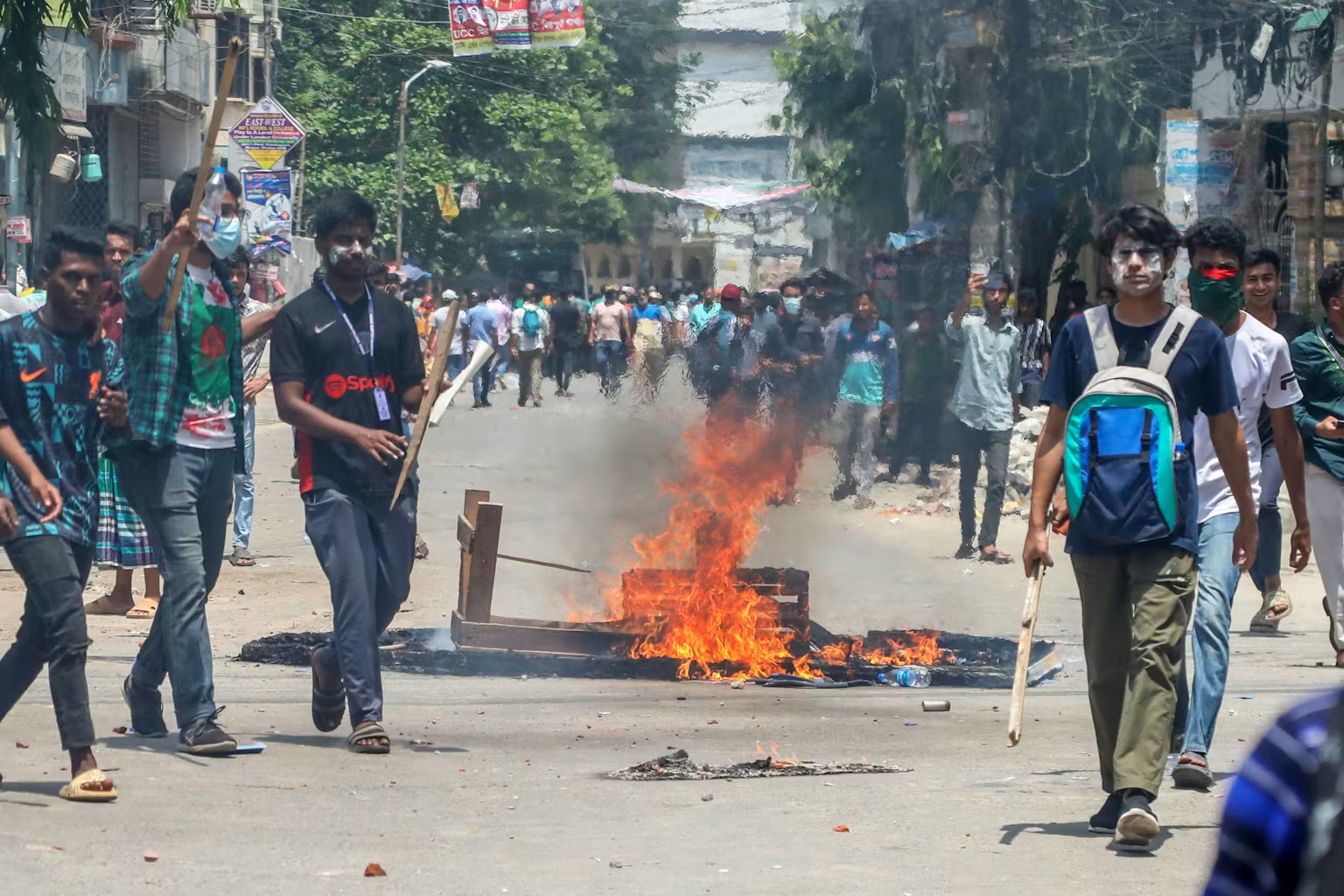
Days after Bangladesh student leader Sharif Osman Hadi died, his brother has accused Muhammad Yunus-led interim government of orchestrating the Killing. The country’s current internal problems are leading Bangladesh to a breaking point.
A Drifting Bangladesh
The unrest that spilled onto Bangladesh’s streets in December should not be mistaken for a passing diplomatic spat. That description understates what actually occurred. The targeting of Indian diplomatic missions, the explicit threats against India’s territorial integrity, and the absence of a decisive state response point to something more consequential. Bangladesh is entering a phase where organised street power is beginning to substitute institutional authority, with implications that stretch well beyond its borders.
What was presented publicly as anger over Sheikh Hasina’s extradition masked a far more deliberate exercise of power. Chants threatening violence against India, explicit references to severing India’s Northeast, and organised attempts to breach diplomatic facilities did not emerge spontaneously. They demonstrated who could command the street, who could set the narrative, and how quickly pressure could be applied when the state hesitated. The message was clear. Power in Bangladesh is drifting away from institutions and towards the street.
The Reassertion of Islamist Leverage
Jamaat’s return to political relevance has been neither subtle nor accidental. Freed from years of legal and administrative pressure, the organisation has moved quickly to reclaim its networks, particularly among students and urban youth. Its strategy has been pragmatic. Socioeconomic grievances have been absorbed, reframed, and redirected outward. India has become the central external reference point in this narrative, portrayed alternately as patron, manipulator, and threat.
What stands out is the discipline of the mobilisation. Protest leaders were not improvising. The language used, including calls to support insurgent activity in India’s Northeast, was calibrated to provoke without immediately triggering repression. Crowds responded because the message had been prepared in advance.
The interim government’s response has been hesitant. Public order was maintained in the narrow sense, but political authority was not asserted. Meetings between Jamaat figures and individuals close to the administration have been widely reported. Whether these contacts reflect accommodation or miscalculation is beside the point. They have reinforced the perception that Jamaat is once again a central political actor.
Minority communities have been the most exposed. Attacks on Hindu homes and businesses have followed a familiar pattern. The state’s reluctance to act decisively has encouraged repetition. History is not being confronted. It is being exploited.
The Making of a Martyr
The killing of Sharif Osman Hadis marked a turning point. Hadis was not a national leader, but he was a recognisable face of the agitation politics that had flourished since 2024. His death, coming just after the announcement of election timelines, created the conditions for escalation.
Within hours, blame was fixed on India. No credible evidence was required. The accusation travelled faster than any investigation could. What followed was a wave of anger that targeted political opponents and foreign symbols alike. Awami League offices were attacked. Indian diplomatic properties were vandalised. Slogans framed the episode as foreign interference rather than domestic instability.
For Islamist networks, Hadis became a rallying point. His death was portrayed as proof of foreign interference and domestic betrayal. For the interim administration, it exposed a fundamental weakness. In the absence of political legitimacy, even false narratives acquire operational power.
Pakistan’s Strategic Re-Entry
Behind the unrest lies a familiar pattern of external facilitation. Intelligence assessments increasingly point to Pakistan’s Inter-Services Intelligence leveraging Jamaat networks through regional financial and logistical channels. This is not ideological solidarity. It is a strategic calculation.
For Pakistan, Bangladesh offers leverage against India’s eastern flank. It provides space for extremist regrouping, potential routes into the Northeast, and diplomatic deniability. The easing of Dhaka-Islamabad relations under the interim setup has lowered barriers that once existed.
The danger lies in convergence. Jamaat’s domestic resurgence, Pakistan’s experience in proxy mobilisation, and Bangladesh’s governance paralysis are reinforcing one another. Restrictions on older jihadist entities have quietly loosened. The ecosystem is becoming permissive.
There are also persistent indications of indirect Chinese tolerance. Beijing’s engagement remains economic, but its partnerships are transactional. In a Bangladesh increasingly dependent on external financing, leverage accumulates quietly. Strategic ambiguity suits all actors except those exposed to the consequences.
India’s Strategic Blind Spot
For India, the implications extend far beyond diplomatic protocol. The eastern border has been treated as a managed space, secured through economic interdependence and political familiarity. That model presumes a functioning counterpart state. It falters when authority fragments.
An empowered Islamist presence in Bangladesh increases the risk of cross-border movement, both of people and ideas. Even limited destabilisation in border regions would strain India’s internal security architecture, particularly in the Northeast, where historical fault lines have never fully disappeared.
There is also a strategic economic cost. India’s Act East policy relies on transit stability through Bangladesh. Persistent unrest threatens logistics, investor confidence, and regional connectivity initiatives that took years to negotiate.
Most critically, India’s influence in Dhaka is eroding through inertia rather than confrontation. Influence unused does not remain neutral. It dissipates.
What a Measured Response Looks Like
This moment does not call for theatrics. It demands discipline. Diplomatically, India must maintain constant engagement, rather than episodic. Bangladesh’s interim leadership should be left in no doubt that diplomatic security and minority protection are non-negotiable. These messages are most effective when delivered consistently and through multiple channels. Border management must prioritise intelligence and preparedness. Visibility deters miscalculation. Quiet coordination reduces the space for deniable activity.
Economic leverage should be applied selectively. Trade access and development cooperation are tools, not entitlements. Conditioning them on behaviour is standard practice in international relations. Finally, attention must shift towards financial and logistical networks that sustain extremist mobilisation. Ideology travels on money. Disrupting funding has a more lasting impact than responding to protests.
2026: A year of Reckoning
Bangladesh stands at a point of transition. One direction leads towards a difficult but functional political contest grounded in institutions. The other drifts towards a system where street power, external encouragement, and state hesitation combine to produce chronic instability. For India, the lesson is unambiguous. Stability on the eastern flank cannot be assumed. It must be maintained through engagement, leverage, and readiness.
South Asia’s history offers little comfort to those who mistake delay for diplomacy. When authority weakens, and narratives harden, events move quickly. The coming year will test whether Bangladesh can arrest this drift, or whether the region is about to absorb another source of strategic friction.
Article Courtesy: Raksha Anirveda
Title Image Courtesy: The Conversation
Disclaimer: The views and opinions expressed by the author do not necessarily reflect the views of the Government of India and the Defence Research and Studies