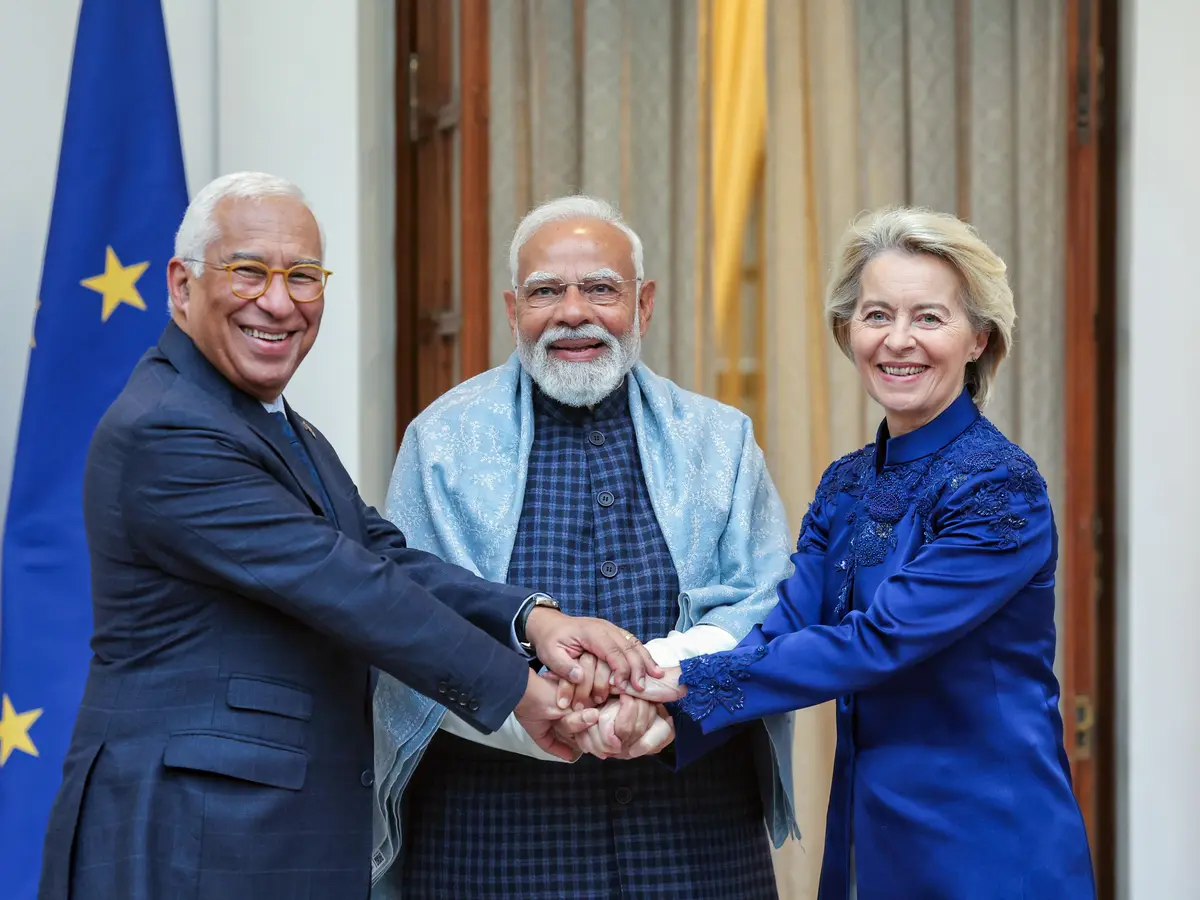
On January 27, 2026, during the 16th India-EU Summit in New Delhi, India and the European Union announced the successful conclusion of negotiations for a landmark Free Trade Agreement (FTA), alongside the formalisation of a Security and Defence Partnership (SDP). This “mother of all deals” creates a trade bloc encompassing nearly two billion people and a quarter of global GDP, while elevating bilateral strategic ties in an era of geopolitical volatility.
The FTA, negotiations for which began in 2007 and were restarted in earnest in 2022, represents a major milestone in India-EU economic relations, with bilateral trade already exceeding $136 billion as of the fiscal year ending March 2025. The SDP, meanwhile, institutionalises defence cooperation, including annual dialogues, maritime security collaboration, and industrial partnerships – a framework extended to only a select few partners such as Japan and South Korea.
This article analyses key areas of convergence in the FTA, the framework of the SDP, core aspects of both, and a detailed examination of challenges and differences, particularly from a defence and security lens. It highlights how economic and strategic imperatives converge, yet persistent asymmetries in threat perceptions and priorities limit deeper alignment.
Background: From Stalled Talks to Strategic Imperative
India-EU relations have evolved from a 2004 Strategic Partnership to a multifaceted engagement across trade, technology, and security. Negotiations for the FTA faced repeated stalls over agriculture, tariffs, and non-tariff barriers, but geopolitical shifts – including the Russia-Ukraine war, US trade uncertainties, and China’s assertiveness – accelerated progress. By 2025, both sides prioritised diversification amid global supply-chain disruptions and rising protectionism.
The 2026 announcements reflect this urgency. The FTA promises to boost exports in labour-intensive sectors for India and provide EU firms greater access to India’s growing market. The SDP builds on deepened ties in 2025, including joint statements and administrative arrangements for third-country cooperation.
Key Areas of Convergence in the FTA
The FTA focuses on tariff reductions, market access, and regulatory alignment, with compromises reflecting sensitivities on both sides.
Tariffs and Goods Access: India agreed to slash import duties on EU cars to 40% from up to 110%, a significant concession opening its automotive market. EU concessions include duty cuts on Indian textiles, footwear, leather, gems and jewellery, marine products, sports goods, and toys – labour-intensive sectors critical for India’s employment-driven growth. Wines and machinery also see reductions.
Sensitive Sectors: Agriculture and dairy remain largely excluded or protected, addressing India’s concerns over livelihood impacts. The deal does not eliminate tariffs on 95% of goods as initially sought by the EU, opting for phased reductions and quotas.
Services and Non-Tariff Issues: Progress on services delivery, intellectual property, and investment protection supports India’s IT and professional services exports. However, EU regulations like the Carbon Border Adjustment Mechanism (CBAM) remain contentious, viewed in India as discriminatory to developing economies.
Convergence lies in mutual economic benefits: India gains export markets and investment for ‘Make in India’, while the EU diversifies away from China and secures supply chains in critical sectors.
Framework for the Security and Defence Partnership
The defence and security relationship between India and the European Union has entered a phase of substantive evolution, moving beyond a declaratory strategic partnership towards selective but meaningful capability cooperation. For decades, India–EU engagement was largely confined to trade, development cooperation, and normative dialogue, with defence remaining peripheral and fragmented across bilateral relationships, most notably with France. However, shifting geopolitical realities, particularly since 2022, have forced both India and Europe to reassess the strategic utility of each other in an increasingly contested international system.
The erosion of the European security architecture following the Russia–Ukraine war, the growing militarisation of the Indo-Pacific, persistent instability in West Asia and the Red Sea, and the weaponisation of supply chains have collectively reshaped threat perceptions on both sides. Simultaneously, the relative retrenchment of the United States and uncertainty surrounding long-term alliance guarantees have incentivised middle and major powers to diversify security partnerships. In this context, India and the EU are discovering converging interests rooted not in alliance politics, but in capability development, industrial resilience, and maritime stability.
At the core of India–EU defence cooperation lies defence industrial collaboration. Europe possesses advanced military technologies and design expertise but faces significant constraints in scaling production due to labour shortages, rising costs, and fragmented industrial bases. India, by contrast, offers a large and increasingly sophisticated manufacturing ecosystem, a skilled workforce, and strong political momentum behind indigenisation through initiatives such as Atmanirbhar Bharat and Make in India. This structural complementarity makes defence manufacturing the most consequential pillar of the partnership.
European defence firms are increasingly viewing India not merely as a market, but as a production and co-development partner. Cooperation in artillery systems, ammunition, naval platforms, propulsion technologies, sensors, and electronic subsystems aligns with Europe’s urgent need to rebuild stockpiles depleted by the Ukraine war and India’s objective of reducing dependence on legacy suppliers. Over time, such collaboration could result in joint production hubs capable of servicing European requirements while also catering to third-country markets. From an Indian perspective, this offers not only technological absorption but also long-term integration into global defence value chains.
Maritime security constitutes the most geopolitically visible convergence between India and the EU. The Indian Ocean has emerged as a critical economic artery for Europe, with a substantial proportion of European trade and energy flows transiting through the region.
Disruptions caused by piracy, state coercion, and non-state actors, particularly in the Red Sea and western Indian Ocean, have underlined Europe’s vulnerability to distant maritime instability. India, with its geographic centrality and expanding naval capabilities, is increasingly viewed as an indispensable partner in safeguarding sea lines of communication.
Cooperation in maritime domain awareness, coordinated naval deployments, information sharing, and anti-piracy operations has steadily expanded. India’s Information Fusion Centre for the Indian Ocean Region has emerged as a key node for maritime data sharing, with growing European participation. For the EU, working alongside India provides regional anchoring and operational credibility, while for India, it reinforces its self-image as a net security provider without binding alliance commitments. Importantly, this maritime convergence remains non-confrontational in character, focused on stability rather than power projection, which aligns with India’s preference for strategic autonomy.
Emerging technologies form another critical axis of cooperation. Modern warfare is increasingly shaped by artificial intelligence, cyber capabilities, electronic warfare, autonomous systems, and secure communications. Europe retains strong research and development capabilities in these domains, while India offers software expertise, operational experience, and a rapidly expanding innovation ecosystem. Defence technology collaboration, particularly in dual-use areas, allows both sides to enhance military capabilities while navigating political sensitivities associated with direct technology transfer.
Institutional mechanisms such as innovation partnerships, research collaboration between India’s Defence Research and Development Organisation and European entities, and alignment with India’s iDEX framework provide pathways for co-development. While export controls, intellectual property regimes, and regulatory divergences continue to pose constraints, joint design and development models offer a pragmatic solution. From India’s perspective, such cooperation enhances technological depth without creating dependency, while Europe benefits from scalable innovation partnerships.
Space security represents a quieter but increasingly significant frontier in India–EU defence cooperation. The militarisation of space, proliferation of counter-space capabilities, and vulnerability of satellite infrastructure have elevated space into a contested domain. Both India and the EU rely heavily on space-based assets for communication, navigation, intelligence, and civilian infrastructure. Cooperation in space situational awareness, protection of space assets, secure satellite communications, and dual-use technologies aligns with shared concerns over resilience rather than weaponisation.
India’s cost-effective launch capabilities and growing operational experience complement Europe’s advanced space technologies and regulatory frameworks. Together, they can contribute to building resilient space architectures that support military operations while maintaining a civilian-oriented narrative, an approach particularly suited to Europe’s political culture and India’s strategic posture.
Cybersecurity and hybrid warfare have gained prominence as areas of functional cooperation, driven largely by lessons from the Ukraine conflict. Cyber-attacks, disinformation campaigns, and attacks on critical infrastructure have demonstrated how non-kinetic tools can achieve strategic effects. The EU has developed extensive institutional experience in countering hybrid threats, while India has faced persistent cyber intrusions and information warfare from hostile actors. Cooperation in cyber incident response, protection of critical infrastructure, and counter-disinformation strategies allows both sides to enhance resilience below the threshold of armed conflict.
Counter-terrorism remains an understated but operationally valuable component of the partnership. India and the EU face overlapping challenges from transnational terrorist networks, terrorist financing, radicalisation, and online extremism. Intelligence sharing, cooperation in aviation and port security, forensic technologies, and counter-radicalisation frameworks form the backbone of this engagement. While differences in threat geography and political sensitivities limit the depth of cooperation, incremental progress in this domain contributes to mutual security.
Military training and interoperability initiatives, though limited in scale, play an important role in building trust and familiarity. Naval exercises, officer exchanges, counter-terrorism training, and staff college cooperation help create shared professional norms and operational understanding. France remains India’s most advanced European defence partner, but Germany, Italy, and Spain are gradually expanding their engagement, particularly in naval and logistical domains.
A critical emerging area is defence supply-chain resilience. The Ukraine war exposed Europe’s dependence on narrow and geographically concentrated defence supply chains, while India has long sought to mitigate similar vulnerabilities. Joint production of critical components, diversification of suppliers, and development of trusted vendor ecosystems serve the strategic interests of both sides. For India, this aligns with export ambitions, while for Europe, it supports rearmament and long-term sustainability.
Despite growing convergence, structural constraints remain. The EU’s fragmented defence decision-making, reluctance to transfer sensitive technologies, regulatory differences, and India’s insistence on strategic autonomy limit the pace and scope of cooperation. These realities argue against grand institutional frameworks and in favour of selective, project-based engagement focused on tangible outcomes.
From an Indian strategic perspective, the EU does not represent an alternative security guarantor or alliance partner. Its value lies in acting as a force multiplier that enhances India’s capabilities without constraining policy choices. Defence manufacturing, maritime security, emerging technologies, space cooperation, and supply-chain resilience constitute the most productive avenues for sustained engagement. If pursued pragmatically, India–EU defence cooperation can evolve into a stable, capability-driven partnership that contributes to a more resilient and balanced security architecture in an era of global uncertainty.
Challenges and Differences: Divergent Threat Perceptions
Despite convergence, structural frictions persist.
Threat Perceptions: The EU views Russia as an existential threat post-Ukraine, committing €800 billion to defence and imposing sanctions. India prioritises China as its primary challenge – border conflicts, maritime encroachments, and Sino-Pakistani ties – while maintaining Russia as a key defence supplier (60% of inventory) and energy partner. This asymmetry leads to EU pressure on India to curb Russian imports, contrasted by India’s strategic autonomy.
Regional Priorities: EU engagement with Pakistan (GSP+ access) despite terrorism concerns contrasts with India’s expectations of solidarity. EU trade ties with China persist amid India’s Himalayan tensions.
Normative and Sovereignty Issues: EU criticism of Indian internal matters (e.g., human rights laws) is seen as interference, eroding trust. India’s development-first approach clashes with the EU’s regulatory demands (CBAM, environmental standards).
Institutional Asymmetries: The EU’s multi-state structure leads to inconsistent bilateral ties (strong with France, thinner elsewhere). India’s non-alignment limits full alignment.
These differences make the partnership modular rather than comprehensive, with defence cooperation viable in domains like maritime awareness but constrained overall.
Strategic Implications for Defence
The SDP offers opportunities: co-development reduces costs, enhances interoperability, and supports India’s indigenisation goals. Access to EU programs (e.g., SAFE funding) could boost India’s defence exports. Yet, without addressing divergences – particularly Russia and China – cooperation risks remaining tactical. Success depends on regular dialogues, mini-lateral formats, and mutual risk-sharing.
The FTA indirectly bolsters security by building resilient supply chains in critical technologies, reducing China’s dependencies.
Conclusion
The 2026 India-EU FTA and SDP mark significant progress in a fractured world, demonstrating economic and strategic engagement amid US tariffs and global tensions. Convergence in trade and functional defence areas offers tangible benefits, but challenges from divergent priorities underscore the need for pragmatic, compartmentalised cooperation.
For defence planners, the partnership is promising yet brittle – profitable commercially, but strategically shallow without greater alignment. Institutional mechanisms and consistent dialogue will determine whether it evolves into a robust pillar of Indo-Pacific and European security.
Title Image courtesy: https://eu-india.org/
Disclaimer: The views and opinions expressed by the author do not necessarily reflect the views of the Government of India and the Defence Research and Studies. This opinion is written for strategic debate. It is intended to provoke critical thinking, not louder voices.