As Southeast Asia becomes increasingly contested by the superpowers, the regional majors are looking for collaboration with a benign power, as well as significant business and security opportunities. PM Modi’s visit to Malaysia is of significant importance in the present dynamic geopolitical situation in Southeast Asia.
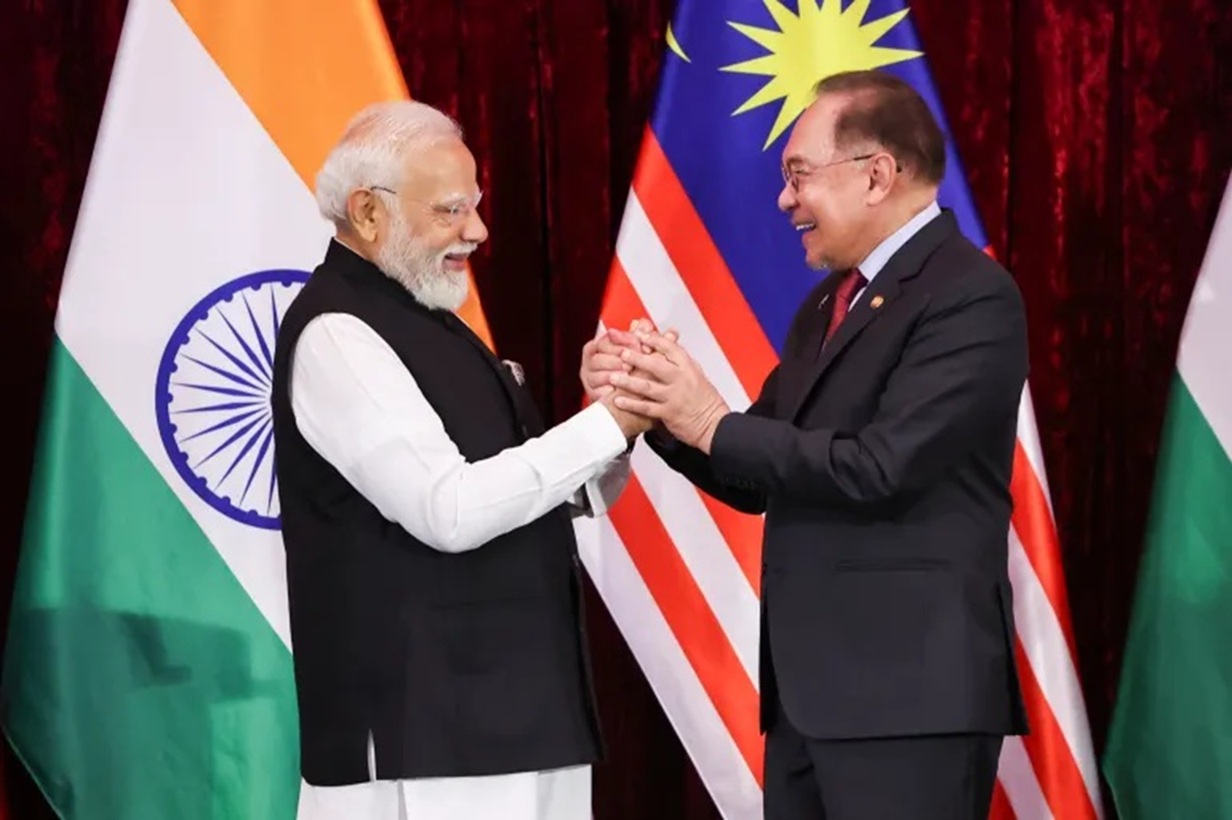
Prime Minister Narendra Modi has begun his third visit to Malaysia (February 7-8) at the invitation of his Malaysian counterpart, Dato Seri Anwar Ibrahim. Dato Ibrahim was on a state visit to India in August 2024 when the bilateral relationship was converted from ‘Enhanced Strategic Partnership’ to ‘Comprehensive Strategic Partnership’, with the inclusion of the whole spectrum of bilateral and regional dimensions. It is also extremely important within the context of ASEAN, with which India has continued to shift to higher orbits of cooperation since 1992 in accordance with the ‘Act East Policy’.
The first visit of PM Modi in 2015 was also combined in that context. Both countries adhere to a rules-based international system and believe that it is imperative to ensure peace and development. They pledged to work together to enhance multilateralism, reflective of contemporary realities, to make international organisations, including the UN Security Council, more representative.
In 2025, Malaysia, as Chair of Asean, did remarkably well by affording Asean a neutral location for bridging political gaps and divisions while striving for greater inclusivity, transforming the summit from a regional multilateral ritual into a geopolitical bridge. That is precisely what India tries to do through dialogue and diplomacy and development for sustainable peace, and by being a bridge between North and South and East and West through its sane foreign policy.
Moreover, the people-to-people historic and civilisational connection with Malaysia is unique, with the second-biggest Indian diaspora and Persons of Indian Origin after the US, which in itself creates a definitive momentum and a living bridge among people. Hence, PM Modi will be interacting with and addressing them during the visit.
As the region becomes increasingly contested by the superpowers, the regional majors also look for collaboration with a benign power and a significant business and security opportunity. India and Malaysia not only follow strategic autonomy and multi-alignment as pillars of their international discourse, but both have convergences on key global challenges to multilateralism, climate change, the Global South, freedom of navigation, and the threat of extremism and terrorism, which has become even more tech-savvy and problematic.
Sustainable development, disaster management and cybersecurity, as well as new technologies, have provided a newer impetus to the relations. However, a point of concern has been the presence and nefarious activities of notorious extremist Zakir Naik, whose anti-India tirade has been a point of discussion between the two sides and hopefully will be contained in good faith. As such, the two countries have established a working group on terrorism and extremism, where the two sides exchange views and work on collaborative mechanisms and intelligence cooperation.
Trade and economy are often the critical verticals in any relationship. Malaysia is no different. Both countries enjoy a Comprehensive Economic Cooperation Agreement (CECA), apart from being part of the Asean-India Free Trade Area (AIFTA). The second Joint Committee Meeting of the Malaysia-India Comprehensive Economic Cooperation Agreement (MICECA) was held and took stock of the economic imperatives and frameworks of cooperation. Of course, the FTA has been under renegotiation to upgrade it to the changing economic realities and diversified trade and economic spectrum, which is expected to be firmed up soon and will surely be a point of discussion between the leaders.
Trading in national currencies is the current trend, and both countries have already agreed to do so and have been working to further facilitate the invoicing and settlement of trade in local currencies, ie, the Indian rupee and the Malaysian ringgit. Now it is likely that the use of UPI could be extended beyond trade transactions, especially for tourists, since Malaysia has even offered visa-free entry for Indians to attract more of them. Thailand has cracked it. As such, India has noted the designation of 2026 as Visit Malaysia Year.
Although rated as the 31st FDI investor, Malaysian investments in India, including third-party routes, are estimated to be around $3.3 billion. Around 70 Malaysian companies, including joint ventures, have established operations in India, focusing on diverse sectors like infrastructure, healthcare, telecommunications, oil and gas, power plants, tourism and human resources. Malaysia’s National Oil Company, Petronas, has been operating in India as Petronas India Holdings Company Pvt Ltd. for the past three decades, diversifying its portfolio across various segments and regions, especially in Tamil Nadu, etc. According to available information, in 2022, Petronas announced that it plans to invest $4.1 billion in Tamil Nadu in green hydrogen and ammonia projects. Their sovereign wealth fund has also been quite interested in India for over two decades. In 2022, Petronas also announced investments worth $4 billion in Karnataka for a renewable energy project.
In October 2023, Gentari (the wholly owned RE arm of Petronas) announced the acquisition of a 30 per cent stake in AM Green Ammonia Holdings BV at an investment of $1.6 billion. In July 2023, ReNew Energy Global Plc and Gentari established a 50:50 joint venture to develop 5 GW of renewable energy capacity in India. The largest presence of Malaysian construction companies outside Malaysia is in India. According to Malaysia’s Construction Industry Development Board (CIDB), as of December 2016, Malaysian companies have completed 98 highway and road projects worth $4.64 billion in India. IJM alone has completed over 1,500 km of road projects in India.
Likewise, more than 250 manufacturing projects have been completed by 135 Indian companies in Malaysia, with nearly $2.62 billion in investments. According to the Ministry of External Affairs and Malaysian sources, prominent Indian investors and projects include Biocon Malaysia, Recron Malaysia Sdn Bhd (owned by the Reliance Group), UNZA Malaysia (owned by Wipro), Ranbaxy Malaysia, Melaka Manipal Medical College in Melaka, and the Melaka International College in Nilai, among others. Veeda Clinical Research Organisation, Ahmedabad, has set up its advanced research unit at Ampang Hospital in Kuala Lumpur. Presently, there are more than 200 Indian companies, including 61 Indian joint ventures and three Indian public sector undertakings, operating in Malaysia.
With bilateral trade exceeding $20 billion, the operative dimension of economic engagement appears quite sound. However, as the saying goes, there is always room for improvement and growth to exploit the existing potential. Prime Minister Modi is also expected to address Malaysian businesses and industry at the 10th India-Malaysia CEOs’ Forum, urging them to avail of the trillions of dollars of opportunity and be a part of India’s economic journey.
Defence and security are other important verticals for cooperation, given the strategic importance of Malaysia in the Straits of Malacca. Both countries conduct bilateral exercises and maintain regular exchanges at the military-to-military level. The fifth edition of the Army Exercise Harimau Shakti was conducted in Rajasthan, India, from December 5 to 18, 2025; the bilateral naval exercise Samudra Laksamana was conducted from February 28 to March 2, 2024, off the coast of Visakhapatnam. The MoU for defence cooperation signed in 1993 was further upgraded during the visit of Defence Minister Rajnath Singh in 2023 to expand the scope of cooperation.
During the visit by Singh to Malaysia, the first regional office of HAL was also inaugurated in Kuala Lumpur. Malaysia has also shown interest in Indian defence equipment. Malaysia expressed keen interest in acquiring the BrahMos supersonic cruise missile system from India for both its air force and navy. Besides, both have their versions of the Su-30 MKI and MKM, respectively, which provide yet another area of collaboration and diversification.
There is also a bilateral security dialogue, which first met last year in January. The Malaysia-India Digital Council is tasked to guide engagement in the digital realm and accelerate collaboration in this area, such as digital public infrastructure, digital business-to-business partnerships, digital capacity building, cyber security, and emerging technologies such as 5G, quantum computing, cloud computing and the Internet of Things, between the two countries, according to the last Joint Statement. The India-Malaysia Startup Alliance (IMSA) is a strategic partnership established by Cradle Fund Sdn Bhd and Invest India to carry the collaboration forward.
Thus, the institutional mechanisms and high-level frequent exchanges, with the highest-level political interactions, mean the relationship is set to move into a much higher orbit and augur well for the future. Therefore, the visit of PM Modi is timely and will steer the momentum even further.
Article Courtesy: Firstpost
Title Image Courtesy: Al-Jazeera
Disclaimer: The views and opinions expressed by the author do not necessarily reflect the views of the Government of India and the Defence Research and Studies. This opinion is written for strategic debate. It is intended to provoke critical thinking, not louder voices.