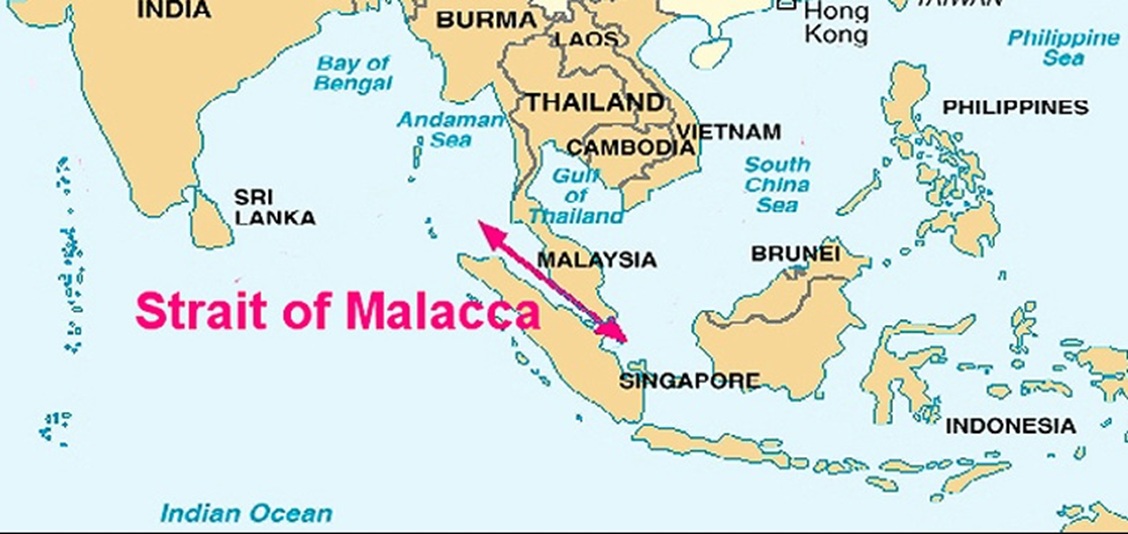
The Malacca Strait is one of the world’s most critical maritime waterways, serving as the primary shipping channel between the Indian Ocean and the Pacific Ocean. This narrow, 930-kilometre-long stretch separates the Malay Peninsula from the Indonesian island of Sumatra.
The Chokepoint Doctrine Revisited
The evolving geopolitical discourse around a potential US strategic shift from the Strait of Hormuz to the Strait of Malacca marks a transition from energy-centric coercion to systemic leverage over global trade. While Hormuz is a valve on oil flows, Malacca is the central artery of global commerce. For India, this shift is strategically transformative. Its proximity to Malacca’s western approaches places it in a position not merely of observation, but of potential influence over one of the world’s most critical maritime chokepoints.
The Strait of Malacca is a crucial 930 km (580 mi) long, funnel-shaped waterway connecting the Indian and Pacific Oceans, handling 40-50% of global trade and 70% of Asia’s oil imports. It runs between Indonesia, Malaysia, and Singapore, with depths as shallow as 25-37 meters and a narrow southern bottleneck of only 40 miles (65 km), creating significant maritime traffic congestion and piracy risks.
The Strategic Weight of Malacca
The Strait of Malacca links the Indian Ocean with the Pacific Ocean, forming the shortest maritime route between West Asia, Europe, and East Asia. Its narrowness, heavy traffic density, and absence of viable alternatives elevate it into a systemic vulnerability in the global trading system. Any disruption in Malacca would not remain localised; it would cascade across global supply chains, affecting manufacturing hubs, energy markets, and maritime insurance regimes. This distinguishes it sharply from Hormuz, whose impact, though significant, remains largely energy-centric.
The US Strategic Calculus
The United States’ potential focus on Malacca must be understood through the classical lens of sea power articulated by Alfred Thayer Mahan. Control over maritime chokepoints enables a power to shape outcomes without direct territorial confrontation. In a contingency involving China, particularly in the Indo-Pacific, Malacca offers the US a mechanism for exerting pressure through supply chain disruption. This allows for coercive signalling and economic strangulation without crossing thresholds that would trigger full-scale war. The experience in the Strait of Hormuz reinforces the effectiveness of chokepoint leverage, but Malacca provides a far more consequential instrument due to its systemic reach.
How the US Could Seek to Control Malacca
Direct “control” of the Strait of Malacca by the United States is neither legally straightforward nor politically feasible in peacetime, given sovereignty constraints. However, in operational terms, control does not necessarily imply ownership; it implies the ability to monitor, regulate, or interdict maritime flows when required. The United States could pursue a layered approach.
First, it would rely on forward-deployed naval assets operating from bases in Singapore and Diego Garcia, combined with carrier strike groups and submarines, to establish a persistent presence.
Second, it would integrate surveillance and reconnaissance through satellites, maritime patrol aircraft, and allied intelligence networks to achieve near-total maritime domain awareness.
Third, the US could implement what may be termed “selective interdiction regimes”, involving boarding, inspection, or diversion of vessels under the pretext of sanctions enforcement or maritime security. Such measures fall within the grey zone between peace and war.
Fourth, control could be exercised indirectly through alliances and partnerships. By working with regional states and partners like India, the US could create a distributed network capable of influencing traffic flows without overtly militarising the strait.
Finally, in an extreme conflict scenario, the US Navy could enforce a distant blockade, targeting shipping before it even enters Malacca, thereby avoiding legal complications within the strait while achieving the same strategic outcome.
Thus, US control would likely be functional and networked rather than territorial, relying on dominance of sea and information rather than physical occupation.
Present Stakeholders and Control Architecture
The Strait of Malacca is not controlled by any single power; rather, it is governed through a combination of sovereignty, international law, and cooperative security mechanisms. The primary littoral states exercising jurisdiction are Indonesia, Malaysia, and Singapore. These countries retain sovereign rights over their respective territorial waters within the strait. Under the framework of the United Nations Convention on the Law of the Sea (UNCLOS), the strait is classified as an international waterway, guaranteeing transit passage to all vessels. This legal regime limits the ability of any external power to unilaterally control the strait in peacetime.
PC: Indian Express
Operationally, security is maintained through coordinated patrols such as the Malacca Strait Patrols, involving the littoral states, along with intelligence sharing mechanisms. Singapore, in particular, plays a disproportionate role due to its advanced port infrastructure and naval capabilities. Beyond the littoral states, external stakeholders include major trading powers such as China, Japan, and India, all of whom depend heavily on the strait. The United States remains a security stakeholder, though not a sovereign authority, with a sustained naval presence in the broader region.
China’s Structural Vulnerability: The Malacca Dilemma
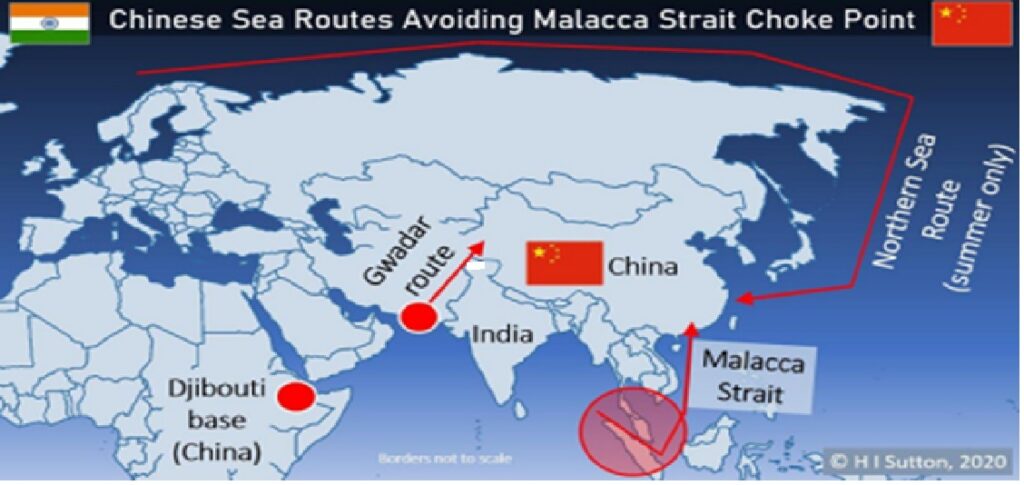
The “Malacca Dilemma,” articulated by Hu Jintao, highlights China’s dependence on this narrow corridor for energy imports. This dependence creates a structural vulnerability that adversaries can exploit through interdiction or even the threat of disruption. Despite investments in alternative routes and expanded naval capabilities, China remains exposed. This vulnerability drives its efforts to expand influence across the Indian Ocean and develop strategic alternatives, but none have yet replaced Malacca’s centrality.
PC: H I Sutton
India’s Geostrategic Advantage
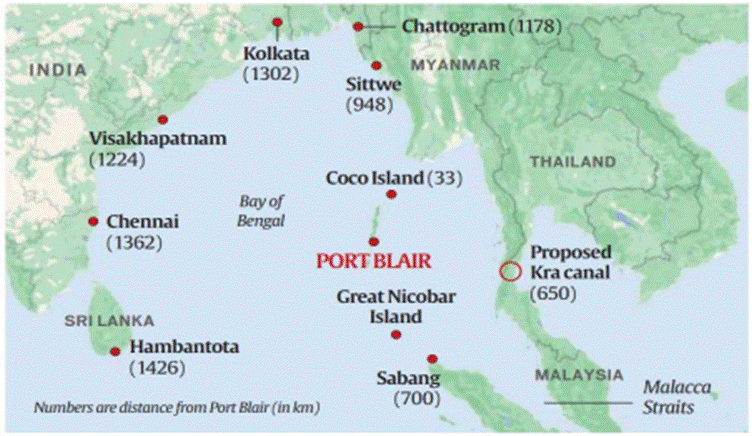
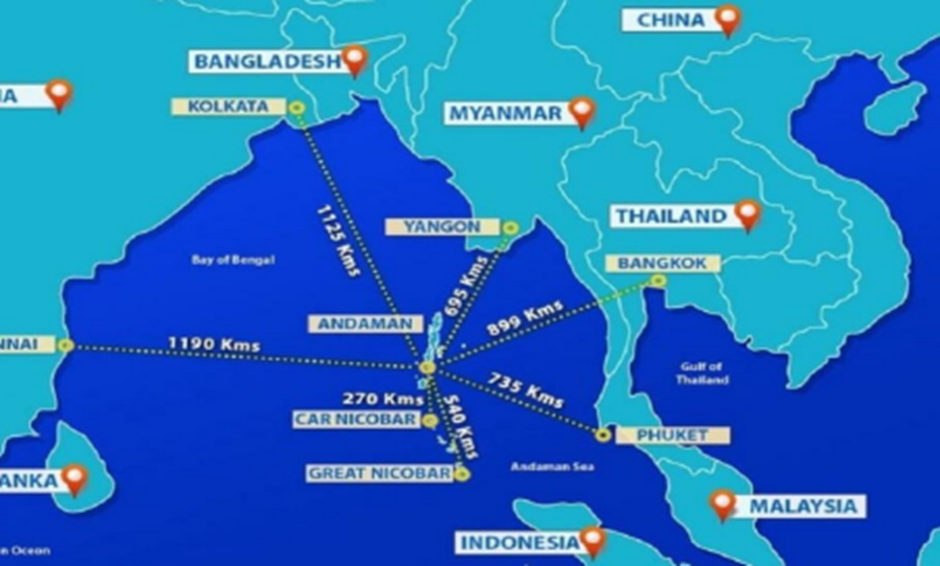
India’s proximity to the western approaches of Malacca through the Andaman and Nicobar Islands provides it with a unique vantage point. From installations such as INS Baaz, India can monitor maritime traffic, deploy surveillance assets, and potentially influence access to the strait. This geographic advantage effectively transforms the island chain into a forward operating hub, enabling India to participate in any future control architecture, whether independently or in partnership with other powers.
PC: https://www.drishtiias.com/
Strategic Convergence and Constraints for India
The US focus on Malacca creates opportunities for strategic convergence with India, particularly in areas such as maritime domain awareness and logistics cooperation. However, this alignment must be balanced against the risks of escalation with China and sensitivities among Southeast Asian states. China may respond to perceived encirclement through increased military activity along the Line of Actual Control or expanded deployments in the Indian Ocean. Simultaneously, ASEAN states may resist any overt external militarisation of the strait, complicating India’s diplomatic posture.
Doctrinal and Capability Implications for India
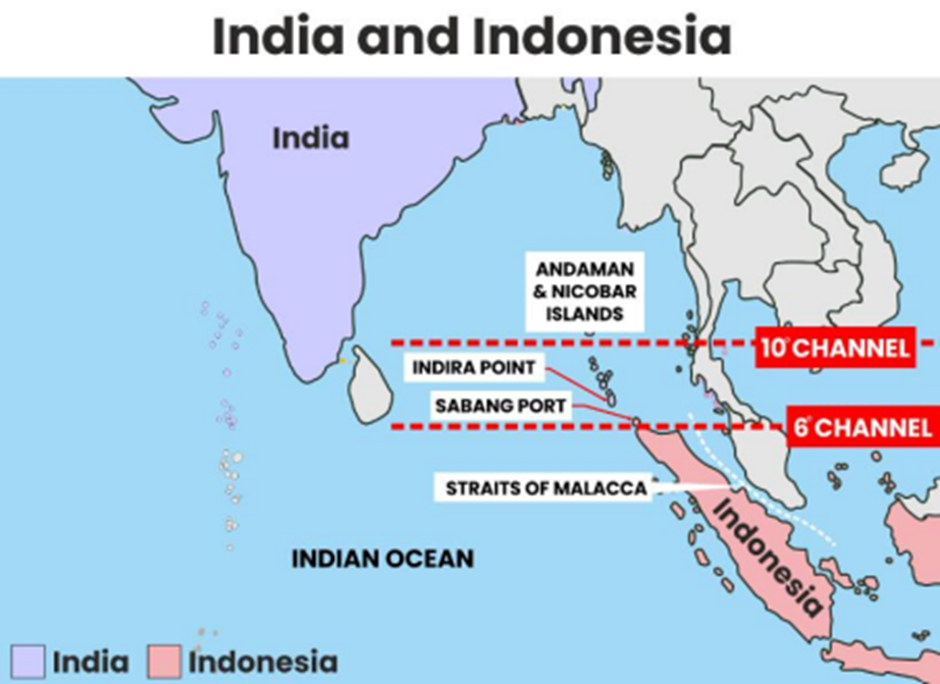
India has secured a significant strategic foothold at Sabang Port in Indonesia’s Aceh province, situated at the northern tip of Sumatra and at the mouth of the Malacca Strait. This move is a major component of India’s “Act East” policy, aimed at strengthening maritime cooperation with Southeast Asia, bolstering regional connectivity, and counterbalancing growing Chinese influence in the Indian Ocean Region (IOR).
PC: https://www.npnewsmm.com/news
Key aspects of India’s stakes in Sabang Port include:
Strategic Location: Sabang is located only 90 nautical miles (approx. 170 km) from India’s Indira Point in the Andaman and Nicobar Islands, making it a critical position for monitoring the Malacca Strait—a major maritime chokepoint for global trade and Chinese energy supplies.
Infrastructure Development: India has been involved in developing port-related infrastructure, with discussions on building an economic zone around the port. As of 2025, reports indicated that India was prepared to cover 85% of the construction costs for the port’s development.
Naval Access: The deep-water port (roughly 40 meters deep) can accommodate naval vessels, including submarines, thereby enhancing India’s capacity to monitor the region.
Counterbalancing China: The investment is part of India’s larger “Security and Growth for All in the Region” (SAGAR) strategy to create a security presence against China’s naval expansion.
Joint Task Force: A joint task force was set up following a 2018 agreement between Prime Minister Narendra Modi and President Joko Widodo to improve infrastructure and maritime connectivity between Aceh and the Andaman and Nicobar Islands.
India’s evolving maritime doctrine must account for both opportunity and risk. The ability to influence Malacca requires not just geographic advantage but credible capability, including surveillance systems, submarine fleets, and surface combatants. Infrastructure development in the Andaman and Nicobar Islands is central to this transformation.
At the same time, India must reconcile its dual role as both a potential chokepoint influencer and a major user of the strait. This necessitates a strategy that emphasises stability, resilience, and calibrated deterrence rather than coercive dominance.
Conclusion: Control Without Ownership
The future of the Strait of Malacca will not be defined by formal control but by functional dominance—the ability to monitor, influence, and if necessary, disrupt maritime flows. The United States can achieve this through networked power projection and partnerships rather than direct sovereignty.
For India, the implications are profound. Its geographic position, combined with evolving capabilities, places it at the centre of any future Malacca calculus. The challenge lies in converting this positional advantage into strategic influence while maintaining autonomy and regional stability.
In the emerging Indo-Pacific order, Malacca will remain the decisive chokepoint—and India, by virtue of geography and strategy, will remain indispensable to its future.
Title Image Courtesy: https://compass.rauias.com/current-affairs
Disclaimer: The views and opinions expressed by the author do not necessarily reflect the views of the Government of India and the Defence Research and Studies.