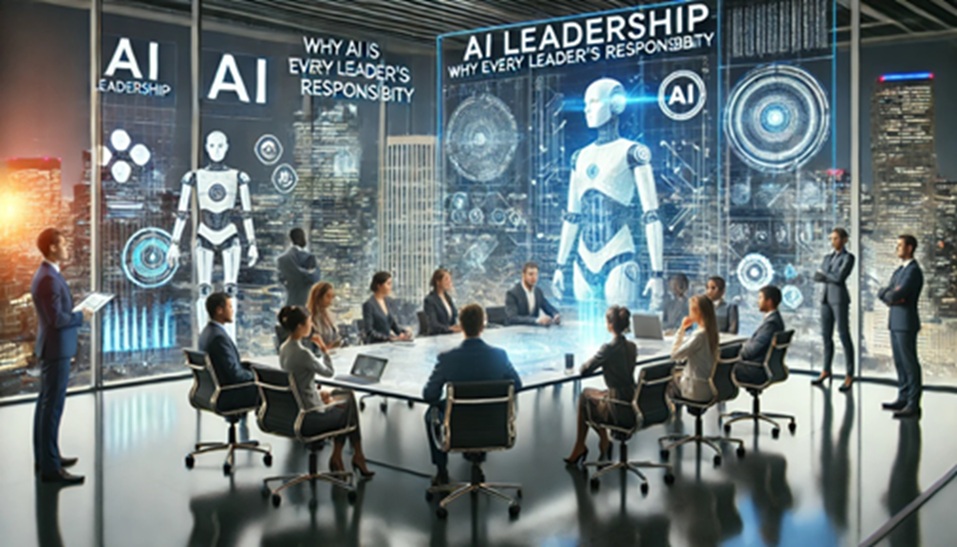
AI significantly supports the leadership by enabling data-driven decisions and automating routine assignments. New-age leaders could embrace AI as a strategic amplifier, focusing on its ethical integration to empower teams and drive organisational agility, making AI literacy a crucial competency for corporate success.
Having returned from delivering my Keynote speech at the ‘Leadership In The AI Age’ seminar in Dubai, I’ve been thinking about not only the impact but also the deep underlying implications of exponential AI growth.
- First, the pace of AI development far outstrips anything we have experienced thus far as a species.
- Second, quantum leaps in productivity are already visible, but far from fully realised; the trajectory is clear, but the destination is not yet certain.
- Third, governments are light years behind in understanding, administering and legislating an AI society.
Liability Regime For AI
Clearly, AI is one of the most exciting inventions of humankind, and it holds infinite possibilities. Therein lies the rub…infinite possibilities! Which, by definition, means we can’t really forecast where exactly all this is going to go. And that tempers my excitement about AI with not just disquiet but also a gnawing fear.
What if it all ‘careens out of control’? Maybe it’s time for humankind to play GOD. Not a God, but Guardians Of Destiny – GOD. Humankind has to step in and guide, very, very proactively, the Destiny of where AI will take us. Which directly brings us to that one question that’s been bothering us. Accountability!
Nuclear power has provided us with clean and almost infinite electricity to further our economic development aspirations. Since anything nuclear poses existential risks, the generation of nuclear power is governed by tight, globally mandated agreements, protocols and controls. An entire enforceable legal & surveillance ecosystem has been erected around nuclear power, R&D and indeed, weapons. This includes a very effective and sophisticated Liability Regime, which assigns liabilities for accidents and incidents.
This is “the legally defined system that allocates who is financially responsible, to what extent, and under what procedures for compensating victims and remediating damage arising from a nuclear incident. Accountability is inescapable if anything goes wrong (not that damage can be undone!). This is an important reason for the extremely high safety standards in the nuclear arena.
AI is no less important than anything nuclear. Its benefits are way beyond anything else. But the risks that AI poses are as existential as anything nuclear. Which is why I believe that a Liability Regime for AI must be globally mandated immediately. This must cover AI research, production, productization and implementation to ensure that runaway replications (akin to runaway nuclear chain reactions)..unintentional, accidental or deliberate… are prevented and where necessary, penalised. Accountability for rogue effects will have to be assigned and enforced.
Therefore, a legally defined system that allocates who is financially responsible, to what extent, and under what procedures for compensating victims and remediating damage arising from an AI-related incident/accident/pernicious effect/out of human control system is a vital safeguard. Any delay in creating such a Liability Regime for AI will be tantamount to closing the barn doors after the horses have fled. Already, the AGI horses are beginning to pressurise the barn doors to open…
A Liability Regime for AI is an immediate imperative! If humankind doesn’t become GOD (Guardians of Destiny), AI will!
AI: What’s At Stake?
In the current frenzied development, deployment and disruption relating to AI, we need to step back for a moment and reflect! What’s going on and how is it affecting the trajectory of humankind?
Firstly, let’s pay attention to the rate of growth. According to AI pioneer Richard Susskind, the power of computing is doubling every 6 months; that translates into computing growing more than a million times in the next 10 years!
Secondly, this rate of growth makes it impossible to predict what functionalities and features will become available and what we can do with them; but it is reasonable to expect Artificial General Intelligence (#AGI) to be available sooner than later ( maybe even within 2 years according to to some experts) and therefore, humanoids (like #Optimus2 from Tesla ) can very well go mainstream. Therefore, making predictions on the basis of what is available today is a fatal conceptual error.
Thirdly, the availability of Generative and Agentic AI is widespread and becoming more effective, efficient and exciting by the minute. This will cause not just virtual work becoming more efficient but the rapid “invasion” of ‘digital immigrants’ who can work 24*7 across geographies with zero travel costs, minimal transaction costs and no HR related costs (overtime, wages, salaries, maternity leave, welfare allocations, training, relocation costs and so on); no immigration permissions, visa applications and related costs will be necessary. The upshot? A near total wipeout of the global remittance economy! If and when that happens, how will remittance-based economies deal with revenue loss and consequent ballooning of fiscal deficits? What alternative sources of revenue can governments develop? In fact, what roles will governments play?
Fourthly, the entire HR function as it exists today can, itself (along with several other functions), be erased when all work processes are run by Agentic AI? This can happen not in some distant quarter – but quite likely by Q4 of calendar 2026! So, the HR function is now going to be engaged in a fight for its own survival. Far from continuing as power centres in many companies, HR leaders have their work (and survival) cut out for themselves: what role will they now play, and how will they remain relevant contributors?
Fifthly, given its pace, power and potential, can the rest of humanity leave control of AI in the hands of just a few technopreneurs or tech companies? Already, inequality of income and wealth is unbearable; can we risk more and more concentration of economic power?
Sixthly, there is a Code Red need for global collaboration to define and enforce guardrails for the development and deployment of AI. This cannot wait, given the exponential growth of this technology. Human beings will have to set aside differences (national, cultural, religious and social) and come together to establish what AI will and will not do. Humans-In-the Loop will not suffice. The destiny of humankind is at stake. Humans have to become Guardians of Destiny (GOD).
As a species, we have historically proven that we can come together in the face of existential threats. The Montreal Protocol enabled control and repair of damage to the ozone layer. The Nuclear Non-Proliferation Treaty (NPT) and nuclear weapons agreements have created some level of protection from nuclear holocaust (albeit by Mutually Assured Destruction). The global alliance for vaccine development and distribution during the COVID pandemic saved humanity (only just!). So it is with AI – we HAVE to create a global system of checks and balances, now, before the AGI genie escapes the bottle!
Today, it’s vital to discuss substantive issues uncovered by AI. It’s not enough to hold developer conferences or demos of AI tools. We have to stop thinking of AI merely as tactical tools. This technology has civilisation-scale implications; it is far more strategic than virtually anything that humankind has invented hitherto. Along with unprecedented opportunities for emancipation, evolution and eradication of poverty, AI poses fundamental and far-reaching challenges.
As revered spiritual guru Dr Mohanji teaches us, our purpose must be to make humankind more kind humans! And kind humans will evolve when they use AI to help raise the floor for everyone instead of raising the ceiling for just a few!
AI Impact on Leadership: From Tactical to Strategic
As the AI revolution gathers momentum, its impact on leadership is inevitable; however, exactly how much and in what ways remains difficult to predict. That is because the rate of growth in AI capabilities is so high that opportunities and problems are both arriving at scale and at speed from unexpected directions.
Surveying the landscape, I have some thoughts on how the role of the leader is changing. The Command & Control model of leadership is irrelevant in the AI age.
That is because agentic models ensure that realtime dashboards can not only reveal data and results but also kickoff decisions, actions and forecasts; these agents will also launch preventive and pre-emptive actions that will eliminate any possibility of missing targets, based on realtime micro-monitoring based corrective action and analytic forecasts, barring force majeure or black swan events; even for these extreme events AI will have readymade protocols or SOP based action which will be triggered if and when symptoms appear.
So, the number of operational, result achievement-oriented decisions that a leader has to make will drastically reduce. Already, AI-based #driverless cars have taken over every aspect of driving. Human drivers are likely to become extinct sooner rather than later.
In effect, Command & Control will become agentic, thereby freeing a leader’s operational bandwidth. However, it is important to note that though control of operations vests with agentic AI, the leader will always be accountable for results. As #PeterDrucker taught us, the leader is accountable for ALL results, or lack thereof, irrespective of difficulties, situations or reasons!
The upshot of this is a substantive shift of the leader’s role from the tactical to strategic. This is the real work of leadership: setting direction, building capabilities, creating pipelines (products, people and innovation) and assessing the trajectory of customer needs, mapping and delayering organisation structure to better serve customers and other stakeholders (including employees) and, of course, defining values and non-negotiable ethical boundaries.
For many current leaders, this transition is going to be difficult. That is because a Q on Q approach has been vital to deliver results in the near term; CEOs, COOs, VPs and business heads are accountable for these results, and so their almost total focus has been on the near term. Their ability to view and understand the entire landscape is relatively undeveloped. This is as true for corporate leaders as it is for national/political leaders.
Until now, the priority for leaders has been to create capabilities and pipelines that would enable them to download or “downsource” operating results to newly developed, emerging, rising managers. Now, however, the operating environment is very likely to be optimised, not just managed, by agentic AI. Therefore, the emerging leadership will have to make the switch from a tactical to a strategic mindset. Developing this capability is going to be the dominant HR challenge in the very near future.
To become leaders in the AI age, managers will have to emerge from their domain silos and master the art of navigating the interplay between technology, economics, geopolitics, sustainability, behaviour and personal discipline while staying true to their character and principles. They will have to rediscover purpose for themselves and their organisations and cope with the almost complete evaporation of hierarchies, less control and more accountability for results and governance.
And most importantly, they will have to control the behaviour of AI, focus it on “good citizenship”, prevent it from dehumanising the community it serves and deliver on a broader, more humanistic definition of ROI which includes improving quality of life for all stakeholders, not just investors
Conclusion
AI is the most powerful new tool in the modern leader’s toolkit. AI-augmented leaders will be those who leverage its analytical power to make better decisions, while simultaneously doubling down on the uniquely human skills of empathy, ethics, inspiration, and long-term vision. The goal is not to create a leader that looks like an AI, but to create a leader who can lead in the age of AI.
Title Image Courtesy: LinkedIn
Disclaimer: The views and opinions expressed by the author do not necessarily reflect the views of the Government of India and the Defence Research and Studies. This opinion is written for strategic debate. It is intended to provoke critical thinking, not louder voices.