In October 2025, we put forward the idea that Central Asia could be considered a ‘Rising Spotlight’ in contemporary geopolitics1. Now that this proposal has been made, it is time to examine it in more detail in order to clarify its analytical foundations and examine the concrete manifestations that could support such an interpretation.
A Historical Centrality
« In our Europe-centric history, we too often forget that Asia did not wait for Marco Polo or Vasco da Gama to begin2»
Between the 2nd century BC and the 15th century, oasis cities such as Samarkand and Bukhara established themselves as major urban centres, integrated into the successive Achaemenid and Kushana empires, which exploited their pivotal position between sedentary worlds and nomadic spaces. Under the Mongol Empire, founded by Genghis Khan († 1227), the political unification of much of the continent in the 13th century further amplified this centrality: the securing of land routes encouraged an intensification of transcontinental flows, a phenomenon that historians such as Marie Favreau refer to as the ‘Pax Mongolica’3. This period saw the circulation of European ambassadors, missionaries and merchants to East Asia, including Guillaume de Rubrouck, Jean de Plan de Plancarpin, Marco Polo and many others.
Beyond economic exchanges, Central Asia emerged as a major centre for religious and intellectual dissemination. Buddhism spread from there to China, while Islam took root in the region in the 8th century, profoundly transforming its social and cultural structures 4. Scholars such as Avicenna (Ibn Sīnā), a native of the Bukhara region, attest to the intellectual influence of this area, whose scientific achievements enriched both the Islamic world and medieval Europe.
Therefore, far from being an isolated periphery, Central Asia has historically been a crossroads, linking the Chinese, Indian, Persian and Mediterranean worlds. Its ‘centrality’ refers not only to its geographical position, but also to its structuring role in the organisation of continental-scale movements. This historical depth sheds light on the contemporary reinvestment in the region: current connectivity strategies are ultimately simply reviving a long-standing role as an interface in Eurasian history.
A Hub for Logistics and Energy
The centrality of Central Asia cannot be understood in isolation from contemporary geopolitical dynamics, as these dynamics are fully embedded in the region. China’s Belt and Road Initiative (BRI) illustrates the importance of ‘connectivity’ as the region’s primary focus. Since its announcement in 2013 in Astana, in the heart of Central Asia, by President Xi Jinping, this vast infrastructure and economic integration programme has given Central Asia an essential role in the land corridors linking China to Europe. The Chinese president’s speech leaves no doubt about the project.
To strengthen economic ties, deepen cooperation and expand the development space of the Eurasian region, we must adopt an innovative approach and build an ‘economic belt along the Silk Road’. (…)5
The China–Central Asia–West Asia economic corridor, backed by rail and motorway projects crossing Kazakhstan, Kyrgyzstan and Uzbekistan, aims to reduce Eurasian transport times and costs, while consolidating Beijing’s economic foothold in this post-Soviet space 6. Examples such as the dry port of Khorgos on the Sino-Kazakh border and the China–Kyrgyzstan–Uzbekistan railway line (a long-standing project) demonstrate this ambition to reconfigure trade flows. According to World Bank data, the BRI corridors could eventually reduce transport times by 12 to 20% on certain Eurasian routes, thereby strengthening regional integration7.
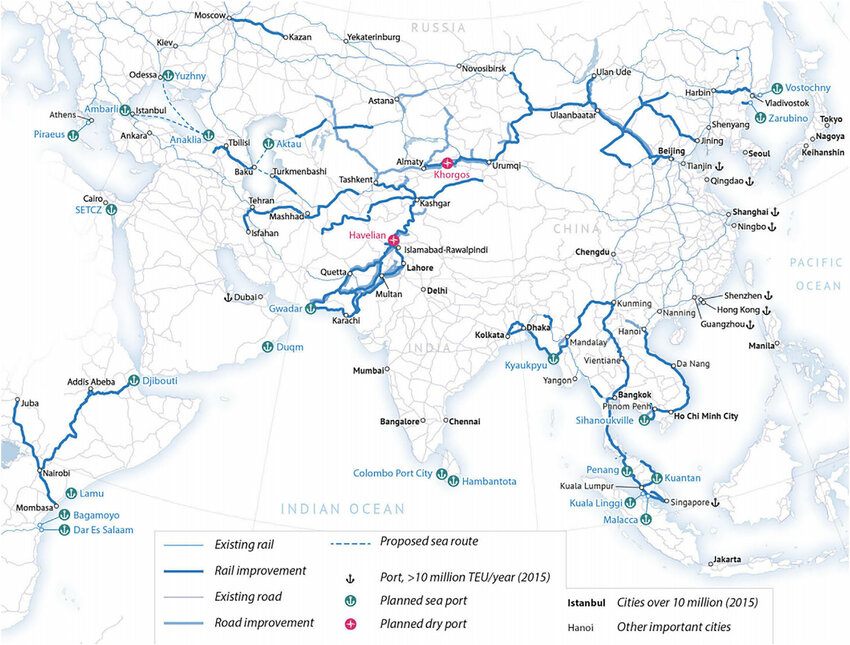
PC: Research Gate8
With this in mind, it is worth examining the concrete manifestations of the powers’ investment in Central Asia. Cross-border energy projects, designed to secure and direct hydrocarbon supplies, are a particularly significant example of this. The Central Asia–China Gas Pipeline (CACGP) thus meets Beijing’s energy needs, while the Caspian Pipeline Consortium (CPC) is part of Moscow’s strategy to maintain its key role in the transport of regional resources. In addition to these routes, there is the TAPI (Turkmenistan–Afghanistan–Pakistan–India) gas pipeline, designed to diversify the outlets for Turkmen gas to South Asia, and the Trans-Caspian Gas Pipeline project, intended to link Turkmenistan to Azerbaijan and then to the South European Gas Corridor to reach the European market. All of these infrastructures reveal the competition between energy routes and the strategic centrality of Central Asia in the restructuring of hydrocarbon flows 9.
| Pipeline name | Capacity (billion cubic meters/y) 2025 |
| CACGP (Central Asia–China Gas Pipeline)10 | 60 bcm/y |
| CPC (Caspian Pipeline Consortium)11 | ≈ 22 bcm/y |
| TAPI (Turkmenistan–Afghanistan–Pakistan–India)12 | 33 bcm/y |
| TPGP (Trans‑Caspian Gas Pipeline)13 | 30 bcm/y |
A Theoretical Centrality
Beyond the material dimension, to better understand the subject, let us dwell for a moment on the importance of words. According to Friedrich Ratzel, geopolitics is: ‘Political geography is the science of the state as a geographical organism, as it extends in space’14. This definition outlines a fundamental premise: the state cannot be understood independently of its spatial environment. Its strategies and interactions with other actors are conditioned by a set of material factors, such as natural resources and borders. Ultimately, space is not a neutral framework; it is an essential component of the dynamics of the state.
This initial approach, attributed to Ratzel, was widely adopted and renewed in the 20th century, particularly by French geographers such as Yves Lacoste, who emphasised the strategic dimension of space. In his famous article, ‘Geopolitics is primarily used to wage war’ (1976)15, Lacoste reminds us that geopolitics is not an abstract science, but an interpretation of the balance of power in space. As such, borders, trade routes and crossing points are not only physical realities; they also have political and symbolic significance. They also embody issues of power, control and influence between major powers. This interpretation should enable us to shed light on how contemporary initiatives, such as China’s Belt and Road Initiative, should be understood. Let us not establish an artificial dichotomy between theory and material.
A Pragmatic Nexus
It is therefore worth considering the practical nature of this centrality and the powers that are investing politically in the region. Central Asia cannot be viewed simply as a transit area: it is a theatre of interaction where regional and extra-regional power relations are being redefined. To account for this, it is possible to propose a simple and practical framework, distinguishing between the ‘traditional powers’ established in the region, the ‘new entrants’ and those that are not suspected.
Among the traditional powers, China stands out first and foremost, with its well-established economic leverage, while Russia retains a historical depth inherited from the Soviet period, as exemplified by the training of Central Asian administrative elites at MGIMO in Moscow. Finally, Turkey mobilises a pan-Turkic civilisational register, notably through its imposing Organisation of Turkic States (OTS), which structures cooperation based on linguistic and cultural proximity16.
Alongside these established players, new entrants are emerging, keen to expand their diplomatic footprint in the region. The United States has institutionalised its dialogue with Central Asia through the C5+1 format, launched in 2015, whose recent developments reflect a desire to raise the level of political engagement. The forum’s tenth anniversary in 2025 was marked by its first presidential meeting, with the participation of Donald Trump and the Central Asian presidents17. The European Union has also positioned itself, albeit more gradually, by increasing the number of high-level meetings with Central Asian leaders. One notable example is the meeting held on 4 April 2025 in Samarkand between European Commission President Ursula von der Leyen and the five Central Asian heads of state, illustrating Europe’s desire to assert a strategic presence focused on connectivity, renewable energy and standards.
Finally, beyond these powers, other players in the region are less obvious but active. Japan, for example, is an excellent representative, as Tokyo has maintained diplomatic relations with the five Central Asian states since their independence and, in 2004, developed an institutional framework similar to that of the United States known as the ‘Central Asia Plus Japan’ dialogue, aimed at strengthening political and economic cooperation between Tokyo and the region. This initiative has just been elevated to summit level, marking a turning point towards a more assertive presence for Japanese diplomacy in the region18.
This Japanese involvement is part of a pragmatic strategy based on development aid, political dialogue and access to resources and markets for Japanese companies, rather than on direct security ambitions. Other East Asian states, such as South Korea, also play a significant role, particularly through knowledge-sharing and technical assistance programmes, which have contributed to projects such as the Knowledge Sharing Programme (KSP) launched in 2004, including the integration of Uzbekistan (2004), Kazakhstan (2009), and both Tajikistan and Kyrgyzstan (2014). While this investment in Central Asia may come as a surprise, it should be understood as a response to the region’s predators, as summarised in the following statement: “Trade and foreign direct investment (FDI) from Japan and South Korea have allowed this once-isolated part of the world to balance against powerful actors such as Russia and China.19 ”
Conclusion
Central Asia is now establishing itself as a major strategic crossroads at the start of this century, with its centrality constantly reaffirmed by the growing interest of major and medium-sized powers. The interests of China, Russia, Turkey, Europe, the United States, Japan and South Korea evidence this. Current events demonstrate this once again: on 26 February 2026, the first formal ministerial meeting between the Central Asian states and the United Kingdom was held in London, within a new C5-UK cooperation framework20. Perhaps they imagined themselves to be the first to invest in this theatre… Far from being underestimated, Central Asia appears to be a periphery that has become, literally and figuratively, central once again.
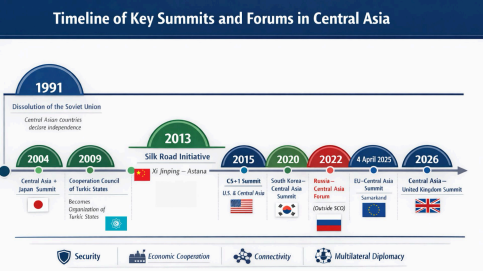
Timeline of Key Summits and Forums in Central Asia, IFME 2026. PC: Author
Title Image Courtesy: Dook International
Disclaimer: The views and opinions expressed by the author do not necessarily reflect the views of the Government of India and the Defence Research and Studies.


References
1 ZELKO-YILMAZ Ethan, Renewed French Diplomacy in Central Asia, DRaS, octobre 2025. https://dras.in/renewed-french-diplomacy-in-central-asia/
2 DE LA VAISSIERE Étienne, Antoine Germa & Benjamin Lellouch & Evelyne Patlagean (dir.), Les Juifs dans l’histoire : De la naissance du judaïsme au monde contemporain, Champ Vallon Editions, Seyssel, pp. 178-186, 2011.
3 FAVEREAU Marie, La Horde, Comment les mongols ont changé le monde, Perrin, Paris, 2023.
4 DEWEESE Devin, Islamization and Native religion in the Golden Horde, Baba Tükles and Conversion to Islam In Historical and Epic Tradition, Penn State University Press, Pennsylvanie, 1994. 1
5 Xi Jinping’s speech in Astana (Kazakhstan) in 2013: launch of the New Silk Roads. https://histegeodgab.com/wp-content/uploads/2019/10/xi-astana-2013.pdf
6 Vision and Actions on Jointly Building Silk Road Economic Belt and 21st-Century Maritime Silk Road, Ministry of Foreign Affairs, and Ministry of Commerce of the People’s Republic of China, 2015. https://www.mfa.gov.cn/eng/zy/jj/2015zt/xjpcxbayzlt2015nnh/202406/t20240606_11381659.html
7 Belt and Road Economics: Opportunities and Risks of Transport Corridors, 2019, cit. p.9 https://documents1.worldbank.org/curated/en/715511560787699851/pdf/Main-Report.pdf 2
8 Reed and Trubetskoy 2019. Note: TEU = twenty-foot equivalent unit
9 TSERETELI Mamuka, The Evolution of Central Asian Energy, May 2020. https://www.afpc.org/publications/articles/the-evolution-of-central-asian-energy
10 CACGP BCM/y (2025) : https://english.www.gov.cn/archive/statistics/202411/19/content_WS673bd780c6d0868f4e8ed270.html
11 CPC BCM/y (2025) : https://www.reuters.com/business/energy/kazakhstan-plans-12-increase-caspian-cpc-oil-exports-march-energ y-ministry-says-2025-03-04
12 TAPI BCM/y (2025) : https://www.defense.gouv.fr/sites/default/files/dgris/Rapport – Asie centrale – octobre 2025.pdf
13 TPGP BCM/y (2025) : https://www.bakunetwork.org/fr/news/analytics/13847
14 Friedrich Ratzel, Politische Geographie, R. Oldenbourg, Munich, 1897. Der Staat ist ein Stück Menschheit und ein Stück organischen Lebens, das an den Boden gebunden ist.
15 LACOSTE Yves, La géographie, ça sert, d’abord, à faire la guerre, Paris, La Découverte, « Poche / Essais », 2014.
16 ZELKO-YILMAZ Ethan, L’Organisation des États Turciques : un acteur régional en devenir ?, No. 2, OFB, février 2026.
17 ZELKO-YILMAZ Ethan, Reconfiguring Central Asia: The Strategic Role of the US, DRaS, novembre 2025. https://dras.in/reconfiguring-central-asia-the-strategic-role-of-the-us-2/
18 Press release from JICA (Japan International Cooperation Agency) entitled: Central Asia’s enormous potential and its long-standing ties with Japan, june 2024, https://www.jica.go.jp/french/information/topics/2024/p20240606_01.html 19 Ibid, p. 4.
20 https://timesca.com/uzbekistan-eyes-ukef-backing-and-market-access-at-c5-uk-talks/