

Conventional deterrence is the use of credible conventional non-nuclear military power to convince an adversary that starting a conflict would fail or cost more than it is worth, thus forcing them to refrain from initiating a war.
The recent U.S. approval of a Foreign Military Sale of 93 million USD to India, including FGM-148 Javelin anti-tank guided missiles and M982 Excalibur precision-guided artillery rounds, marks a significant step in India’s modernisation of its warfighting and deterrence posture in land warfare. Each system adds a transformative capability: Javelin strengthens infantry dominance in anti-armour ambush and defence, while Excalibur gives artillery the ability to strike deep with surgical accuracy. Although the approved quantities are limited, their operational value, doctrinal influence, and signalling effect on Pakistan create meaningful improvements in deterrence.
India’s infantry and mechanised forces require highly reliable Anti-Tank Guided Missile (ATGM) systems to counter a range of threats from Pakistan and China, ranging from T-80UD and Al-Khalid tanks in the west to Type-15 light tanks, ZBL-09 IFVs and the fortified positions in the north-east and LAC. The long-standing debate over US-made FGM-148 Javelin vs Israel’s Spike family of missiles became prominent around 2009–2014, when India evaluated both systems for its Infantry ATGM (I-ATGM) requirement.
Background and Context
India faces a geographically diverse but predictable set of threats from Pakistan. These include armoured thrusts in limited war scenarios (e.g., Punjab–Rajasthan plains), forward deployment of armour and infantry along the LoC to support infiltration operations, dependence on artillery firebases and supply depots close to the border and vulnerabilities in Pakistani logistics and C2 networks, many located within 20–50 km of the international border.
India has historically relied on T-90/T-72 armour, Konkurs and Milan ATGMs, and tube/rocket artillery for counter-armour and counter-force roles. Precision was limited, and infantry ATGMs lacked fire-and-forget capability. The U.S. sale thus fills gaps in ensuring portable precision anti-armour response, and long-range, low-collateral precision artillery strike.
FGM-148 Javelin Anti-Tank Guided Missile
Javelin is globally recognised as one of the most lethal infantry anti-tank systems. Its key characteristics include Fire-and-Forget- once the gunner locks onto a target using its Imaging Infrared (IIR) seeker, the missile autonomously guides itself. This gives great advantages in terms of higher survivability to crews, ability to relocate immediately (“shoot-and-scoot”), and reduced exposure time and improved ambush tactics.

PC: TOI
The tandem-Charge HEAT Warhead is designed to defeat Explosive Reactive Armour (ERA), thus ensuring penetration of Pakistan’s armour, including Al-Khalid MBT, T-80U and Al Zarrar upgrades. The top-attack profile is especially lethal given thinner roof armour. The missile climbs ~150 m then dives onto turret roof—ideal against MBTs. In the direct attack role, the missile can target bunkers, buildings, soft-skinned vehicles, and helicopters.
It has an effective range: 2.5–4 km, depending on the block and an extremely high first-round hit probability. In the ongoing Russia-Ukraine war, 300 Javelin missiles were fired, accounting for 280 combat losses of Russian tanks/armour vehicles, almost giving a hit probability of 93 percent. 4-crore missile shooting 8-crore tank. The launcher is operated by two soldiers; being highly portable and therefore very useful in mountains, built-up areas, and narrow valleys where Pakistan cannot manoeuvre tanks easily.
M982 Excalibur Precision-Guided 155 mm Artillery
Excalibur transforms artillery into a precision-strike instrument. It has GPS/INS guidance and a Circular Error Probable (CEP) < 2 meters. Some variants include semi-active laser guidance, enabling moving target engagement. It has an extended range of 30–40 km from standard 39/52-cal guns. Higher ranges are achievable with extended barrels and charge combinations.
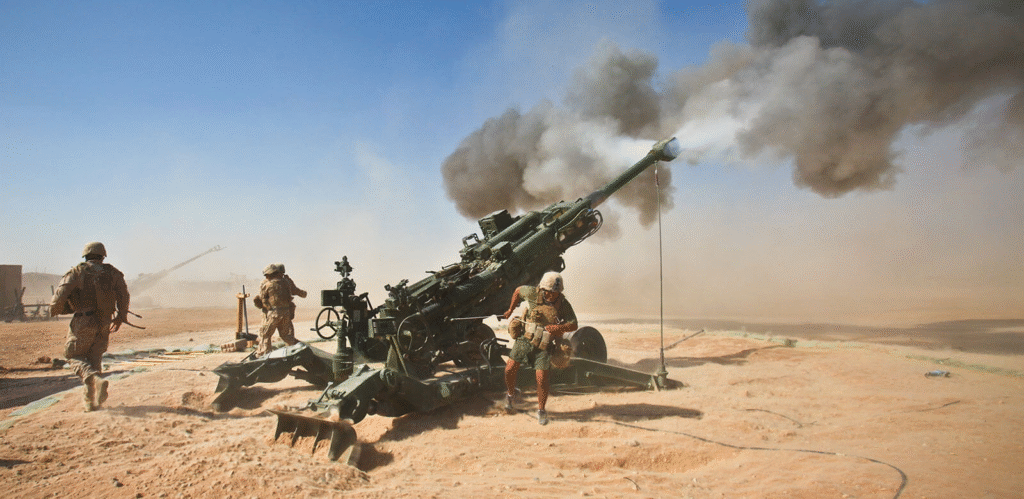
PC RTX
On account of pinpoint accuracy, a single round can neutralise Command posts, Artillery batteries, Ammunition depots, Radars, and Forward operating bases. This is essential for calibrated retaliatory strikes without widening the conflict. This projectile is fully compatible with India’s M777 Ultra-Light Howitzers (deployed in mountains), K9 Vajra-T SP Artillery, and Dhanush and ATAGS future integration. Its battlefield Role will encompass counter-battery operations, interdiction of logistics nodes, precision suppression of enemy air defence (SEAD) missions, and destruction of time-sensitive targets.
Shifting the Tactical Balance in India’s Favour
Javelin- Pakistan’s armour-heavy brigades rely on rapid thrusts through predictable corridors (e.g., Shakargarh, Chor, Rahim Yar Khan sectors). Javelin-equipped infantry can ambush armour effectively in canal belts, villages, and chokepoints, defend key approaches without needing tank support and neutralise even advanced tanks regardless of frontal armour. This dramatically raises the attrition cost of any Pakistani armoured offensive.
Excalibur- Indian forces can strike Pakistani artillery before it fires, destroy logistic trains, POL installations, and ammunition points, and disrupt mobilisation in the early hours of the conflict. Pakistan’s forward depots in Gujranwala, Sialkot, and Rahim Yar Khan fall well within range.
Enhancing India’s Limited War Strategy
India’s strategic environment, especially with Pakistan, has led New Delhi to evolve a “limited war” doctrine—a calibrated approach to employ military force below Pakistan’s nuclear threshold while achieving politically significant objectives. This doctrine emerged prominently after the Kargil War (1999) and the Parliament attack (2001), and has been refined through Cold Start concepts, surgical strikes, airpower employment, and today’s hybrid and grey-zone engagements. India’s military doctrine emphasises rapid punitive strikes, holding limited territory, and avoiding escalation to full-scale war or nuclear thresholds. The raising of the Rudra Brigade and the Bhairon battalions is a step in this direction.
Excalibur enables India to conduct retaliation with minimal collateral damage—politically acceptable, target military infrastructure precisely, avoiding civilian zones—reducing escalation risk, destroy high-value assets early—forcing Pakistan to reconsider further retaliation. Javelin enables forward brigades to withstand counterattacks after India captures limited objectives.
Deterrence Through Punishment and Denial
Deterrence by Denial (Stopping Pakistan’s Plans). Javelin contributes to denial by ensuring Pakistan cannot expect a low-cost armoured breakthrough.
Deterrence by Punishment (Imposing Costs). Excalibur allows India to retaliate against Pakistan’s artillery regiments, Command posts, Supply dumps and forward air defence batteries. If Pakistan initiates a provocation, India can impose disproportionate costs with precision—without crossing nuclear red lines.
Scenario Analysis: How These Systems Alter Battlefield and Outcomes
Scenario 1: Pakistani Armour Thrust into Rajasthan. Pakistan historically trains for rapid penetration using T-80UD and Al Khalid tanks. Javelins deployed with mobile infantry regiments along expected corridors (e.g., Shahgarh Bulge) create multi-layered kill zones, top-attack engagements even from concealed dune positions, and rapid shoot-and-scoot survivability.
Outcome: Pakistan’s spearhead units suffer significant losses before contact with India’s armour, disrupting operational tempo.
Scenario 2: LoC Escalation with Artillery Duels. Pakistan uses artillery to support infiltration and escalate pressure. India responds using Excalibur to neutralise specific firing guns, destroys ammunition storage near the LoC, limits civilian casualties, which Pakistan exploits diplomatically.
Outcome: Pakistan’s artillery loses effectiveness; escalation control improves.
Scenario 3: Pre-empting Pakistan’s War Mobilisation. Pakistan’s logistics hubs near the border triangles are critical in the first 48 hours. These include railway unloading stations, fuel parks, artillery ammunition dumps and Brigade HQs. India could use Excalibur to selectively destroy these without deep incursions.
Outcome: Pakistan’s ability to launch a coherent offensive may collapse early.
Scenario 4: Urban Warfare in Jammu or Punjab. If Pakistan attempts to push small mechanised groups through urban chokepoints, the Javelin teams hidden in multi-storey structures can strike top surfaces, high lethality with minimal collateral damage and support infantry holding operations.
Signalling Effect to Pakistan
The U.S. approval indicates continued strategic convergence between India and the U.S., U.S. willingness to strengthen India’s land warfare capabilities and no hesitancy to supply high-end precision systems. This raises doubts in Pakistan’s mind about long-term military advantage. Pakistan’s traditional belief that it can achieve quick gains in the opening days is now weakened. Precision reduces collateral damage, enabling India to respond forcefully yet proportionately. This is vital in nuclearised environments, where escalation control is crucial.
Limitations and Challenges
Current numbers (~100 Javelin systems, ~200+ Excalibur rounds) are tactically significant but strategically limited. India must scale up stockpiles for meaningful deterrence.
Pakistan could increase deployment of Active Protection Systems (APS) on tanks, though even APS struggle against top-attack angles. GPS jamming could affect Excalibur; mitigated by INS and laser-guided variants. Excalibur rounds are expensive; sustained operations require large reserves. Javelin missiles must be procured in hundreds more for divisional impact.
India must improve its UAS-based targeting, Counter-battery radars, Secure GPS, Forward observer training and Joint fire integration.
Recommendations
Scale Up Procurement. Increase Javelin numbers to several hundred launchers and thousands of missiles. Secure co-production or technology transfer where feasible, and expand Excalibur stockpile to at least several thousand rounds for sustained high-tempo operations.
Integrate with Sensors and Networked Warfare. Pair Excalibur with RQ-11B or Indian UAVs, Swarm drones for spotting, Satellite imagery, and WLR (Weapon Locating Radar) systems. Integrate Javelin teams with infantry reconnaissance drones.
Adapt Doctrine. Create specialised anti-armour ambush companies in each infantry brigade. Revise limited war plans to incorporate precision first-strike options and train for synergy between ATGM teams and artillery observers.
Build Redundancy and Resilience. It is imperative to harden and disperse ammunition stockpiles, and ensure GPS-denial resistant targeting through dual-mode Excalibur, as well as improve logistical lines for high-value munitions.
Conclusion
The introduction of Javelin ATGMs and Excalibur precision artillery marks a qualitative leap in India’s defensive and offensive firepower. Their combined effect increases lethality against Pakistani armour, enhances precision and reduces collateral damage, strengthens deterrence through denial and punishment, and improves India’s ability to conduct limited wars under the nuclear threshold.
While the present quantities are modest, the systems’ psychological and strategic impact is considerable. With scaled procurement, doctrinal adaptation, and integration with India’s surveillance–strike complex, these systems can significantly reshape the Indo–Pakistan conventional balance.
This also ignites a debate on whether Javelin was a good decision, considering the superior performance of Spike Missiles from Israel, which are already in the inventory of the Indian Army.
Optimal Solution lies in a hybrid fleet: Spike MR/LR2 for infantry and mechanised brigades and Javelin for rapid deployment forces and high-altitude battalions with the indigenous MPATGM and Nag/HELINA for long-term self-reliance. This ensures tactical flexibility, strategic redundancy, high-altitude superiority and capability gap closure vs Pakistan and China.
Title Image Courtesy: Google Gemini AI
Disclaimer: The views and opinions expressed by the author do not necessarily reflect the views of the Government of India and the Defence Research and Studies