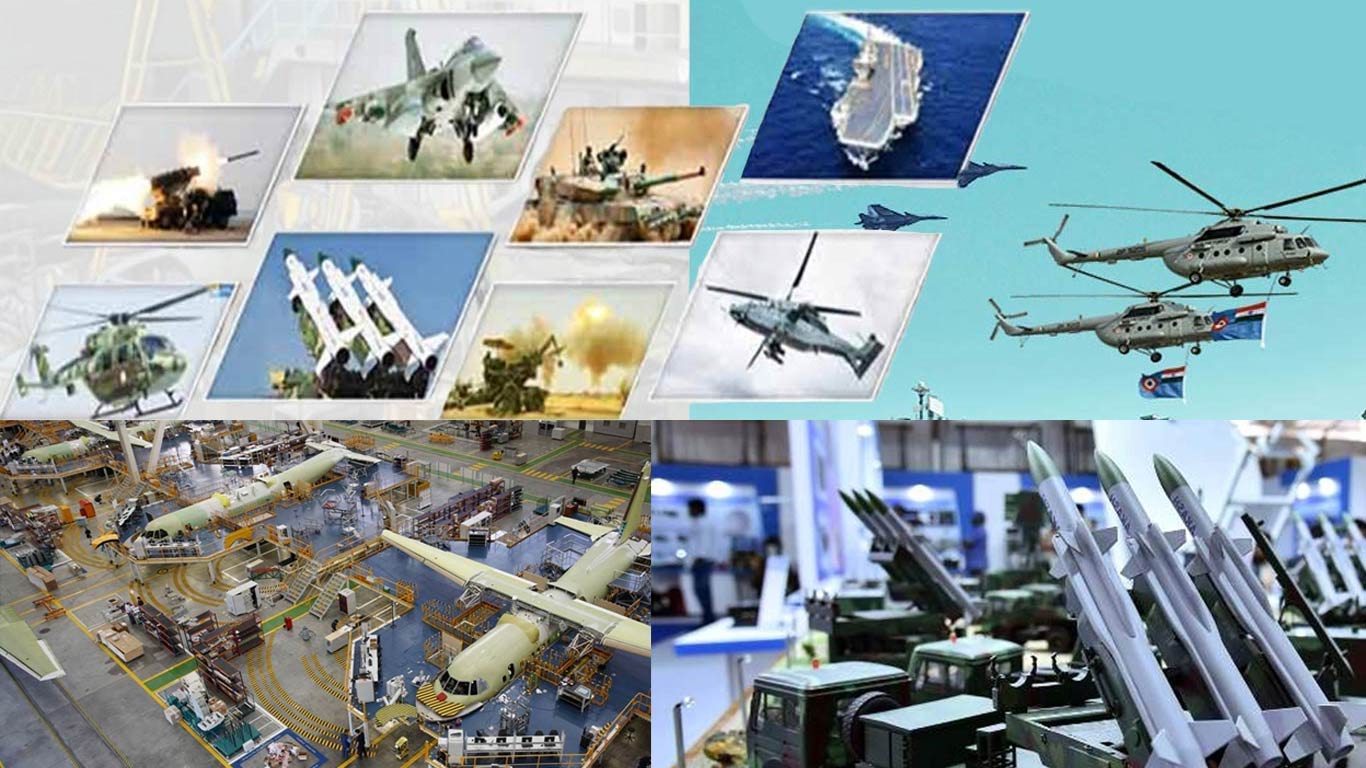
Post-independence, India’s “Indigenous Content (IC) in weapon and defence equipment manufacturing story is characterised by slow growth, even though there are many success stories of design and production viz; INS Vikrant, LCA Tejas, Dhruv and Prachand helicopters, Agni long-range missiles, Brahmos cruise missiles, Akash Missile systems, BVR missiles ASTRA, Pinaka Guided Rockets, Dhanush howitzer gun, and ATAGs, etc. In the last two decades, the Indian defence equipment manufacturing has received momentum with the entry of big private companies and MSMEs. The Indian private sector has designed and manufactured many state-of-the-art and cost-effective weapons and delivery platforms. Major defence equipment designed and developed by the Indian private sector includes: artillery systems like the Advanced Towed Artillery Gun System (ATAGS) (Bharat Forge/Tata), armoured vehicles (Tata Marksman, Mahindra Mine Protected Vehicle), and UAVs/drones (ideaForge), etc. Whereas, the DPSU driven programmes like; Light Combat Aircraft (LCA) Tejas Mk2, Light Utility Helicopter (LUH), 13 ton Indian Multi-Role Helicopter (IMRH), Advanced Medium Combat Aircraft (AMCA), future infantry combat vehicles, next Generation submarines and autonomous underwater vehicles, Future Ready Combat Vehicles (FRCVs), Arjun Main Battle Tank (Mk-1A/Mk-II), and upgraded armoured personnel carriers etc continue to be plagued by huge delay in series production and induction in to the Armed Forces, thus affecting national security and defence preparedness. However, achieving total self-reliance remains a steep mountain to climb.
Until a decade ago, only the DRDOs were responsible for ‘Design & Development’ of all major defence equipment and the DPSUs were responsible for ‘System Integration’, Private industries played a very limited role for ‘Component & Sub-system Manufacturing’. Considering the ever expanding requirement of state-of-the-art weapons and their delivery platforms as well network centric warfare systems, the DRDOs and DPSUs are unable to meet the demand of the Armed Forces, hence there is an urgent need for leveraging the capacity of the private sector also in the design and manufacturing of global standard defence equipment for domestic use and export. With the promulgation of the Defence Procurement Manual (DPM) in 2005, the Government envisaged establishing a systematic, fair, and transparent process for revenue procurement of goods and services for the Indian Armed Forces. Through the subsequent revised edition of DPM in 2009, the defence procurement procedure became more effective, transparent, inclusive and cost-competitive. The latest edition of DPM 2025 marks a tectonic shift – from being a purely “administrative” document to a “strategic” one, aligning military spending with the Atmanirbhar Bharat (self-reliance) initiative. The new DPM focuses on “Innovation and Indigenisation” and allows the Services to partner directly with startups, academia (IITs/IISc), and MSMEs for in-house design and development. For items developed indigenously, the government will provide an assured guarantee of orders for 5 years, extendable by another 5, thus providing the financial predictability needed for private R&D.
Government: Regulator or Facilitator
The goal of the Government is to encourage the private sector to invest in R&D for state-of-the-art weapons and delivery platforms. Though the Govt’s current defence procurement policies provide for the participation of the private sector in defence equipment, they are not adequate to meet the mass production of modern equipment in tune with the induction plans of the Armed Forces.
The current policies of the Government for the design, buy and make and buy global and manufacture in India can be broadly classified into:-
- Buy (Indian-IDDM) with Indigenous Design and at least 50% Indigenous Content (IC).
- Buy and Make (Indian), with initial purchase of a small quantity from a foreign OEM, followed by full-scale
- Buy (Global-Manufacture in India), by encouraging Foreign OEMs to set up subsidiaries or JVs in India to manufacture entire platforms or critical spares.
With the roll out of Defence Acquisition Procedure (DAP) 2025, the capital goods acquisition procedure has been made more “industry-friendly” to fix the delays and to benefit local manufacturers over foreign; instead of demanding 50% local parts on Day 1, vendors can now start at 30% and ramp up to 60 over the life of the contract, special fast-track route for urgent requirements (up to ₹100 crore) allows the military to buy directly from a capable Indian startup or MSME without a 2-year multi-vendor competition, a newer category that allows the Services to lease assets (like transport planes or trainers) rather than buying them, saving massive upfront capital and the new provision “Product Support” throughout the life of the equipment (30+ years) ensuring business to the OEM for prolonged period.
Despite the various initiatives on indigenous design and production of defence equipment, India continues to be dependent on foreign OEM for some niche technologies viz; tanks (60-70% high-power engines and thermal sights), fighter jets (60% – aero engines and ejection seats), missiles (70-80% – seekers and high-end electronics), and war ships (75-90%) – gas turbines and propulsion sensors). These niche technologies have been developed by foreign OEMs after spending a huge amount of money on R&D, and ToT in India will be prohibitively expensive. The solution lies in indigenous R&D. The DPSUs and DRDOs, due to their inherent work culture, can provide only limited output, and therefore, it is imperative to tap the private corporates and MSMEs for the design and development of technologies.
78 Years of Indigenous Defence Equipment Manufacturing
In spite of the concerted efforts of various governments since independence, the total indigenous content by value is only two-thirds; from a mere sub-10% in 1947 to approximately 65 % in 2025-26. Though the latest DPM focuses on leveraging the role of private sector indigenous defence equipment manufacturing by providing a 5-year assured order guarantee for certain items, in the revenue expenditure category, the incentives for investing capital in the R&D are meagre, and the bureaucratic hurdles restrict the benefits reaching the MSMEs. While the DPSUs and DRDOs have made some impressive achievements by developing many crucial equipment for Army, Navy and Air Force, these Government establishments continue to miss induction time-lines; LCA Mk 1, while the cry for state-of-the-art weapons and delivery platforms by our Armed Forces louder, particularly in the aftermath of Operation Sindhoor and possibility of another such swift conflict in the foreseeable future.
Historical Evolution of Indigenous Content (1947–2025)
The journey of self-reliance in defence equipment can be divided into four distinct phases of “Atmanirbharta” as given below.
| Era | Primary Strategy | Avg. Indigenous Content (by value) | Key Milestones |
| 1947–1962 | The British Legacy | < 10% | Inherited 16 Ordnance Factories. Mostly basic small arms/ammo. |
| 1963–1990 | Licensed Production | 20% – 35% | HAL (MiG-21), Tank Factory Avadi. “Screw-driver technology” phase. |
| 1991–2014 | The Missing Middle | 35% – 45% | Launch of LCA Tejas & Arihant. High dependence on Russian spares. |
| 2015–2025 | The Structural Shift | 65% – 75% | iDex, Positive Indigenisation Lists, BrahMos (75%+), Akash (96%). |
- The “Self-Reliance Index” (SRI) Breakdown. The SRI was a term coined by the Dr APJ Abdul Kalam Committee in 1993. Their goal was to move from 30% to 70% by 2005. While India missed that deadline, it finally crossed the 70% threshold for new procurement in late 2024.
- Post-Independence “Vulnerability” (1947–1965). In 1947, India had almost zero R&D. Equipment was 90%+ imported from the UK. The 1962 and 1965 wars were a wake-up call, showing that “importing security” left the country vulnerable to foreign sanctions (as seen with the US arms embargo in 1965).
- Era of “Licensed Manufacturing” (1970s–1990s). India began producing Soviet and European equipment (MiGs, Jaguars, T-72 tanks). On paper, these were “Made in India,” but by value, 70% was still imported as “raw materials” and “semi-knocked down” (SKD) kits. India was essentially an assembly hub.
- Modern Transformation (2014–2025). This era is characterised by the implementation of Positive Indigenization Lists (banning the import of over 5,500 items). In FY 25-26, for the first time, 92% of new defence contracts (by number) are being awarded to Indian vendors. In the last FY 24-25, Defence production crossed ₹1.54 lakh crore, with domestic procurement making up 75% of the modernisation budget.
- Where the “Remaining 25%” Lies. As of January 2026, the gap is between 75% and 100% in indigenisation; it is not about quantity, but complexity. The remaining imports are concentrated in:-
- Aero-engines: Still 80-90% imported for high-performance jets.
- Specialised Semiconductors: High-end chips for missile seekers and AI processors.
- Propulsion & Transmission: Heavy-duty engines for tanks (like the Arjun) and specialised gearboxes for ships.
- Poster Child – Akash Missile System. The Akash Missile System remains the “poster child” of indigenisation with 96% indigenous content, proving that when India owns the designs, the manufacturing ecosystem and the supply chains.
Atma Nirbharta (Self-Reliance) in the Defence Sector
Today, India stands at a critical juncture in its quest for Atmanirbharta (self-reliance) in defence. While domestic production has soared to a record ₹1.54 lakh crore (FY24-25) and exports have crossed ₹23,500 crore, the path to total strategic autonomy is still obstructed by deep-seated structural and technological bottlenecks.
Challenges to India’s Self-Reliance in Defence Equipment Design & Manufacture
There are a host of factors which currently inhibit India’s self-reliance, even though there is govt defined roadmap to becoming a global defence powerhouse by 2030. Despite the “Buy Indian-IDDM” (Indigenously Designed, Developed, and Manufactured) priority, several “missing links” continue to drain the exchequer and delay modernisation:-
- The “Critical Technology” Gap. While India can manufacture hulls, airframes, and missiles, it remains heavily dependent on imports for “heart and brain” technologies.
- Aero-engines. Though India has entered into an agreement with Safran and GE for the development of aero engines for Tejas Mk IA,/Mk II and AMCA fighters, the induction of these engines for our Tejas and AMCA still lacks a clear timeline. The indigenous Kaveri engine, in spite of 40-plus years, is still stuck in dry-regime range.
- Advanced Electronics. High-end sensors, radars, and seeker technologies for missiles are still being sourced from Israel, France, and Russia.
- Semiconductors: The lack of a domestic high-end chip ecosystem makes Indian defence hardware vulnerable to global supply chain shocks.
- Bureaucratic “Administrative Straggling”. The procurement cycle—from the initial “Request for Proposal” (RFP) to the final induction—often spans over a decade. Some of the other straggling pain points in defence procurements are:-
- L1 Syndrome. The historical preference for the “Lowest Bidder” (L1) rather than the “Most Technologically Advanced” has often sidelined innovative private players in favour of stagnant legacy systems.
- Trial Delays: Rigorous and sometimes repetitive field evaluation trials in diverse terrains (from Siachen to the Thar Desert) extend timelines significantly.
- Underfunded Research & Development (R&D). India’s R&D spend is roughly 0.6% to 0.7% of GDP, far below the 2%–3% spent by the US, EU countries, Israel and China.
- DRDO Monopoly. Historically, R&D was centralised within the DRDO. While this is changing with the ADITI and iDEX schemes, the private sector still accounts for only about 23% of total defence production.
- Skill Gap in High-Precision Engineering. As warfare shifts toward AI-driven surveillance, quantum computing, and hypersonic systems, India faces a shortage of specialised talent. There is a “missing middle” of technicians and engineers capable of handling Industry 4.0 manufacturing standards.
Role of DRDO: The Architect of Innovation
The Defence Research and Development Organisation (DRDO) has pivoted from being a closed-door research house to an enabler of the private industry:-
- Technology Transfer (ToT): DRDO now actively transfers mature technologies to private firms. In late 2025/early 2026, events like Samanvay 2025 saw dozens of licensing agreements for products like Electronic Warfare suites and Laser Target Designators.
- Deep Tech Focus: DRDO is currently spearheading “futuristic” domains, including Quantum Computing, Photonics, and Hypersonic weapons (such as the Pralay missile system), ensuring India doesn’t just catch up but leads in next-gen tech.
- Testing Infrastructure: DRDO provides its high-end testing ranges (like the Integrated Test Range in Odisha) to private players, lowering the barrier to entry for smaller defence startups.
Role of DPSUs: The Industrial Giants
The Defence Public Sector Undertakings (DPSUs) have undergone a radical “Efficiency Makeover.” The most significant change has been the corporatisation of the Ordnance Factory Board (OFB) into seven specialised DPSUs:-.
- From Loss to Profit: The newly formed entities (like Munitions India Ltd and Armoured Vehicles Nigam Ltd) have turned a cumulative loss of over ₹2,800 crore (pre-2020) into a net profit of over ₹1,625 crore by 2025-26.
- Mass Production & Export: While DRDO designs, DPSUs like HAL (Hindustan Aeronautics Ltd) and Mazagon Dock handle the heavy lifting of mass production. HAL’s order book in 2026 has reached record highs (approx. ₹2.3 lakh crore), driven by the Tejas Mk-1A and Prachand helicopters.
- Global Competitiveness: DPSUs are no longer just domestic suppliers; they are aggressive exporters. In 2025-26, DPSU exports grew by over 40%, shipping equipment to over 100 countries, including Armenia and nations in Southeast Asia.
Need for Synergy Between DRDO, DPSU & Private Sector
The modern model is no longer about the public sector doing everything. It is now a Consortium Model:-
| Feature | Role of DRDO | Role of the Private Sector | Role of the Private Sector |
| Concept | Design & Prototyping | System Integration | Component & Sub-system Mfg |
| Funding | Govt. R&D Budget | Corporate Reserves | Venture Capital / FDI |
| Example | AMCA Stealth Fighter | Final Assembly (HAL) | Tier-1 & Tier-2 Suppliers (Tata/L&T) |
The Way Forward – Strategy for 2030
To reach the government’s target of ₹3 lakh crore in production and ₹50,000 crore in exports by 2029, a fundamental repositioning is required. The way forward strategies are discussed below:-
- Institutionalising “Design Authority”. India must transition from being a “Licensed Producer” to a “Design Owner.”
- IP Ownership. Future contracts should mandate that the Intellectual Property (IP) for critical components stay with Indian firms, even in joint ventures with foreign OEMs (Original Equipment Manufacturers).
- Focus on Jet Engines. Accelerating the co-development of jet engines with global partners (USA, Russia, Japan and France ) with full technology transfer is the single most important hurdle to clear for the IAF’s future.
- Strengthening the “Triple Helix” Model. The synergy between the Military, Industry, and Academia must be deepened. The 15 Defence Industry-Academia Centres of Excellence (DIA-CoEs) should be empowered to turn laboratory prototypes into “combat-ready” equipment within 2–3 years, rather than decades.
- Empowering Private “Lead Integrators”. Rather than viewing the private sector as mere component suppliers to Defence PSUs, the government should encourage firms like Tata, L&T, Adani and capable and committed MSMEs to act as Lead System Integrators for major platforms like submarines and tanks.
- Creating a “Defence Export” Ecosystem. India must move beyond exporting “soft” items like bulletproof jackets and boots.
- High-Value Exports: The focus should shift to platforms like the LCA Tejas, BrahMos, and Pinaka Multi-Barrel Rocket Launchers.
- Maintenance Hubs. India can position itself as a regional MRO (Maintenance, Repair, and Overhaul) hub for Russian and Western equipment used by friendly nations in Southeast Asia and Africa.
Summary of Key Targets (by 2030)
| Metric | Current Status (2025-26) | Target (2029-30) |
| Annual Production | ~₹1.54 Lakh Cr | ₹3.0 Lakh Cr |
| Annual Exports | ~₹23,500 Cr | ₹50,000 Cr |
| Indigenous Content | 65% | 75% – 80% |
| Private Sector Share | 23% | >35% |
Conclusion
Moving from “Make in India” to “Design and Develop in India” is the true hallmark of a sovereign power. When a nation owns the blueprints, it isn’t just saving foreign exchange—it is eliminating the risk of “sanction-diplomacy” and ensuring its equipment works exactly when and how it’s needed. The battlefield of 2030 will be defined by autonomous fighter jets, swarms, quantum-encrypted communication and command and control. India’s “National Quantum Mission” is now being fast-tracked specifically to ensure these protocols are built on indigenous silicon. India currently spends billions maintaining ageing Russian and Western fleets. Ultimately, India’s transition from a leading arms importer to a self-reliant defence powerhouse is no longer a choice but a strategic imperative necessitated by an increasingly volatile global order, going by the implications of current conflicts in West Asia, Ukraine-Russia and a possible military confrontation in the South China region. While deep-seated challenges—ranging from the lack of critical aero-engines and semiconductor technology to bureaucratic “administrative straggling”—continue to test the nation’s resolve, the structural shift toward an indigenous ecosystem is now imperative and irreversible.
The success story of the development of platforms like LCA Tejas, INS Vikrant, and the Akash missile system has proven that the synergy between the military, private startups (iDEX), and modernised DPSUs can deliver world-class hardware. To secure its future, India must now move beyond “licensed assembly” to achieve true Design Sovereignty, ensuring that the “brain and heart” of its weaponry and delivery platforms are conceived and built on Indian soil. As the nation targets a ₹3 lakh crore production milestone by 2029, its ability to master high-end propulsion and deep-tech innovation will be the final frontier in cementing its status as a truly autonomous global power.
India has the intent and the policy (Negative Import Lists, increased FDI); the next five years should be about execution speed and mastering deep tech powered by AI and ML, as well as propulsion and sensor technology. With the concerted efforts of DRDOs, DPSUs, MSMEs and academia, India can certainly become self-reliant in defence equipment and manufacturing, subject to the government playing the role of an enabler and regulator.
Title Image Courtesy: KNN India
Disclaimer: The views and opinions expressed by the author do not necessarily reflect the views of the Government of India and the Defence Research and Studies. This opinion is written for strategic debate. It is intended to provoke critical thinking, not louder voices.