

India–Israel defence cooperation is often seen mainly in terms of weapons deals, missile systems, drones, and military technology. But that view is now too narrow. Over the past few years, the relationship has grown beyond a simple buyer-seller arrangement. It is increasingly becoming a broader strategic partnership in which defence cooperation is also opening the door to joint development, industrial collaboration, innovation, and work in critical technologies.
The February 2026 India–Israel Joint Statement reflected this change clearly. Both countries upgraded their relationship to a “Special Strategic Partnership for Peace, Innovation & Prosperity.” They also welcomed the defence cooperation MoU signed in November 2025 and called for closer cooperation not only between governments, but also between businesses and institutions. This shows that the relationship is moving into a new phase.
For India, the main issue is no longer whether Israel is an important defence partner. It clearly is. The more important question is whether India can leverage this partnership to strengthen its domestic capabilities in areas where speed, advanced technology, and practical military needs are critical. This matters even more at a time when India is pushing hard for self-reliance in defence while remaining one of the world’s largest arms importers.
That is why India–Israel defence cooperation matters not just in military terms, but also in economic and industrial terms. For India, the ideal partnership does not keep the country dependent on imports. Instead, it should help India build expertise faster in important areas such as air defence, sensors, electronic warfare, autonomous systems, counter-drone technology, cyber security, and battlefield communications. Israel brings strengths in innovation, rapid adaptation, combat-tested systems, and dual-use technology. India brings scale, manufacturing potential, engineering talent, a large defence market, and strong policy support for indigenisation. When these strengths come together, defence cooperation becomes part of industrial strategy.
The November 2025 Joint Working Group on defence cooperation is important for this reason. The official discussions went beyond procurement and included strategic dialogue, training, defence industry cooperation, science and technology, research and development, innovation, artificial intelligence, and cyber security. The purpose of the MoU was not just to buy and sell equipment, but to promote advanced technology sharing, co-development, and co-production. That matters a great deal. It suggests that the relationship is no longer purely transactional and is becoming more structured and forward-looking.
A good example of this shift is the BEL–IAI joint venture announced in late 2024 and made operational in early 2025. The venture was designed to provide long-term support for India’s MRSAM systems and broader life-cycle support. BEL noted that IAI and DRDO had jointly developed the MRSAM system, and that the venture fits well with the vision of Atmanirbhar Bharat. On the surface, this may look like a technical support arrangement. But in strategic terms, it is far more important than that. Maintenance, repairs, upgrades, serviceability, and local support are central to real defence capability. A system that is only imported is not the same as a system that can be maintained, supported, and improved within India. The latter comes much closer to true strategic autonomy.
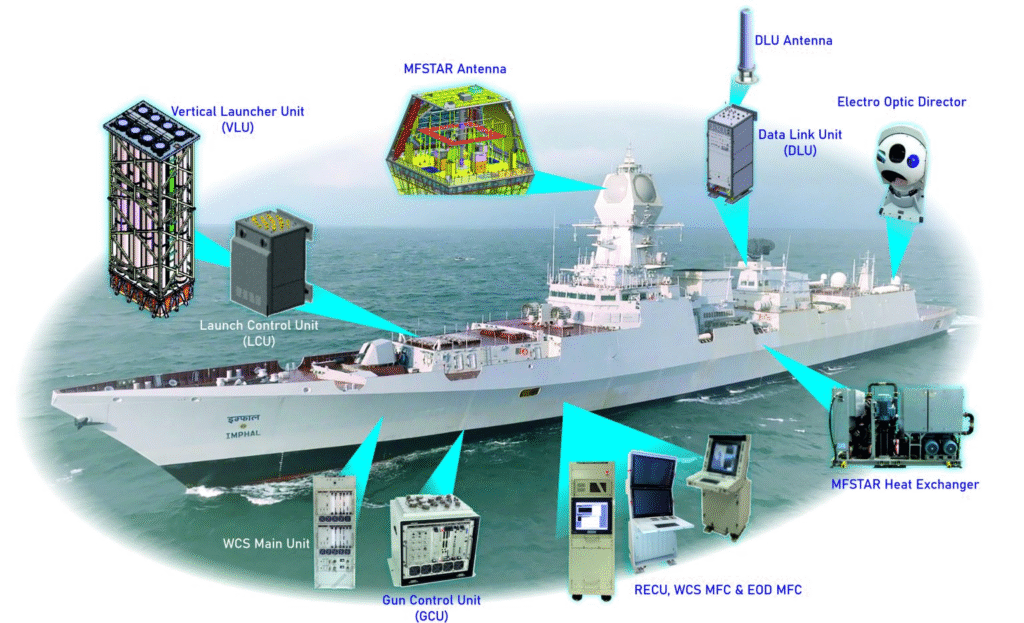
Source: Bharat Electronics Limited – MRSAM and MFSTAR system visual, reflecting India– Israel collaboration in air defence and system support.
The innovation side of the relationship is just as important. The India–Israel Industrial R&D and Technological Innovation Fund was created as a $40 million platform to support industrial research and development leading to co-development and commercialisation. What makes this model significant is that it is business-led, with both governments helping to fund projects. This is not just about academic cooperation or symbolic research. It is about building products, technologies, and companies that can have real strategic and commercial value.
This becomes even more important when one looks at the kinds of projects being supported. The 2024 call under the fund focused on the integration of biological, physical, and human systems with autonomous systems. It included areas such as sensing, modelling, digital twins, man-unmanned teaming, and cyber security. Some of the supported projects also include drone detection and neutralisation systems aimed at the Indian market, along with secure communications and other advanced technologies. This shows that India and Israel are not only cooperating on existing defence systems. They are also beginning to work together on the kinds of technologies that are likely to shape future military competition.
The 2023 CSIR–DDR&D agreement expanded this innovation architecture further. It covered a wide set of areas, including aerospace, electronics, materials, energy, biotech, and healthcare. It also built on earlier efforts between DRDO and Israel’s DDR&D to support innovation and faster R&D involving startups and MSMEs in dual-use technologies. This is especially important for India. The long-term economic value of defence partnerships does not come only from big contracts with major companies. It also comes from building a wider ecosystem in which startups, MSMEs, research labs, and larger Indian firms can absorb technology, produce components, adapt products for local needs, and later compete in export markets.
The broader economic relationship between India and Israel supports this view. Bilateral trade, excluding defence, remains modest in absolute terms, but the direction of the relationship is important. The February 2026 Joint Statement was not limited to defence and cybersecurity. It also highlighted trade and investment, the Bilateral Investment Agreement signed in September 2025, discussions on an FTA, financial dialogue, fintech cooperation, and stronger business engagement. In November 2025, India’s commerce minister also led a 60-member business delegation to Israel that included sectors such as defence, emerging technologies, cyber security, infrastructure, life sciences, water technology, and advanced manufacturing. This is not the pattern of a narrow military relationship. It is the pattern of a growing strategic-economic partnership.
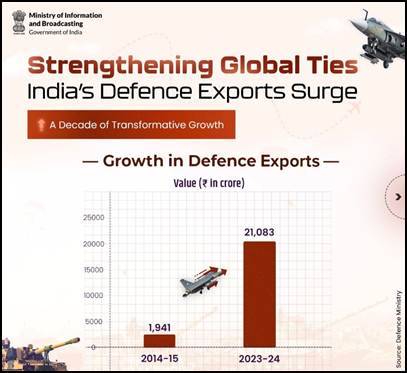
Source: Defence Ministry & www.pib.gov.in – India’s defence exports growth under the Atmanirbhar Bharat framework.
This wider framework matters for India’s long-term planning. The 2026 visit outcomes also included cooperation in geophysical exploration using advanced geophysical and AI tools, a declaration on horizon scanning, an India–Israel cyber centre of excellence in India, and an MoU on artificial intelligence. When read together with the defence MoU and the innovation fund, these steps suggest that future India–Israel cooperation will increasingly be built around critical and emerging technologies rather than older military platforms alone. That is where the real long-term value lies. Countries do not gain a lasting strategic advantage simply by buying more equipment. They gain it by becoming part of the technology and innovation chains that shape the next generation of defence capability.
At the same time, this relationship also has clear limits and challenges. India has to maintain strategic autonomy in West Asia and ensure that one bilateral relationship does not restrict its wider regional diplomacy. India must also avoid confusing assembly with real technology absorption. Co-production by itself is not enough if it does not include deep maintenance capability, supply-chain learning, local industrial participation, and the right to upgrade and adapt systems over time. If cooperation remains shallow, the structure of dependence will remain in place, even if the language changes.
For this reason, India should see Israel not as an alternative to self-reliance, but as a way to strengthen it. Israel can help India move faster in selected areas, improve readiness, build local support capability, and deepen partnerships in R&D, cyber, AI, and autonomous systems. India, in return, offers manufacturing scale, production depth, engineering talent, and a market large enough to take technologies from the prototype stage to industrial relevance. If managed wisely, this is not a relationship of dependence. It is a form of strategic economic cooperation that can serve India’s long-term interests.
India–Israel defence cooperation should therefore be understood as part of a larger strategic and economic shift. It has already moved beyond simple procurement. The next stage should be judged by more serious questions: how much technology is actually absorbed in India, how many Indian companies become part of the supply chain, how much life-cycle support is localised, how many joint R&D projects turn into field-ready products, and whether the partnership helps India become not just a major defence buyer, but also a stronger defence producer. That is where the real meaning of the strategic partnership between India and Israel lies.
Title Image Courtesy: OpIndia
Disclaimer: The views and opinions expressed by the author do not necessarily reflect the views of the Government of India and the Defence Research and Studies.


References
1. Ministry of External Affairs, Government of India, India – Israel Joint Statement (February 26, 2026), 26 February 2026.
2. Press Information Bureau, Government of India, 17th India-Israel Joint Working Group meeting on defence cooperation held in Tel Aviv, 4 November 2025.
3. Ministry of External Affairs, Government of India, India-Israel Bilateral Relations, February 2026.
4. Prime Minister’s Office / Press Information Bureau, List of Outcomes: Visit of Prime Minister to Israel, 26 February 2026.
5. Ministry of External Affairs, Government of India, English Translation of Prime Minister’s Press Statement during the Joint Press Statement with Prime Minister of Israel, 26 February 2026.
6. Press Information Bureau, Government of India, Defence Atmanirbharta: Record Production and Exports, 20 November 2025.
7. Bharat Electronics Limited, BEL & IAI, Israel, form Joint Venture Company, 4 January 2025.
8. Israel Innovation Authority, I4F – Israel – India: Israel-India Industrial R&D and Technological Innovation Fund, n.d.
9. Israel Innovation Authority, Israel–India (I4F) Strategic Call for Proposals 2024, 1 October 2024.
10. Press Information Bureau, Government of India, India and Israel will enhance partnership in areas like innovation and StartUps, and usher in a new phase of deeper bilateral collaboration, says Union Minister Dr Jitendra Singh, 2 May 2023.
11. SIPRI, Trends in International Arms Transfers, 2025, March 2026.