The maritime relations between India and Russia stem from Cold War legacies and have evolved into a multi-dimensional strategic partnership encompassing naval cooperation, shipbuilding, sea-route connectivity, and energy transport. The strength of this relationship, proven especially in critical times, flows from agreements such as the 1971 Treaty of Peace, Friendship and Cooperation; the 2000 Declaration of Strategic Partnership; and the 2+2 ministerial dialogues initiated in 2021. This article examines the historical background, the current state of maritime ties, key initiatives and challenges, and the implications for the Indo-Pacific and global maritime order.
Turning The Pages of History
Considering how the maritime relations developed, it is ironic that in the closing stages of World War II and before India’s independence, the Soviet Union was considered a threat to India. In the late 1940’s, the British formed a committee to examine the planning requirements of the Indian Armed Forces. The committee based its reports on three assumptions: first, that Japan would be defeated; second, that the USSR and the US would emerge as the principal powers in the East; and third, that China and India would maintain sufficient forces to overcome a minor power and would hold out against a major power until Imperial Forces could arrive.
The committee, clearly, did not factor in the possibility of an independent India and the subsequent partition of India and Pakistan—or perhaps chose to ignore it. Many of these issues were revealed in documents published by the British Government in 1980, covering top secret and secret correspondence just before 1947. These disclosures reveal the basis for developments in the Indian Ocean and the Western mindset during the second half of the 20th century. These issues also paved the way for Western strategic anxiety and, perhaps, resulted in the West seeing India as a Soviet ally, which came with the following ramifications played out during the Cold War:
- Threat of a Soviet invasion post-departure of the British.
- Implications for Imperial Defence if India opted out of the Commonwealth and became susceptible to Russian influence.
- The feasibility of backing Pakistan against threats from India and Russia.
- Concerns that Soviet domination of India would sever communications with Australia and New Zealand.
- The impact on the British Commonwealth Defence System should India cease to be a member.
It was evident that “the British wanted an Indian Navy which would assist in serving the wider Allied cause, not one for independent power projection”. Admiral Mountbatten—despite his understanding of the maritime environment, this role as the last viceroy of India, and his later position as Chief of the British Defence Staff in 1965—was unable to persuade the British Government and Admiralty to adequately meet the Indian Navy’s requirements for British ships and submarines.
Further, the 1963 Defence Review envisaged the creation of a fleet and associated infrastructure for the eastern seaboard, along with the induction of submarines and aircraft. The review accepted the acquisitions recommended during the 1964-69 Defence Plan, which included additional ships, submarines, and aircraft. These requirements were projected to the US, Britain, and the Soviet Union. While only the Soviet Union was willing to meet these requirements, India—at the request of Britain—delayed accepting the Soviet offer, as Britain did not want to sever its centuries-old naval relationship with India, particularly in the context of the ongoing Cold War.
After the US and Britain declined to provide what the Indian Navy required, the Navy turned to the Soviet Union for naval acquisitions. Thus, while the Indian Navy continued to induct British ships up to 1961—including the aircraft carrier INS Vikrant—and pursued the joint Leander-class ship building project, the Soviet Union began meeting the Indian Navy’s needs and expectations (ships and submarines) from the mid-1960s onward.
India-Russia Maritime Relations: Bonding and Growth
Given the prevailing Cold War environment, the US and Britain would have been fully aware that their inability and refusal to meet India’s naval requirements would compel India to turn to the Soviet Union. Consequently, India’s maritime relationship with the Soviet Union, and later Russia, stems from broader strategic bonds forged in the post-independence period. The Soviet Union became a mainstay in the development of India’s defence and naval capacity and capabilities, including technology transfers that shaped India’s maritime warfare prowess.
This relationship saw the advent of a number of ships, submarines, and aircraft into the Indian Navy. Soviet assets and equipment—originally designed for cold and dry climates and for cold, low-salinity seas—were progressively ‘tropicalised’ based on operational experience in Indian conditions. This further strengthened the partnership.
The foundation of India-Russia maritime cooperation was laid with the September 1964 offer of ships and submarines, formalised through an agreement signed in September 1965. The agreement was also precipitated by the India-Pakistan war of 1965. It provided for India’s acquisition of four submarines, a submarine depot ship, five Petya-class anti-submarine warfare ships, two Landing Ships Tanks (Medium), and five patrol boats.
Despite the continued warmth in India-Britain relations during this period, Britain sought assurances that Soviet assistance would not compromise the security of the Leander Project. Similarly, the Soviet Union sought, and received, assurances that the naval equipment it supplied would not be shared with the West. Continued Soviet acquisitions substantially enhanced the Indian Navy’s deterrent and combat capability. This was demonstrated during the 1971 war with Pakistan, and later in the realm of combat power and surveillance and air anti-submarine capability with the acquisition of Foxtrot- and Kilo-class submarines, destroyers, frigates, IL-38 and Tu-142 long-range maritime reconnaissance aircraft, and Kamov helicopters.
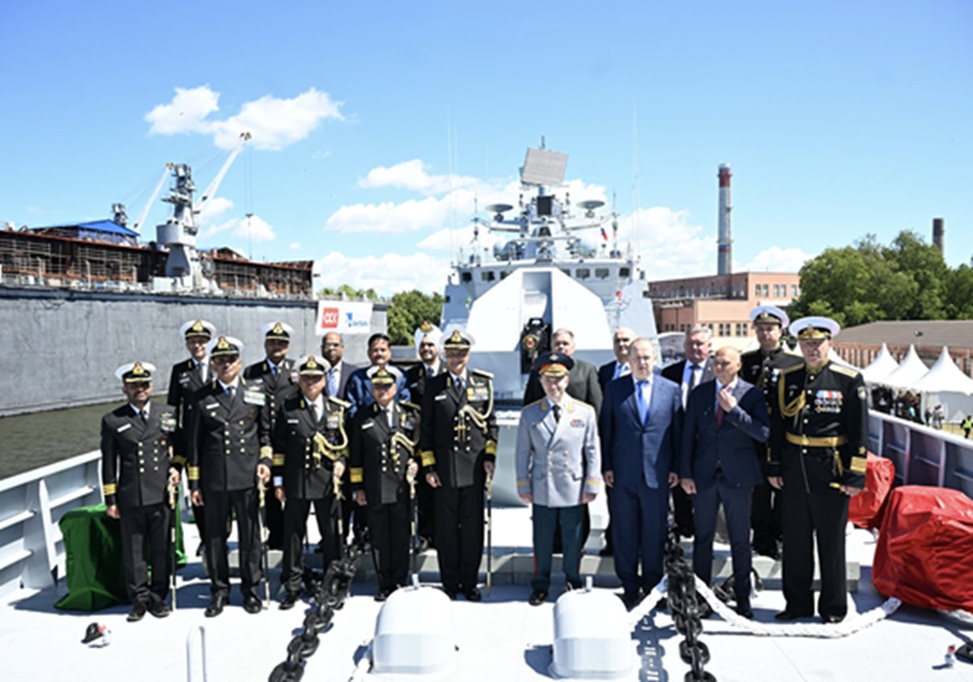
One notable step was the leasing of nuclear-powered submarines to India, which laid the foundation for indigenous nuclear-powered submarine construction, including the ongoing SSBN programme and the planned SSN programme. Although INS Tamal, a Talwar-class frigate commissioned on 1 July 2025 at the Yantar shipyard in Kaliningrad, may be the last warship to be acquired from foreign sources, the relationship is likely to transition towards joint production, co-development, and operational collaboration.
This evolution would be based on the 2000 Strategic Partnership, elevated to a Special and Privileged Strategic Partnership in 2010, thus providing an umbrella for deepening maritime cooperation. The co-production of the BrahMos missile, its export to the Philippines, and the interest shown by several other nations lend both military and commercial depth to the partnership.
Crystal Ball Gazing
The maritime dimension of India–Russia maritime relations has stood the test of time, remaining a trusted, multi-layered partnership spanning several naval exercises, shipbuilding, energy logistics, and trade corridors. At the same time, India continues to seek the best global fit for its evolving naval requirements. While sanctions, technological dependencies, and strategic divergences impose certain constraints, the overall trajectory of the relationship remains positive. Ongoing maritime cooperation reinforces India’s and Russia’s maritime ambitions, creating a partnership that bridges the waters connecting the two nations. As maritime competition intensifies in the Indo-Pacific, India and Russia’s continued collaboration and maritime relations offer potential—anchored in capacity and capability development, maritime multipolarity, and the shared pursuit of open and secure sea lanes
Title Image Courtesy: PIB
Disclaimer: The views and opinions expressed by the author do not necessarily reflect the views of the Government of India and the Defence Research and Studies. This opinion is written for strategic debate. It is intended to provoke critical thinking, not louder voices.
Article Courtesy: India’s World