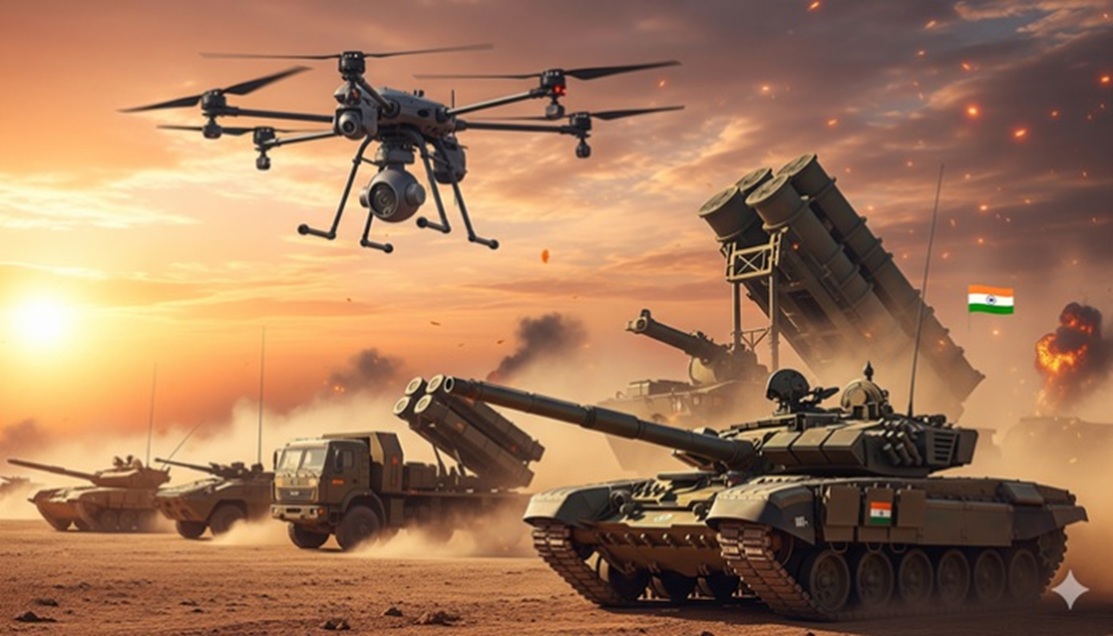
India’s strategic imperative is to attain strategic autonomy through indigenisation and to build a credible, modern deterrent by developing advanced indigenous platforms and adopting multi-domain operations to achieve regional dominance.
Wars do not begin with the big guns or the armour columns violating the sanctity of sovereign nations. They begin with invisibility and without international opinion. By the time the first missile is launched, the outcome is often already shaped as systems get penetrated, networks mapped, targets prioritised, and decisions pre-computed.
The ongoing US–Iran confrontation offers a stark, almost clinical demonstration of this shift. It is not just another conflict. It is a prototype of how future wars will be designed, sequenced, and concluded. And the message for India is direct: adapt early or absorb the consequences later.
The New Objective: System Collapse, Not Battlefield Victory
Traditional warfare aimed to destroy armies and capture territory. That logic is now secondary. What we are witnessing is the rise of system destruction warfare. The West Asia war was without opening phases and troop engagements. Instead, they focused on:
- Command and control networks.
- Air defence systems.
- Missile infrastructure.
- Defence-industrial and manufacturing hubs.
Within hours, not days, the intent was clear –paralyse the system that sustains war, not just the forces that fight it. Factories, R&D centres, electronics hubs, once considered rear areas, were treated as frontline targets. Because the logic is unforgiving: If a nation cannot produce, repair, or communicate, it cannot fight.
Air and Sea Denied: The Swift Neutralisation of Platforms
Perhaps the most striking lesson lies in the speed at which traditional assets are being neutralised. Air power and naval platforms, historically symbols of dominance, become increasingly vulnerable in a precision battlespace. In recent operations:
- Air bases were rendered ineffective through pre-emptive strikes
- Aircraft were destroyed on the ground before sortie generation
- Naval assets were tracked, targeted, and denied operational freedom
- Air defence networks were degraded early, opening corridors for follow-on strikes
This is a critical shift. The question is no longer: Who has more platforms? The real question is: Who can keep them surviving for long enough to matter?
The Algorithm Enters the Kill Chain
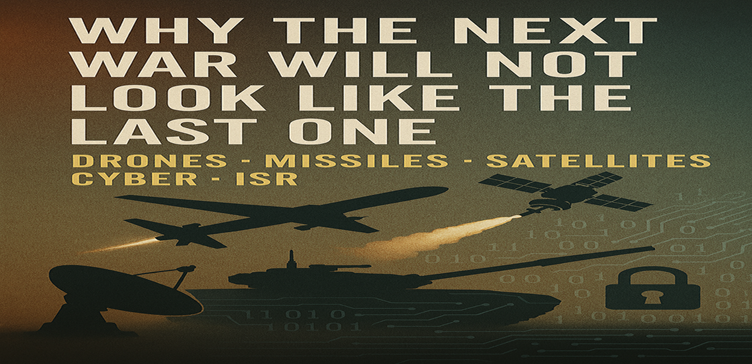
The real disruption is not hardware, but rather it is cognition, powered by algorithms. Modern kill chains are no longer linear. They are AI-assisted, data-driven, and continuously adaptive.
- Sensors detect in real time
- Algorithms process and prioritise targets
- Decision support systems recommend courses of action
- Shooters execute with minimal latency.
The time between detection and destruction has collapsed dramatically. This is not just a swift or a surgical strike but a pre-emptive warfare enabled by predictive intelligence. In a modern-day battlefield environment:
- Human decision-making becomes a bottleneck if not augmented
- Delayed response equals vulnerability
- Static defence equals certain targeting
Or simply put: The side that closes the loop faster wins.
Multi-Domain Warfare: The New Normal
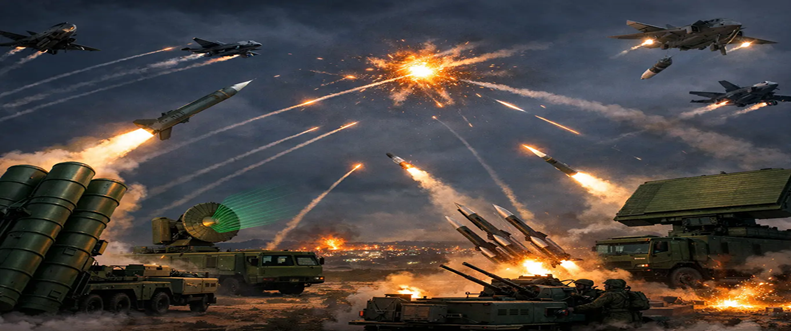
PC: WION
Another defining feature of the US–Iran conflict is its seamless integration across domains:
- Cyber-blinded sensors and communications
- Space assets enabled persistent surveillance
- Electronic warfare disrupted the response capability
- Kinetic strikes delivered physical destruction
This is not coordination. It is orchestration. The battlefield is no longer land, air, or sea. It is a simultaneous contest across all domains, executed in a unified operational design. For militaries structured in silos, this is a structural disadvantage. For fragmentation in peace becomes failure in war.
The Cognitive Domain: War in the Mind
The most yet underappreciated dimension is not physical but psychological. Modern conflict is increasingly fought in the cognitive domain:
- Shaping public perception.
- Influencing decision-making.
- Controlling narratives in real time.
Information flows faster than missiles. Narratives form before facts stabilise. A nation can be:
- Militarily stable but psychologically shaken.
- Operationally effective but narratively isolated.
This is where national mindset and resilience become strategic assets. Ask a simple question: What breaks first in modern war—the system, or the society? Increasingly, the answer is the latter. A population that panics, polarises, or loses trust amplifies the adversary’s objectives without additional effort. Iran’s strategic and national mindset and resilience have today brought the US to the negotiation table.
The Harsh Reality: Alliances Are No Longer Permanent
One of the most uncomfortable truths emerging from the current global environment is that Alliances are becoming transactional. Partners today may not align tomorrow. Strategic interests are fluid, not fixed. The US–Iran dynamics, shifting West Asian alignments, and even great power competition demonstrate that:
- Geopolitical loyalties are conditional.
- Strategic partnerships are interest-driven.
- Reliability is situational, not guaranteed.
This has profound implications for India as it emerges that strategic autonomy is not a slogan but a necessity. As witnessed recently, in a crisis, no nation fights your war for you.
India’s Strategic Imperative: Preparedness Beyond the Military
What must India internalise? Not the abstract lessons but actionable realities.
- First, survivability over visibility. Disperse, harden, and decentralise military and industrial infrastructure.
- Second, algorithmic warfare capability.
AI must be integrated into ISR, targeting, and decision-making loops, not as an add-on but as core architecture. - Third, true multi-domain integration.
Theatre commands must evolve from concept to capability. - Fourth, technological sovereignty.
Dependence on semiconductors, AI, and communication systems is a strategic vulnerability. - Fifth, cognitive resilience.
National preparedness must include:- Information discipline.
- Societal cohesion.
- Narrative stability.
Because wars will be fought as much on screens as on borders.
A Cultural Advantage—If Leveraged Correctly
India possesses a unique advantage, its strategic culture. Restraint, proportionality, and calibrated response, as evident in operations like Operation Sindoor, reflect maturity in the application of power without escalation. The US- Iran conflict witnessed an India which maintained a stoic silence; a silence that will be interpreted. Its statements were measured, and actions taken were closely watched. What must India therefore do every time?
- Stay engaged but not entangled.
- Stay principled but not rigid.
- Stay prepared above everything else
But restraint without readiness is risk. The balance must be deliberate.
Conclusion: The Future Has Already Arrived
There are moments in history when the cost of misreading change becomes existential. This is one such moment. The West Asia conflict demonstrates that wars will now be:
- System-centric, not force-centric.
- Algorithm-driven, not manpower-driven.
- Multi-domain, not theatre-bound.
- Cognitively contested, not purely kinetic.
And fought in a world where alliances shift faster than battle plans. As the ancient Greek historian Thucydides once famously observed in his Melian Dialogues: “The strong do what they can, and the weak suffer what they must.” The definition of “strong” has changed. It is no longer about size. It is about speed, systems, and strategic clarity. The Next War Will Be Won Before It Begins.
For India, the question is not whether it recognises this shift. The real question is: Will it act before the next war begins—or react after it is already decided?
Title Image Courtesy: OpIndia
Disclaimer: The views and opinions expressed by the author do not necessarily reflect the views of the Government of India and the Defence Research and Studies.