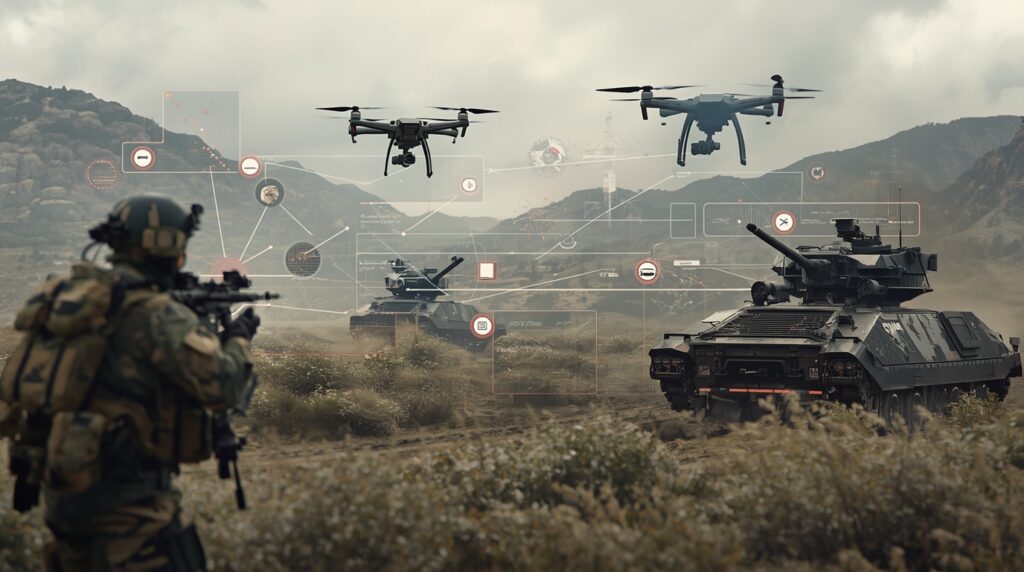
The Indian Army’s decision to designate 2026 as the Year of Networking & Data Centricity marks a decisive inflexion point in its journey from a platform-heavy force to a truly information-age networked Indian Army. Anchored in the broader ‘Decade of Transformation’, this theme is not a slogan but a deliberate operational shift: to convert every sensor, unit and formation into a node on a resilient grid where data moves faster than the adversary can think. The aim is clear to generate battle-winning advantage through seamless connectivity, real-time decision-making and an indigenous digital backbone that can endure contested, high‑technology wars.
Strategic Rationale for a Networked Army
India’s principal land threats emanate from an aggressive China on the northern front and an unpredictable Pakistan on the western. Both are increasingly defined by tempo, precision and perception rather than just numbers and tonnage. The People’s Liberation Army has invested for years in “system‑of‑systems” operations, integrating space, cyber, electronic warfare, drones and long‑range fires into a single decision loop; Pakistan, despite constraints, has leaned on drones, information operations and cyber tools as cost‑effective offsets. In this environment, a traditional, linear, hierarchy‑bound army risks fighting the last war.
The Year of Networking & Data Centricity is therefore a strategic response to an operational reality: unless the Army can see, decide and act faster across multiple domains, tactical excellence on the ground will be blunted by informational disadvantage. By treating data as a core combat resource, on par with firepower, manoeuvre and logistics, the Army seeks to compress its observe-orient-decide-act cycle, particularly along sensitive fronts from Eastern Ladakh and Arunachal Pradesh to the Line of Control and the counter‑terror grid in the hinterland.
From Platforms to Data: Operational Transformation
The central shift in 2026 is from platform‑centric to network‑centric and, increasingly, data‑centric operations. Instead of viewing a tank, gun, helicopter or infantry battalion as an isolated asset, the Army’s focus is on how each can plug into a secure, high‑bandwidth network that shares a common operational picture down to the last section commander. Battlefield Surveillance Systems, ground‑based radars, UAVs, satellites, SIGINT platforms and human intelligence are being fused into integrated command and control systems so that information is no longer stranded in silos.
Data centricity goes one step further. It is not enough to move information; it must be processed, prioritised and translated into options for commanders at multiple echelons in near real time. This is where artificial intelligence, machine learning and edge computing become combat enablers rather than buzzwords: from automated target recognition on live video feeds to predictive threat analytics along infiltration routes or build‑up corridors opposite key sectors. The declared theme gives the Army institutional focus and resource priority to operationalise these capabilities instead of scattering them as isolated pilot projects.
Technological Pillars and Indigenous Backbone
The Year of Networking & Data Centricity is inseparable from the Army’s push for indigenisation. The Chief of Army Staff (COAS) has repeatedly underlined that true operational sovereignty in the digital era depends on owning the networks, code and data, not just imported hardware. Indigenous efforts through DRDO, DPSUs and an expanding ecosystem of start‑ups and private industry are directed at secure software‑defined radios, hardened tactical 4G/5G networks, cloud‑enabled command platforms and AI tools tuned to Indian operational conditions.
These technologies take shape as resilient, multi‑layered setups, battle-hardened chains rather than a single fragile backbone. At the tactical end, combat teams lean on quick‑form ad‑hoc radio nets and direct line‑of‑sight links to stay connected under fire. At the operational level, fibre, microwave relays, and satellite beams layer in backups, while hardened data centres serve as repositories and processing hubs.
The push for indigenous encryption, quantum‑resistant key management and automated cyber‑defence mechanisms is crucial, given the certainty that any future conflict will be preceded and accompanied by aggressive attempts to disrupt Indian networks.
Lessons from Recent Experience
Recent experience both in India’s Op Sindoor, Galwan and in contemporary conflicts abroad has reinforced the need for a networked, data‑centric force. Post‑2020 developments along the Line of Actual Control illustrated how quickly the tactical situation can shift when one side can combine drones, EW, long‑range fires and information operations into a coherent whole. At the same time, episodes along the Western Front and internal security operations have shown how disjointed information flows can slow response despite local tactical superiority.
Operation Sindoor and exercises in recent years, including high‑intensity firepower and network‑centric demonstrations, have already validated elements of this shift, with networked fires and integrated surveillance showing marked improvements in response time and target accuracy. The 2026 theme is designed to consolidate these gains, exposing units across the Army, not just niche formations but to realistic, digitally‑enabled training environments. Live, virtual and constructive simulations, fed by real operational data, will allow commanders to rehearse joint, networked operations at a fraction of the cost and risk of traditional large‑scale manoeuvres.
Enhancing Combat Effectiveness Across Fronts
Networking and data centricity are not abstract goals; they translate directly into concrete combat advantages on every front. Along the LAC, persistent ISR linked to responsive firepower reduces the scope for surprise, deters salami‑slicing manoeuvres and allows rapid, calibrated response short of escalation thresholds. Along the LC and in counter‑terror operations, fused data from sensors, social media, HUMINT and patrol reports can enable early warning of infiltration attempts, faster attribution of incidents and more precise, proportionate retaliatory options.
In major conventional operations, integrated networks and data systems cut the sensor-to-shooter timeline, enable rapid retargeting of artillery and air assets, and minimise fratricide incidents through a shared, real-time situational awareness. Data-informed sustainment sharpens inventory control, convoy routing, and equipment upkeep as key enablers for sustained campaigns in severe high-altitude conditions or areas lacking fixed infrastructure. In each case, the payoff is the same: higher tempo, greater precision and better use of limited resources.
Jointness, Integration and Interoperability
The Army’s 2026 focus also complements the broader national drive towards theatrisation and jointness. Networks and data cannot stop at single‑service boundaries; a genuinely future‑ready Indian military requires a common information architecture through which the Army, Navy, Air Force and strategic agencies can plug, share and exploit relevant data. By defining standards, interfaces and security protocols around the Year of Networking & Data Centricity, the Army strengthens the foundations on which joint theatre commands and multi‑domain operations will rest.
Interoperability also extends beyond national borders. As India deepens defence cooperation with partners in the Indo‑Pacific, from information‑sharing agreements to joint exercises, secure, standards‑compliant networks and data frameworks will be essential for combined situational awareness and coordinated action. The Army’s internal reforms in 2026 thus have external strategic dividends, enhancing India’s credibility as a net security provider and a serious player in coalition operations, should national policy ever require them.
Managing Risks and Building Resilience
A year dedicated to networking and data inevitably confronts difficult questions of vulnerability. A hyper‑connected force can be a hardened, agile organism or a brittle system waiting to be paralysed. The Army’s approach, as articulated in official commentary around the 2026 declaration, emphasises resilience: distributed architectures, multiple communication paths, robust cyber hygiene and the ability to operate in degraded‑network conditions when required.
Equally important is the human dimension. Data literacy, understanding of information security, and the ability to interpret decision aids without becoming over‑dependent on automation will be central to leadership at all levels. Training, promotion and evaluation systems will have to reflect this, rewarding commanders who can integrate digital tools into mission command rather than simply complying with technical checklists. The Year of Networking & Data Centricity provides the institutional cover to push such cultural changes through a traditionally conservative system.
Towards a Future‑Ready Land Force
The Army’s declaration of 2026 as the Year of Networking & Data Centricity stands as far more than an annual theme. It marks a strategic direction and an operational commitment during a critical decade when control of information will dictate battlefield results ahead of raw ordnance as the silicon and steel merge.
Through deliberate allocation of national resolve, funding streams, and command priorities, the force is embedding resilient networks, advanced data processing, and domestically developed digital infrastructure. This ensures that all engagements in disputed sectors, high-altitude confrontations, measured conventional responses, or sustained counter-insurgency efforts are launched from a position of superior situational awareness and information superiority.
With opponents accelerating towards algorithm-guided operations and integrated multi-domain pressure, partial reforms fall short for India. A fully networked, data-driven Army grounded in indigenous systems and fused with tri-service and national frameworks forms the essential shield for territorial integrity and the means to influence regional dynamics decisively.
The Year of Networking & Data Centricity is thus not a destination but the launch pad from which the Indian Army intends to forge and sustain its battle‑winning edge.
Title Image Courtesy: AI CERT
Disclaimer: The views and opinions expressed by the author do not necessarily reflect the views of the Government of India and the Defence Research and Studies. This opinion is written for strategic debate. It is intended to provoke critical thinking, not louder voices.