The relationship between India and West Asia dates back several centuries, but nowadays it is not motivated by memory but by hard interests. A big portion of the Indian crude oil and LNG, millions of Indian workers and a key partner in trade, investment and connectivity undertakings are supplied by the region[1]. Other countries like Saudi Arabia, UAE, Iraq, Qatar and Iran are not only sources of energy but also markets as well as logistical centres and investors in the development of India itself[2].
In its non-aligned stance during the post-independence period, New Delhi generally backed the Arab stand on Palestine and also developed working relationships with various regional capitals. The oil shocks of the 1970s and the mass migration of Indian workers to the Gulf at the time established a solid economic foundation based on energy security and remittances. [3] Economic reform and the post cold-war realignment policy to a more realistic and pragmatic look West strategy, one that further enhanced involvement in the Arab Gulf, Iran and, notwithstanding the 1990s, Israel.
The Gaza war, Iran-Israel tussle, Houthi attacks on Red Sea shipping and changing position of the United States and China have contributed additional levels of risk to sea lanes, energy markets and regional politics in recent years[4]. India cannot be an exception to these trends. Its tankers, seafarers, workers and companies are first-hand exposed to the occurrences in the Gulf and eastern Mediterranean. This commentary examines how the Gaza war, coupled with the developing one in the Gulf, is recasting the policy of the Indian government of Look West and posits that now India must think in terms of nimble interest-motivated realignment.
The Gaza Conflict: Major Trends and Strategy
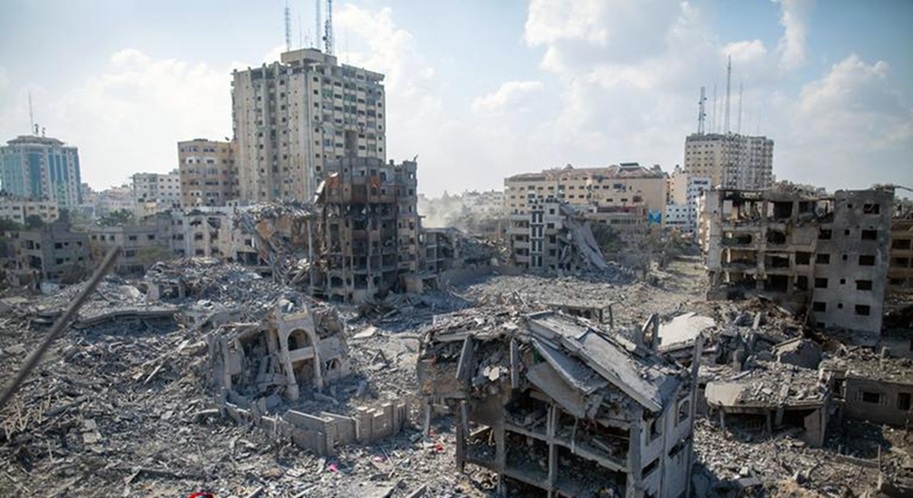
The attacks of Hamas on Israel on 7 October 2023 took the lives of approximately 1,200 people and resulted in approximately 250 hostages. The reaction of Israel became an open-ended war in Gaza as opposed to short rounds of war that were witnessed in the previous years. Towards the end of 2025, the health ministry of Gaza was already reporting over 70,000 Palestinians killed, hundreds more injured, and much of the basic infrastructure of the Strip seriously destroyed[5].
| Country | Bilateral Trade (USD Bn) 2024 | Energy share of India’s import | Key strategic sector |
| Saudi Arabia | 52 | 21 | Energy, Defence, Tech, Infrastructure |
| UAE | 85 | 16 | Ports, Digital Economy, Tourism |
| Iraq | 38 | 18 | Crude Oil, Energy Logistics |
| Qatar | 15 | 10 | LNG, Education, IT |
| Oman | 8 | 6 | Maritime, Energy Services |
| Iran | 6 | 5 | Connectivity, Chabahar Port |
Table1: India–GCC trade and energy links (illustrative recent year)
This has drawn the extended axis of resistance, unlike in the earlier days when Cast Lead, Pillar of Defence and Protective Edge were in operation[6]. Hezbollah on the northern border of Israel, militias in Iraq, Houthis in Yemen and Syria, each of them positioning their operations as trying to defend Gaza. Money, training, and weapons are just some of the resources that Iran has been supporting these groups, despite each having their priorities[7]. What has come out is a conflict that has expanded from the Mediterranean to the Red Sea and the Gulf, with numerous wrong moves possibly leading to a larger regional war.
Houthi attacks on commercial shipping in the Red Sea and Bab al Mandeb have led to the rerouting of sea routes around the Cape of Good Hope, which increases freight, insurance prices, and energy flows. The United States, several European countries, India and regional states are in an open-ended fight to ensure that sea lanes remain open, although they are not sucked into the Gaza war itself. To India, the Gaza war is not just an actual humanitarian crisis at a distance. Maintaining a close relationship with Israel, maintaining good faith with key Arab players, and balancing a challenging relationship with Iran, all at the same time, urging restraint and humanitarian access in Gaza, is a difficult diplomatic step.
Oil Crisis in the Gulf: Dynamics and Consequences
The term Gulf crisis was first used in 1990, following the invasion of Kuwait by Iraq. Oil prices shot to the skies and shook the entire world economy. It has since come to signify repeat shocks in the area, including intra-GCC rifts, Iran Arab tensions and outside interventions, since the 2017 blockade of Qatar to the current turmoil in the Red Sea and Strait of Hormuz[8].
The 201721 conflict with Qatar demonstrated the ease with which fast Gulf alignments could disintegrate. Saudi Arabia, the UAE, Bahrain and Egypt severed their ties, accusing Doha of supporting Islamist groups and becoming excessively close to Iran and Turkey. Qatar spread out its allies and accumulated its LNG exports, which would become important to Europe when gas shipments were struck by the Russia-Ukraine war[9].
Meanwhile, Saudi Arabia and the UAE have attempted to go beyond oil, and major schemes in logistics, tourism, finance and technology, and embedding business with India and Africa. This more practical approach found its reflection in the Abraham Accords that normalised relations between Israel, the UAE and Bahrain, but the Palestinian question was not addressed[10]. This mediation of the Saudi-Iran rapprochement by China in 2023 added a dimension, indicating that Beijing has become a serious diplomatic player in the Gulf, with an unpredictable United States.
All these bets have been put to the test by the 7 October 2023 Hamas attacks and Israel’s response, which took place in Gaza. Gulf governments deplored the extent of the campaign by Israel and had to handle massive popular outbursts, but also had to maintain contacts with Israel, the US and Europe due to increased defence, energy and technology relationships[11]. Qatar took advantage of its mediator position. It was Saudi Arabia and the UAE that slackened, although it was still involved in Israel and the relations of allied militias to the Lebanese, Iraqi, Syrian, and Yemeni networks.
Response and Policy Realignment of India
To India, the Gaza war and the Gulf in general present complementary tests. The economic collaboration with the UAE and other Gulf countries, along with such projects as Chabahar port and the India Middle East Europe Corridor, is still at the centre of the agenda of New Delhi[12]. Meanwhile, the pandemic has revealed the fragility of Indian supply chains in terms of being shaken by disruptions to shipping and ithe ncreased cost of insurance.
| Strategic area | India’s interests | Emerging risks after 2023 |
| Energy security | Disruption at Hormuz and the Red Sea; price spikes | Conflict-driven job losses; evacuation risks |
| Diaspora welfare | Safe sea lanes in the Arabian Sea and Red Sea | Safety and employment of Indian workers in the Gulf |
| Maritime strategy | Corridor delays; political shocks in the Gulf | Militia and Houthi attacks on shipping routes |
| Trade & connectivity | Growth of India GCC trade, IMEC, India UAE corridor | U.S.-China rivalry forcing sharper choices |
| Multilateral role | BRICS+, SCO, Gulf summits with India | US China rivalry forcing sharper choices |
Table 2: India’s key interests & emerging risks in West Asia
Following 7 October 2023, India demanded restraint and denounced the Hamas attacks and renewed its support of a negotiated two-state solution. It supported the right of Israel to protect itself against terrorism but did not support the extent of the military operation in Gaza, and stressed the importance of protecting the civilians and respecting international humanitarian law.
This jug walking stance is based on India’s two-fold reliance on strategic alliance with Israel in defence, agriculture, water and technology and long-term reliance on the Arab world in energy, labour markets and remittances[13]. Its foreign policy thus attempts to remain agile, aiding humanitarian aid in Gaza, arranging evacuation flights as part of Operation Ajay, and maintaining contacts with all capitals of interest. Domestically, there is one more dimension of politics as a large number of Indians sympathise with the Palestinian cause, while others sympathise with Israel as a major ally in combating terrorism. The delicate communication by the government is an attempt not offend either of the camps.
In a larger context, the policy of West Asia of India has been in a transition shift from traditional non-alignment to widely referred to multi-alignment. In New Delhi, the economic and strategic relationship has been strengthened with Israel, the UAE and Saudi Arabia, and at the same time, it has been approaching Iran and expressing its desire to have a Palestinian state. The underlying aim is clear. Maintain strategic independence, do not become sucked into the blocs of others and place India as a reliable ally that can negotiate with everyone in a region where very few states have that luxury.
Conclusion
Symptoms and not singular events are the Red Sea crisis and changes in the great power positions. To India, the theatre is not some remote theatre but a neighbourhood of serious interests. Power circulates, trade routes, security of maritime routes and well being of millions of people employed in the Gulf. The instability in the region will then be fed directly into the growth opportunities in India and its own perceived strategic security. It has been gradually forging long-term ties with the UAE and other Gulf states and maintaining a free line with Israel, Iran and strategic Arab capitals.
This is a strategic decision not to take sides in as volatile an area as alliances are, and where shocks are common. The real challenge in the next few years will be whether India will convert this balancing act into a more assertive agenda, like stabilisation of major sea lanes, anchoring of new economic corridors. If it can do so, India will not only be dealing with the tempest of the Gulf, but also mould the regional order to its own benefit as well as to a more stable West Asia.
Title Image Courtesy: UN News
Disclaimer: The views and opinions expressed by the author do not necessarily reflect the views of the Government of India and the Defence Research and Studies.


References
[1] Dr. Nasirul Hoque, ‘India’s Relation with West Asis: Prospects and Challenges’, International Education & Research Journal [IERJ] 10, no. 11 (2024): 45–47, https://ierj.in/journal/index.php/ierj/article/view/3727
[2] India’s Relations with West Asia: What Patterns and What Future? | Middle East Institute’, accessed 21 September 2025, https://mei.edu/publication/indias-relations-west-asia-what-patterns-and-what-future/
[3] Ministry of Commerce (GoI), RBI Remittance Data 2024, Trade Statistics, MEA Annual Reports (2024–25). https://www.mea.gov.in/Annual_Reports.htm?dtl/39677/Annual_Report_20242025
[4] Nicolas Blarel,‘India and West Asia: Re-Emerging Region(s)? (Chapter 8) – Globalizing Regionalism and International Relations’. https://www.researchgate.net/publication/357211400_India_and_West_Asia_Re-Emerging_Regions
[5] Amb Sujn R Chinoy, Prashant Kumar Pradhan, “India’s Policy Towards West Asia: The Modi Era” (New Delhi, IDSA, 2024), 174. https://idsa.in/publisher/book/indias-policy-towards-west-asia-the-modi-era
[6] Nassif, Hicham Bou, “Worse than Camp David? Revisiting the May 17, 1983, Lebanon-Israel Agreement”, Middle East Journal, Vol 78, No 2-3, 2025, pp 259-279, DOI. https://doi.org/10.3751/78.23.17
[7] Mumtaz Ahmaed Shah, ‘West Asia Policy: Limits of Bilateralism’, World Affairs: The Journal of International Issue 25, no. 4 (2021): 60–77. https://www.researchgate.net/publication/358967457_INDIA_WEST_ASIA_POLICY_LIMITS_OF_BILATERALISM
[8] Marry E Morris, “Regional dynamics of the Gulf Crisis”, (RAND, 1991). https://www.rand.org/pubs/papers/P7700.html
[9] Interview with Amb Srikumar Menon on “India – West Asia Relations: Prospects and Challenges” held on 05 Mar 2025, World Geostrategic Insights, https://www.wgi.world/india-west-asia-relations-prospects-and-challenges/
[10] Jane Kinninmont, “The Gulf Divided: The Impact of the Qatar Crisis”, Chatham House, updated 26 Sep 2024, ISBN 978178132996, https://www.chathamhouse.org/2019/05/gulf-divided-impact-qatar-crisis
[11] Huzeyfe Altioke, “Kuwait’s Mediation in the Gulf Crisis: Dynamics of Kuwait’s Foreign Policy Approaches” Chapter form the book “Social Change in Gulf region, pp 597-618, https://link.springer.com/chapter/10.1007/978-981-19-7796-1_35
[12] Ranjith Rebello, “India’s Response to the October 7 Gaza Conflict: A Geopolitical and Strategic Analysis” Diplomatist, 21 Oct 2024, https://diplomatist.com/indias-response-to-the-october-7-gaza-conflict-a-geopolitical-and-strategic-analysis/
[13] Henry Storey, “India’s Gaza Dilemma”, Lowy Institute, 16 Nov, 2023, https://www.lowyinstitute.org/the-interpreter/india-s-gaza-dilemma