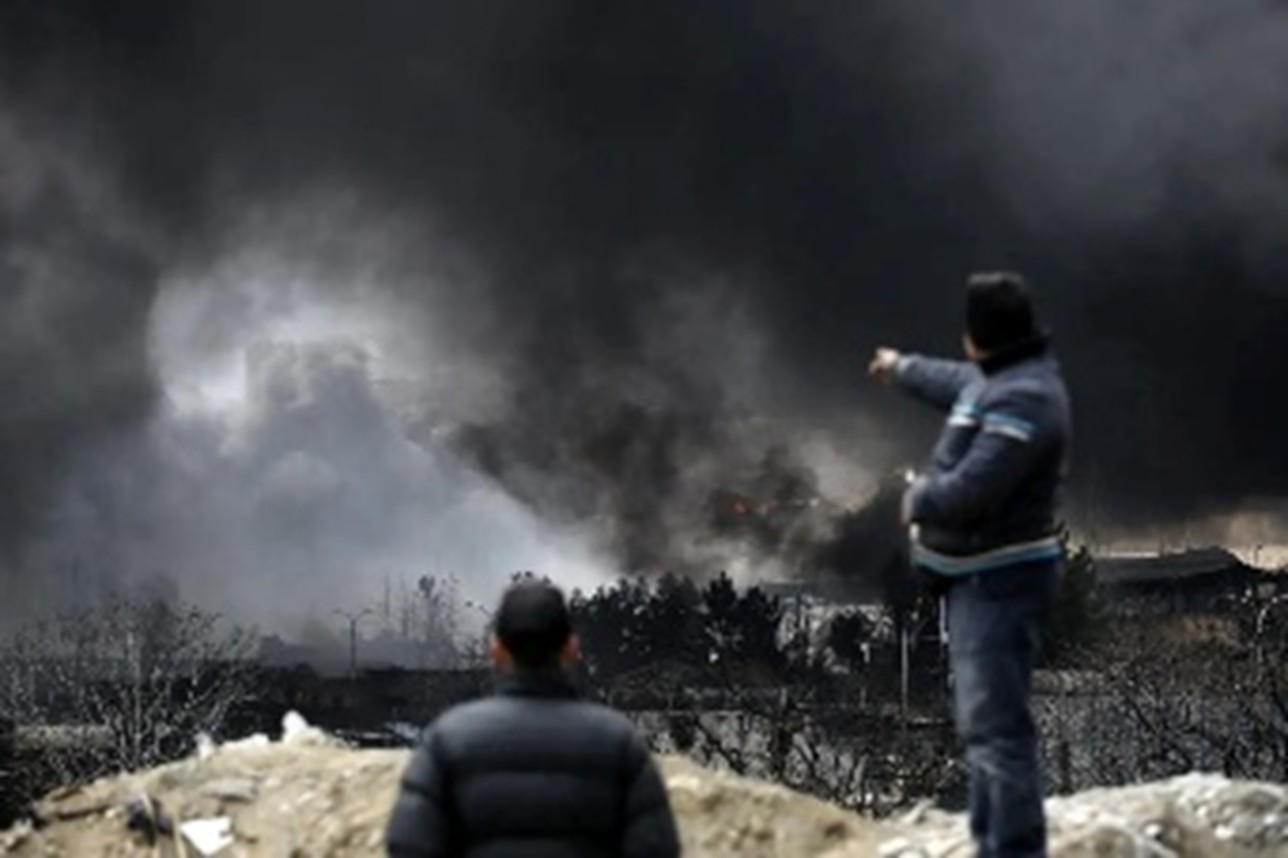
The “Black Rain” falling over Tehran this March 2026 isn’t just an environmental catastrophe; it is the physical condensation of a global defence order that has quite literally gone up in smoke. While the world’s financial press stares at the $120 oil ticker, they are missing the forest for the burning trees.
We are not merely in an energy crisis; we are in a Civilisation Crisis—one where the “Exquisite” defence models of the West have been exposed as fundamentally naked, and the supply chains of the modern world are unravelling at their chemical seams. For decades, the American military-industrial complex has strutted in trillion-dollar Armor and “best-in-the-world” rhetoric—an Emperor’s cloth of gold woven by the “Fat Five” prime contractors. Yet, in the last two weeks, Operation Epic Fumble has delivered a brutal reality check. Eleven MQ-9 Reaper drones—$330 million of high-end hardware—were swatted from the Iranian sky like overfed flies. These drones were designed for permissive skies and low-tech insurgents. Against a peer-level adversary armed with Missile 358s and advanced electronic warfare, they are nothing more than “barn-sized radar magnets.” The failure of the Reaper is the failure of a philosophy: the belief that complexity equals capability. But as Ukraine whispered and Iran has now shouted, the future of warfare belongs to the attritable mass—the cheap, the decentralised, and the autonomous. This shift is not just tactical; it is the greatest opportunity for the Indian Private Defence Industry since independence.
The Autopsy of Operation Epic Fury

To understand the current failure, we must first analyse the background of the authors of Western defence doctrine. Organisations like the RAND Corporation and the Atlantic Council—frequently funded by the very contractors they evaluate—have long championed “exquisite” platforms. They argued that a $30 million platform with a 2.8-second satcom latency was “survivable” because it was sophisticated. Iranian forces just proved that math is a lie. In the skies over the Gulf, the U.S. has lost 10% of its active Reaper fleet in under a fortnight. This is not an outlier; it is a structural collapse. The MQ-9, with its 66-foot wingspan and 200 mph cruise speed, is a relic of 20th-century colonial policing. In a peer-conflict, it is a liability. The “Fat Five”—Lockheed Martin, Boeing, RTX (formerly Raytheon), Northrop Grumman, and General Dynamics—have spent the last five years prioritising shareholder buybacks over the surge capacity needed for a real war. RTX alone spent $43.5 billion on buybacks and dividends between 2020 and 2024. They built a “Ghost Fleet” of hardware that looks brilliant on a balance sheet but smoulders in a contested desert. This hubris has left the American defense establishment “stark naked,” as recent critics have noted, exposing a facade of superiority that cannot withstand the high-attrition reality of modern electronic warfare and cheap, mass-produced interceptors.
The Eastern Shift Toward Mass Attrition

The Eastern perspective, often characterised by the “CRINK” (China, Russia, Iran, North Korea) innovation loop, offers a starkly different approach to the “Exquisite” Western model. Analysts in Shanghai and Tehran have long ridiculed the Western obsession with high-margin, low-volume “miracle weapons.” Instead, they have focused on mass, decentralised production, and sheer volume. They understand that in a war of attrition, quantity has a quality all its own. While a single U.S. Patriot interceptor costs upwards of $4 million, it can be exhausted by a swarm of drones costing less than $5,000 each. This economic asymmetry is the primary driver of the current shift. The Oriental and Indian perspectives further emphasise that true strategic autonomy cannot be bought from foreign OEMs with proprietary “walled gardens.” It must be built on open architectures that allow for rapid, localised adaptation. The failure of the MQ-9 in the Gulf is not just a hardware failure; it is the failure of a closed-source, contractor-locked industrial philosophy that prioritises quarterly dividends for its paymasters over the survivability of the soldiers who depend on its technology. This realisation is finally hitting the corridors of power in New Delhi, where the drive for “Owned by India” technology is replacing the old “Buyer-Seller” paradigm that kept the nation tethered to foreign supply chains.
The Sulphur-Nickel-Nitrogen Trinity
The Western press focuses on “freedom of navigation” and oil barrels, but they rarely discuss the chemical precursors that make modern civilisation possible. This is where the civilisation crisis hides. 92% of the world’s sulphur is a byproduct of oil and gas refining. Sulphur is the precursor to sulphuric acid, the single most produced chemical on Earth. Without it, the modern world stops. In the defence sector, sulphuric acid is the “workhorse” of the mining industry. You cannot extract the copper for wiring, the nickel for super-alloys, or the cobalt for drone batteries without it. The “Black Rain” over Tehran is the global supply of battery-grade nickel washing away. Indonesia, which produces 60% of the world’s nickel, relies on High-Pressure Acid Leaching (HPAL) that consumes massive quantities of sulphur. As Middle Eastern refineries burn, the “Sulphur Squeeze” will hit the EV and defence sectors simultaneously. By mid-2026, we will see a bidding war between the agricultural sector (which needs sulphur for fertiliser) and the defence sector (which needs it for missiles). This chemical interdependence creates a massive, singular chokepoint that threatens every battery and microchip on Earth.
The Fragility of Modern Civilization
Furthermore, the Nitrogen Collapse is the most dangerous domino. Synthetic nitrogen fertiliser, created via the Haber-Bosch process, sustains 4 billion people—half of the human population. One-third of the world’s nitrogen feedstock moves through the Strait of Hormuz. If that chokepoint stays closed, global agricultural output doesn’t just decline; it collapses. Western analysts, often funded by the fossil fuel lobby, downplay this link to avoid admitting that “National Defence” is tethered to the same fragile chokepoints as global food security. You cannot eat semiconductors, and you cannot defend a nation with hungry soldiers. The intersection of energy, sulphur, and nitrogen forms a “Trinity of Survival” that is currently exposed at a 21-nautical-mile chokepoint. The global industrial capacity for the coming months is being literalized as acid rain falling on 15 million people in Tehran. Every drop that falls represents a unit of capacity the world will not have for the critical manufacturing tasks ahead. This is not an energy crisis; it is a fundamental challenge to the stability of modern industrial civilisation that has been overlooked by those only watching the price of a barrel of crude oil. The vulnerability of Taiwan, which relies on Qatari LNG for the power required by TSMC’s EUV lithography machines, adds another layer of fragility to this stack. If the gas stops, the chips stop; if the sulphur stops, the batteries stop; if the nitrogen stops, the food stops.
The Contractor Trap and Cost-Plus Cancer
The American model is hollowing out from within due to Cost-Plus Contracts. These are deals where the government pays for all costs plus a percentage of profit. It is a system that literally rewards failure, delays, and over-engineering. For example, the F-35 program is seven years late with $900 billion in overruns, and the Patriot system has seen a 77% cost escalation while U.S. stockpiles remain at just 25% of strategic needs. In contrast, India’s private sector, unburdened by these legacy “paymaster” structures, has the opportunity to lead the Fixed-Price Revolution. In India, “frugal engineering” is not just a buzzword; it is a survival mechanism. We have the software talent to lead in AI-enabled “Swarm-C2” and the manufacturing base to build an Integrated Defence Manufacturing Hub across friendly countries and allies — that bypasses the “Fat Five” model. This hub must focus on “Owned by India” IP, ensuring that every design document, source code, and circuit layout is held domestically, shielding the industry from foreign proprietary locks.
Prioritising Dividends Over Defence
The paymasters of the Western defence industry—institutional investors and hedge funds—demand constant stock buybacks to keep share prices inflated. Between 2020 and 2024, the five largest U.S. defence firms spent over $100 billion more on shareholder returns than on expanding their production capacity. This “harvest” strategy extracts value from a dying industrial model while leaving the front lines exposed to high-attrition threats. India’s approach must be the antithesis of this: a focus on Surge Capacity and Fixed-Price Contracts that reward firms for delivering under budget and ahead of schedule. By mandating Indian IP ownership under the DAP 2026, the government can catalyse a private sector that is not just a sub-contractor to global giants, but a primary architect of modern, attritable warfare. This shift is essential to ensure that the Indian private defence industry can provide the “mass” that the current global order so desperately lacks. Only by breaking the cost-plus cycle can India build a defence ecosystem that is both economically viable and tactically superior in the age of decentralised drone warfare. The success of this model will depend on the government’s ability to pivot away from the slow, bureaucratic procurement cycles of the past and toward a venture-capital style approach to defence technology.
Lessons from the Ukrainian Drone Line
Ukraine has revolutionised the “Wardrobe” of war. They aren’t building $30 million Reapers; they are producing 3 million FPV drones annually for $500 each. They have moved to Open Architecture, where sensors, flight controllers, and AI algorithms are interchangeable across platforms. This model achieves 24/7 Persistent ISR through rotation and redundancy. If you lose one drone, you launch the next ten. It is a mathematical inevitability that no “Golden Dome” missile shield—which has a 55% success rate after $67 billion in spending—can economically defeat. The “Drone Line” initiative, which neutralises 1 in 4 enemy soldiers through mass-produced tactical UAVs, is the template for modern land defence. India must adopt this “Swarm” mentality, leveraging its software prowess to develop jam-resistant autonomy that survives without constant Sat-Com links. This is the only way to counter the “CRINK” innovation loop that is currently flooding the market with cheap, effective, and resilient technologies designed to overwhelm exquisite Western systems.
The Paradigm Shift to Attritable Mass
The persistence of ISR in the Ukraine model is not achieved through a single high-end platform, but through a layered, mass-scale ecosystem. Thousands of tactical drones like the Leleka-100 and Shark are in constant rotation, providing real-time data to battlefield management platforms like Delta. This decentralised approach allows for quick regeneration and absorbs losses that would be catastrophic for a U.S. MQ-9 fleet. The Indian private sector is perfectly positioned to manufacture these attractive systems at scale. By focusing on low-cost, high-volume production, India can become the primary supplier for nations that have realised the “Emperor’s Armour” is too expensive to lose and too slow to replace. The transition from exquisite to attritable is a paradigm shift that rewards those who can master mass manufacturing and AI-enabled swarms. For India, this means moving beyond a reliance on foreign “miracle weapons” and toward a sovereign capability to produce the millions of drones required to win a 21st-century war. The battlefield of tomorrow is not a place for “gilded fantasies” of missile shields, but for the “leaden reality” of mass-produced, expendable, and intelligent machines.
India’s Strategic Opportunity
India stands at a historic crossroads. Our defence exports have hit ₹23,622 crore, but we are still largely playing in the “old” world of legacy hardware. To win in 2026, we must become the global hub for Attritable Technology. The future belongs to firms like Arigni Defence that can bypass the “Cost-Plus” inefficiencies of the West and build Integrated Defence Manufacturing Hubs in strategic locations in South East Asia. India must learn from the “Black Rain” and secure its “Chemical Sovereignty.” We cannot be “Atmanirbhar” if we are dependent on imported sulphur or Qatari gas for our chips. The government must incentivise domestic production of chemical precursors and diversify supply chains toward an Indo-Pacific corridor—incorporating the South East Asia and Taiwan—to ensure minerals and microchips remain accessible even when Middle Eastern chokepoints are closed. This is the only path to a resilient, self-reliant defence industry that can thrive during a prolonged civilisation crisis.
Empowering the Private Sector
The Government of India must recognise that the private defence industry is the engine of this transition. For too long, the industry has been dominated by state-owned giants that lack the agility of private MSMEs. To promote the Indian private defence industry, the government must implement a 10-point roadmap with wartime urgency. This includes mandating fixed-price contracts to kill the “cost-plus cancer,” establishing a ₹5,000 crore Defence Venture Fund specifically for scaling drone production, and leveraging the discipline of ex-servicemen through a scheme modelled for ESM by the Directorate General of Resettlement. By utilising the expertise of retired officers who understand the lived reality of the front line, India can build a manufacturing corridor that is both disciplined and innovative. This approach doesn’t just build weapons; it builds a resilient industrial base capable of surging to meet the demands of a global conflict. The “tailors” of India must now step up to clothe the world’s militaries in the new wardrobe of attritable, sovereign, and mass-produced technology. This is not just a business opportunity; it is a national security imperative in a world where the old alliances and supply chains are rapidly fracturing.
A 10-Point Roadmap for Strategic Autonomy
To promote the Indian Private Defence Industry and secure our future, the GoI must act with wartime urgency.
First, it must mandate Positive-Exchange Fixed-Price Contracts for all “Attritable” systems. This means rewarding firms that build interceptors costing significantly less than the target they destroy, flipping the economic war in India’s favour.
Second, it must expand iDEX into a ₹10,000 crore Manufacturing-Focused Subsidy Scheme (as proposed in the 2026 Budget) to scale production from thousands to millions.
Third, the GoI should create an ESM Defence Manufacturing Scheme, leveraging the leadership of retired officers to lead private manufacturing hubs.
Fourth, DAP 2026 must be updated to prioritise Indian IP ownership, ensuring design control remains domestic.
Fifth, a National Mineral and Chemical Reserve for sulphur, nitrogen, and helium must be established to bypass Persian Gulf chokepoints.
Sixth, the military should shift to a “Drone-as-a-Service” model, contracting private firms for ISR to keep the tech cycle fast.
Seventh, Dual-Use Tech startups must be incentivised with tax breaks to bridge the gap between civilian AI and military applications.
Eighth, the GoI must support “Distributed Manufacturing” hubs in allied nations, especially in Southeast Asia
Ninth, a “Digital DGQA” must be created for real-time certification.
Finally, a Sovereign Defence Cloud must be built to protect Indian manufacturing data.
Structural Reformation for Conflict Readiness
These ten steps are not merely administrative changes; they represent a fundamental restructuring of how India prepares for war. The “Fat Five” model in the West is currently in a “death spiral” because it cannot produce at scale or at a viable price point. India must avoid this trap by ensuring its industrial base remains lean, private-sector-led, and highly attritable. The focus on Indian IP ownership is particularly critical; it ensures that the “guts” of our defence systems—the flight controllers, the AI algorithms, and the sensors—are not subject to foreign “kill switches” or proprietary locks. By building a National Mineral Reserve, India also addresses the “hidden” vulnerabilities exposed by the “Black Rain.” We must secure the molecules of sulphur and nitrogen as aggressively as we secure the borders of our nation. Only a comprehensive, integrated approach that combines financial incentives, veteran leadership, and chemical sovereignty can transform India into the primary global arsenal for the coming decades. This requires a level of coordination between the Ministry of Defence, the Ministry of External Affairs, and the private sector that has historically been lacking, but the current geopolitical climate leaves no room for hesitation.
The Geopolitics of the “Golden Dome” vs. The Leaden Reality
The U.S. push for a “Golden Dome” missile shield—a $175 billion vision announced in May 2025—is fundamentally doomed by the same complex that killed the Reaper. It relies on space-based sensors and interceptors that have a historically low success rate and astronomical costs. This is a distraction from the real threat: massed, low-cost, hypersonic and drone salvos that can easily saturate any exquisite defence. India must not fall into the trap of chasing these “miracle weapons.” Our strength lies in mass, reliability, and cost. While the West builds gilded fantasies, India should build the “Leaden Reality”—millions of reliable, attritable systems that can overwhelm any “Golden Dome.” The “Black Rain” over Tehran has shown that the industrial capacity for these exquisite systems is being incinerated in real-time. India’s opportunity is to provide the world with the realistic, high-volume alternatives that are actually survivable on a 21st-century battlefield.
Breaking the Mirror of Hubris
The narratives pushed by Western paymasters often focus on these high-profile projects because they generate the most significant revenue for contractors. However, these projects often ignore the physics and engineering realities of modern warfare. The Strategic Defence Initiative (SDI) of the 1980s was a similar “pipe dream” that yielded zero operational systems despite billions in spending. India must avoid this hubris. Our focus should be on the “Drone Shipyard” model—decentralised, high-volume, and AI-enabled. This is the only way to meet the threats posed by the “CRINK” loop and the broader systemic rot in the global defence order. By providing a trustworthy, Indian-owned alternative to both Western exquisite tech and Eastern surveillance tech, India can lead a new global defence consensus based on transparency, open architecture, and economic reality. The era of the single, expensive “national champion” platform is over; the era of the decentralised, resilient, and attritable network has begun, and India is uniquely qualified to lead it.
The Silent Collapse of the Industrial Base
The hollowing out of the Western industrial base is a silent collapse that has been decades in the making. Between 2020 and 2024, the five largest U.S. defence firms spent $100 billion more on shareholder returns than on capital expenditures. This has led to a situation where the U.S. fired 800 Patriot interceptors in five days during Operation Epic Fury, exhausting years of production in less than a week. The Indian private sector can avoid this by building High-Volume, Low-Complexity production lines that can be scaled overnight. We must look at the Oriental perspective, such as China’s switch to mesh technologies, to understand how they are defeating Western SatCom and EW challenges. India’s role is to compete not just on technology, but on trust. An Indian-made drone, with open-source code and transparent IP, is the only alternative for nations that want to avoid both Western debt-traps and Eastern surveillance-traps. This is the foundation of the new global defence order.
Manufacturing for the Battlefield
The “Fat Five” contractors have essentially become SaaS platforms with a hardware problem. They prioritise high-cost sustainment and proprietary lock-in over operational readiness. This is the “Civilisation Crisis” — a world where we have lost the ability to surge production because our factories are built for dividends, not for defence. India’s Integrated Defence Manufacturing Hubs must be the answer to this. By utilising private sector agility and fixed-price accountability, India can surge its production of attritable systems to meet the demands of a global conflict. The “Black Rain” is a physical manifestation of this hollowing out—the burning of the very industrial capacity that was supposed to extract the copper and build the transformers.
India must learn this lesson: true security comes from a resilient, high-volume, and sovereign industrial base that is not beholden to the whims of hedge fund paymasters. We must build for the battlefield, not for the boardroom, and this requires a radical reprioritisation of our national industrial goals toward surge capacity and chemical independence.
Countering Eastern Mesh Technology
While the U.S. struggles with Sat-Com latency and large-signature platforms like the Reaper, China has pivoted to decentralised mesh technologies. They are integrating commercial satellite data with drone-based relays to create a resilient, jam-resistant communication web. This approach is designed to flood the market with cheap, effective hardware that displaces Western influence across the Global South. India must compete in this arena by offering a technologically superior and more trustworthy alternative. The “Clothes” America needs are not more exquisite jets, but the attritable drone swarms and AI autonomy that Ukraine has perfected and that India can manufacture. This is a strategic imperative; the shared threats from the “CRINK” loop mean that collaboration between India and its allies is no longer optional—it is a matter of survival in a world where the old “Emperor’s Clothes” no longer provide protection.
The Tailor’s Mission for the Global South
The price point of these Eastern systems should terrify anyone relying on traditional Western defence models. They are designed to be “good enough” at a fraction of the cost, making them ideal for the high-attrition warfare of 2026. India’s unique advantage is its ability to bridge the gap between high-end software and low-cost manufacturing. An Indian-owned drone hub in the ASEAN nations can provide them with a credible alternative to Chinese influence, built on a foundation of open architecture and fixed-price reliability. This is the “Tailor’s” mission: to provide a new set of “clothes” for the global defence order that are actually fit for the fight. By focusing on mass, autonomy, and trust, India can ensure it is not just a participant in the new order, but its leader. The global south is looking for an alternative to the binary choice of Western over-engineering or Eastern authoritarianism, and a self-reliant Indian defence sector can be that “third way” that provides security without compromising sovereignty.
Conclusion
The era of the “Emperor’s Armour” is over. The “Black Rain” over Tehran is a physical warning that the global supply chain is too fragile and our defence systems are too exquisite for the reality of 2026. India has the tailors, the fabric, and the engineering genius to lead this paradigm shift. By empowering the private sector, securing our chemical precursors, and embracing the “Attritable Mass” model, we don’t just protect our borders—we become the arsenal of the new civilization. The message from the front lines in Kharkiv and the skies over the Gulf is clear: the next swarm will not wait for a five-year procurement cycle. It will be decentralised, cheap, and relentless. India must act now to build the industrial capacity and the sovereign IP required to meet this threat.
The civilisation crisis hiding behind the oil price is a call to action for every stakeholder in the Indian defence ecosystem. We must move beyond the hubris of the past and the hollowing out of the present. We must build a future where our defence industry is as resilient as our soldiers and as innovative as our software engineers. The 10-point roadmap provided is the starting point for this transformation. It is time to move from “Made in India” to “Owned by India” and from “Exquisite” to “Attritable.” The world is watching, and the “tailors” of India are ready to deliver. The next decade of warfare will be won by those who can master mass, autonomy, and chemical sovereignty. True leadership requires the courage to dismantle the legacy systems that no longer serve us and the vision to build something new in the face of a mounting global storm. It is time to dress for the fight. Prepare accordingly.
Title Image Courtesy: Author
Disclaimer: The views and opinions expressed by the author do not necessarily reflect the views of the Government of India and the Defence Research and Studies.


References and Research Sources
Industrial & Chemical Data (March 2026):
The Sulfur-Nickel Nexus: Data regarding the “Sulfur Squeeze” is derived from the SMM Sulfur Special Series—2025 Review and 2026 Outlook.
The Nitrogen-Food Security Link: Figures on global nitrogen trade (33% of urea/ammonia) transiting the Strait of Hormuz are sourced from the NDSU Agricultural Trade Monitor (March 2026), and Morningstar DBRS reports on the Iran conflict’s consequences for fertiliser supply chains.
Military & Geopolitical Reports (March 2026):
Operation Epic Fumble: Documentation of the 11 MQ-9 Reaper losses is based on reports from Air & Space Forces Magazine and verified by CBS News (March 9, 2026).
Taiwan’s LNG Reserves: The “11-day energy cliff” is substantiated by the Taiwan Ministry of Economic Affairs assessments and Global LNG Database® reports (February/March 2026), citing Taiwan’s 97% energy import dependency.
The “Ukraine Model”: Attrition and production stats (target of 5 million drones for 2025/26) are drawn from Polytechnique Insights and the CSIS Futures Lab Analysis of Ukrainian force data.
Policy & Corporate Audits:
Indian Defence Policy: The “Owned by India” framework and “Fixed-Price” initiatives are based on the Draft DAP 2026 released by the Ministry of Defence (PIB Delhi, Feb 13, 2026).
Contractor Financials: Data on the “Fat Five” buybacks ($43.5B for RTX; $6.8B for Lockheed) is sourced from the Government Accountability Office (GAO) reports and the January 2026 Executive Order restricting buybacks for underperforming contractors.
Images