This paper explores the possibility of using the principle on which the planet Jupiter (Guru) works to propose an idea for harnessing the power of the sun and its solar flares to protect military satellites with the help of certain indigenous technologies. In other words, this piece also proposes the usage of localised magnetospheric generation to transform destructive solar flares into a ‘Scalable Stream’ of energy that could be harvested for use on the Earth.
Introduction
The concept of harnessing solar energy and defending against celestial instabilities is deeply rooted in the Indian mathematical tradition. From the orbital calculations of Aryabhata and the Surya Siddhanta (n.d./1860) to the philosophical understanding of solar energy in the Vedic texts, everything points to a prevailing solution to a recent issue with the military satellites of India. As documented by Joseph (2010), the mathematical foundations laid by the Kerala School provided the precision necessary to understand these cosmic motions long before modern calculus.
Timely Solution For The Ever-Ticking Atomic Clocks of Indian Military Satellites
India has always been a generous giver of scientific and other useful knowledge to the world. However, given that during the 1999 Kargil war, India was unfortunately denied access to precision GPS data, India realised the need for Atmanirbharta (self-sufficiency) as envisioned by Kalam and Rajan (1998). As of the 13th of March, 2026, the Indian military satellite NaVIC lost its final atomic clock to destructive solar flares (ISRO, 2025), which has only three fully functional PNT (Position, Navigation, and Timing) satellites. On the other hand, it needs at least four functional satellites to be able to track the 3D positions of the enemy. As a result, it may have to either wait for the NVS-03 and NVS-04 replacements to be launched or develop an effective make-shift solution.
At the moment, the only two make-shift solutions include: 1. Modelling a synthetic clock and sending it into outer space near the other three satellites, and 2. A circular manoeuvre using space balloons made of a combination of Austenitic Stainless Steel (like 304 or 316), and silica that serve as harvesters, along with a plasma shield for actively protecting the balloons and military satellites from solar flares while serving as a solar flare energy harvester.
In order for the balloons to work effectively, one needs to understand the principles based on which they work. Just as the Nandikeshwara at Yaganti grows to occupy its space, and the Jovian ma`gnetosphere expands to provide a wider umbrella of protection—a phenomenon explored by Van Allen (1958) regarding Earth’s own radiation belts—the Guru Bhagwan Defence Line must be an Adaptive System. It should not be a static wall, but a magnetic ‘glove’ that can expand its influence when a solar flare is detected, utilising the Lorentz (1895) force to deflect charged particles, shielding not just one or two satellites, but the entire constellation of orbital military satellites.
The use of the 304 or 316 Austenitic Stainless Steel is a strategic choice when it comes to using it as a base for the balloons, especially when it comes to angling the Guru Bhagwan framework. Just as the iron-cased rockets of the 18th century provided a revolutionary structure for defence (Narasimha, 1985), the reason behind this is that they are highly space-resistant. In other words, they serve as the ideal frameworks or bodies for supporting superconducting thin films (like YBCO) in the harsh environment of a solar storm. On the other hand, such high-quality steel is non-magnetic, thus allowing for the effective deflection and capturing of solar plasma while serving as harvesting coils for the same. It also assists with acting as a protective ‘glove,’ since such high-grade steels have a Coefficient of Thermal Expansion (CTE) that closely matches several high-temperature superconducting (HTS) ceramics. This 304 or 316 Austenitic Stainless Steel “balloon chassis” functions just like Lord Vishnu of the Hindu Trinity, since it sustains and preserves the model atomic clock inside it.
The silica umbrella of the balloon with a window, on the other hand, should be cerium-doped silica, rather than plain silica, since the ions in cerium act as sacrificial energy absorbers (Mishra et al., 2022). At the same time, the cerium-doped silica balloon umbrellas will both serve as a shield, while also disallowing one’s view of the sun from being blocked by it. It acts just like Brahma, the Creator, since it harvests and creates energy out of the destructive solar flares, a concept first pioneered for space-based solar power by Glaser (1968).
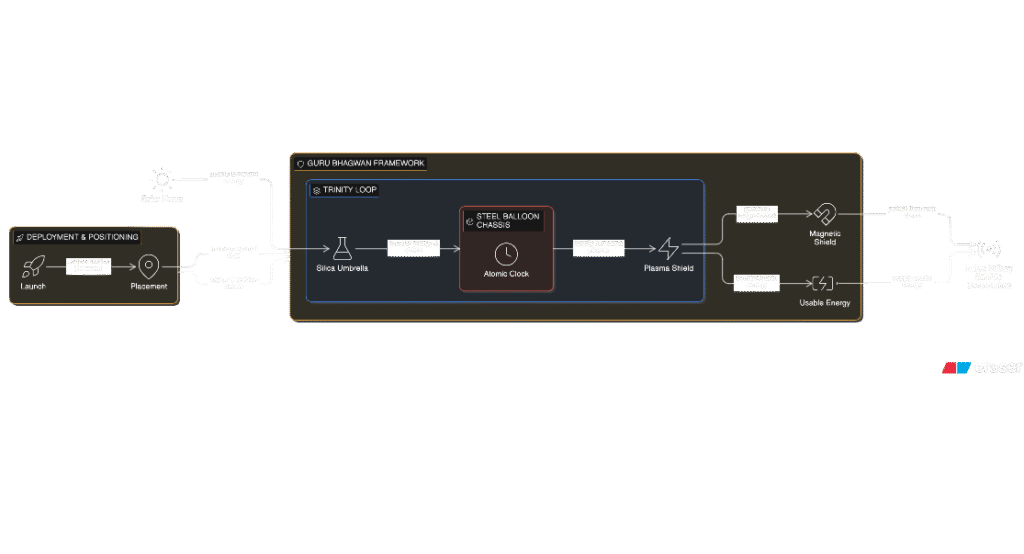
Technical visualisation diagram (PC: Eraser.io)
The final piece of the Trinity Loop is the plasma shield, which functions just like Lord Shiva and breaks down the destructive energy from the solar flares to protect the entirety of the makeshift system. By utilising localised plasma to create a “Magnetoshell,” a concept validated by modern aerospace research (Slough et al., 2011), it serves as a Transformer. Furthermore, using digital twins of the fourth atomic clock before sending it out into space could effectively solve the problem of being able to test it out on Earth itself before making expensive investments in the same. To deploy these complex systems efficiently, we look to the foundational rocketry principles of Tsiolkovsky (1903), ensuring the “Many Cannons” of Indian launch vehicles can place these assets precisely.
Conclusion
From a purely budgetary perspective, launching a GB Harvester is equivalent to launching two NVS replacements; however, it aligns perfectly with the Ministry of Defence (2024) roadmap for radiation-hardened assets. Because it prevents future failures and adds a revenue stream (energy), it is the more fiscally responsible choice for a nation seeking long-term space sovereignty. By implementing the “Trinity” of materials—Silica, Austenitic Steel, and Plasma—India transforms a military crisis into a national asset. As of April 2026, the NaVIC constellation no longer just tells us where we are; it tells the world who we are: a nation that doesn’t just survive the storm, but captures it. This isn’t just a “make-shift” fix for three satellites; it is the blueprint for a Global Sovereign Defence Line that uses the sun’s fury to power the earth’s peace.
Title Image Courtesy: https://www.geeksforgeeks.org/
Disclaimer: The views and opinions expressed by the author do not necessarily reflect the views of the Government of India and the Defence Research and Studies.


References
Glaser, P. E. (1968). Power from the sun: Its future. Science, 162(3856), 857-861. https://doi.org/10.1126/science.162.3856.857
Indian Space Research Organisation (ISRO). (2025). Annual report 2024-2025: NavIC and strategic positioning. Department of Space, Government of India.
Joseph, G. G. (2010). The crest of the peacock: Non-European roots of mathematics (3rd ed.). Princeton University Press.
Kalam, A. P. J., & Rajan, Y. S. (1998). India 2020: A vision for the new millennium. Viking.
Lorentz, H. A. (1895). Versuch einer theorie der electrischen und optischen erscheinungen in bewegten körpern [Attempt at a theory of electrical and optical phenomena in moving bodies]. E.J. Brill.
Ministry of Defence, Government of India. (2024). Technology perspective and capability roadmap (TPCR).
Mishra, R. K., et al. (2022). Radiation effects on silica-based glasses in Low Earth Orbit. Journal of Spacecraft and Rockets, 59(4), 1102-1115.
Narasimha, R. (1985). The rocketry of Tipu Sultan (Technical Report No. 85-TR-1). National Aerospace Laboratories, Bangalore.
Slough, J., et al. (2011). The analysis of a magnetoshell for aerocapture and shielding (NASA NIAC Phase I Report). NASA Innovative Advanced Concepts Program.
Surya Siddhanta. (n.d.). (Rev. E. Burgess, Trans., 1860). Journal of the American Oriental Society, 6, 141-498. (Original work published approx. 4th-5th Century CE).
Tsiolkovsky, K. E. (1903). Issledovanie mirovykh prostranstv reaktivnymi priborami [The exploration of cosmic space by means of reaction devices]. Nauchnoe Obozrenie.
Van Allen, J. A. (1958). Radiation belts around the earth. Scientific American, 200(3), 39-47. https://doi.org/10.1038/scientificamerican0359-39