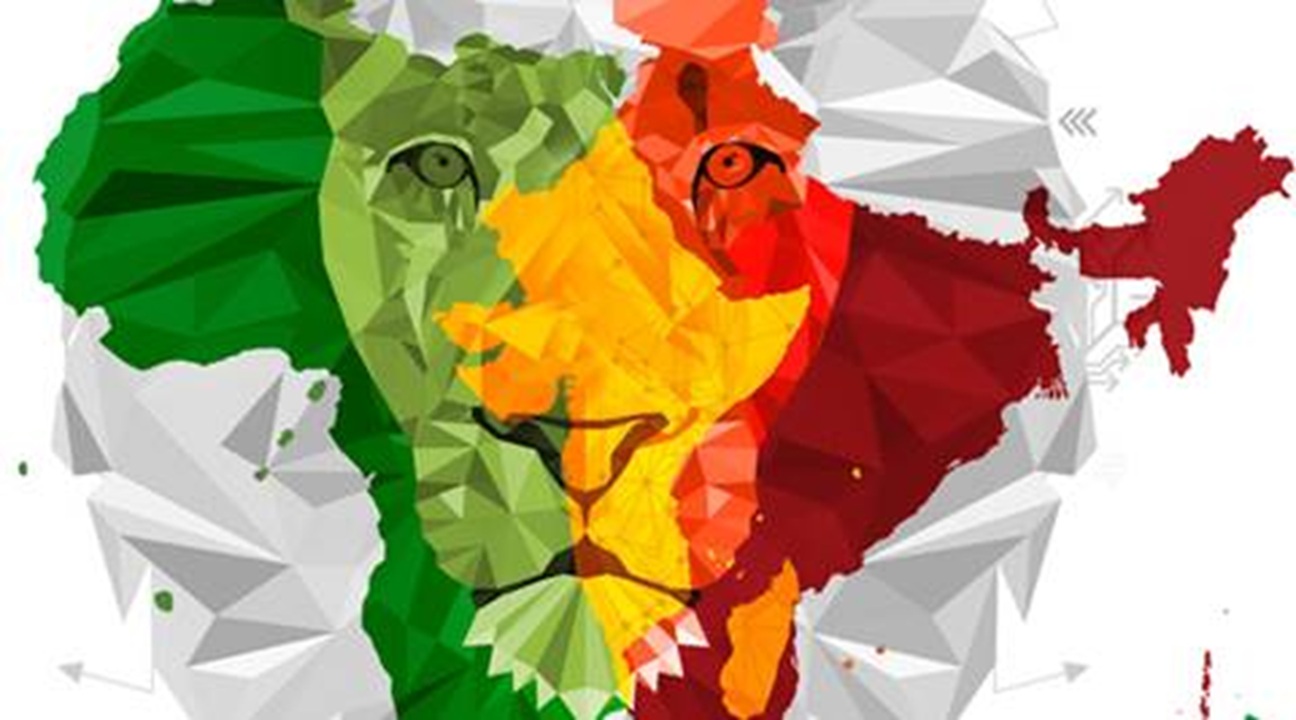
India and Africa are strengthening a strategic, development-focused partnership, with India emerging as a key trading partner and investor. With 47 active embassies, India emphasises capacity building, digital infrastructure and security.
India’s engagement with Africa is already important, and that should be acknowledged clearly at the outset. Trade has grown, political ties are warm, and India has built a position that is generally more balanced than many external actors operating on the continent. But the larger question now is whether India wants to stop at a useful level of diplomatic goodwill and commercial presence, or whether it wants to move into a much deeper position inside Africa’s strategic transformation. Because the real opportunity now lies less in symbolism and more in whether India can become a long-term partner in Africa’s mineral industrialisation, energy security, maritime resilience and defence capacity. India’s own official framing already points in that direction: bilateral trade is now near $100 billion, Indian investment is near $75 billion, and New Delhi has explicitly said its engagement should align with AfCFTA and Agenda 2063.
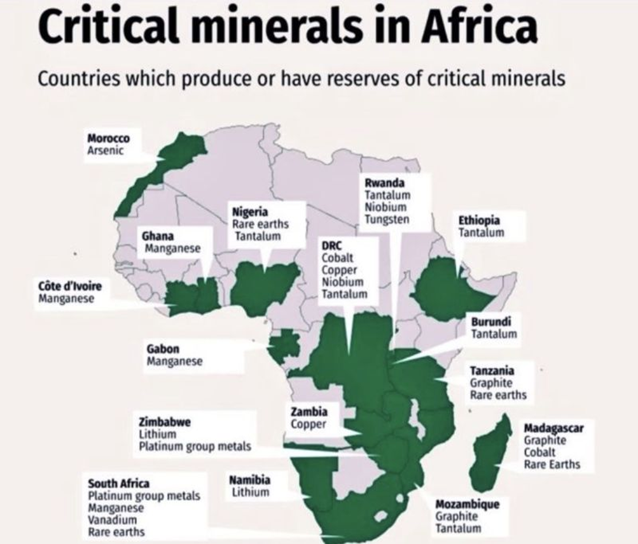
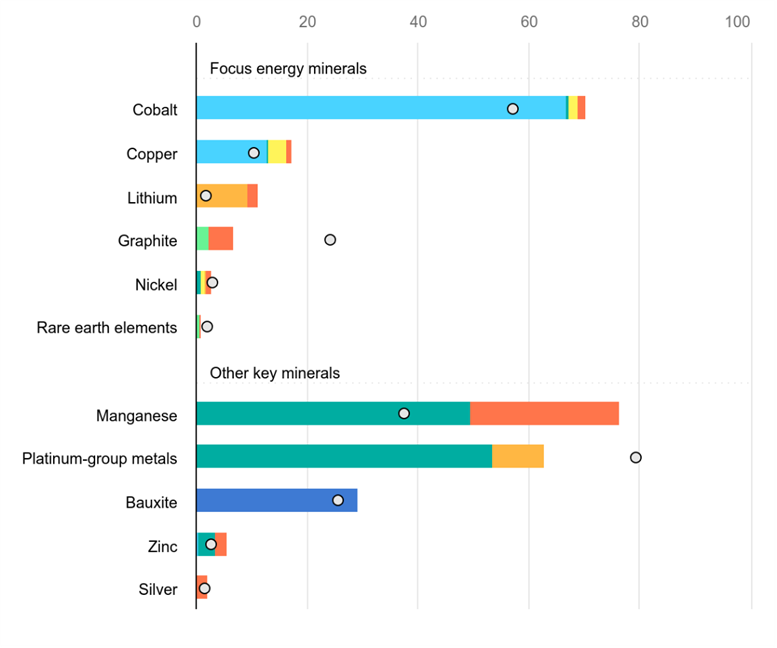
And that is where the critical minerals map matters. It sharpens the point that Africa is not one resource story, but several strategic corridors at once. There is the DRC-Zambia copper-cobalt belt; the southern African lithium, platinum-group metals, manganese and vanadium space built around South Africa, Zimbabwe and Namibia; and the Indian Ocean-facing graphite and rare earth corridor running through countries such as Tanzania, Mozambique and Madagascar. That geography matters because the clean-energy transition is not just about extraction. It is about who mines, who refines, who processes, who manufactures and who captures the strategic leverage that follows. The IEA now estimates that Africa supplies around 75% of global manganese, 70% of cobalt and nearly 20% of copper used in these wider clean-energy and industrial chains, but still captures less than 1% of the value generated from clean-energy technology manufacturing.
PC: African Development Bank, IEA, S&P Global
So the first change to the report is straightforward: critical minerals should no longer be treated as one section among many. They should be the anchor of the whole geoeconomic argument. India should not approach Africa merely as a buyer of raw material, because that would be too small and too old a model. It should instead pursue joint processing, refining, recycling, logistics and downstream manufacturing partnerships. And Africa itself is moving in exactly that direction. The African Union’s Green Minerals Strategy is explicit that the continent must move beyond raw mineral exports toward integrated value chains, local beneficiation, job creation and economic diversification. The IEA makes the same point from a market perspective, arguing that the economic contribution of Africa’s minerals rises materially when countries move from extraction into processing, smelting and refining.
That then raises the obvious question: what should India provide in return? The answer has to be more serious than purchase contracts and political goodwill. India should be providing process engineering, project development support, capital equipment, vocational training, geological services, mineral-testing capability, battery-material know-how, and, in some cases, joint industrial parks linked to ports and power. It should also offer financing structures that reduce project risk. This matters because Africa’s wider geoeconomic challenge is not just production. It is also finance. Afreximbank estimates that the continent faces about a $100 billion annual trade-finance gap, which constrains regional value chains and limits the ability of small and medium firms to scale. So if India wants to go deeper into Africa, then it should not only bring demand; it should bring financing architecture.
The second pillar is energy security, and here also the argument has to be wider than oil and gas cargoes. Energy security today is about grids, storage, fertiliser, refining, distributed solar, transmission and the resilience of productive systems under external shocks. Africa’s own strategic debate is increasingly moving in that direction. At the World Economic Forum in 2025, the African Union stressed both supply-chain diversification and local value-chain investment as part of a broader ambition to push Africa’s renewable-energy share much higher. At the same time, food and energy stress remain tightly connected: the FAO’s 2025 food security assessment highlights how high food-price inflation has weakened access to healthy diets, while the World Bank notes that fertiliser prices remained elevated in 2025, raising input costs and threatening agricultural productivity across Sub-Saharan Africa.
That is why India’s energy offer to Africa should be broader than crude purchases. India should be ready to provide EPC capability, grid modernisation support, refinery cooperation, solar manufacturing partnerships, digital systems for power distribution, utility management tools, and stronger fertiliser-security arrangements tied to agri-productivity. In effect, India should be helping African states secure power, manage power and use power productively. That would make India more than an importer; it would make it a partner in productive sovereignty. And that is a stronger long-term proposition than commodity access alone.
The third pillar is defence and maritime security. And here the map is again useful, because mineral geography and maritime geography overlap more than is usually admitted. A great deal of Africa’s future strategic value runs through ports, sea lanes, undersea infrastructure, offshore energy routes and Indian Ocean connectivity. India has already begun moving in this direction. AIKEYME 2025, the first Africa-India maritime engagement exercise, was designed to strengthen maritime security cooperation and interoperability with African maritime partners. India has also signalled a more concrete defence posture in bilateral ties, including a $200 million defence line of credit to Angola, along with training and support for the repair and overhaul of defence platforms.
PC: International Energy Agency
But India should still be careful in how it deepens this track. Africa does not need another external actor arriving with a purely militarised lens. So the correct model is a light but useful one: maritime domain awareness, coastal radar systems, coast guard and naval training, maintenance and overhaul support, secure port technologies, selective defence-industrial cooperation, and limited intelligence-sharing focused on piracy, terror finance, trafficking and organised maritime crime. On conflict management too, the Indian role should be calibrated rather than intrusive: peacekeeping interoperability, officer education, crisis logistics, communications support and dialogue facilitation where requested. The objective should be resilience and trust, not dependency.
This also means India should stop approaching Africa as one single theatre. The mineral map suggests a corridor-based strategy. In the DRC-Zambia belt, the emphasis should be on copper-cobalt processing, transmission, logistics and industrial power. In southern Africa, India should think in terms of lithium, platinum-group metals, manganese, vanadium, refining and battery-material linkages. In the Indian Ocean-facing belt, the strategy should connect graphite, port infrastructure, LNG, undersea cables and maritime security. And in West Africa, where minerals, agriculture and manufacturing markets overlap, India should be integrating fertilisers, pharmaceuticals, digital payments and food-processing systems into its broader commercial strategy. That is what a real geopolitical and geoeconomic framework would look like: not one slogan for all of Africa, but a differentiated architecture of strategic corridors.
The broader point, then, is simple. India is already present in Africa, but presence alone is no longer enough. The next phase should be about strategic depth. That means India should go deeper into the continent not as a gesture and not as a late reaction to other powers, but as part of a deliberate effort to secure minerals, energy partnerships, maritime access, industrial opportunities and political leverage in a fragmented world. But to do that credibly, India must provide something substantial in return: local value addition, industrial training, project finance, power systems, defence support, digital infrastructure and policy respect for African agency. If that compact can be built, then India will not simply have a larger footprint in Africa. It will have a more durable strategic position there.
Title Image Courtesy: Indian Express
Disclaimer: The views and opinions expressed by the author do not necessarily reflect the views of the Government of India and the Defence Research and Studies.


References
African Export-Import Bank (Afreximbank) (2025) African Trade Report 2025: Africa’s Trade in a Changing Global Financial Architecture. Cairo: Afreximbank.
African Union (2025) Africa’s Green Minerals Strategy. Addis Ababa: African Union Commission.
African Union (2025) ‘African Union at the World Economic Forum’. Addis Ababa: African Union Commission.
Food and Agriculture Organization of the United Nations, IFAD, UNICEF, WFP and WHO (2025) The State of Food Security and Nutrition in the World 2025. Rome: FAO.
International Energy Agency (2025a) Africa’s share of global mined production and reserves, 2024. Paris: IEA.
International Energy Agency (2025b) Stepping Up the Value Chain in Africa. Paris: IEA.
Ministry of External Affairs, Government of India (2025a) ‘EAM’s address at the Africa Day Celebrations (May 28, 2025)’. New Delhi: MEA.
Ministry of External Affairs, Government of India (2025b) ‘Question No. 2166: Strategic Partnership with Africa’. New Delhi: MEA.
Ministry of External Affairs, Government of India (2025c) ‘English Translation of Prime Minister’s Press Statement during Joint Press Statement with President of Angola (May 03, 2025)’. New Delhi: MEA.
Press Information Bureau, Government of India (2025a) ‘Africa India Key Maritime Engagement 2025’. New Delhi: PIB.
Press Information Bureau, Government of India (2025b) ‘Africa India Key Maritime Engagement (AIKEYME) 2025 inauguration’. New Delhi: PIB.
World Bank (2025) Africa’s Pulse. Washington, DC: World Bank.