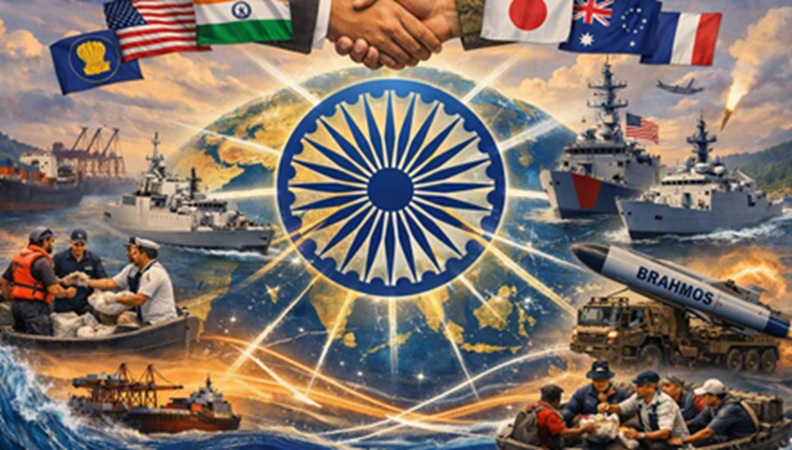
The study focuses on the blue economy strategy of India, which is being implemented as a maritime diplomacy instrument (tool) in the Indo-Pacific region. The problem being addressed through this study is that while there have been several studies/ discussions on the maritime involvement of India in the context of security and economic progress, not enough emphasis has been placed on the use of the blue economy itself as a diplomatic instrument (tool). The research follows a qualitative document analysis, such as official documents, bilateral briefs, annual reports, joint statements, and policy papers from the Ministry of External Affairs, Ministry of Defence, and Ministry of Ports, Shipping and Waterways. The findings reveal that port-led development, coastal shipping, ocean governance, and maritime infrastructure play an essential role in providing India’s external strategic aims. It means India’s blue economy strategy can be treated as a diplomatic and developmental tool that complements India’s foreign policy efforts by enhancing cooperation with country partners, promoting better connectivity, and strengthening the bases of international cooperation in the maritime domain. The main conclusion of the research is that India’s blue economy policy is not just a developmental process, but a diplomatic instrument (tool) serving the causes of bilateral and multilateral cooperation, maritime connectivity, and a rules-based maritime system in the Indo-Pacific.
Introduction
The Indo-Pacific region has become one of the most important regions in modern-day international relations due to its importance in the connectivity of trade, maritime security, geopolitical competition, regional cooperation, and ocean- related economic growth. As far as India is concerned, this maritime region has become more important not just in terms of the security of the sea routes but also in terms of economic growth and improved living conditions for coastal communities.
The blue economy is now a key part of India’s policy plans. The government claims that it’s about using the ocean’s resources in a way that’s good for the economy, the environment, and the people living in the coastal areas, while also keeping the economy secure. At the same time, India is working with other countries in the Indo-Pacific region to make sure the oceans are used fairly and responsibly, which emphasises a free, open, inclusive, and rules-based maritime order. This means following rules, working together to solve common problems, and making sure the oceans are safe and secure for everyone. India’s maritime policy framework wants to make sure that the oceans are used in a way that benefits every country, and not just a few countries. This is important for the country’s economic growth, environmental sustainability, and national security. By cooperation and coordination with other countries, India can help create a more stable and prosperous region, while also protecting the ocean’s resources for future generations.
Both themes are of increasing importance but are often studied separately. The blue economy is generally discussed as a developmental or sectoral policy issue, while maritime diplomacy is treated mainly as a matter of foreign policy and strategic affairs. This leaves an analytical gap, as it does not consider the extent to which India may be using blue economy policy not only for domestic development, but also as a tool of maritime diplomacy and regional influence in the Indo-Pacific.
The present study is premised on the assumption that understanding India’s blue economy strategy requires moving beyond an economic reading of ocean policy and situating it in a larger framework of maritime statecraft. It thus examines the interplay of India’s blue economy strategy with its maritime diplomacy in the Indo-Pacific, and argues that the blue economy should be understood not only as a developmental agenda, but also as a strategic and diplomatic tool through which India advances sustainable development, builds regional partnerships, and strengthens its position in the evolving Indo-Pacific order.
Objectives
The objectives of the study are:
- To examine the major features and policy priorities of India’s blue economy strategy.
- To analyse the scope and significance of India’s maritime diplomacy in the Indo-Pacific.
- To explore the relationship between blue economy policy and maritime statecraft in India’s regional strategy.
- To assess how sustainable development and strategic interests are linked in India’s maritime outlook.
- To identify the main opportunities and challenges in using blue economy as a diplomatic instrument.
This study helps understand how India’s blue economy strategy supports development, sustainability, and maritime diplomacy in the Indo-Pacific region, while also broadening maritime strategy in statecraft.
Hypothesis
India’s blue economy is often framed as a developmental policy. However, it also functions as a tool (instrument) for maritime diplomacy in the Indo-Pacific, promoting sustainable growth, regional cooperation, and strategic influence.
Research Questions
The study will address the following questions:
- What are the major elements of India’s blue economy strategy?
- How does India’s maritime diplomacy support and extend the goals of its blue economy strategy in the Indo-Pacific?
- How do India’s maritime initiatives connect development, sustainability, security, and regional cooperation?
- To what extent can India’s blue economy strategy be understood as a tool of maritime diplomacy or maritime statecraft?
- What opportunities and constraints shape India’s attempt to use the blue economy for strategic influence in the Indo-Pacific?
Research Methodology
The study will use a qualitative methodology that is based on descriptive and analytical methods. It will rely on secondary sources such as policy documents, reports, academic journals, research papers, and think tank publications related to the blue economy and the Indo-Pacific maritime strategy.
To provide more strengthened empirical aspects of the research, information will be gathered from the Ministry of Earth Sciences, the Ministry of External Affairs (BIMSTEC and ASEAN+2), the Ministry of Ports, Shipping, and Waterways, and other institutions that deal with ports, fisheries, marine resources, and ocean policies.
This method of analysis will include:
- Content Analysis of official policy documents and diplomatic statements.
- Thematic analysis of the relationship between blue economy policy, maritime diplomacy, and strategic influence.
- Case references from India’s Indo-Pacific partnerships and maritime initiatives.
Literature Review
Existing literature on India’s blue economy primarily frames it as a policy for development, sustainability, and the efficient utilisation of ocean resources. The Blue Economy Policy draft for India defines the blue economy as a comprehensive framework encompassing marine sectors, coastal development, and long-term planning for national ocean resources. India views the blue economy as a significant framework for national priorities, economic growth, sustainability, and the productive use of maritime space. However, this mostly emphasises the domestic dimensions of blue economy policy.
Another area of literature examines India’s maritime diplomacy and engagement in the Indo-Pacific region. India emphasises the importance of a free, open, inclusive, and rules-based Indo-Pacific, highlighting initiatives like SAGAR and the Indo-Pacific Oceans Initiative. These initiatives also demonstrate India’s collaboration with regional partners on maritime security, the blue economy, connectivity, disaster response, and capacity building. This indicates that India’s maritime policy encompasses not only security concerns but also cooperation and shared development. Nevertheless, it addresses maritime diplomacy as distinct from blue economy policy.
Now, the third area is of strategic thinking, which focuses on the sea power and maritime strategy of Alfred Thayer Mahan. He emphasises the significance of sea routes, maritime trade, naval strength, and control of the seas in shaping national power. This is relevant to India because its Indo-Pacific policy relies on maritime access, connectivity, and strategic presence. However, Mahan’s sea power theory does not fully capture the modern blue economy, which also involves sustainability, governance, and economic diplomacy.
The main gap in the literature is that blue economy policy, maritime diplomacy, and sea power are typically examined as separate themes. It remains less explored how India’s blue economy strategy might serve as a tool (instrument) for maritime diplomacy and strategic objectives. For a theoretical framework, this study uses Mahan’s sea power theory, alongside geo-economics and liberal institutionalism. Mahan provides insights into why maritime power, trade routes, and control of the seas are essential for national strength. Geo-economics explains how economic policy and marine resources can be influenced for strategic benefits. Liberal institutionalism clarifies India’s emphasis on cooperation, regional mechanisms, and rules-based engagement in the Indo-Pacific. Together, these concepts illustrate that India’s blue economy is not just a development policy but also an integral part of its maritime diplomacy and statecraft.
India’s Blue Economy Strategy
The blue economy of India is the sustainable utilisation of resources from the oceans, coastal regions and inland waters for economic growth, livelihoods, environmental conservation and marine security. It’s not just fisheries but also ports and shipping, inland waterways, coastal and cruise tourism, shipbuilding and repair, marine energy, logistics and coastal community development. In this sense, the blue economy should be conceptualised as an integrated development framework that connects growth with sustainability and maritime capacity- building.
Four broad dimensions can be identified for the major elements of the blue economy. The economic dimension includes fisheries, aquaculture, maritime trade, logistics and port-led industrial development. The social dimension includes employment generation, skill development and improvement of coastal livelihoods. The environmental dimension covers marine conservation, pollution control and climate- resilient coastal development. The strategic dimension includes maritime security, regional connectivity and enhanced cooperation with neighbouring maritime countries.
In this context, fisheries and aquaculture, ports and shipping, inland waterways and coastal shipping, cruise and marine tourism, shipbuilding and ship repair, marine renewable energy and maritime education and research are the priority sectors for development. These sectors are inextricably linked and form the backbone of a sustainable blue economy. Their development is especially important for India as it can boost trade competitiveness, create coastal employment and enhance regional integration.
The objectives of the blue economy should be envisaged in both developmental and strategic terms. Developmentally, India should aim to increase sustainable production from fisheries and aquaculture, reduce logistics costs through efficient ports and waterways, expand tourism- linked income, and enhance coastal livelihoods. Strategically, the goal should be to strengthen India’s maritime position through better connectivity, stronger institutional coordination, and deeper regional cooperation in the Indian Ocean and Bay of Bengal region. Environmentally, the blue economy should ensure that growth occurs without damaging marine ecosystems or coastal sustainability.
These goals are being strengthened by the Government of India’s programs and cooperative mechanisms: The Sagarmala Programme focuses on port-led development, coastal shipping, connectivity, industrialisation, and development of coastal communities. Maritime India Vision(MIV) 2030 is a broad road map with regard to ports, shipping, inland waterways, sustainability, safety, cruise tourism, training, and cooperation with foreign countries. The Pradhan Mantri Matsya Sampada Yojana (PMMSY) provides for sustainable and responsible development of the fisheries sector and aims at improving value chains, infrastructure, and welfare of the fishers. Fisheries, tourism, ocean energy, logistics, marine infrastructure, shipping and offshore resources are listed as the priority sectors under the Blue Economy policy framework.
Regarding coordination and cooperation, Maritime India Vision 2030 places significant focus on BIMSTEC and maritime connectivity with neighbouring countries. It suggests a regional BIMSTEC centre, data sharing and customs uniformity, coordinated maritime training, inland waterways connectivity and coastal shipping arrangements. Moreover, it defines cruise, ferry and cargo connectivity with Sri Lanka, Maldives, Bangladesh, Myanmar and Thailand as key tools of maritime cooperation. Further, India has explored MoUs (Memorandum of Understanding) with countries like Indonesia, Norway, Germany, Denmark, and Australia on blue economy, maritime safety, green shipping, technology and sustainable development, etc. This illustrates that the blue economy in India is not only a domestic development plan but also a platform for cooperation with neighbouring countries and further.
Thus, the blue economy must be framed as a multi-sectoral and long-term policy agenda, incorporating the principles of sustainable development, welfare of coastal communities, modernisation of the maritime sector and regional diplomacy. These would need coordinated implementation across sectors like fisheries, ports, shipping, tourism, marine energy, skills and environment governance. In India, this overall agenda is primarily structured through Sagarmala, Maritime India Vision 2030, PMMSY and maritime cooperation based on BIMSTEC.
India’s Maritime Diplomacy in the Indo-Pacific
India’s maritime diplomacy helps in strengthening and widening India’s strategy for blue economy in the Indo-Pacific by integrating the national maritime objectives with regional engagement and cooperation over trade, connectivity, sustainability and security. This is clearly demonstrated in the Maritime India Vision 2030 with the focus on ports, shipping, inland waterways, cruise tourism, shipbuilding, skill development, green growth, and cooperative partnerships with the neighbouring maritime countries.
BIMSTEC is one important forum where this will be pursued, as its charter deals with themes such as economic development, social progress, training and research, transport and communication, multidimensional connectivity, and cooperation with international and regional organisations. These are precisely the themes that align with the blue economy concerns highlighted within Maritime India Vision 2030, particularly connectivity, cargo transit, infrastructure, skill development, and regional integration. Additionally, within BIMSTEC, India also has better reach in terms of connecting the Bay of Bengal to the inland and the littoral transportation networks and addresses both the strategic and the economic dimensions of the blue economy.
ASEAN brings a wider Indo-Pacific layer to the same agenda. The ASEAN Maritime Outlook reiterates the importance of maritime connectivity, blue economy, green economy, sustainable management of marine resources, marine biodiversity, maritime safety and technical cooperation, which is closely linked with the targets related to sustainability, environment, and energy outlined in the Maritime India Vision 2030. Further, its emphasis on linking maritime cooperation with the objectives related to trade, transport, tourism, pollution control, and energy security shows that maritime diplomacy can simultaneously pursue economic and environmental objectives together. This indicates that India’s blue economy policy is not confined to national efforts alone but is structured for regional and sub-regional cooperation/initiatives. One of the strongest areas of intersection between Maritime India Vision 2030 and the regional frameworks is the energy and sustainability nexus. Maritime India Vision 2030 encompasses green shipping, port-based renewable energy, shore-powering, cleaner fuels, and environmentally conscious port operations. Likewise, ASEAN’s maritime strategy also reiterates the goal of green shipping, environmental protection, and sustainable marine development. This indicates that the objectives of India’s maritime diplomacy can be achieved not only by fostering connectivity and trade but also by greening maritime transitions in the Indo-Pacific. On a policy level, diplomacy allows India to foster common standards, technological connections, training, and sustainability practices across the region.
India’s maritime diplomacy also broadens the scope of the blue economy by providing a framework for cooperation on cruise connectivity, ferry services, cargo transport, and maritime capacity building. The Maritime India Vision 2030 specifically pushes for broader and greater maritime cooperation on multiple levels with the BIMSTEC countries and ASEAN countries, such as common standards, training and direct connectivity routes. Furthermore, it suggests partnership on blue economy, maritime security, green technology and training with countries such as Indonesia, Australia, Denmark, Norway, and Germany. This indicates that India’s diplomacy functions through both sub- regional and wider Indo-Pacific frameworks. Thus, this suggests that the use of diplomacy aims to build a broader maritime ecosystem where trade, skill development, sustainable shipping, and regional connectivity can thrive simultaneously. Further, the 2024 ASEAN-India joint statement on strengthening the comprehensive strategic partnership in the context of the ASEAN Outlook on the Indo-Pacific, with the support of India’s Act East Policy, is further indicative of the fact that India’s maritime diplomacy is aimed at enhancing peace, stability, prosperity, and regional connectivity of the Indo-Pacific.
Through such maritime diplomacy, India’s blue economy strategy is expanded and enhanced from an inward-focused strategy and turned into a foreign policy for the Indo-Pacific region through bilateral engagements. While BIMSTEC aids in the consolidation of Bay of Bengal connectivity and cooperation, trade, infrastructure, training, and regional development, and ASEAN broadens the maritime scope to comprehensive cooperation, security and sustainability in Southeast Asia and the Indo-Pacific region. The joint statement of ASEAN-India on ASEAN Outlook on the Indo-Pacific, strengthened by India’s Act East Policy, is a confirmation of this direction, and it envisages maritime cooperation to further achieve the objective of promoting long-term peace, stability, prosperity and integration within the Indo-Pacific region. Therefore, India’s maritime diplomacy becomes a tool (instrument) that India uses to make its blue economy goals outward and build partnerships that enhance economic growth, resilience and maritime leadership in the Indo-Pacific.
Table 1: India’s Indo-Pacific goodwill visits and bilateral naval engagements (2021-2025)
| Year | Country | Types of visit | Diplomatic/Strategic Significance | Strategic Outcome |
| 2021 | Australia (e.g. Fremantle/ Sydney) | Goodwill visit/port call | Part of India’s regular goodwill visits by Indian Navy Ships, reflecting India’s commitment to friendly maritime engagement in the Indo-Pacific. | Trust-building and regional connectivity |
| 2022 | Eritrea (Massawa Port) | Port call | Supports India’s maritime outreach along the Horn of Africa and the Red Sea corridor, reinforcing India’s role as a responsible maritime partner. | Red Sea / Horn of Africa presence |
| 2022 | Israel (Haifa) | Goodwill Visits/port call | Demonstrates India’s naval presence beyond the immediate Indian Ocean, linking maritime diplomacy with broader strategic partnerships in the wider Indo-Pacific and Mediterranean. | Extended strategic networking |
| 2022-2023 | Vanuatu, Fiji, Tonga | Goodwill Visits/port call | Extends India’s maritime diplomacy to the South Pacific, showing that India’s Indo-Pacific engagement goes beyond South and Southeast Asia into the wider Pacific region. | South Pacific outreach |
| 2023 | Cambodia (Sihanoukville) | Goodwill Visits/port call | Deepens India’s naval ties with Southeast Asian partners and underlines India’s interest in a free, open, and inclusive Indo-Pacific. | Southeast Asia connectivity |
| 2024 | New Zealand (Port Lyttelton) | Operational turn-around/port call (22 Dec 2024 – 4 Jan 2025) | Port call reflects India’s military diplomacy and expanding naval reach in the South Pacific and broader Indo-Pacific. | Pacific Island presence |
| 2024 | Papua New Guinea | Goodwill visit/port call | Shows India’s willingness to engage with smaller Pacific Island states and to build maritime links beyond the traditional Indian Ocean neighbourhood. | Pacific partners engagement |
| 2023-2024 | Indonesia | Port visits / operational deployments / CORPAT | Naval engagements and the IND- INDO Coordinated Patrol (CORPAT) underline the strategic importance of India-Indonesia maritime ties and support India’s vision of a free and open Indo-Pacific. | Strategic partnership/sea-lane security |
| 2023-2024 | Singapore (Port of Singapore) | Operational turn-around/goodwill port calls | Frequent visits to Singapore highlight India’s strategic engagement with a key maritime hub and India’s role in regional security dialogue and Indo-Pacific connectivity. | Regional hub engagement |
| 2023-2024 | Malaysia (Port Kota Kinabalu, Port Klang) | Operational deployment/port calls | Port visits to Malaysia emphasise India’s interest in cooperation on the Malacca Strait and broader Southeast Asian maritime routes, which are central to India’s Indo-Pacific maritime diplomacy. | Malacca / SE Asia connectivity |
| 2023-2024 | Philippines, Brunei | Goodwill visits / operational deployments | Port calls in the South China Sea context signal India’s willingness to engage with ASEAN states and support a rules-based maritime order in the Indo-Pacific. | Rules-based order support |
| 2024 | Egypt (Port Said) | Port call | Extends India’s naval diplomacy into the Red Sea and Eastern Mediterranean, linking maritime engagements in the Indian Ocean with broader Indo-Pacific strategic interests. | Red Sea / Mediterranean link |
| 2023-2024 | Oman (Duqm, Salalah) | Multiple port visits / operational turnaround | Oman is reported as the most-visited country for Indian Navy deployments, reflecting India’s focus on securing trade routes and maritime security in the Arabian Sea and Red Sea region. | Red Sea / Arabian Sea security |
| 2025 | Singapore | Port call (16-19 July 2025) | Part of Eastern Fleet Operational Deployment to South East Asia, it is used to enhance bilateral naval ties and maritime cooperation in the Indo-Pacific. | Bilateral naval cooperation |
| 2025 | Indonesia | Bilateral port calls / joint exercises / CORPAT | MEA’s 2025 India-Indonesia bilateral brief and vision documents emphasise closer naval cooperation, joint exercises, and combined maritime patrols, showing how naval port calls are embedded in India’s broader maritime diplomacy and Indo-Pacific strategy. | Strategic partnership / Indo-Pacific alignment |
| 2025 | Cyprus (Limassol Port) | Port call (21-24 September 2025) | Port call reflects India’s maritime outreach in the Eastern Mediterranean and broader Indo-Pacific strategic interests. | Eastern Mediterranean / Indo-Pacific link. |
Sources: Compiled from Ministry of External Affairs bilateral briefs, annual reports, and Ministry of Defence press releases and annual reports on Indian Navy goodwill visits, port calls, and operational deployments in the Indo-Pacific region (2021-2025).
The table on “ India’s Indo-Pacific goodwill visits and bilateral naval engagements (2021-2025) shows that India’s maritime diplomacy is systemic and geographic in nature. It indicates that naval port calls and operational deployments are not secluded diplomatic acts; rather, they show a consistent pattern of interaction throughout Southeast Asia, the Pacific Islands, the Red Sea, and the Indo-Pacific region. By maintaining a regular naval presence in countries such as Singapore, Indonesia, Malaysia, the Philippines, Brunei, New Zealand, Papua New Guinea, Oman, and Egypt, India carries out maritime diplomacy to enhance trust, improve security cooperation, and reinforce its strategic alliances. The table also shows that Indian maritime diplomacy has changed from symbolic goodwill visits to operational engagements like joint patrols, and deployment and turnarounds, thereby indicating the extent of India’s maritime outreach. The pattern hence corroborates the sub-heading “India’s Maritime Diplomacy in the Indo-Pacific” and shows that India’s naval interactions are strategic and regular and carry a meaning rather than being just random gestures.
Blue Economy as an Instrument (tool) of Maritime Diplomacy
India’s blue economy strategy policy includes both national development and a wider statecraft strategy that relates to the country’s presence in the Indo-Pacific region. In the context of the draft blue economy framework, the ocean is perceived as a system that consists of resources, infrastructure, and strategic space connecting economic growth, environmental sustainability, national security and international engagement. In this view, the blue economy does not only serve as a development strategy but also as an instrument (tool) for strengthening India’s maritime presence through regional cooperation and other maritime affairs.
The link between them can be further understood in the context of policies like Sagarmala and Maritime India Vision (MIV) 2030. Sagarmala is India’s flagship port-led development programme, and its core vision is to reduce logistics costs for EXIM(Export-Import) and domestic trade by improving port-led infrastructure through port modernisation, port connectivity, coastal community development, port-linked industrialisation, and coastal shipping. Maritime India Vision (MIV) 2030 provides a broader framework for the holistic development of India’s maritime sector, including ports, shipping, waterways, logistics efficiency, shipbuilding, and sustainability. Together, these policies strengthen India’s domestic maritime base and create the framework for stronger external maritime engagement.
These development policies or initiatives also serve as instruments (tools) of maritime diplomacy, as they improve India’s ability to receive more ships, expand trade flows, and deepen cooperation with regional partners. Better ports, improved logistics and stronger coastal connectivity are making India a more important node in maritime trade and regional supply chains. As a result, India’s maritime footprint expands, not only inside the country, but also across the Indo-Pacific maritime region. Thus, domestic maritime infrastructure is an instrument of foreign policy which makes India more connected, more capable and more influential in maritime affairs.
The development of maritime region diplomacy is also not seen as a purely internal matter, as the blue economy framework includes security, strategic dimensions, and international engagement. This is important because the Indo-Pacific is a region where shipping lanes, trade routes, marine resources and strategic interests are closely interlinked. India’s blue economy thus strengthens diplomacy by providing a stronger economic and infrastructure base for engagement with neighbours and wider regional partners.
Thus, the link between blue economy policy and maritime statecraft is directly related. Policies such as Sagarmala, Maritime India Vision (MIV) 2030 and the blue economy framework are not only domestic development programmes but also help India expand trade, strengthen port cooperation and build maritime influence in the Indo-Pacific region. That is why the blue economy can be seen as an instrument (tool) of maritime diplomacy.
Table 2: Blue Economy as an Instrument of India’s maritime diplomacy (2022-2025)
| Year | Country / Forum | Forum/mechanism (blue economy and maritime infrastructure) | Outcomes on blue economy and maritime infrastructure | Strategic/diplomatic significance |
| 2022 | France (bilateral) | India-France roadmap on Blue Economy and Ocean Governance (adopted Feb 2022) | Agreement to enlarge maritime cooperation on sustainable use of marine resources and ocean governance; first annual Blue Economy Dialogue held in Paris (Oct 2023) with institutional, economic, infrastructure, scientific, academic, and cultural pillars. | Establishes a structured, high-level India-France blue economy partnership in the Indo-Pacific, linking economic cooperation with strategic maritime engagement. |
| 2023 | Paris (bilateral dialogue) | First India-France Bilateral Dialogue on Blue Economy and Ocean Governance (Paris, 12 Oct 2023) | Detailed discussion on institutional, economic, infrastructure, scientific, academic, and cultural pillars of blue economy; it was with the intent to strengthen coordination in international bodies on ocean governance. | Reinforces India-France convergence on ocean governance and blue economy as a joint strategic tool in the Indo-Pacific. |
| 2023 | Indonesia (bilateral dialogue) | India-Indonesia Joint Statement on Blue Economy and Ocean Governance (built on earlier 2018 vision ) | Closer cooperation on sustainable use of marine resources, connectivity, maritime domain awareness, and protection of marine resources; it was the joint work in the Indian Ocean Rim Association (IORA) on the Blue Economy Working Group with Indonesia. | Deepens India-Indonesia strategic maritime partnership, using blue economy as a platform for Indo-Pacific alignment and regional leadership. It embedded blue economy cooperation within a broader strategic and security partnership in the Indo-Pacific. |
| 2023 | ASEAN (multilateral) | ASEAN-India Joint Statement on Maritime Cooperation (07 Sept 2023) | Commitment to maritime connectivity, sustainable use of marine resources, and cooperation on maritime infrastructure and capacity-building; it was linked to ASEAN Outlook on the Indo-Pacific | Positions India’s blue economy agenda within a multilateral framework, expanding its diplomatic footprint across the ASEAN region. |
| 2024 | Vientiane (multilateral) | ASEAN-India Joint Statement on Strengthening CSP (Comprehensive Strategic Partnership) for Peace, Stability and Prosperity in the context of ASEAN Outlook on the Indo-Pacific (AOIP) with support of Act East Policy (AEP). | Further emphasis on maritime cooperation, connectivity, and sustainable use of marine resources under the Comprehensive Strategic Partnerships and integration with Indo-Pacific Oceans Initiative (IPOI) and ASEAN Outlook on the Indo-Pacific (AOIP). | Strengthens India’s multilateral maritime diplomacy and blue economy engagement at the ASEAN level. |
| 2024-2025 | Pacific Islands (multilateral/bilateral) | India’s engagement with Pacific Island states (e.g. Vanuatu, Fiji, Tonga) under broader Indo-Pacific and blue economy agenda. | Discussions on maritime connectivity, sustainable use of marine resources, and capacity-building in line with blue economy priorities. The naval goodwill visits thereby reinforce the maritime links. | Extends India’s blue economy diplomacy into the South Pacific, broadening its Indo-Pacific reach beyond South and Southeast Asia. |
| 2025 | Nice, France (multilateral) | Third United Nations Ocean Conference (Nice, 9-13 June 2025) | India engages on blue economy, ocean governance, and sustainable marine resource use. It envisages coordination with partners on infrastructure and capacity-building. | Positions India as an active player in global blue economy governance, using multilateral forums to amplify its maritime diplomatic agenda. |
| 2025 | Nice, France | Seventh International Conference on Disaster Resilient Infrastructure (Nice, 7 June 2025) | Link between disaster-resilient infrastructure and coastal/maritime infrastructure. Also emphasises cooperation on climate resilience as part of blue economy strategy. | Integrates blue economy with climate and disaster resilience, widening India’s diplomatic narrative on sustainable maritime development. |
Sources: Compiled from official Ministry of External Affairs bilateral, multilateral briefs and documents, joint statements, and from Ministry of Ports, Shipping and Waterways material on India’s blue economy and maritime infrastructure initiatives (2022-2025).
The table on “Blue economy as an instrument (tool) of India’s maritime diplomacy (2022-2025)” indicates that India’s blue economy is not just being considered as a developmental agenda but also a pragmatic foreign policy tool. It reflects that high-level bilateral and multilateral engagements with France, Indonesia, ASEAN and other partners have been followed by structured cooperation on ocean governance, maritime infrastructure, coastal connectivity and the sustainable use of marine resources. This indicates that the blue economy functions as a bridge between domestic economic needs and India’s broader diplomatic goals in the Indo-Pacific. The table also shows that India’s blue economy diplomacy is institutionalised through roadmaps, joint statements, working groups, and ongoing dialogues that provide continuity to its maritime outreach. The blue economy is not a broad policy idea, but an operational framework through which India builds partnerships, strengthens regional connectivity and advances a rules-based maritime order. The table thus supports the sub-heading “Blue Economy as an Instrument (a tool) of Maritime Diplomacy” by showing that India’s maritime development initiatives are linked to strategic cooperation and external engagements.
Way Forward / Recommendations
The approach for the blue economy in India should be in a manner that goes beyond just being an economic policy but envisioned as a long-term instrument (tool) for diplomatic strategy in the Indo-Pacific. This demands improved coordination among ministries, enhancement of connectivity among maritime initiatives and foreign policy objectives and utilisation of port calls, bilateral visits, and multilateral platforms to engage in maritime infrastructure, ocean governance, and regional connectivity. Such an approach can help India build deeper partnerships, enhance regional stability, and reinforce a rules-based maritime order. Further, research can look into India’s blue economy diplomacy in response to evolving regional security dynamics, climate challenges, and competition for influence, thereby showing how maritime engagement empowers India with broader strategic autonomy and realisation of its Indo-Pacific vision.
Conclusion
As the article has shown, India’s maritime diplomacy in the Indo-Pacific is a strategic and ongoing part of its broader foreign policy, not just an occasional extension of naval activity. India has leveraged the sea as a space for diplomacy, partnership building and strategic presence through goodwill visits, port calls, bilateral naval engagements, blue economy forums and cooperation in maritime infrastructure.
The tables above clearly show the intrinsic link between India’s blue economy strategy and maritime diplomacy. Ports, shipping, ocean governance, coastal connectivity and maritime infrastructure are not just economic developmental goals but also diplomatic and strategic goals, particularly in the Indo-Pacific, where India seeks to promote regional cooperation and support a stable, rules-based maritime order.
The article also indicates how the maritime strategy of India may be seen in the wider context of Mahan’s sea power theory, which stresses the importance of controlling the sea, being strong at sea, having trade routes, and naval capability to determine national power. In today’s world, India’s blue economy and maritime diplomacy are an updated form of this approach, where the sea is not just a means of commerce but also a strategy through which influence, security, and international partnerships are built.
In the pattern observed in both bilateral and multilateral negotiations/engagements, it becomes clear that Indian maritime diplomacy is a calculated and strategic effort rather than figurative. Whether through the perspective of the Ministry of External Affairs, the Ministry of Defence, or the Ministry of Ports, Shipping and Waterways, India’s maritime diplomacy is a broader strategy to link domestic maritime development with external partnerships.
In conclusion, the article emphasises that India’s blue economy strategy should be understood as an instrument (a tool) of maritime diplomacy in the Indo-Pacific, and that this approach is consistent with the principles of Mahan’s sea power theory. It connects economic growth, infrastructure development, and ocean governance with India’s geopolitical perspectives, which makes maritime diplomacy a central pillar of its regional role.
Note: No AI has been used in the writing except for the compilation of the tables above, in which Perplexity has been used.
Title Image Courtesy: Copilot AI
Disclaimer: The views and opinions expressed by the author do not necessarily reflect those of the Government of India or the Defence Research and Studies.


Reference
The Influence of Sea Power upon History 1660-1783 by Alfred Thayer Mahan. (1987). [English] (Revised edition). Dover Pubns. Retrieved from https://dn760102.eu.archive.org/0/items/seanpowerinf00maha/seanpowerinf00maha.pdf
ASEAN Maritime Outlook ,2023. (2023, August). ASEAN. Retrieved from https://asean.org/wp-content/uploads/2023/08/AMO-1.pdf
Joint Statement on Strengthening ASEAN-India Comprehensive Strategic Partnership for Peace, Stability and Prosperity in the Region In the context of the ASEAN Outlook on the Indo-Pacific (AOIP) with the support of India’s Act East Policy (AEP. (2024, October 10). Retrieved June 15, 2026, from https://www.mea.gov.in/bilateral-documents?dtl/38396/Joint_Statement_on_Strengthening_ASEANIndia_Comprehensive_Strategic_Partnership_for_Peace_Stability_and_Prosperity_in_the_Region_in_the_context_of_the
India’s Blue Economy: A draft Policy framework. (2020, September). Indian National Centre for Ocean Information Services. Retrieved from https://incois.gov.in/site/general_reports.jsp
Annual Reports (2022,2023,2024,2025). (2022b, February). Ministry of Defence. Retrieved from https://mod.gov.in/en/annual-report
Annual Reports (2022,2023,2024,2025). (2022, February). Ministry of External Affairs. Retrieved from https://www.mea.gov.in/annualreports
India-US Joint Statement. (2025, February 13). Retrieved June 25, 2026, from https://www.mea.gov.in/bilateral-documents?dtl/39066
BIMSTEC Charter. (2024, May). Ministry of External Affairs. Retrieved from https://mea.gov.in/Portal/LegalTreatiesDoc/022M3847.pdf
Transforming India’s blue Economy: Investment, innovation , sustainable growth. (2025, May). Ministry of Earth Sciences. Retrieved from https://www.moes.gov.in/documents/publications/white-paper-on-blue-economy-QDMxkjMtQWa?pageTitle=White-Paper-on-Blue-Economy
Maritime India Vision 2030. (2021, February). Ministry of Ports, Shipping and Waterways. Retrieved from https://shipmin.gov.in/content/maritime-india-vision-2030
Sagarmala. (n.d.). Retrieved June 15, 2026, from https://shipmin.gov.in/en/division/sagarmala
Ministry of External Affairs. (2022). Retrieved July 10, 2026, from https://Www.mea.gov.in/bilateral documents/India France Roadmap on the blue economy and ocean governance
India-Indonesia joint statement on the state visit of H.E. Prabowo Subianto. (2025, January 25). Retrieved July 10, 2026, from https://Www.mea.gov.in/portal/foreign relation/india-indonesia-bilateral.pdf
India-France bilateral brief. (2023). Retrieved July 10, 2026, from https://Www.mea.gov.in/Portal/ForeignRelation/India-France.pdf
ASEAN-India Joint Statement on Strengthening CSP for Peace, Stability and Prosperity in the Region. (2024, October 10). Retrieved July 10, 2026, from https://www.mea.gov.in/Portal/ForeignRelation/India-ASEAN .pdf
ASEAN-India Joint Statement on Maritime Cooperation. (2023, September 7). Retrieved July 10, 2026, from https://www.mea.gov.in/bilateral-documents/ASEAN India Joint Statement on Maritime Cooperation