
Introduction
As seen in the ongoing wars–Russia–Ukraine and the US–led Israeli–assisted war against Israel- the character of modern warfare is undergoing a profound and irreversible transformation. For centuries, military dominance was measured by its mass; the sheer volume of battalions, armoured columns, naval fleets, and artillery batteries a nation could mobilise. Today, a relentless wave of technological disruption is upending that paradigm. The modern battlespace has digitised, compressed time and space, and shifted the centre of gravity towards algorithms, connectivity, and unmanned automation. Conflicts from the rolling plains of Eastern Europe to the rugged terrain of the Middle East have shown that future wars will not be won merely by heavy armour or conventional troop superiority, but by data-processing speed, smart-munitions accuracy, and the pervasive presence of autonomous delivery platforms.
For India, situated in one of the world’s most volatile geopolitical neighbourhoods, this technological transition is not an abstract exercise in military modernisation; but it is an urgent structural imperative. Flanked by two nuclear-armed adversaries with whom India shares disputed, highly complex land borders- the high-altitude Himalayan frontiers with China and the perpetually volatile Line of Control (LoC) with Pakistan – India faces a multi-front threat matrix. This matrix is further complicated by asymmetric threats, state-sponsored proxy networks, and grey-zone tactics designed to nibble away at territory below the threshold of all-out war. In response, the Indian Armed Forces have embarked on a massive trajectory of capability enhancement, pivoting towards indigenous development and rapid induction of Smart Weapons and Autonomous Delivery Platforms (ADPs). Recent operational realities, such as the tactical employment of loitering munitions and integrated air defence architectures during cross-border contingencies, have underlined the tactical utility of these systems. However, transitioning from a buyer-follower military mindset to a self-reliant, globally competitive leader in autonomous warfare presents profound industrial, technological, doctrinal, and ethical hurdles. This article explores the imperative for India’s adoption of smart weapons and autonomous platforms, evaluates the current state of indigenous technological maturity, examines the multi-dimensional challenges constraining rapid deployment, and outlines a comprehensive strategic roadmap for future wars.
Strategic Imperatives – Why India Must Automate and Digitise
India’s defence planning has historically been dictated by geographical realities and historical security challenges. The traditional models of holding terrain through sheer manpower are increasingly untenable, cost-prohibitive, and strategically risky in high-altitude environments and amid geopolitical and geographical pressures:-
The High-Altitude Challenge (Northern Borders)
The Himalayas present an unforgiving theatre of operations, and maintaining large permanent deployments of troops at altitudes exceeding 15,000 feet imposes severe logistical burdens and psychological strains on personnel. Autonomous delivery platforms, viz., heavy-lift logistics drones, unmanned ground vehicles (UGVs), and autonomous mules, offer a viable solution to resupply remote outposts without risking human lives. Similarly, smart loitering munitions can provide localised air supremacy and precision firepower in deep gorges and high-altitude passes where traditional air support faces severe weather and terrain constraints.
- Two-Front Deterrence and Compressed Timelines. A simultaneous conflict scenario on two fronts requires the Indian Armed Forces to achieve strategic efficiency, force multiplication, and rapid response. Smart weapons with fire-and-forget capabilities, swarm drones, and autonomous strike platforms allow a leaner force to project disproportionate combat power, neutralise enemy armour, and suppress air defences (SEAD) swiftly before political or military momentum can be lost.
- The Rise of Grey-Zone and Asymmetric Warfare. India’s adversaries increasingly rely on sub-conventional warfare, cross-border infiltration, and proxy drone incursions to bleed India through a thousand cuts. Combating these threats require; persistent, autonomous intelligence, surveillance, and reconnaissance (ISR) coupled with precision kinetic response capabilities that minimise collateral damage and eliminate escalation risks for human pilots.
Defining the Arsenal – Smart Weapons and Autonomous Delivery Platforms
To understand the scope of India’s military transformation, it is essential to categorise the core technological pillars driving this shift. Smart weapons are munitions integrated with guidance systems, sensors, and data-links that enable them to track, select, and engage targets with high precision:-
- Precision-Guided Munitions (PGMs). Lasers, NaVIC and inertial-guided bombs and artillery shells that minimise collateral damage.
- Loitering Munitions (Kamikaze Drones). Hybrid systems that combine the characteristics of a surveillance drone and a missile. They loiter over a designated area, search for targets, and crash into them to detonate. Systems like the indigenous Nagastra-1 and the Israeli-origin Harop/Agnikaa and SkyStriker deployed by the Indian Army illustrate this class.
- Hypersonic and Manoeuvrable Missiles. Advanced systems like the BrahMos supersonic cruise missile family and ongoing hypersonic technology developments compress enemy decision-making cycles.
Autonomous Delivery Platforms (ADPs)
Autonomous Delivery Platforms refer to unmanned systems capable of executing navigation, transport, deployment, or combat missions with minimal or zero real-time human intervention and comprise multiple domains:-
- Unmanned Aerial Vehicles (UAVs) and Combat UCAVs: Medium-Altitude Long-Endurance (MALE) platforms like the TAPAS-BH-201 and strategic stealth UCAV programs like the DRDO Ghatak, designed for deep penetration and internal weapons delivery.
- Unmanned Ground Vehicles (UGVs) and Robotic Mules. Tracked and wheeled platforms designed for frontline ammunition supply, casualty evacuation (CASEVAC), and direct fire support in mined or hazardous zones.
- Autonomous Surface and Subsurface Vessels (ASVs/UUVs). Vital for safeguarding India’s vast maritime coastline, choke points in the Indian Ocean Region (IOR), and countering expanding undersea threats.
- Drone Swarms. Decentralised, cooperative networks of multiple autonomous drones that overwhelm sophisticated enemy air defence networks through sheer saturation and coordinated algorithmic behaviour.
Current State of Development – India’s Indigenous Landscape
India’s defence establishments, led by the Defence Research and Development Organisation (DRDO), public sector undertakings (DPSUs), and a burgeoning private defence-tech ecosystem have made significant strides in the recent past, thus closing the technological gap. For decades, India’s defence production was monopolised by state-owned ordnance factories, DRDOs and DPSUs, which often suffered from bureaucratic inertia and delayed timelines. The launch of initiatives such as iDEX (Innovations for Defence Excellence), TDF (Technology Development Fund) and the Make-I and Make-II procurement procedures have unlocked the potential of Indian private industry and deep-tech startups. Private firms have rapidly designed, tested, and inducted tactical drones, counter-drone systems, and loitering munitions.
For instance, companies viz; Tata Advanced Systems, Adani, Ambani, Kalayani, Economic Explosives Limited (Solar Group), IdeaForge, New Space, Shivayu Aerospace and many other start-up consortia have supplied thousands of tactical surveillance and kamikaze drones and other autonomous platforms to the Indian Armed Forces under emergency procurement clauses. DRDO’s flagship programmes include:-
- UAV and UCAV Development. The journey from early tactical prototypes to advanced platforms like the Archer-NG and the stealthy Ghatak UCAV reflects growing domestic competence in aerodynamics, composite materials, and flight control software.
- Swarm Intelligence and Munitions. DRDO’s initiatives in developing Swarm Loitering Munitions (SLMUAV) and canister-launched smart munitions have transformed India’s capability to conduct distributed, network-centric operations.
- Command and Control Integration. Systems like the Integrated Air Command and Control System (IACS) built by Bharat Electronics Limited (BEL) have successfully woven disparate radar grids, surface-to-air missile batteries, and real-time data feeds into cohesive operational pictures.
Major Challenges and Bottlenecks
Despite notable successes, India’s path towards fielding a fully autonomous, smart-weapon-dominated military is still fraught with deep-seated technological, institutional, and structural challenges.
Key Challenges
| Challenge Areas | Key Issues |
| Technological Bottlenecks | Critical component dependencies (chips, engines, optical sensors); high-thrust turbofan technology; electronic warfare (EW) and GPS-denied vulnerabilities |
| Industrial and Manufacturing Gaps | Scale mismatch between prototyping and mass-volume production; inadequate quality assurance and testing infrastructure |
| Doctrinal and Organisational Inertia | Conservative military hierarchies; slower adoption of human–machine teaming |
| Legal, Ethical, and Strategic Risks | Accountability in Lethal Autonomous Weapon Systems (LAWS); escalation dynamics in automated duels |
Technological Bottlenecks & Critical Dependencies
Some of the major technological bottlenecks and critical dependencies are as follows:-
- The Propulsion Deficit. One of India’s most persistent vulnerabilities is the lack of indigenous, reliable small turbofan and specialised Wankel rotary engines for medium-to-long-range UAVs and loitering munitions. While domestic design and development are still ongoing and yet to reach mass production, reliance on foreign-sourced power plants creates supply-chain vulnerability.
- Semiconductors and Microelectronics. Advanced smart weapons require radiation-hardened microchips, high-speed Field Programmable Gate Arrays (FPGAs), and specialised microprocessors. India’s domestic semiconductor manufacturing ecosystem is still in its infancy, leaving defence programmes exposed to global trade disruptions and geopolitical chokepoints.
- Electro-Optical/Infrared (EO/IR) Sensors and Guidance Heads. High-resolution thermal imaging, seeker heads, and millimetre-wave radar guidance components are tightly guarded global technologies. Achieving absolute self-reliance (Atmanirbhar Bharat) in precision seeker technology remains a formidable engineering hurdle.
Electronic Warfare (EW) and Cyber Vulnerabilities
Autonomous platforms and smart weapons rely heavily on radio frequency (RF) links, satellite navigation (GPS/GNSS), and digital data streams:-
- The Jamming Threat. Modern peer adversaries possess devastating Electronic Countermeasures (ECM) and GPS-spoofing capabilities. If an autonomous platform loses its data-link or its navigation signals are jammed, simple pre-programmed systems can fail or be hijacked.
- Cyber-Physical Security. Networked munitions and ADPs represent attractive attack surfaces for military-grade cyber warfare. An adversary capable of injecting malicious code into command servers can neutralise entire fleets of autonomous platforms before deployment.
Industrial Scale and Manufacturing Infrastructure
There is a stark chasm between successful prototype demonstration and mass-scale industrial manufacturing. Future wars are wars of attrition; conflicts like the war in Ukraine consume tens of thousands of drones and smart munitions per month. India’s defence industrial base currently lacks the surge capacity to manufacture smart weapons at scale during an extended high-intensity conflict. Quality control, standardised testing ranges, and certification bottlenecks further prolong induction cycles.
Doctrinal and Organisational Inertia
Military organisations are inherently conservative institutions built around traditional hierarchies. Integrating autonomous systems requires a fundamental rethinking of tactical doctrine, command structures, and career progression:-
- The Human-Machine Teaming Dilemma: Traditional commanders often struggle to trust uncrewed platforms with critical tactical decisions. Conversely, over-reliance on automated triggers without robust doctrine can lead to tactical disasters or fratricide.
- Siloed Service Integration: The Indian Army, Navy, and Air Force have historically operated with stovepiped procurement and operational philosophies. Autonomous delivery platforms and smart weapons demand a truly joint, network-centric theatre command structure where data flows seamlessly across all three services.
Legal, Ethical, and International Normative Challenges
The proliferation of Lethal Autonomous Weapon Systems (LAWS) that can independently select and engage targets without human intervention has sparked intense global debate and collateral damage control:-
- Accountability. Under the laws of armed conflict (LOAC) and international humanitarian law (IHL), command responsibility must be attributable to a human being. If a fully autonomous weapon commits a war crime or targets civilians due to an algorithmic bias or sensor glitch, assigning legal liability remains an unresolved grey area.
- India’s Stance. India has consistently maintained a nuanced position at the United Nations Convention on Certain Conventional Weapons (CCW), recognising the operational utility of autonomous functions while opposing rigid, premature global bans that would disadvantage democratic states vis-à-vis irresponsible actors or non-state entities. However, navigating international norms while building offensive autonomous capabilities requires sophisticated diplomatic and legal stewardship.
The Way Forward – A Strategic Blueprint for India
To secure technological and tactical supremacy in future wars, India must transition from a piecemeal modernisation approach to an aggressive, synchronised national mission. The following strategic pillars outline the path forward:-
- Institutionalising a National Mission for Autonomous and Smart Defence. India should establish a National Directorate for Autonomous Military Systems (NDAMS), operating directly under the Chief of Defence Staff (CDS). This body would unify research efforts across DRDO, academic institutions (such as the IITs), DPSUs, and private industry, establishing clear capability roadmaps, standardised testing protocols, and rapid-acquisition pipelines.
- Securing Critical Component Ecosystems. Creating and securing a critical component ecosystem through:-
- Propulsion and Power. Heavy investments must be directed toward conscritical ortiums building indigenous small gas-turbine engines, heavy-fuel Wankel engines, and high-density solid-state batteries.
- Semiconductor Sovereign Supply Chains. Defence-specific semiconductor fabrication nodes must be prioritised under the India Semiconductor Mission (ISM) to guarantee a secure, domestic supply of radiation-hardened chips and high-performance computing modules for edge-AI processing.
- Hardening Systems Against EW and Cyber Threats. To survive in contested electromagnetic environments, India’s autonomous platforms must possess:-
- Resilient Navigation. Advanced Visual Inertial Odometry (VIO), terrain-contour matching, and quantum navigation systems that allow autonomous platforms to operate with high accuracy even in completely GPS-denied environments.
- Edge Artificial Intelligence (Edge-AI). Moving away from continuous reliance on real-time human pilot links by embedding onboard neural networks capable of autonomous target recognition, threat prioritisation, and path-planning under jamming conditions.
- Scaling Up Industrial Manufacturing and War Reserves
India needs to create a large number of public-private mega consortiums to cater to large-scale production and war reserves of smart weapons and autonomous platforms:-
- Public-Private Mega-Consortiums: Encourage joint ventures between established legacy manufacturers and agile defense startups to establish high-volume assembly lines capable of surging production during crises.
- Strategic War Reserves: Build deep national stockpiles of critical sub-components, seeker heads, microchips, and finished smart munitions to sustain a protracted high-intensity conflict.
- Evolutionary Doctrine and Joint Warfare Experimentation
Evolutionary doctrine and joint warfare through:-
- Establishment of Robotic Warfare Units: Create dedicated experimental brigades and squadrons within the Army, Navy, and Air Force tasked exclusively with developing tactics for drone swarms, UGV logistics, and autonomous countermeasures.
- Rigorous Wargaming: Simulate multi-front, high-tech scenarios regularly to test network resilience, communication degradation, and human-machine command workflows under extreme stress.
- Proactive Ethical and Legal Frameworks. While resisting paralysing international bans, India should formulate progressive domestic legal and ethical guidelines governing the deployment of autonomous systems. Ensuring that lethal autonomous decisions retain a mandatory “human-in-the-loop” or “human-on-the-loop” threshold for critical escalation steps will protect India’s global reputation as a responsible democratic power while maintaining operational readiness.
Conclusion
The future of India’s warfare will not wait for bureaucratic deliberation or industrial sluggishness. In the data-driven, hyper-velocity battlefields of tomorrow, victory will belong to those who harness the fusion of artificial intelligence, smart munitions, and autonomous delivery platforms with speed and precision. For India, developing these capabilities is the ultimate test of its strategic autonomy, technological prowess, and national resilience. By addressing foundational gaps in propulsion, microelectronics, and industrial scaling, while fostering a dynamic partnership between the military, academia, and the private sector, India can transcend historical constraints. A modernised, technologically sovereign Indian military equipped with indigenous smart weapons and autonomous platforms will serve as an unassailable deterrent, ensuring peace, stability, and security across its borders for decades to come.
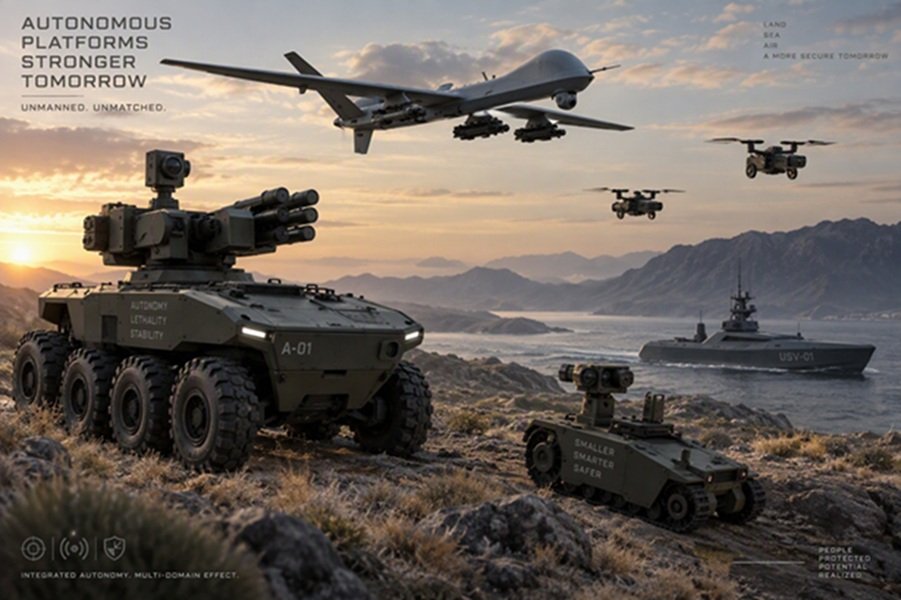
Title Image Courtesy: Copilot AI
Disclaimer: The views and opinions expressed by the author do not necessarily reflect those of the Government of India or the Defence Research and Studies.