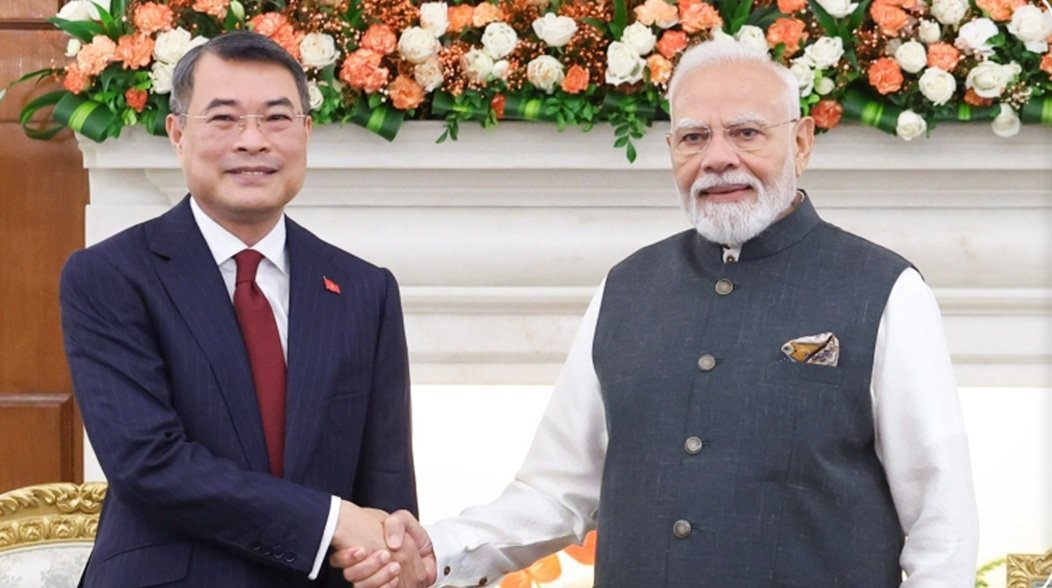
At the BRICS Summit in New Delhi, Vietnam has supported the ‘ASEAN Way’ and served as the ‘Voice of the Global South’. Vietnam came as an official BRICS partner country, where their Prime Minister, Lê Minh Hưng, leading the Vietnamese delegation.
The September 2026 BRICS Summit at New Delhi in India has concluded, and leaders of the 11 member countries (Brazil, China, Egypt, Ethiopia, India, Indonesia, Iran, Russia, Saudi Arabia, South Africa, and UAE) and 10 partner countries (Belarus, Bolivia, Cuba, Kazakhstan, Malaysia, Nigeria, Thailand, Uganda, Uzbekistan and Vietnam) have returned home after reaching a ‘consensus’ on diverse issues reflected in their 140-paragraph joint statement.
Vietnamese Prime Minister Le Minh Hung represented the country at the Summit. Hanoi’s choice to join the BRICS grouping stems from multiple factors. First, its national interests, which dictate its preference for multi-alignment and therefore its foreign policy choices, seek to reform institutions, strengthen multilateralism and enable Vietnam to join the global community efforts for a ‘just global order’.
Second, Vietnam is committed to national economic development and stability. Its economy grew by 8% in 2025 (global ranking 13th), which investors find highly attractive. Middle-class incomes are rising, resulting in higher demand for daily use good quality goods, technology merchandise, healthcare services, and educational opportunities, attracting foreign investment. The BRICS platform helps economic diversification.
Third, and closely associated with the above, is the critical necessity to integrate its growing export-oriented manufacturing economy with global supply chains. For instance, the “manufacturing sector grew nearly 10 percent in 2026, its strongest performance since 2019, and pulled in over US$21 billion in FDI, more than half of the country’s total foreign investment for the year”, which is a result of the “ continuation of a decade-long shift in which global companies have moved production, and increasingly entire supplier relationships, into Vietnam as part of broader global expansion and supply chain diversification strategies”. In this context, BRICS offers numerous opportunities while keeping difficult choices of geopolitical alignments at bay.
Fourth, BRICS has the potential to support Vietnam’s diversification of its supply chains and “therefore to prevent excessive dependence on any single market, supplier or technological ecosystem”. On the sidelines of the BRICS Summit, Vietnamese Prime Minister Le Minh Hung met Prime Minister Modi, the host of the Summit, and emphasised that both countries should “not only trade more goods and attract more investment, but also jointly research and develop technologies, jointly train human resources and participate more deeply in new value chains”.
Fifth is about energy security. The rapid industrialisation in Vietnam is driving a high demand for energy which, according to the government, should also be green. This adds to national climate resilience, leading to national security. BRICS offers opportunities for Vietnam to explore cooperation on energy security and clean-energy transition with the grouping members.
Finally, Hanoi’s support for the ASEAN Way. Vietnam, along with Indonesia, a BRICS Member country and Malaysia, a BRICS Partner country, are the three ASEAN (Association of Southeast Asian Nations) member country who have joined the BRICS grouping and support the ‘ASEAN way’, which is branded by ‘dialogue and consensus-building’. Philippines is the current Chair of ASEAN, and President Ferdinand Marcos represented the grouping at the BRICS Summit. He emphasised that the grouping’s “engagement with BRICS was guided by our principal belief in ASEAN centrality and constructive bridge-building, showing that practical partnerships can address pressing global challenges,”.
In the above context, perhaps a major achievement of the BRICS Summit was its ‘joint statement’, which was in the shadow given that there were major concerns about the text, particularly from Iran and the United Arab Emirates, who are on opposing sides of the war between Iran and US-Israel, to which they finally agreed, calling for “restraint in the Middle East war”, which has been assessed as a “sign of diplomatic progress between the countries divided by the war”. Earlier, in May 2026, the BRICS Foreign Ministers’ Meeting could not arrive at a common statement, and India, the Chair, had to put out a “Chair’s Statement and Outcome Document”.
All in all, Vietnam has accrued several benefits by participating in the BRICS Summit in New Delhi and maximised its stated goal of strategic diversification in many facets of its international relations, including global economic engagement and support for the ‘Voice of the Global South’.
Title Image Courtesy: PM India
Disclaimer: The views and opinions expressed by the author do not necessarily reflect those of the Government of India or the Defence Research and Studies.