For centuries, conventional strategic paradigms have treated science, indigenous traditions, and national security as distinct, non-converging domains. This paper explores a critical intersection where modern quantum mechanics, Vedic structural models, and contemporary threat modelling align. By analysing the decentralised logistics, systemic resilience, and operational traditions of the Jagannath Temple complex in Puri, Odisha, we identify a robust blueprint for societal defence. This study demonstrates that when systems logic and collective alignment reach their highest potential, they reveal a non-linear framework for national security. Ultimately, this paper reframes the concept of “Unity in Diversity” from a passive socio-political motto into an active, self-correcting defence mechanism capable of neutralising modern cognitive warfare and external subversion through Quantum and Vedic Paradigms.
Introduction
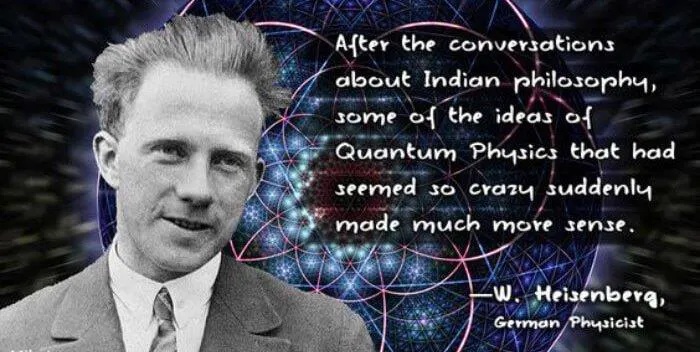
PC:https://medium.com/@margforpeace
Conventional strategic thought frequently relies on rigid binary choices to assess security, drawing a sharp divide between practical defence mechanisms and the fluid, experiential dynamics of societal consciousness. While traditional security apparatuses view these spaces as separate, contemporary unconventional warfare requires a more integrated approach. Quantum physics and ancient Vedic systems both offer models that challenge linear, deterministic security frameworks. Historically, these fluid, non-linear logic structures have been operationalised in India for centuries, preserved within its civilizational institutions.
This structural paradigm is highly visible within the systemic architecture, operational logistics, and enduring traditions of the Jagannath Temple in Puri, Odisha. When examined through the analytical lens of quantum mechanics, the continuous daily operations of this ancient complex offer a profound model for asymmetric defence. They demonstrate how highly diverse, autonomous components can systematically interact to produce a unified, resilient national consciousness that is fundamentally resistant to external polarisation.
The Superposition of Sustenance: Schrödinger’s Pots at Ananda Bazar
The daily operation of the sacred kitchen at Ananda Bazar provides an empirical study in highly scalable, decentralised logistics. The kitchen systematically manages a massive, fluctuating daily demand without relying on modern computerised logistics, cold-chain infrastructure, or centralised forecasting metrics. On any given day, the scale of participation varies dramatically, yet the supply of the Mahaprasad matches human demand without incurring deficits or yielding systemic waste.
Classical linear supply-chain algorithms cannot fully account for this operational predictability. Instead, it closely mirrors the non-linear principles of quantum mechanics, specifically Erwin Schrödinger’s 1935 formulation of macroscopic superposition (Schrödinger, 1935). In quantum theory, a system remains in a mathematical probability wave of multiple simultaneous states until an external measurement or observation occurs, forcing the wave function to instantly collapse into a single, concrete reality.
The traditional kitchen operators, the Suaras, function within a highly structured operational matrix. Food is cooked within the Rosa Ghara using a sacred flame, with nine unglazed earthen pots (kuduas) stacked vertically directly on top of each other. The units remain sealed throughout the thermal process; the operators do not inspect the internal contents, sample the food, or conduct inventory counts. Mathematically, the contents exist in a state of operational superposition—holding an indeterminate capacity relative to the unquantified external demand.
The transition from probability to exact reality occurs during the distribution phase. The systemic act of real-time distribution forces the indeterminate logistical variables to resolve into the exact macroscopic quantity required for that specific day. In threat modelling terms, this serves as an advanced structural framework for decentralised, self-regulating resilience. While classical security models depend on highly centralised, rigid structures that are highly vulnerable to single-point-of-failure disruptions, this framework demonstrates that an adaptive, fluid network can maintain structural equilibrium under highly erratic external pressures.
The Qubit of Consciousness: Navigating Our Inner Duality
The operational models observed in the Vedic paradigm apply directly to psychological defence and modern cognitive threat environments. Human populations operate much like quantum bits, or qubits, making them primary targets for contemporary cognitive warfare operations.
While classical computing architectures rely on binary bits restricted to fixed values of zero or one, a qubit inherits the law of quantum superposition, enabling it to exist as a zero, a one, or both states simultaneously (Nielsen & Chuang, 2010). This subatomic reality accurately models the pluralistic human consciousness within an integrated civilisation. The collective mind holds multiple cultural, regional, and social identities simultaneously in a balanced state until an acute crisis forces the systemic wave function to coalesce into focused action. Hostile external actors executing cognitive warfare typically exploit a classical binary approach. They attempt to manipulate social fault lines by forcing a population into rigid, polarised configurations (such as binary “us versus them” paradigms). However, by maintaining a societal framework built on Vedic-quantum fluid logic, a nation preserves its capacity to hold diverse identities concurrently. This cognitive flexibility serves as a critical defence, rendering the population highly resistant to psychological subversion, informational manipulation, and adversarial polarisation.
The Sacred Well and Spooky Action at a Distance
While cognitive resilience safeguards internal unity, external security relies on non-local, rapid societal cohesion. In 1935, Albert Einstein, Boris Podolsky, and Nathan Rosen identified a non-local correlation in quantum mechanics that Einstein famously called “spooky action at a distance” (Einstein et al., 1935). This principle, verified as quantum entanglement, establishes that when two particles become entangled, the state of one instantly determines the state of the other, completely independent of the spatial distance separating them (Bell, 1964).
This non-local connectivity is structurally mirrored during the annual Snana Yatra festival, where the Suna Kua (the Golden Well) is unsealed exclusively to yield exactly 108 pots of water for the ritual cleansing of the deities. According to long-standing civilizational tradition, this resource is not treated merely as a localised groundwater asset; it is understood to be inextricably linked to a non-physical, higher celestial domain (Vaikuntha).
In classical geography, a well is an isolated, physical point. Within this traditional paradigm, however, the ritual unsealing of the well functions as a non-local systemic anchor—operating as if it were quantum entangled with a broader cosmic network. It consistently yields the precise requirement of 108 structural units annually without relying on localised physical management, demonstrating that immediate, localised resources can be deeply bound to an overarching civilizational grid.
In contemporary threat modelling, this entanglement serves as an exceptional blueprint for national unity. In a resilient society, individual communities do not function as isolated, independent nodes. Instead, citizens are structurally entangled by a shared civilizational identity. Consequently, a security threat or cognitive attack directed at any single geographic or cultural segment instantly reverberates through the entire national consciousness, triggering an immediate, decentralised, and self-correcting defensive alignment across the entire population.
Conclusion
From the decentralised, self-regulating logistics of the Ananda Bazar kitchen to the fluid superposition of the human mind and the non-local connections of the Suna Kua, the Jagannath Temple ecosystem serves as an operational model where quantum principles and national resilience intersect. These parallels do not imply the historical presence of modern particle accelerators; rather, they demonstrate that at the zenith of systems logic and civilizational alignment, scientific principles and cultural structures converge on the same functional realities.
This synthesis offers a vital corrective to modern national security planning. Conventional threat modelling relies heavily on a classical, Newtonian approach—focusing almost exclusively on rigid binaries, physical borders, hard kinetic assets, and centralised surveillance. However, India’s primary contemporary vulnerabilities lie in the grey-zone domain: specifically, cognitive warfare, information operations, and internal polarisation designed by adversarial actors to exploit domestic fault lines.
The Vedic-quantum framework elevates “Unity in Diversity” from a passive political slogan into an active, asymmetric defensive asset. By treating a nation’s citizenry not as rigid, isolated components but as an interconnected collective operating in a state of harmonious cultural superposition, the national fabric becomes highly resilient against polarisation. Ultimately, integrating these indigenous, system-wide frameworks allows India to convert its vast cultural plurality into its greatest strategic defence—rendering the nation’s social architecture completely indomitable against both kinetic and cognitive subversion.
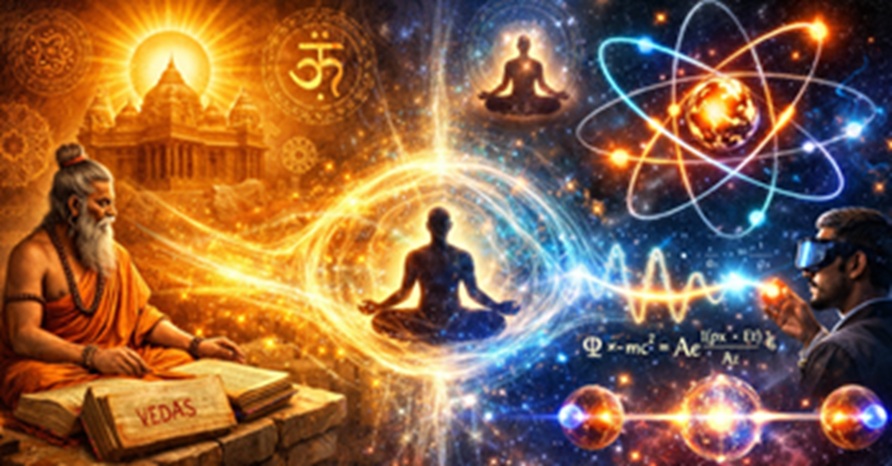
Title Image Courtesy: Copilot AI
Disclaimer: The views and opinions expressed by the author do not necessarily reflect the views of the Government of India and the Defence Research and Studies.


References
- Bell, J. S. (1964). On the Einstein Podolsky Rosen paradox. Physics Physique Fizika, 1(3), 195–200. https://doi.org/10.1103/PhysicsPhysiqueFizika.1.195
- Einstein, A., Podolsky, B., & Rosen, N. (1935). Can quantum-mechanical description of physical reality be considered complete? Physical Review, 47(10), 777–780. https://doi.org/10.1103/PhysRev.47.777
- Nielsen, M. A., & Chuang, I. L. (2010). Quantum computation and quantum information (10th anniversary ed.). Cambridge University Press. https://doi.org/10.1017/CBO9780511976667
- Schrödinger, E. (1935). Die gegenwärtige Situation in der Quantenmechanik [The current situation in quantum mechanics]. Naturwissenschaften, 23(48), 807–812. https://doi.org/10.1007/BF01491891