Activists and diaspora groups symbolically mark August 11 as Baluchistan’s Independence Day. The Baluchistan freedom movement is a long-standing political and militant campaign seeking self-determination and sovereignty from Pakistan, rooted in the disputed March 1948 annexation of the former princely state of Kalat.
A Conflict Rooted in History, Geography and Identity
Balochistan has once again emerged as one of South Asia’s most consequential internal-security fault lines. What was for decades treated by Islamabad as a peripheral insurgency has increasingly acquired the characteristics of a sustained hybrid conflict involving armed separatism, political mobilisation, information warfare, attacks on Chinese interests, cross-border dynamics and growing international attention. The coordinated attacks launched by the Balochistan Liberation Army (BLA) in January 2026, followed by a major Pakistani military operation, demonstrated that the insurgency has acquired a level of organisation and operational reach that cannot be dismissed as merely a collection of tribal militants. Pakistan announced that 216 militants had been killed during its week-long Operation Radd-ul-Fitna 1, while BLA claims of much higher Pakistani casualties could not be independently verified. The episode nevertheless represented one of the most serious challenges to Pakistani authority in the province in years.
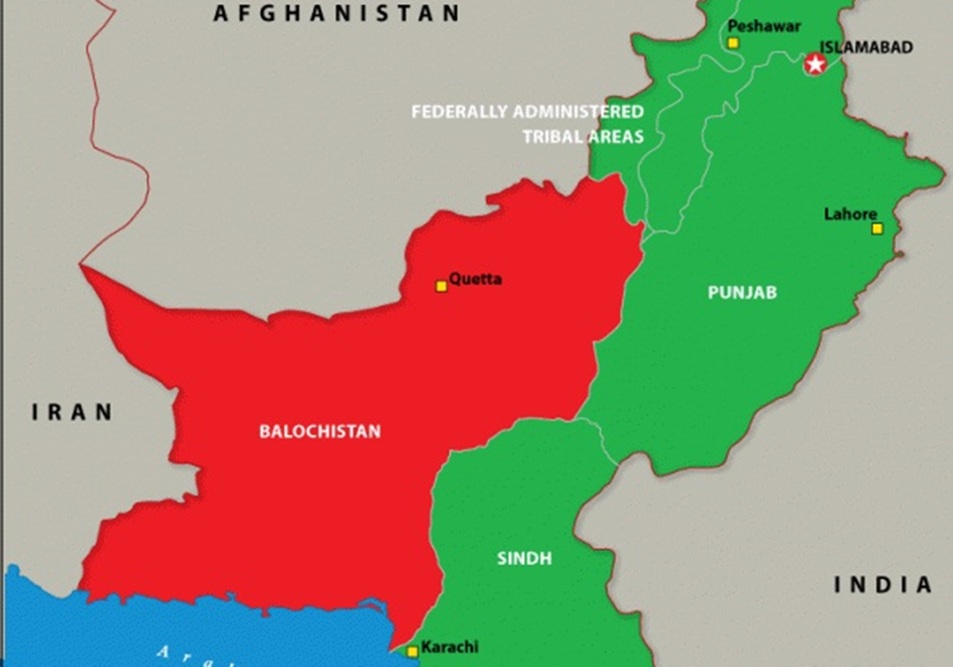
The deeper significance lies not simply in the number of attacks but in the convergence of three forces: Baloch nationalism, longstanding grievances against the Pakistani state and the increasingly strategic value of Baluchistan to China and Pakistan. Gwadar, the mineral wealth of the province, its coastline on the Arabian Sea, its proximity to Iran and Afghanistan and its position astride potential trade and energy corridors make Baluchistan much more than an internal Pakistani problem.
The central contradiction is therefore stark: the more strategically important Baluchistan becomes to Islamabad and Beijing, the more intensely some Baloch nationalist forces perceive development as an extension of external control.
The Making of Baluchistan
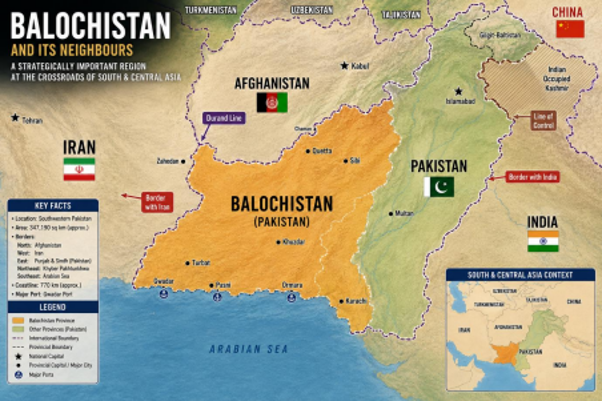
Modern Baluchistan is not the product of a single historical political unit. The region developed over centuries as a cultural and geographical space extending across what are today Pakistan, Iran and Afghanistan. Baloch tribes historically occupied a vast, difficult terrain stretching from the Iranian plateau to the Arabian Sea and from Sindh towards southern Afghanistan.
The Baloch identity is consequently transnational. The Balochi language, tribal affiliations and cultural networks extend beyond contemporary international boundaries. Pakistan contains the largest Baloch population, while substantial Baloch communities live in Iran and Afghanistan. The result is a classic example of a pre-modern ethnocultural geography being divided by modern state boundaries.
The political history of the region became particularly complicated during British expansion. In the nineteenth century, British authorities progressively established control over parts of Balochistan while retaining the Khanate of Kalat as a princely entity. The British-administered areas and the princely states of Kalat, Kharan, Las Bela and Makran did not constitute precisely the same political entity. The Goldsmid boundary settlement of 1871 divided Baloch areas between Persian and British spheres, while the Durand Agreement of 1893 subsequently created the frontier between Afghanistan and British India.
This colonial cartography remains strategically important. The borders were designed primarily according to imperial security calculations rather than Baloch national aspirations. Modern Pakistan inherited these boundaries in 1947, thereby inheriting not only territory but unresolved historical questions.
Kalat and the Accession Controversy
The most important historical reference point for contemporary Baloch nationalism is the Khanate of Kalat. As British rule ended in 1947, the political status of Kalat became contested. Baloch nationalists maintain that Kalat had a distinct treaty relationship with Britain and therefore regained sovereign status after the British withdrawal. Pakistan’s position is that the constitutional and political process eventually resulted in accession to Pakistan.
The historical record is more complicated than either narrative suggests. British-administered Baluchistan and Kalat were separate political arrangements. The Shahi Jirga of British Baluchistan voted for Pakistan in June 1947, but representatives of Kalat were not part of that particular process. The Khan of Kalat initially sought independence and later signed an Instrument of Accession to Pakistan on 27 March 1948. The decision generated resistance within his own family, particularly from Prince Abdul Karim, who launched an armed revolt later that year.
For Islamabad, 27 March 1948 represents legal accession. For Baloch nationalists, it represents the beginning of what they describe as incorporation by coercion. This difference is not merely historical. It provides the intellectual foundation for contemporary separatism.
The importance of 11 August is particularly noteworthy. Baloch nationalist movements regard 11 August 1947 as the date on which Kalat declared independence from British rule. The date has now become a powerful political symbol. In August 2026, Baloch activists have again called for 11 August to be observed as Baluchistan’s Independence Day.
An Ethnically Complex Province
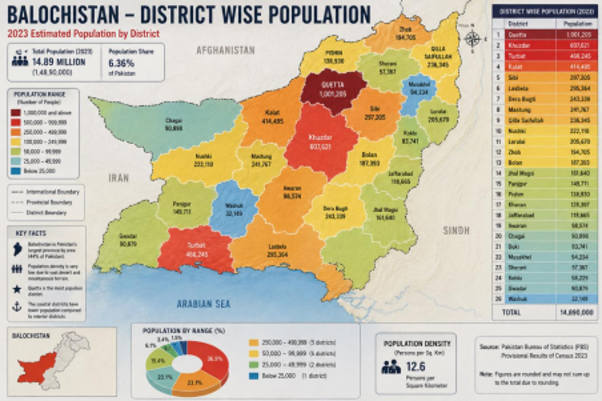
It would nevertheless be a mistake to describe Baluchistan as an ethnically homogeneous Baloch territory. The province contains Baloch, Brahui, Pashtun, Hazara and other communities, together with migrants and settlers from other parts of Pakistan. Pashtun populations are particularly significant in northern Baluchistan, including around Quetta. The Brahui-speaking population is another important component of Baluchistan’s social structure. This complexity has strategic consequences. The separatist narrative is strongest in predominantly Baloch areas, but the province as a whole cannot automatically be equated with the Baloch nationalist movement.
Indeed, one of the most important analytical distinctions is between Baluchistan’s population and Baloch separatism. Not every Baloch supports independence. The official provincial history itself acknowledges that demands range from greater autonomy to full secession, and that the separatist position does not represent all Baloch citizens. This distinction matters enormously when assessing the prospects of an independent Baluchistan.
Afghanistan and the Unfinished Border Question
Baluchistan’s western geography creates another layer of complexity. The Durand Line, established in 1893 between British India and Afghanistan, divided Pashtun and Baloch-inhabited areas. Afghanistan historically refused to accept the border as a permanent international frontier, and the dispute has survived successive Afghan governments.
For Pakistan, the Durand Line is an international border. For successive Afghan regimes, the question has been more complicated. This unresolved frontier has produced a persistent security environment in which movement of tribes, militants, refugees, smugglers and political activists across the border is difficult to control.
The Baloch insurgency therefore operates within a broader frontier environment already characterised by weak state penetration and competing national identities. The Afghanistan-Pakistan relationship has deteriorated further in recent years, with Islamabad accusing elements operating from Afghan territory of supporting attacks inside Pakistan. Afghanistan rejects such allegations. Baluchistan consequently sits at the intersection of two unresolved questions: the Baloch national question and the Afghanistan-Pakistan frontier question.
Why has the Insurgency Survived?
The durability of the insurgency cannot be explained simply through foreign interference. The fundamental drivers are domestic. Political marginalisation, uneven development, perceptions of exploitation of mineral resources, unemployment, weak public services, disappearances, allegations of extrajudicial killings and the dominant role of Pakistan’s security establishment have created an environment in which separatist organisations can recruit.
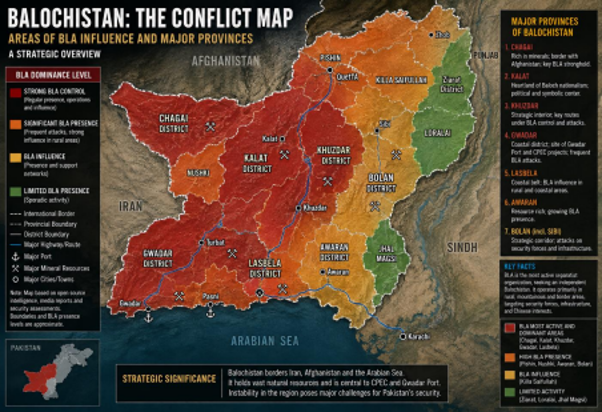
The issue of resources is particularly important. Baluchistan possesses substantial reserves of natural gas, coal, copper, gold and other minerals. Yet many local communities believe that the province has remained poor despite its natural wealth. The grievance is therefore not merely economic. It is political: who owns Baluchistan’s resources, who controls their exploitation and who receives the benefits?
The Gwadar experience has reinforced this perception. China and Pakistan have invested heavily in the port and associated infrastructure under the China Pakistan Economic Corridor. The Pakistani government describes these projects as transformational. Many Baloch activists, however, argue that local communities have not received commensurate benefits and that their land, fisheries and political space have been subordinated to strategic infrastructure. Gwadar protests have repeatedly highlighted restrictions on fishing, movement and economic access. Thus, development itself has become securitised.
From Political Nationalism to Armed Insurgency
Baloch resistance has passed through several phases. There were uprisings in 1948, 1958–59, 1962–63 and 1973–77. The contemporary insurgency began around 2003 and has continued in different forms. The most significant armed organisation today is the Baluchistan Liberation Army(BLA).
The BLA has evolved considerably from an essentially tribal insurgent structure into a more sophisticated organisation combining guerrilla warfare, intelligence gathering, propaganda, suicide operations, improvised explosive devices, small-unit attacks and increasingly sophisticated communications.
Its Majeed Brigade has become particularly important. The organisation has demonstrated an ability to conduct high-profile attacks designed not merely to inflict casualties but to generate strategic and psychological effects. The United States designated the BLA as a Foreign Terrorist Organisation in 2019, while Britain has proscribed it as a terrorist organisation. The British description states that the BLA seeks an independent state encompassing Baloch-majority areas of Pakistan, Afghanistan and Iran.
The BLA is not the only armed actor. The Baloch Liberation Front and other nationalist groups have also operated in the region. There are differences in organisation, ideology and geographical focus, but they share opposition to Pakistani state control. At the same time, Baluchistan faces threats from Islamist organisations that are ideologically distinct from Baloch separatists. This makes the security environment especially complex. Pakistan is effectively fighting different insurgencies simultaneously: ethnic-nationalist separatism in Baluchistan and jihadist militancy elsewhere.
The Transformation of the BLA
The most significant development in recent years has been the increasing sophistication of BLA operations. The January 2026 attacks demonstrated coordinated action across multiple locations, including government facilities, security installations, banks and other infrastructure. Pakistan subsequently conducted a large-scale military operation. Reuters reported that the BLA had become the strongest among several insurgent organisations operating in Baluchistan and had increasingly targeted Chinese interests.
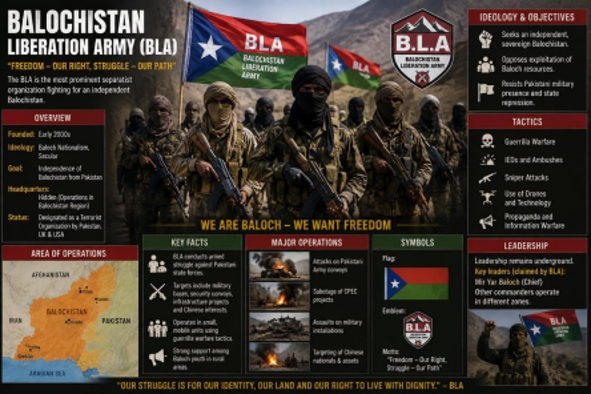
The emergence of female suicide operatives is another significant development. Reuters reported that six women participated in January operations, including three suicide bombers. The report also highlighted the insurgents’ use of drones, satellite communications and advanced weaponry. This suggests that the insurgency is becoming less dependent on traditional tribal mobilisation. The battlefield is moving from the mountains into the information domain, urban centres and strategic infrastructure.
Pakistan’s Response: Force Without Political Resolution
Islamabad has predominantly responded through a security-centric approach. Military operations, intelligence operations, arrests, checkpoints, restrictions on movement and measures against separatist political networks have been central to the Pakistani response. The state argues that it is confronting terrorist organisations determined to dismember Pakistan. But the opposite proposition is equally important: counterterrorism can suppress an insurgency without eliminating the political conditions that reproduce it.
The United Nations human-rights system has received allegations concerning arbitrary arrests, enforced disappearances, mistreatment in detention, extrajudicial killings and excessive force against peaceful Baloch protesters. These are allegations rather than judicially established findings in every individual case, but their persistence has become an important component of the insurgency’s political narrative.
The danger for Pakistan is therefore a classic counterinsurgency dilemma. Every militant killed may reduce immediate operational capacity, but every civilian death or disappearance alleged to be unjust can generate recruits and strengthen separatist narratives.
The Declaration of Independence: Symbolic rather than Sovereign
The recent declaration of a “Republic of Baluchistan” deserves careful examination. In July 2026, activist Mir Yar Baloch and associated circles circulated claims that an independent Republic of Baluchistan had been established, including claims of a national flag, anthem, currency and territorial control. Independent fact-checking organisations reported that these claims could not be verified and that neither Pakistan nor any international organisation had recognised the entity.
Legally and strategically, therefore, the declaration has little immediate effect on sovereignty. A declaration becomes consequential when it is supported by effective territorial control, functioning institutions, a sustainable administrative system, armed capability, population legitimacy and international recognition. At present, the Baloch independence movement does not satisfy those conditions.
Its importance is nevertheless greater in the information domain. The declaration internationalises the narrative, provides diaspora communities with a political symbol and attempts to convert an insurgency into a national liberation struggle. It also places pressure on India and Western governments to clarify their positions. Its greatest immediate value is therefore psychological and diplomatic rather than territorial.
International Interference: Fact, Allegation and Strategic Ambiguity
Pakistan has repeatedly alleged Indian support for Baloch separatists. India has denied such allegations and has not publicly acknowledged supporting the BLA. There is insufficient publicly verified evidence to conclude that India directs the BLA’s operations. A serious strategic assessment must resist the temptation to convert Pakistani allegations into facts. At the same time, the international dimension cannot be ignored.
Iran faces its own Baloch insurgency in Sistan and Baluchistan. Jaysh al-Adl, formerly associated with Jundallah, operates primarily in Iran’s southeastern province and adjoining Baloch areas of Pakistan and Afghanistan. The United States National Counterterrorism Centre describes its operating area as extending across these three countries. The 2024 Iran-Pakistan exchange of strikes against alleged militant targets demonstrated how rapidly Baloch militancy can become an interstate-security issue.
Afghanistan constitutes another potential external factor, particularly because of Pakistan’s deteriorating relations with the Taliban government and the unresolved border question. China is the third major external actor. Beijing’s interest is fundamentally strategic. Gwadar provides China with a foothold on the Arabian Sea and is central to the geographic conception of CPEC. Chinese nationals and projects have therefore become deliberate targets for Baloch militants. The security problem has consequently become a China-Pakistan problem rather than merely a Pakistan-Baluchistan problem.
The China Factor
For Beijing, Baluchistan presents a difficult strategic equation. China can provide Pakistan with infrastructure, capital and technology, but it cannot easily manufacture political legitimacy among the local population.
The repeated targeting of Chinese citizens has already forced Beijing to place security at the centre of its Pakistan relationship. CPEC projects have faced delays and heightened security requirements. Gwadar, originally presented as an economic transformation project, has increasingly acquired the characteristics of a fortified strategic enclave. This is precisely the outcome that Baloch separatists seek to exploit. Every attack on a Chinese project demonstrates Pakistan’s inability to guarantee security. Every security reinforcement by China and Pakistan can, in turn, reinforce the separatist argument that Baluchistan is being militarised for external interests. The strategic paradox is profound: CPEC was intended to integrate Baluchistan economically; insecurity risks transforming it into a heavily securitised corridor.
Impact on Pakistan
For Pakistan, the Baluchistan problem is ultimately a question of state capacity. The province represents almost half of Pakistan’s landmass and provides strategic depth towards the Arabian Sea, Iran and Afghanistan. It contains Gwadar and major mineral and energy resources. Persistent insurgency therefore affects territorial cohesion, economic development, foreign investment and military deployment. The financial burden is substantial, but the strategic burden is greater.
The Pakistan Army must maintain significant forces in a geographically enormous province with difficult terrain. Lines of communication are vulnerable. Infrastructure projects require security protection. Chinese investments require dedicated protection. Political instability undermines investor confidence.
More importantly, prolonged insurgency strengthens the role of the military in Pakistan’s political system. This can create a feedback loop in which security imperatives justify greater centralisation, while greater centralisation produces additional regional resentment. The Baluchistan problem therefore has implications for Pakistan’s civil-military balance as well as its territorial integrity.
What Does it Mean for India?
India’s interest in Baluchistan is strategic rather than territorial. For New Delhi, a weakened Pakistan military establishment and an internally preoccupied Pakistan could reduce Islamabad’s ability to concentrate resources against India. In a future India-Pakistan crisis, Baluchistan could become an additional strategic pressure point for Pakistan. But India must distinguish between exploiting Pakistani vulnerabilities and becoming directly associated with separatist violence.
An overt Indian role would provide Islamabad with a powerful diplomatic narrative and could allow Pakistan to recast a domestic political conflict as an externally sponsored security problem. India’s most effective position is therefore likely to remain one of strategic ambiguity combined with emphasis on human rights, political representation and peaceful political aspirations.
There is also an important maritime dimension. Baluchistan’s coastline stretches along the Arabian Sea, and Gwadar lies close to the approaches linking the Persian Gulf, Arabian Sea and Indian Ocean. Any prolonged instability around Gwadar affects China’s maritime ambitions and Pakistan’s naval posture. For India, the security of the western Indian Ocean, the Makran coast and the approaches towards the Strait of Hormuz cannot be separated from developments in Baluchistan. Could Baluchistan Actually Become Independent?
In the short term, an independent Baluchistan is unlikely. The principal obstacle is not the absence of separatist sentiment. It is the absence of the institutional and international conditions necessary for successful state formation.
Pakistan retains overwhelming military superiority. The separatist organisations do not exercise uncontested control over major cities or administrative institutions. The Baloch population itself is politically divided. Pashtun areas of northern Baluchistan have different political dynamics. Iran would almost certainly oppose any separatist precedent that could energise its own Baloch population. Afghanistan’s position would be shaped by its own Pashtun and border calculations. China would strongly oppose instability threatening Gwadar and CPEC.
International recognition would therefore be extremely difficult. The more realistic near-term possibility is not an internationally recognised Baloch state but a protracted insurgency producing de facto zones of insecurity. This could resemble other long-running conflicts in which the state retains formal sovereignty but faces persistent challenges to effective control.
The Real Danger: the Conflict Becoming Generational
The greatest strategic danger for Pakistan is not that the BLA will suddenly defeat the Pakistani military. It is that the conflict will become generational.
A young Baloch who grows up amid stories of disappearances, military operations, poverty and political exclusion may become receptive to separatist narratives. The state can eliminate organisations, but unless it addresses the political ecosystem that allows those organisations to regenerate, another organisation can emerge. This is why military victory and political settlement cannot be treated as alternatives. Pakistan requires both.
A sustainable solution would require genuine political dialogue, transparent resource-sharing mechanisms, credible provincial autonomy, accountable security operations, investigation of enforced-disappearance allegations, economic participation for local communities and a development model in which Gwadar and mineral projects visibly benefit Baluchistan’s population.
The alternative is a cycle in which development produces displacement, displacement produces protest, protest produces repression, repression produces radicalisation, and radicalisation produces more military operations.
Strategic Outlook
Baluchistan is unlikely to disappear from Pakistan’s security agenda. On the contrary, its importance is likely to grow. Three trends deserve particular attention. First is the increasing sophistication of BLA operations. Second is the deepening securitisation of Chinese investments. Third is the internationalisation of the Baloch political narrative through diaspora networks and social media.
The July 2026 independence declaration should therefore not be dismissed merely because it lacks legal standing. Its immediate territorial claims may be unverified, but the political message is significant. It demonstrates that sections of the Baloch nationalist movement are attempting to move from insurgency towards statehood diplomacy.
The question for Pakistan is whether it can prevent that narrative from acquiring broader international legitimacy. For India, the situation demands strategic patience. Baluchistan is an important vulnerability in Pakistan’s internal security architecture, but instability in a nuclear-armed neighbour is not automatically advantageous. A fragmented Pakistan could generate consequences involving terrorism, refugee flows, maritime insecurity, Chinese military involvement and intensified great-power competition.
India’s strategic objective should therefore be a stable neighbourhood rather than an unstable Pakistan. The Baloch question ultimately illustrates a larger principle of contemporary national security: territorial sovereignty can survive militarily while eroding politically. Pakistan still possesses the military capacity to retain Baluchistan. The more difficult question is whether it can build sufficient political legitimacy to make continued sovereignty sustainable. That distinction may determine the future of Baluchistan.
As the province becomes increasingly important to China’s Indian Ocean ambitions, Pakistan’s mineral strategy and regional connectivity, the Baloch insurgency will acquire consequences far beyond its mountains and deserts. What began as a dispute over accession, autonomy and identity has evolved into a contest involving terrorism, nationalism, human rights, resources, China, Iran, Afghanistan and the strategic balance of the Arabian Sea. Baluchistan is therefore no longer simply Pakistan’s internal frontier. It is becoming one of the defining geopolitical fault lines of South Asia.
Title Image Courtesy: Jagran Josh
Disclaimer: The views and opinions expressed by the author do not necessarily reflect those of the Government of India or the Defence Research and Studies.