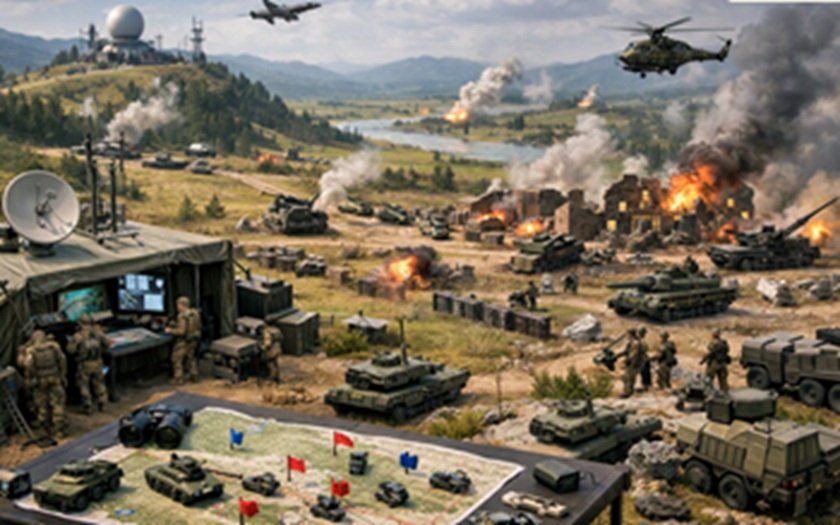
Modern warfare is undergoing a profound transformation. The acceleration of sensor technologies, autonomous systems, multi‑domain operations, and AI‑enabled decision support has reshaped how militaries plan, fight, and adapt. At the centre of this transformation lies Command and Control (C2), the nervous system of military operations. As the battlespace becomes more complex, contested, and data‑saturated, traditional C2 processes struggle to keep pace. This is where C2 wargaming solutions emerge as a decisive capability, enabling militaries to simulate, test, refine, and optimise decision‑making in realistic, multi‑domain environments.
C2 wargaming is no longer confined to tabletop exercises or manual simulations. Today’s solutions integrate advanced modelling, AI‑driven analytics, real‑time data ingestion, and immersive interfaces to create dynamic environments where commanders can experiment with strategies, evaluate force structures, and stress‑test operational plans. These systems are becoming indispensable for armed forces seeking to maintain decision superiority in an era defined by speed, complexity, and uncertainty.
The Evolution of C2 Wargaming
Historically, wargaming served as a tool for strategic planning and officer training. From Prussian Kriegsspiel to Cold War nuclear simulations, militaries used structured games to explore operational concepts. However, these methods were limited by manual adjudication, static rules, and slow iteration cycles.
The digital revolution introduced computer‑based simulations, enabling faster calculations and more detailed modelling. Yet even these early systems lacked the fidelity and adaptability required for modern multi‑domain operations.
Today’s C2 wargaming solutions represent a leap forward. They combine:
- High‑fidelity modelling of land, air, maritime, cyber, and space domains
- AI‑enabled decision agents that simulate adversary behaviour
- Real‑time data fusion from ISR, sensors, and open‑source intelligence
- Immersive interfaces such as 3D visualisation and VR/AR environments
- Automated adjudication for rapid scenario iteration
This evolution has transformed wargaming from a planning tool into a continuous decision‑support system (DSS).
Core Functions of Modern C2 Wargaming Solutions
1. Operational Planning and Scenario Development
C2 wargaming platforms allow planners to construct detailed scenarios reflecting real‑world geography, force structures, and threat environments. These scenarios can incorporate enemy order of battle, terrain and weather effects, electronic warfare conditions, identifying cyber vulnerabilities and logistics constraints. Planners can rapidly modify variables to explore alternative courses of action (COAs), enabling a deeper understanding of operational risks and opportunities.
2. Decision‑Support and Course‑of‑Action Analysis
One of the most valuable aspects of modern wargaming is its ability to support decision‑making. AI‑driven engines evaluate COAs based on probability of mission success, casualty estimates, resource consumption, time taken for the mission or objective and extent of collateral damage. Commanders can compare COAs side‑by‑side, identify bottlenecks, and refine strategies before committing forces and choose the best COA for execution.
3. Multi‑Domain Integration
Contemporary conflicts are fought across interconnected domains. C2 wargaming solutions model interactions between air and missile defence networks, naval task forces and anti‑access/area‑denial (A2/AD) systems, cyber operations affecting kinetic engagements and space‑based ISR supporting ground operations. This multi‑domain integration is essential for understanding how actions in one domain cascade into others.
4. Red Teaming and Adversary Modelling
Effective wargaming requires realistic adversary behaviour. Modern systems incorporate AI‑driven red teams, behavioural models based on historical patterns, adaptive adversary strategies and emulation of cyber threats. This ensures that commanders face credible, evolving threats rather than predictable scripted opponents. Developing realistic adversary strategies and tactics is a challenging task during the development of C2 Wargaming.
5. Training and Human Performance Enhancement
C2 wargaming is a powerful training tool for commanders and staff. It enhances situational awareness, decision‑making under pressure, joint and combined operations coordination and understanding of emerging technologies. Immersive environments allow personnel to rehearse missions repeatedly, improving readiness and reducing cognitive load during real operations.
Technological Pillars of C2 Wargaming
Artificial Intelligence and Machine Learning
AI enables rapid scenario generation, automated adjudication, and predictive analytics. Machine learning models can identify patterns in adversary behaviour, optimise logistics, and recommend COAs.
Digital Twinning
Digital twins of battlefields, platforms, and systems allow militaries to simulate operations with high fidelity. A digital twin of a naval task force, for example, can model sensor ranges, fuel consumption, and vulnerability to missile threats.
Cloud‑Based Architectures
Cloud platforms support scalable simulations, collaborative planning, and integration of real‑time data. They also enable distributed wargaming across multiple command centres.
Immersive Visualization
3D maps, VR interfaces, and augmented reality overlays enhance situational awareness and allow commanders to “see” the battlespace in unprecedented detail.
Cyber‑Physical Integration
Modern wargaming incorporates cyber effects, electronic warfare, and information operations, reflecting the reality that digital attacks can shape kinetic outcomes.
Gaming Applications
Strategic Level
At the strategic level, wargaming supports force structure development, long‑term capability planning, assessment of geopolitical risks and even evaluation of deterrence strategies. Governments use strategic wargaming to test national security policies and anticipate adversary responses.
Operational Level
Operational wargaming focuses on campaign design, joint operations, and theatre‑level coordination. It helps commanders integrate air, land, sea, cyber, and space forces, plan major offensives or defensive operations, evaluate logistics and sustainment plans and test interoperability with allies
Tactical Level
Tactical wargaming supports unit‑level training and mission rehearsal at the lowest level. It enhances fire and attack coordination, close air support integration, urban operations planning, missile defence, counter-UAS and even counter-EW tactics.
Benefits for Modern Armed Forces
1. Decision Superiority
In fast‑moving conflicts, the side that makes better decisions faster gains a decisive advantage. C2 wargaming accelerates decision cycles and improves decision quality, and hence creates superiority over the adversary.
2. Risk Reduction
By testing plans in simulated environments, militaries reduce operational risk and avoid costly mistakes, thus saving resources and men.
3. Enhanced Readiness
Continuous wargaming ensures that commanders and staff remain prepared for emerging threats. Switching from a gaming scenario to live can be done at any time.
4. Innovation and Concept Development
Wargaming is a powerful tool for exploring new doctrines, technologies, and operational concepts such as swarm tactics, autonomous systems integration, distributed maritime operations and multi‑domain command and control.
5. Strengthened Joint and Coalition Operations
Shared wargaming platforms improve interoperability, communication, and coordination among allied forces.
Challenges and Considerations
Despite its advantages, C2 wargaming faces several challenges. Availability of quality data, fidelity of modelling and its proximity to real-time scenarios, plugging cybersecurity risks, integration with existing legacy systems and trust issues with autonomous systems. Armed Forces must invest in robust data pipelines, secure architectures, and training to fully leverage wargaming capabilities.
The Future of C2 Wargaming
The next generation of C2 wargaming will be defined by AI‑autonomous adversaries capable of learning and evolving, and Real‑time wargaming integrated directly into live operations. Quantum‑enhanced simulations for complex optimisation problems and fully immersive synthetic environments blending real and virtual data can take this gaming to the next level. Interoperable global wargaming networks for coalition operations are another area where nations can partner and prepare for the D-Day. As warfare becomes increasingly algorithmic, wargaming will evolve from a planning tool into a continuous operational companion—supporting commanders from peacetime preparation to real‑time conflict management.
Conclusion
Military C2 wargaming solutions are reshaping how armed forces plan, train, and fight. By integrating advanced modelling, AI‑driven analytics, and multi‑domain simulation, these systems provide commanders with unprecedented insight into the complexities of modern warfare. In an era where decision superiority determines victory, C2 wargaming stands as one of the most critical enablers of operational excellence and strategic advantage.
Title Image Courtesy: Copilot AI
Disclaimer: The views and opinions expressed by the author do not necessarily reflect those of the Government of India or the Defence Research and Studies.