
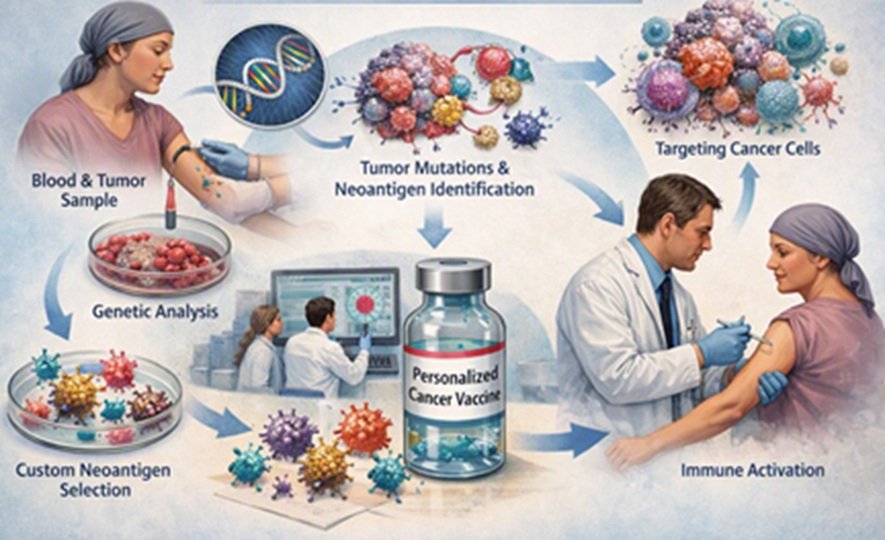
The recent development and administration of a personalised cancer vaccine in Russia have marked a turning point in modern medicine & revolutionary cancer treatment. The breakthrough, which has been named NeoOncovac, has not only introduced a new therapeutic tool but has also redefined how cancer treatment is now being understood. It is no longer taken as a generalised approach, but as an intervention tailored to each patient, based on his/her constitution and condition.
This advancement, driven by the National Medical Research Radiological Centre of the Russian Ministry of Health together with the Gamaleya National Research Centre of Epidemiology and Microbiology, has mercifully opened the doors for a new era in which personalised medicine could become the norm rather than the exception, improving the quality of life for cancer patients.
It has been reported that the first patient to receive this treatment has been a 60-year-old man from the Kursk region, diagnosed with cutaneous melanoma. The procedure was carried out after clinical use authorisation was granted by Russian health authorities. This marked the first official approval worldwide for a personalised mRNA-based anti-tumour vaccine.
Although the term ‘vaccine’ has usually been associated with disease prevention, in this revolutionary case it functions as a therapeutic, as the vaccine has been designed for people already diagnosed with cancer, and the vaccine helps patients activate their immune system to fight the disease more precisely.
According to the official explanation provided by the National Medical Research Radiological Centre of the Russian Ministry of Health, the principle behind NeoOncovac is based on identifying the unique characteristics of each patient’s tumour. Through detailed genetic analysis, specific mutations are detected that generate abnormal proteins—known as neoantigens—present only in cancer cells. These neoantigens become the main target of the treatment.
According to the Russian authorities, this vaccine has been developed using messenger RNA (mRNA) technology, a tool that had been under research for years but gained global attention during the COVID-19 pandemic. In simple terms, the Russian mRNA vaccine acts as an ‘instruction manual’ for the body’s cells, telling them which proteins to produce. It has been specifically reported that the NeoOncovac passes on necessary information for the body to generate fragments of the tumour neoantigens that have been previously identified.
It has been pointed out that once the vaccine is administered, the patient’s cells begin to produce the required specific proteins, allowing the patient’s immune system to recognise them as a threat. This vaccine helps T cells, the cells responsible for immune defence, activate themselves and learn to identify and destroy the real cancer cells that carry those same signals.
The General Director of the National Medical Research Radiological Centre Russia has stated that this approach represents a paradigm shift in oncology. As per his statement, the goal is no longer limited to attacking the tumour with external treatments such as chemotherapy or radiation therapy, but also to ‘train’ the patient’s own immune system to act selectively and continuously, teaching the patient’s body to accurately recognise what represents a threat and eliminate it more efficiently.
It has also been reported that this treatment is not administered on its own, but has been designed to be combined with immune checkpoint inhibitors, a class of medications that help boost the immune system’s response against cancer. The synergy between both strategies aims to maximise the body’s ability to fight the disease.
Russian authorities have stated that the treatment with NeoOncovac is specifically aimed at adult patients with cutaneous melanoma at different clinical stages. This includes both individuals with localised tumours and those with advanced, inoperable, or metastatic disease. In these latter cases, where treatment options are often more limited, the possibility of having a personalised therapy represents a promising alternative.
Status in Other Countries
Houston Methodist USA has stated that it has achieved a breakthrough to reshape cancer treatment and has developed its first personalised mRNA cancer vaccine- designed to prevent recurrence of osteosarcoma, a rare and aggressive type of bone cancer.
It feels that this approach could transform cancer care. Its ability to design a vaccine that trains the immune system to recognise and attack cancer cells unique to each patient would open the door to treating many other cancer types. This first-of-its-kind treatment was made possible through a compassionate use allowance from the U.S. Food and Drug Administration (FDA) and represents a major step in personalised medicine and cancer care. Interestingly, Moderna & Merck have also announced their personalised mRNA cancer treatments.
In 2025, China announced the emergence of XH001, the mRNA personalised tumour neoantigen vaccine developed by NeoCura using AI technology, launched at Peking Union Medical College Hospital. This is the first Chinese mRNA personalised tumour neoantigen vaccine to enter the clinical stage.
India is also moving forward in this field. A major breakthrough has been achieved by Dr Anil Suri, Director of the Centre for Cancer Immunotherapy at Mahatma Gandhi University of Medical Sciences and Technology, Jaipur, and his team, which has been leading the research for the past 27 years to develop this technology. Based on this technology, Rajasthan (India) is set to manufacture India’s first indigenous cancer vaccine that promises effective treatment at a fraction of the current cost. The Dendritic Cell Vaccine, developed using desi technology, has received approval for production at Mahatma Gandhi Medical College, Jaipur. This vaccine is expected to treat five types of cancer and could be a game-changer in affordable cancer treatment. Dr Suri has stated that the Dendritic Cell Vaccine is an immunotherapy-based cancer vaccine that trains the body’s immune system to identify and destroy cancer cells effectively. One of the biggest advantages of this vaccine is its cost-effectiveness. While similar treatments in the US and the UK cost around Rs 25 lakh, this indigenous vaccine will be available for just Rs 10,000, making it a low-cost alternative to expensive cancer treatments.
It is heartening to see that many serious breakthroughs have been achieved by many countries in the world for effective treatment of cancer. The author would like to wish all of them resounding success in improving the quality of life of cancer patients worldwide.
Title Image Courtesy: Copilot AI
Disclaimer: The views and opinions expressed by the author do not necessarily reflect those of the Government of India or the Defence Research and Studies.


References
Falah, Natalia, 08 Apr 2026, NeoOncovac: The World’s First Personalised mRNA Cancer Vaccine, https://colombiaone.com/2026/04/08/neooncovac-worlds-first-personalized-mrna-cancer-vaccine/
Houston Methodist, 13 May, 2026, Houston Methodist develops first personalised mRNA cancer vaccine for osteosarcoma, https://www.houstonmethodist.org/newsroom/houston-methodist-develops-first-personalized-mrna-cancer-vaccine-for-osteosarcoma/
NeoCura, 24 Oct 2025, China’s First mRNA Personalised Neoantigen Cancer Vaccine XH001 Enters Phase I Clinical Trial, https://www.vcbeathealth.com/article/6015
The News Radar, 14 Feb, 2025, India’s first cancer vaccine that can prove game-changer in treatment, https://thenewzradar.com/health-lifestyle/indias-first-cancer-vaccine-that-can-prove-game-changer/
TOI, 27 Aug 2026, Software in a syringe? Decoding the world’s first personalised cancer vaccine, https://timesofindia.indiatimes.com/toi-plus/health/software-in-a-syringe-decoding-the-worlds-first-personalised-cancer-vaccine/articleshow/133534043.cms