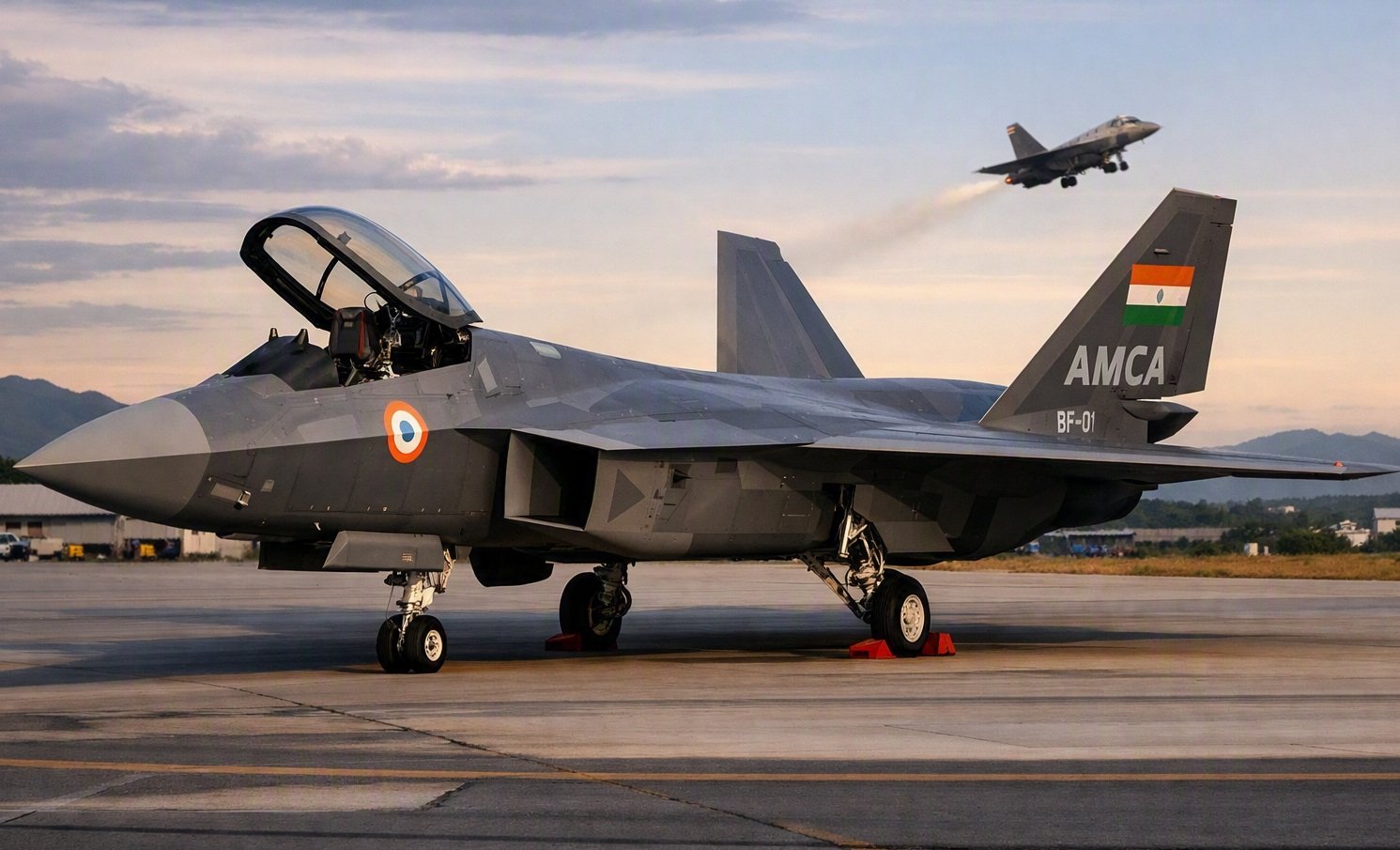
India has initiated concerted efforts to join the French-led Future Combat Air System (FCAS) sixth-generation fighter program while advancing its indigenous fifth-generation Advanced Medium Combat Aircraft (AMCA) project to strengthen the future Air Force capabilities.
Defining the Architecture of Future Air Power
As times change, air defence architecture is undergoing a global shift. While the fighter remains the heart of operations, it has now also become the node around which entire ecosystems, consisting of unmanned wingmen, data links, sensor fusion and other intelligence, are centred to form a combat web. India is attempting to secure elements of this multicomponent combat space by simultaneously pursuing aatmanirbharta through indigenous systems and procuring capabilities through foreign partnerships. While Rafale answers India’s fighter jet shortfall, sovereign bets are also being placed on the next generation of combat aviation, being the Advanced Medium Combat Aircraft (AMCA). Further, India has also formally initiated joining France’s sixth-generation fighter jet program, the Future Combat Air System (FCAS), consisting of a New Generation Fighter (NGF) coupled with autonomous remote carriers, guided through a shared Combat Cloud. India’s interest in France’s aeronautical nervous system raises questions about its degree of involvement with FCAS and the underlying intent behind this defence collaboration, especially when India is at the brink of indigenising its own defence technology. Further, with the Combat Air Teaming System (CATS) already pursuing loyal-wingman capabilities in India, one must ask whether India will now operate two competing wingman ecosystems in parallel or weave the two into one coherent architecture? Can India make its airpower operate as one integrated combat force?
Two Strategic Autonomies, One Airpower: Why FCAS Makes Strategic Sense?
Nearing 28 years of strategic partnership, the Indo-French collaboration rests on an unusual strategic convergence. While both nations deem multilateralism important to tackle global challenges, equal importance is accorded to strategic autonomy. Prime Minister Modi’s visit to France in 2023 on the French National Day, and the adoption of the Horizon 2047 Roadmap is an assurance that France is committed towards a ‘Partnership for security and sovereignity’ [2] Further, both nations have actively come together to also foster bilateral trade, economic security and technological innovations, recent instances including President Macron’s visit to India in February 2026 and his participation in the Artificial Intelligence Impact Summit, 2026 and Prime Minister Modi’s visit to France in June 2026 to jointly inaugurate “Bharat Innovates”;[3] proving that the Indo-French partnership does not come at the cost of autonomy.
Moreover, India’s strategic geographical location and consequent involvement in the security of the Indo-Pacific also pique French interest in investing in India’s military capabilities, since France maintains territories in both the Indian and Pacific Oceans. This interest is further fuelled by the threat of China’s aggressive posture. [4] Consequently, the Indo-French defence cooperation has evolved into deep operational interoperability, including various joint military exercises like Shakti, Garuda, Varuna, Tarang Shakti and Milan.[5]
Apart from extensive defence involvement between the nations, France as a cherry on the cake, has also been increasingly supportive towards India’s drive for aatmanirbharta, for instance the Inter-Governmental Agreement signed between the nations on 28 April 2025 for the procurement of 26 Rafale-M aircrafts, includes transfer of technology for integration of indigenous weapons in India, and the setting up of a production facility for Rafale fuselage and Maintenance, Repair and Overhaul (MRO) for aircraft engine, sensors and weapons in India.[6]
Therefore, with aligned defence policies, strategic interdependence, and the room for independent decision-making, participation in the FCAS could provide India with early access to sixth-generation technologies, giving India the chance to observe the French ecosystem, whilst simultaneously developing its own sovereign architecture. With air superiority hinging on the ability to orchestrate a network of manned and unmanned teaming (MUM-T), India ought to learn how to evolve its fighter into a quarterback who could stay outside the purview of threat, and yet be the focal point for all information.
India’s Building Blocks: AMCA, CATS and India’s Combat Web
The AMCA stands at the core of India’s future combat-air capability. Led by the Aeronautical Development Agency (ADA) under the Defence Research and Development Organisation (DRDO), AMCA is India’s indigenous stealth, twin-engine, fifth-generation fighter programme that is being built on public-private partnerships.[7] With sensor fusion, AI-enabled decision support, network-centric operations and MUM-T, the AMCA has been termed an AI-powered Electronic Pilot.[8] Key to the said program is the idea of a network-centric aircraft, around which a combat network has not yet been publicly disclosed. A concern central to the Indian ecosystem is the absence of a loyal wingman specific to the AMCA. In the past, Hindustan Aeronautics Limited (HAL), in conjunction with private players, developed an indigenous MUM-T termed the CATS, which can operate alongside a manned fighter and potentially conduct intelligence, surveillance and reconnaissance (ISR), identify targets, perform electronic warfare, and much more. Inasmuch, CATS is perfectly capable of being the MUM-T for the AMCA; however, differing program custodians and lack of official clarification compel us to question whether CATS has been finalised as the loyal wingman for the AMCA. Whether India is procuring an unmanned wingman from the FCAS in the first place?
In the absence of a defined end-to-end Indian ecosystem, and a lack of clarity on the exact procurements from the FCAS, one can only wonder where the procured components from the FCAS will fit in the Indian defence aerospace?
Interoperability without Dependence: French Gateway leading to Indian Architecture
It is therefore pertinent that India does not become a mere customer of the FCAS, and instead uses it as a technology accelerator to make indigenous systems optimal. With the aim being the integration of their advanced technology within our architecture, India ought to ensure cross-compatibility between Indian and French systems, as our unmanned components and weaponry ought to be put to use in conjunction with their technology. Data and software ownership ought to remain with India. Most importantly, within the ecosystem India is building, newer products ought to be installed without requiring external permissions. Hence, FCAS ought to be used as a gateway to accelerate our own capability, rather than becoming a source of dependence.
The Race for the Sky: The Chinese Counterpart
Rapid developments in the Chinese airspace further make India’s involvement with the FCAS pertinent. Since 2023, Beijing has created systems to adopt intelligentised warfare, incorporating AI and cloud computing during real-time operations.[9] With stealth fighters like the J-20 and J-35 being upgraded to match fifth-generation capabilities, with upgrades involving installation of “domestically produced” WS-10 and WS-15 engines, and GJ-11’s unmanned capabilities, including ISR, penetrating air defence, striking and teaming, is proof that the Chinese indigenous air defence ecosystem is also seemingly underway.[10] Further, China’s emerging sixth-generation J-36 and J-50 programmes are testimony that the strategic window for India to prevent widening of the architectural gap is narrowing.[11]
Choices India Cannot Postpone
With China accelerating its J-20 production, with an aim to produce hundreds of fifth-generation fighters by 2030, and India still being heavily reliant on Fourth and 4.5-generation aircraft, with AMCA set to enter service in 2028, the nation faces a critical capability gap in the interim, not to mention the obvious industrial advantage China already carries.[12]
Further, India’s decision in 2018 to walk away from the Russian Fifth-Generation Fighter Aircraft (FGFA), Sukhoi Su-57, due to lack of technology transfer and unequal work-sharing arrangements, may seem like a power move to champion the nation’s indigenous-first policy. However, till the AMCA is operational, India faces an unusual void in its defence aerospace capabilities in sheer contrast to its contemporaries. Further, AMCA aircraft’s induction alone would not benefit India much, since the global shift now requires stealth aircraft to be accompanied by an intricate web. With Rafale being a potent fighter, Su-30MKI being progressively modernised using indigenous capabilities, the S-400 and Project Kusha (initiated by DRDO in July 2026) being long-range shields against fifth-generation aerial threats, and a loyal wingman like CATS,[13] India now ought to weave these individual strengths into one coherent combat system.
Therefore, partaking in a sixth-generation program like the FCAS ought to be complementary to the AMCA. While India sharpens its fifth-generation capabilities, learnings in parallel from the FCAS program should be used to incorporate advanced functioning into the Indian ecosystem so that the path towards aatmanirbharta is carved as time progresses. One also ought to acknowledge that FCAS itself does not come without its challenges. With Germany’s fallout, and disputes over technological ownership, leadership and industrial workshare, this multinational defence project might bring with it immense fragility.[14] Further, with the extent of integration with the FCAS unknown, we risk the possibility of dependence; accordingly, India ought to opt for selective integration. Besides development of a structured Indian ecosystem, the nation also ought to ensure that the said ecosystem is compatible with the integration of newer technologies, without surrendering sovereign control of its underlying architecture.
Title Image Courtesy: Copilot AI
Disclaimer: The views and opinions expressed by the author do not necessarily reflect those of the Government of India or the Defence Research and Studies.


References
[1] India, Parliament, Lok Sabha, Standing Committee on Defence, Twenty-Fifth Report on Action Taken by the Government on the Recommendations/Observations Contained in the Twentieth Report of the Committee on Demands for Grants (2026-27) (New Delhi: Lok Sabha Secretariat, 2026).
[2] India, Embassy of India, France & Principality, ‘India-France Bilateral Brief’, July 2026, pp. 1, available at https://www.eoiparis.gov.in/content/Ind_France_Bilateral_brief_100726.pdf, accessed on 27 August 2026.
[3] Embassy of India, France, India-France Bilateral Brief, pp. 2.
[4] Madhuri Sukhija, ‘Unveiling the Roadmap to India-France Defence Ties: A Vision Beyond Legacy,’ Journal of Polity & Society, Vol.16, No. 2 (2024), pp.41, https://journalspoliticalscience.com/index.php/i/article/download/903/129/2941.
[5] Sukhija, “Unveiling the Roadmap to India-France Defence Ties”, pp. 40.
[6] Embassy of India, France, India-France Bilateral Brief, pp. 6.
[7] India, Ministry of Defence, Government of India, ‘Make-in-India played a key role during Operation Sindoor’, Press Information Bureau, 29 May 2025, available at https://www.pib.gov.in/PressReleasePage.aspx?PRID=2132250®=3&lang=2, accessed on 27 August 2026.
[8] India, Defence Scientific Information & Documentation Centre, Newspaper Clippings 50, No. 28, 8-10 February 2025, pp. 1-2, https://drdo.gov.in/drdo/sites/default/files/drdo-news/NPC08to10Feb2025.pdf.
[9] U.S. Department of Defense, Office of the Secretary of Defense, ‘Military and Security Developments Involving the People’s Republic of China 2023’, Washington, D.C., Office of the Secretary of Defense, 2023, available at https://media.defense.gov/2023/Oct/19/2003323409/-1/-1/1/2023-MILITARY-AND-SECURITY-DEVELOPMENTS-INVOLVING-THE-PEOPLES-REPUBLIC-OF-CHINA.PDF, accessed on 27 August 2026.
[10] U.S. Department of Defense, Military and Security Developments 2023, 168.
[11] Shania Ali, ‘Demand for Grants 2026-27 Analysis: Defence’, PRS Legislative Research, 17 February 2026, pp. 6, available at https://prsindia.org/files/budget/budget_parliament/2026/DfG_Analysis_2026-27-Defence.pdf, accessed on 27 August 2026.
[12] M.S. Chatterji, ‘Bridging the Stealth Gap After FGPA Exit: How India Plans to Counter China’s J-20 Fleet Before AMCA Arrives by 2035,’ Defence.in, 24 August 2026, available at https://defence.in/threads/bridging-the-stealth-gap-after-fgfa-exit-how-india-plans-to-counter-chinas-j-20-fleet-before-amca-arrives-by-2035.18517/, accessed on 27 August 2026.
[13] Chatterji, “Bridging the Stealth Gap After FGPA Exit”.
[14] Shairee Malhotra, ‘Europe’s Fighter Jet Plans Crash Before Take-Off’, Observers Research Foundation, 27 June 2026, available at https://www.orfonline.org/expert-speak/europe-s-fighter-jet-plans-crash-before-take-off, accessed on 27 August 2026.