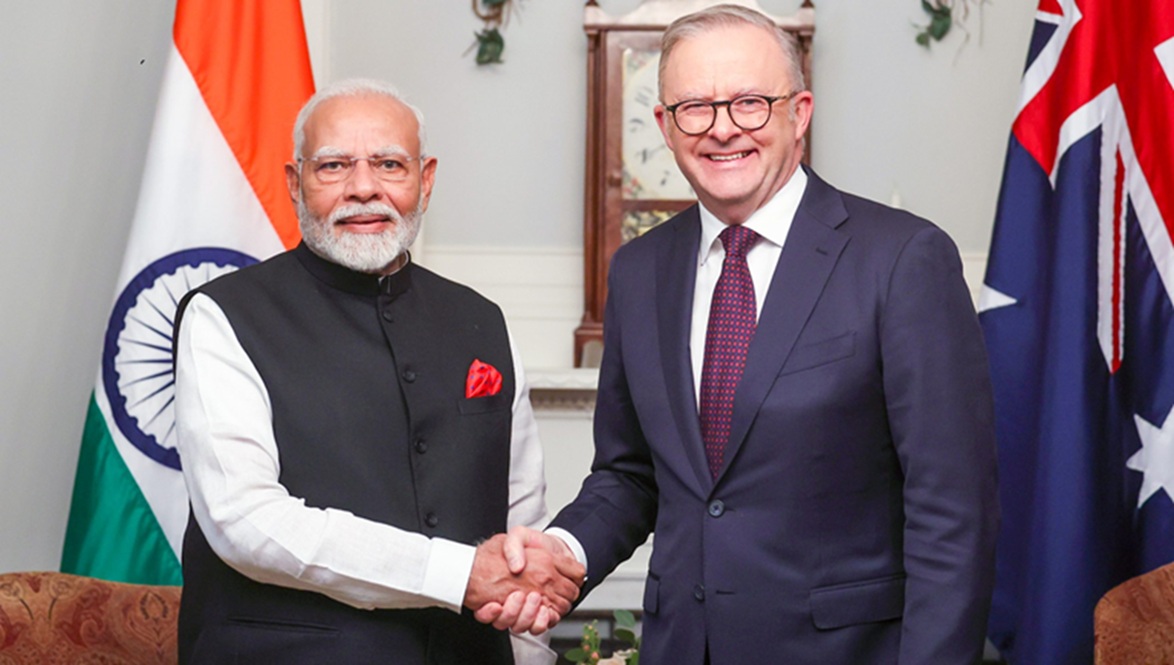
Eighteen outcomes, a defence declaration eighteen years in the making, and a uranium deal unlocked by domestic legal reform- the Melbourne summit has given the India-Australia relationship an architecture. The open question, for a soldier reading a strategic document rather than a communiqué, is whether that architecture is built to bear operational weight.
Background and Context
Prime Minister Narendra Modi’s State Visit to Australia from 8 to 10 July 2026 was built around the Third India-Australia Annual Summit in Melbourne, where he and Prime Minister Anthony Albanese reaffirmed the Comprehensive Strategic Partnership (CSP) the two countries adopted in 2020. The summit’s centrepiece, the Australia-India Joint Declaration on Defence and Security Cooperation (2026), formally supersedes the 2009 Joint Declaration on Security – a document that was, in retrospect, a statement of intent rather than an operational framework.
The distance between those two declarations, seventeen years apart, is itself instructive. The 2009 text was signed when India-Australia defence engagement was thin and largely symbolic. The 2026 text arrives after a decade of Quad consolidation, AUKUS recalibration, and a shared reassessment of China’s posture in the Indo-Pacific. It is a different relationship being formalised, not the old one being refreshed.
Anatomy of the Outcomes
The visit produced eighteen agreements and initiatives in total, spanning defence, maritime security, civil nuclear energy, critical technology, education, skilling, mining and cultural cooperation. For a strategic audience, four clusters merit close reading.
1. Defence and Security Architecture
- The Joint Declaration on Defence and Security Cooperation (JDDSC), which broadens the relationship into military interoperability, defence industrial collaboration, cyber security, counter-terrorism, humanitarian assistance and disaster relief (HADR), and coordination across the Quad, ASEAN, the Indian Ocean Rim Association and the Pacific Islands Forum.
- The establishment of an annual Defence Ministers’ Dialogue, institutionalising a conversation that has so far been episodic.
- An invitation for an Indian military instructor to serve at the Australian Defence College during 2028-29, a small gesture in personnel terms, but a meaningful one in professional military education, where influence is built slowly and over careers, not summits.
- Continuing negotiations on a Memorandum of Understanding for the reciprocal provision of defence articles and services, alongside deeper industry-to-industry engagement — the unfinished business of this summit, and arguably its most consequential pending item.
2. Maritime Domain
- The India-Australia Maritime Security Collaboration Roadmap (MSCR), covering information sharing, capability development and operational coordination, along with HADR, pollution response and search-and-rescue cooperation.
- A Memorandum of Understanding between the Indian Coast Guard and the Australian Border Force’s Maritime Border Command, aimed at maritime law enforcement, domain awareness and border protection — a coast guard-to-coast guard arrangement that sits below the headline defence declaration but is operationally significant in its own right.
3. Civil Nuclear Energy
The two governments finalised the administrative arrangements under the 2014 India-Australia Civil Nuclear Agreement, operationalising a pact that had sat commercially dormant for over a decade. The immediate enabler was domestic, not diplomatic: India’s Sustainable Harnessing and Advancement of Nuclear Energy for Transforming India (SHANTI) Act, which received Presidential assent in December 2025. The SHANTI Act repealed the Atomic Energy Act, 1962 and the Civil Liability for Nuclear Damage Act, 2010, replacing them with a single statute that opens nuclear generation to private and joint-venture participation under licence, and recasts the supplier-liability regime that had deterred Western vendors for fifteen years. Canberra’s willingness to commercially supply uranium — legally available to India since 2014 but never drawn upon — follows directly from this legislative reform, and supports India’s stated ambition of scaling nuclear capacity from roughly 8.8 GW today to 100 GW by 2047.
4. Critical Technology and Supply Chains
The Australia-India Partnership on Cyber, Critical Technologies and Supply Chains (PACTS) was launched to deepen cooperation on cyber security and resilient supply chains for critical and emerging technologies — a response, implicit but unmistakable, to the sourcing vulnerabilities both countries have identified in semiconductors, rare earths and telecommunications equipment.
A broader set of outcomes — Flinders University’s planned campus in Bengaluru, Victoria University’s in Gurugram, a mining skills centre of excellence at the National Skill Training Institute in Bhubaneswar, a rooftop solar training academy at Pandit Deendayal Energy University, the repatriation of three Indian antiquities, and a film-education partnership between the Satyajit Ray Film and Television Institute and Griffith Film School — rounds out the eighteen. These matter for the texture of the relationship, but they are not the subject of this brief.
Strategic Assessment
1. From Declaration to Deployment
A joint declaration is a statement of political will. It is not, by itself, a capability. The JDDSC’s language on interoperability and defence industrial collaboration is ambitious, but interoperability is built through years of shared exercises, common logistics standards, compatible communications architecture and — critically — a functioning defence articles and services agreement, which remains under negotiation rather than signed. Until that instrument is concluded, India and Australia can plan together far more easily than they can operate together at short notice.
This is not a criticism unique to this relationship. It is the standard gap between diplomatic architecture and military readiness, and it is precisely the gap a professional soldier is trained to interrogate rather than take on faith. The test of the JDDSC will not be its text but its exercise calendar, its logistics-sharing arrangements, and whether the annual Defence Ministers’ Dialogue produces measurable capability outcomes rather than restated communiqués.
2. The Nuclear Breakthrough as a Governance Case Study
The uranium breakthrough deserves particular attention because it demonstrates something strategic analysts often underweight: that legislative and regulatory reform at home can be as decisive to a bilateral relationship as diplomacy abroad. The SHANTI Act did not merely amend a liability formula — it removed the single largest structural obstacle that had kept Western nuclear suppliers, and Australian uranium, out of the Indian market for over a decade. From a governance standpoint, this is a template: regulatory certainty is itself a strategic asset, and the Atomic Energy Regulatory Board’s new statutory status under the Act gives India a credible institutional counterpart for future supplier and investor engagement.
3. Maritime Domain: Institutionalising Presence
The Coast Guard-to-Maritime Border Command MoU is a modest instrument in headline terms, but it addresses a real operational need — grey-zone activity, illegal fishing, and maritime domain awareness gaps across the eastern Indian Ocean and the approaches to Australia’s north-west shelf are law-enforcement problems as much as they are military ones. Pairing the MSCR’s information-sharing architecture with this coast guard arrangement gives the relationship a persistent, lower-signature presence that complements the higher-profile naval exercise relationship already in place under the Quad.
4. PACTS and the Supply Chain Question
PACTS is, at this stage, a framework rather than a set of deliverables. Its real test will be whether it produces concrete cooperation on critical minerals processing, semiconductor packaging, or telecom equipment sourcing — areas where both countries have expressed dependence anxieties but have yet to build joint capacity. Absent specific projects with named timelines, PACTS risks becoming another well-intentioned platform that outlives its initial momentum.
The Implementation Gap
Three structural risks stand between the Melbourne outcomes and durable alignment. First, the defence articles and services MoU remains unsigned, and without it, the interoperability ambitions in the JDDSC lack a legal and logistical backbone. Second, neither government has disclosed volumes or timelines for uranium supply, leaving the headline nuclear breakthrough short on the specificity that industry and regulators require to plan. Third, the relationship still lacks a standing joint mechanism — akin to India’s 2+2 dialogues with the United States and Japan — that would give ministers and service chiefs a recurring forum to convert the JDDSC’s broad mandate into a tracked implementation plan.
Recommendations
1. Prioritise early conclusion of the defence articles and services MoU, with a public timeline, so that the JDDSC’s interoperability language has an operational instrument to sit on.
2. Elevate the annual Defence Ministers’ Dialogue into a formal 2+2 Foreign and Defence Ministers’ mechanism within the next two summit cycles, matching the institutional depth India has already built with Washington and Tokyo.
3. Establish a joint working group, under PACTS, with named pilot projects and delivery timelines in critical minerals processing and telecom supply chains, rather than leaving the partnership as a framework document.
4. Negotiate an indicative uranium supply schedule and pricing framework promptly, to give India’s nuclear power expansion planners — public and now private, under the SHANTI Act — bankable certainty.
5. Expand the single instructor posting at the Australian Defence College into a reciprocal arrangement, with an Australian officer similarly embedded at an Indian service academy or the National Defence College, to build two-way institutional familiarity.
6. Use the Indian Coast Guard-Maritime Border Command MoU as a template to explore a standing, scheduled joint patrol or information-fusion arrangement in the eastern Indian Ocean, rather than an ad hoc cooperation framework.
7. Task the Ministry of External Affairs and Department of Atomic Energy to jointly report, at the next Annual Summit, on measurable progress against each of the eighteen outcomes — converting a list of announcements into a tracked scorecard.
Conclusion
The Melbourne summit has given India and Australia the most substantial defence and security architecture the relationship has produced in nearly two decades. It reflects, correctly, a recognition in both capitals that the Indo-Pacific’s security environment no longer permits loosely coupled partnerships between like-minded democracies. But architecture is not capability, and declarations are not deployments. The measure of this summit’s success will not be recorded in July 2026, when the eighteen outcomes were announced, but in the years that follow — in whether the defence articles agreement is signed, whether uranium actually moves, and whether an Indian officer walks the corridors of the Australian Defence College in 2028 as planned. For a professional soldier, that is always where the real assessment begins: not at the signing table, but at the point of execution.
Title Image Courtesy: DD India
Disclaimer: The views and opinions expressed by the author do not necessarily reflect those of the Government of India or the Defence Research and Studies.