India’s strategic influence relies on multi-alignment, economic heft, and its role as a voice for the Global South. Eschewing old non-alignment frameworks, New Delhi navigates a multipolar world by balancing key partnerships.
“The object of strategy is not merely to survive today’s crisis but to shape tomorrow’s environment.”
For decades, India’s foreign policy was defined by one phrase- Strategic Autonomy. It served the nation well. India maintained its independence, preserved decision-making freedom and avoided becoming captive to competing power blocs. But history rarely stands still.
Today, the world is entering a different phase. Great-power rivalry is intensifying. Supply chains are being reconfigured. Artificial Intelligence is reshaping economic competition. Maritime security has become inseparable from energy security. Traditional alliances are evolving while new coalitions emerge almost every year.
In such an environment, strategic autonomy alone is no longer sufficient. The real question is different.
Can India move from protecting its strategic space to shaping it?
Recent diplomatic engagements by Prime Minister Narendra Modi y suggest that this transition is already underway. Viewed individually, his visits to European nations(May 2026), Seychelles (June 2026), Indonesia, Australia and New Zealand, together with the India–Japan Summit (July 2026) may appear as routine bilateral engagements.
Viewed together, however, they reveal something far more significant. They represent the architecture of India’s emerging global strategy. Military commanders understand an enduring principle. No battlefield is won by concentrating only on the front. Supply routes must remain secure. Partners must remain committed. Communication lines must stay open. Logistics determine endurance. Diplomacy creates strategic depth. The same logic applies to nations.
India is steadily building multiple layers of strategic partnerships that extend well beyond defence cooperation. They encompass technology, maritime security, clean energy, resilient supply chains, critical minerals, digital infrastructure, education and trusted investment. This is no accident. It reflects deliberate strategic planning.
Europe remains India’s largest technology and investment partner outside North America. Stronger engagement with European nations helps diversify trade, strengthen advanced manufacturing, deepen semiconductor cooperation and reduce excessive dependence on single markets.
To many observers, these agreements appear largely economic. In reality, they are strategic. Economic resilience has become national security. The Indian Ocean tells a similar story. India’s engagement with Seychelles is often viewed through the lens of development assistance. That interpretation misses the larger picture. The Indian Ocean has become one of the world’s most contested strategic theatres. Nearly every major energy route connecting West Asia, Africa and Asia passes through these waters. Protecting maritime security is therefore no longer merely a naval responsibility; it is fundamental to economic stability. Partnerships with island nations such as Seychelles strengthen maritime domain awareness, humanitarian assistance capabilities and regional trust. Influence, after all, is built through presence rather than proclamation. The same strategic logic extends eastwards.
Indonesia occupies one of the world’s most important maritime gateways. As the guardian of approaches linking the Indian and Pacific Oceans, Indonesia naturally becomes an indispensable strategic partner for India. Connectivity, maritime cooperation and regional stability increasingly define the Indo-Pacific.
Australia represents another important pillar. The relationship has expanded rapidly from defence cooperation to critical minerals, clean energy, cyber security, education and resilient supply chains. This reflects an important doctrinal shift. Modern alliances are no longer built exclusively around military treaties. They are built around economic interdependence and technological collaboration. The same is true for New Zealand. Although geographically distant, New Zealand’s growing engagement with India demonstrates how middle powers increasingly seek trusted partnerships beyond traditional geopolitical alignments.
Perhaps the most strategically significant engagement during this period, however, was the India–Japan Summit held in New Delhi on 1 July 2026. Few bilateral relationships illustrate India’s evolving strategic priorities better than its partnership with Japan. Japan contributes capital. India contributes scale. Japan offers advanced technology. India offers innovation and demographic strength. Together, both countries share a common commitment to a free, open and rules-based Indo-Pacific. Their cooperation now extends beyond high-speed rail and infrastructure.
Semiconductors, green hydrogen, resilient supply chains, digital transformation, maritime security and defence industrial collaboration are becoming central pillars of the relationship.
Military professionals often describe partnerships as force multipliers.
The India–Japan relationship has become precisely that. It enhances economic capability while simultaneously strengthening regional deterrence. Taken together, these diplomatic engagements reveal a larger pattern. India is no longer merely balancing relationships. It is constructing a network. This distinction matters. Traditional diplomacy often focused on bilateral equations.
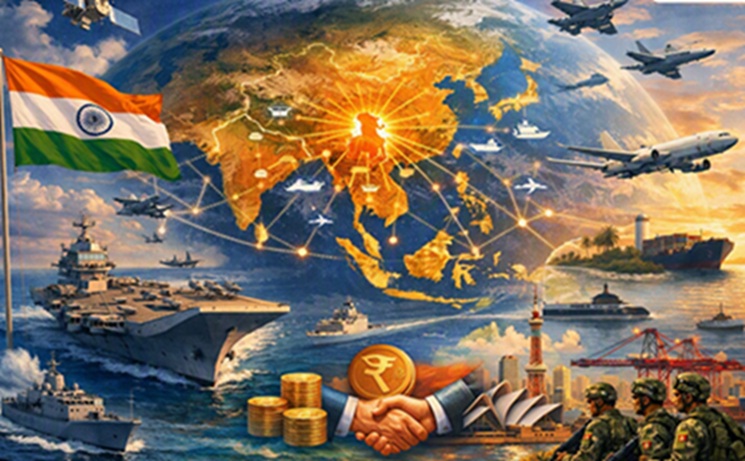
The emerging model resembles a strategic ecosystem where every partnership reinforces another. Europe strengthens technology. Japan strengthens industrial capability. Australia strengthens critical minerals. Indonesia strengthens maritime connectivity. Seychelles strengthens Indian Ocean security. New Zealand strengthens Indo-Pacific outreach. Collectively, they increase India’s strategic resilience. That resilience is perhaps the most valuable currency in today’s world. The military calls this creating strategic depth. Corporate leaders recognise the same principle as diversification. Boards describe it as resilience. Governments call it national preparedness. Different vocabulary. The same philosophy. There is another lesson here for leadership. Effective leaders rarely respond to crises in isolation. They shape the environment before crises emerge. That requires patience, consistency, credibility and trust. None of these qualities can be improvised during emergencies. They must be cultivated over time.
India’s diplomatic outreach reflects precisely this long-term approach. Rather than choosing between East and West, India is expanding partnerships across regions. Rather than seeking dominance, it is building credibility. Rather than creating dependency, it is promoting mutual capability. This represents mature strategic leadership.
For Corporate India, the implications are equally important. Businesses operating in a geopolitically uncertain world must learn from this model. Diversify supply chains. Develop trusted partnerships. Reduce concentration risks. Invest in technological capability. Strengthen institutional resilience before disruption occurs. The same principles that guide national strategy increasingly define corporate competitiveness.
For civil servants, another lesson emerges. Governance today extends beyond administration. It requires strategic thinking. Policies must anticipate future disruptions rather than merely solve present problems. Infrastructure planning must account for climate resilience. Digital governance must incorporate cyber security. Economic policy must integrate geopolitical realities. The boundaries separating governance, economics and national security are steadily disappearing.
As a soldier, one learns that the best commanders rarely fight unnecessary battles. Instead, they position themselves so effectively that conflict itself becomes less likely. Preparedness creates deterrence. Partnerships create influence. Credibility creates stability. That is precisely where India’s diplomacy appears to be heading. The coming decade will not simply reward nations that possess military power or economic size. It will reward those capable of building trusted networks across continents.
India’s recent engagement from Europe to the Indian Ocean, from Southeast Asia to the Pacific, and through its deepening partnership with Japan demonstrates that New Delhi increasingly understands this reality. Strategic autonomy gave India the freedom to choose. Strategic partnerships are now giving India the ability to shape. And in an increasingly fragmented world, shaping the environment may prove far more valuable than merely navigating it. That is the real measure of national leadership in the twenty-first century.
Title Image Courtesy: Copilt AI
Disclaimer: The views and opinions expressed by the author do not necessarily reflect those of the Government of India or the Defence Research and Studies.