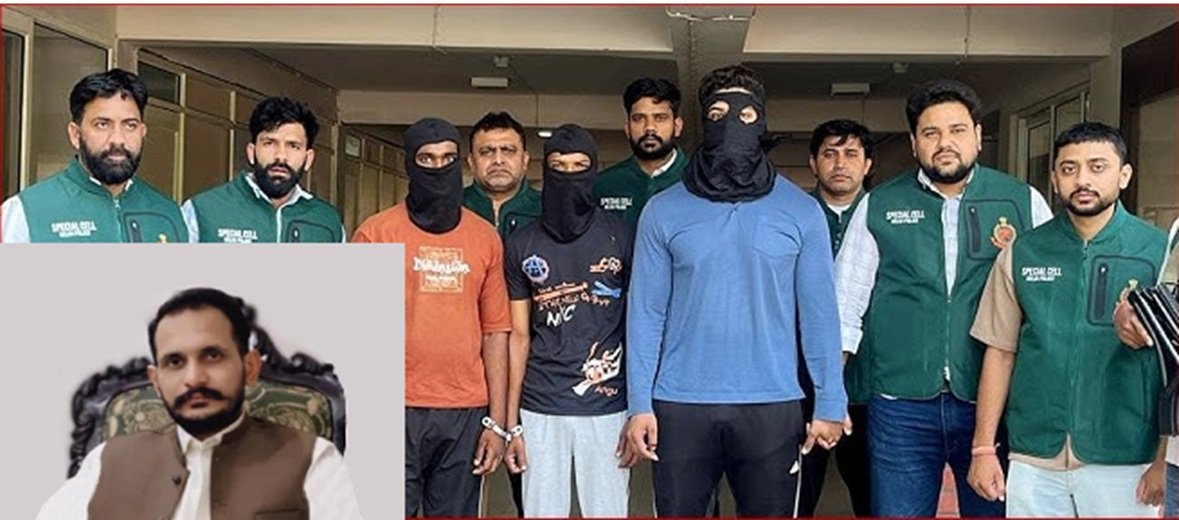
India’s 14-state operations demonstrate the power of real-time intelligence, which dismantled the Pakistan ISI-backed Shahzad Bhatti terror network across 14 states, arresting over 200 people ahead of Independence Day.
There is a tendency to measure counter-terrorism success by what the public sees: an encounter, an arrest, a recovered weapon or an attack that has been stopped. But the most sophisticated counter-terrorism operation may be the one in which nothing happens. No explosion. No mass casualty event. No dramatic gun battle.
That is what makes India’s recent operation against the Shahzad Bhatti Network particularly significant. On 12 August 2026, security agencies coordinated operations across 14 states, detaining 253 people and registering more than 80 FIRs in cases linked to the network. The operation was conducted using a real-time intelligence-sharing system with state police forces. (Akashvani News). This is more than a story about arrests. It is a story about how technology has changed the architecture of national security.
From Information to Intelligence and from Intelligence to Action
For decades, intelligence organisations faced a fundamental problem. Information was available — sometimes in abundance. But information sitting in different police stations, intelligence units, databases and agencies is not necessarily intelligence. A suspect noticed in Punjab may be meaningless to a police officer in Haryana. A suspicious phone number in Delhi may not mean much until it is connected with a number appearing in an investigation in Uttar Pradesh. A financial transaction may appear innocuous until it is connected to a known facilitator. A photograph of a location may appear harmless until another agency knows that the location is being surveilled. The breakthrough comes when these apparently unrelated pieces become connected. That is where real-time intelligence sharing becomes transformational.
The 14-State Operations- Illustrates the Idea
The operation reportedly involved simultaneous action across Uttar Pradesh, Haryana, Delhi, Punjab, Rajasthan, Maharashtra, Uttarakhand, Karnataka, Gujarat, Bihar, Telangana, Himachal Pradesh, Jammu & Kashmir and Kerala.
The distribution itself tells a story. Uttar Pradesh accounted for 62 detentions, Haryana 52, Delhi 51 and Punjab 44 — 209 of the 253, or roughly 83%, concentrated in these four areas. (Hindustan Samachar). That is not simply a large police operation. It is a network operation. The objective is not necessarily to find one terrorist hiding in one location. It is to identify the connections between people, places, communications, money, weapons and intended targets. And then act before those connections can become an attack.
The Real Technological Achievement: Seeing the Network
Modern terrorism increasingly resembles a network rather than an army. A Pakistan-based handler may never physically enter India. A local recruit may know only one or two other people. A courier may know nothing about the ultimate objective. Someone else may conduct reconnaissance. Another person may install surveillance equipment. Another may possess an explosive. Individually, each piece can look insignificant. Together, they form a threat.
The Indian agencies’ description of the Bhatti network illustrates precisely this problem. Authorities say the network was involved in grenade, IED and petrol-bomb attacks and targeted killings, while also using local conduits to conduct reconnaissance of police, defence and religious sites and install CCTV cameras for espionage. (Akashvani News). Technology allows investigators to move from individual incidents to network intelligence. That is the real revolution.
Imagine the Intelligence Picture
Think of the national security system as a giant, constantly changing map. One node represents a person. Another represents a telephone number. Another represents a vehicle. Another represents a bank transaction. Another represents a social-media account. Another represents a location. Another represents a weapon recovery. Another represents a previous FIR. On their own, these are just data points.
But when systems are able to connect them: Person A → phone number → Person B → location → suspicious reconnaissance → previous case → known facilitator, the picture changes. The investigator is no longer asking: “Who committed this crime?”. The question becomes: “What network produced this crime — and what else is that network preparing to do?” That is a fundamentally different form of policing.
Speed of Operation
There is another dimension that is often overlooked: Time. Traditional investigation can be sequential. One agency discovers something. A report is prepared. It moves up the chain. Another agency receives it. The information is analysed. A request is sent to another state. The other state investigates. By then, the suspect may have disappeared. A network, however, operates in parallel. So the counter-network must also operate in parallel. The reported use of a real-time intelligence-sharing mechanism with state police forces during the August 12 operation is therefore perhaps the most technologically important aspect of the entire story. (Akashvani News). It means intelligence could potentially move: detect → correlate → alert → locate → verify → act without waiting for the traditional boundaries between jurisdictions to slow the response.
Fourteen States- Single Operation
This is where federal policing becomes genuinely powerful. India’s constitutional and administrative structure naturally creates jurisdictional boundaries. Terror networks don’t respect them. A criminal can recruit someone in one state, obtain material in another, communicate with a handler overseas and target an installation hundreds of kilometres away. The threat is geographically distributed. Therefore, the intelligence architecture must be geographically distributed but operationally connected. That is exactly what makes the August 12 operation noteworthy. The 14 states did not need to become one police force. They needed to become one intelligence picture.
Technology- No Match to Human Intelligence
There is an important misconception here. Real-time intelligence does not mean that artificial intelligence or computers suddenly “found the terrorists.” Technology is an accelerator and connector. Human intelligence remains crucial.
Someone has to understand:
- why a person is suspicious;
- whether a communication is meaningful;
- whether a photograph is reconnaissance;
- whether a financial transaction is legitimate;
- whether two apparently unrelated people are actually connected;
- whether intelligence is reliable;
- and, ultimately, whether the law permits action.
Technology can reveal the pattern. Humans interpret the pattern. Technology can provide speed. Humans provide judgement. That combination is enormously powerful.
Connecting the Dots
The recoveries reported by the government included IEDs, grenades bearing Pakistan Ordnance Factory markings, pistols, live ammunition and CCTV cameras allegedly used for espionage. (NDTV). Each recovery tells investigators something different. An explosive may establish capability. A weapon may establish intent or preparation. A surveillance camera may reveal reconnaissance. A communication device may reveal connections. A financial record may reveal funding. A mobile phone may reveal an entire network. The technological challenge is therefore not merely collecting more data. It is determining which data points belong together.
Connectivity: The Most Powerful Counter-terrorism Weapon
The Bhatti operation demonstrates a broader principle. Terrorism thrives on fragmentation. The handler knows one person. The courier knows another. The recruiter knows another. The local operative knows a target. Different agencies know different pieces. The terrorist network survives because the defenders see fragments. The technological answer is to connect the fragments faster than the network can exploit them. That is why the reported real-time intelligence-sharing mechanism matters so much. It potentially turns 14 separate state-level investigations into one national network investigation.
A Silent Victory
The public normally notices counter-terrorism when something explodes. But the greatest success may occur several days earlier, when an intelligence analyst notices a connection, a police officer receives an alert, a team moves into position, and a suspect is detained. The citizen never knows what almost happened. There is no dramatic footage. No headline saying: “Attack prevented.” Instead, Independence Day arrives. The parade takes place. People go to work. Families celebrate. Nothing happens. That nothing is the victory.
The Future of Counter-Terrorism
The lesson extends far beyond the Bhatti network. The future battlefield is increasingly one of information velocity. The side that can collect → connect → analyse → verify → share → act faster will have a decisive advantage. And this is where India’s scale becomes both a challenge and an extraordinary technological opportunity. A country of 1.4 billion people, with thousands of police stations and multiple intelligence and security organisations, produces an enormous amount of information. The challenge is converting that information into actionable intelligence without drowning in data. The August operation offers a glimpse of what that architecture can achieve when the pieces work together.
The Real Wonder of Technology
The most remarkable thing about this operation may not be the number 253. It is the invisible architecture behind that number. Somewhere, information from different places was brought together. Patterns were identified. Connections were established. Threat assessments were made. State police forces were alerted. Operations were synchronised. And hundreds of people were detained before the suspected network could execute its plans around Independence Day, according to the authorities. (The Indian Express). Technology did not fight the terrorists. It enabled thousands of human beings, spread across a vast country, to see the same threat at nearly the same time. That may be one of the most important transformations in modern counter-terrorism: The weapon is no longer merely the gun, the drone or the explosive. The decisive weapon can be the ability to turn scattered information into shared intelligence — and shared intelligence into action, in real time.
And when that happens successfully, the greatest evidence of success is sometimes wonderfully simple: Nothing happened.
Title Image Courtesy: YouTube
Disclaimer: The views and opinions expressed by the author do not necessarily reflect those of the Government of India or the Defence Research and Studies.