Secretary General of the Communist Party and President To Lam continues to spearhead Vietnam’s diplomatic outreach. Besides customary and diplomatic necessities, the majority of President To Lam’s overseas visits have a strong focus on practical cooperation aimed at catapulting Vietnam’s bilateral ties to new levels. Emerging Technologies and Nuclear Energy are top on the agenda.
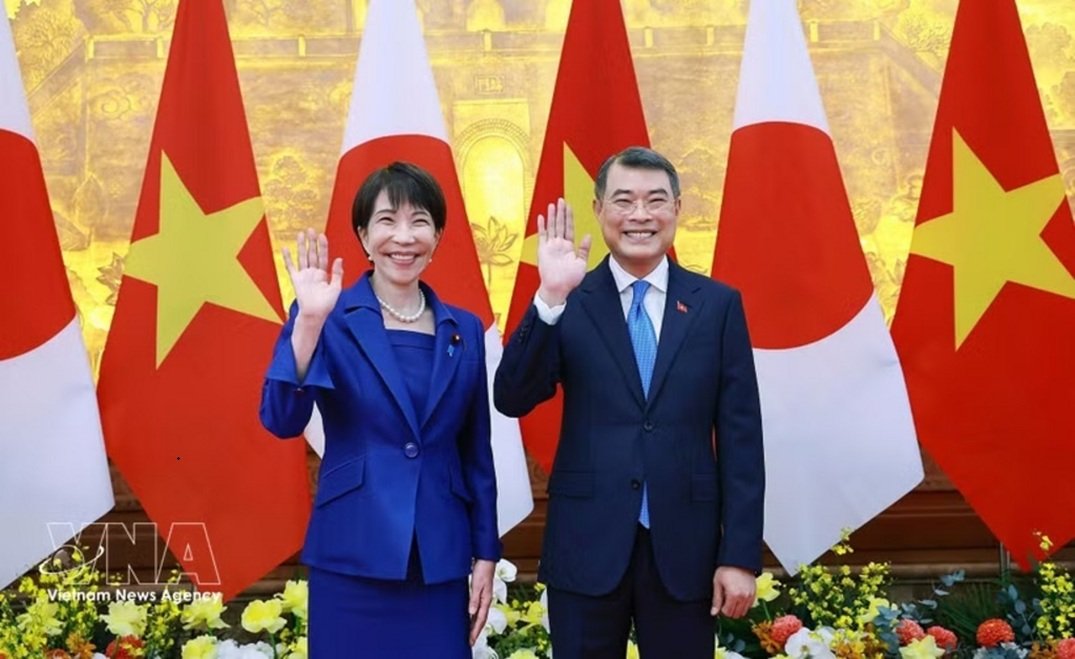
President To Lam is currently in Japan and is scheduled to address the Japanese parliament and the Vietnam-Japan Public-Private Forum on Economic and Science-Technology Cooperation. He will also meet a diverse set of important functionaries, including economic leaders and corporate heads. The visit is significant because both countries have endorsed a “Comprehensive Strategic Partnership for Peace and Prosperity in Asia and the World”.
Among the wide range of bilateral issues, Vietnam seeks Japanese cooperation in building domestic capabilities in emerging technologies and nuclear energy. In the above context, President To Lam will interact with Vietnamese experts and intellectuals in Japan to “review achievements and discuss ways to better connect knowledge, experience and resources between Vietnam and the Vietnamese expert community in Japan”.
It is President To Lam’s firm belief that “tripartite linkage between the State, businesses and universities” will “strengthen [and] attract more Japanese investment projects with high technological content and added value”. For that, the “recommendations from Vietnamese experts and intellectuals in Japan” will help develop pathways and strategies for augmenting Vietnam-Japan bilateral cooperation. It is hoped that by doing so, both countries will be in a good position to advance “research and development, technology transfer and high-quality human resources training in Vietnam, while strengthening business connections between the two countries”.
Furthermore, these “bridges for bilateral cooperation” between Vietnamese and Japanese experts would act as a catalyst and support Vietnamese technology requirements in “innovation, space, artificial intelligence (train 100 doctoral-level AI experts), semiconductors, quantum, marine science, marine economy, digital technology, rare earth exploration and development, medical technology, advanced biotechnology, and hydrogen-powered high-tech agriculture”.
As far as nuclear cooperation is concerned, Vietnam is seeking Japanese expertise in small modular nuclear reactors (SMRs) and other emerging technologies. According to Nikkei Asia, Japanese Prime Minister Takaichi Sanae and General Secretary and President Lam are expected to “discuss a plan to boost new-generation nuclear energy cooperation” through an MoU under which “Japan will help with technology transfer and human resource training to help Vietnam access advanced nuclear power technology”. The SMR technology could be ready for use by Vietnam from 2040 onwards.
Earlier, Vietnam’s attempts to secure Russian nuclear energy technology and infrastructure suffered a major setback after the US and several other Western countries sanctioned Russia, which precluded bilateral nuclear partnership and financing. In fact, the Russia –Vietnam nuclear energy cooperation agreement is not new; in 2010, both sides signed a construction agreement for a nuclear plant for which Russia agreed to provide technology as well as financial support, i.e. an $8 billion Russian loan. The construction was scheduled to have commenced in 2014 but suffered headwinds, and the program was cancelled.
However, in 2024, there were reports about its resumption, but the continuing Russia-Ukraine war and the US sanctions led to freezing the project. According to the World Nuclear Association, in March 2026, Vietnam and Russia signed an agreement for the construction of the Ninh Thuan 1 plant in the southern Khanh Hoa province. It will be built by Rosatom and is scheduled for operations between 2030 and 2035.
As far as Japan is concerned, it merits mention that Vietnam will be the first country in the region to receive nuclear-related equipment and materials, and it could be the “way for Japan to resume its involvement in Vietnam’s nuclear power development programme, supporting the Southeast Asian country’s long-term energy security and sustainable development”.
All in all, Vietnam-Japan bilateral relations under the “Comprehensive Strategic Partnership for Peace and Prosperity in Asia and the World” will add robustness to multiple sectors, strengthen political trust and expand cooperation, which at this time is experiencing multiple challenges on account of great power competition (US and China) and the ongoing wars in Eurasia and West Asia. Besides these, the South China Sea and East Asia remain sources of tensions which directly impact Vietnamese and Japanese security.
Title Image Courtesy: ttps://vietnamlawmagazine.vn
Disclaimer: The views and opinions expressed by the author do not necessarily reflect those of the Government of India or the Defence Research and Studies.