While Large Language Models (LLMs) have demonstrated remarkable capabilities in natural language understanding and generation, their deployment in military environments faces several practical challenges. These include high computational requirements, dependence on cloud infrastructure, security concerns, and restricted operation in disconnected or contested environments. As a result, defence organisations worldwide are increasingly focusing on the development of Small Language Models (SLMs) tailored for military applications. They can always venture these systems in dedicated captive networks to keep the data safe.
Small Language Models are AI systems that contain significantly fewer parameters than state-of-the-art LLMs while maintaining sufficient performance for specific operational tasks. By optimising model architecture, training methodology, and domain-specific knowledge, SLMs provide a practical solution for military platforms operating under stringent resource constraints.
The Need
Military operations frequently occur in environments where bandwidth is limited, communications are disrupted, and access to cloud-based computing resources is unavailable. Tactical headquarters, naval vessels, submarines, armoured vehicles, unmanned systems, and forward-deployed soldiers require AI capabilities that can function independently and securely.
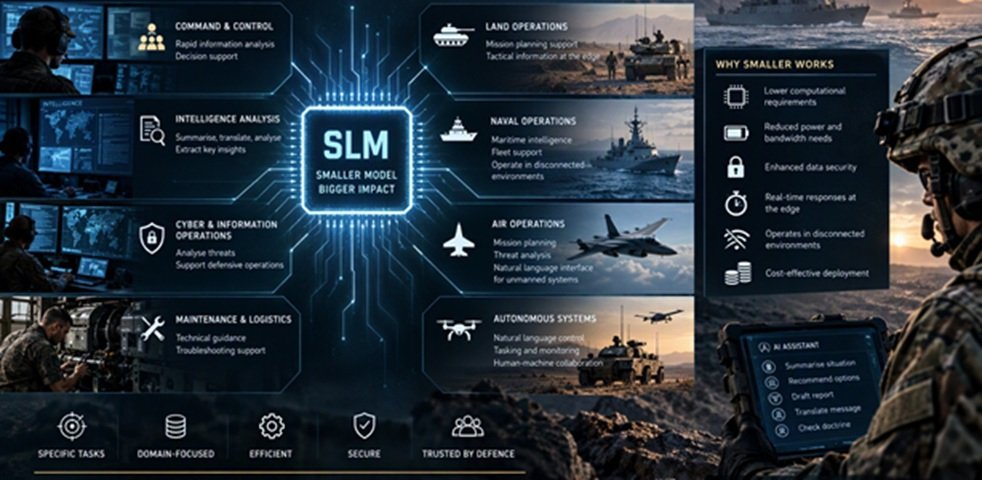
Large models often require powerful graphical processing units (GPUs), high energy consumption, and large memory footprints. Such requirements are incompatible with many battlefield platforms. In contrast, SLMs can operate on edge devices, ruggedised computers, and embedded systems while delivering near real-time responses.
The military also places a high emphasis on information security. Sending sensitive operational data to external cloud services may expose vulnerabilities. SLMs can be deployed entirely within secure military networks, ensuring that classified information remains local and protected.
Associated Key Technologies
Model Compression
Techniques such as pruning, quantisation, and knowledge distillation are used to reduce model size while preserving performance. Knowledge distillation involves training a smaller “student” model using outputs generated by a larger “teacher” model. This allows the compact model to inherit much of the larger model’s capability.
Domain-Specific Training
Unlike general-purpose AI systems trained on vast internet datasets, military SLMs are trained using defence-specific content. These may include, military doctrine, tactical manuals, intelligence reports, maintenance procedures, Naval operational publications and even battlefield communication protocols. Domain-focused training enables smaller models to achieve high accuracy within their intended operational domain despite having fewer parameters.
Edge AI Optimisation
Modern military SLMs are designed for deployment on edge computing devices. Optimisations allow them to execute efficiently on processors found in vehicles, ships, drones, and soldier systems without requiring extensive hardware support.
Retrieval-Augmented Generation
Many military SLMs are integrated with secure databases and knowledge repositories. Rather than storing all information internally, they retrieve relevant documents when needed, reducing model size while maintaining access to up-to-date information.
Military Applications
Military Decision Support
Commanders often face information overload due to the enormous volume of operational reports, intelligence feeds, and battlefield updates. SLMs can rapidly summarise information and generate decision-support recommendations. For example, an operational commander may receive hundreds of intelligence messages daily. An SLM can prioritise reports, identify significant developments, and generate concise summaries to support situational awareness.
Battlefield Information Management
Modern military networks generate enormous quantities of structured and unstructured data. SLMs can process operational logs, mission reports, sensor outputs, and communication transcripts. By automating routine information-processing tasks, military personnel can focus on mission-critical decision-making rather than administrative workloads.
Naval Applications
Naval operations are particularly suitable for SLM deployment due to limited communication links during extended deployments. Potential naval applications include, shipboard decision support, fleet coordination assistance, maritime intelligence analysis, tactical communication management, anti-submarine warfare support, maintenance and logistics management. On submarines, where communication restrictions are severe, locally hosted SLMs can provide intelligent assistance without requiring external connectivity.
Intelligence Analysis
Military intelligence organisations process vast quantities of open-source, commercial, and classified information. SLMs can assist analysts by translating foreign-language reports, extracting key entities and events, identifying trends and patterns, summarising intelligence products and supporting threat assessments. Since many intelligence activities involve classified data, locally deployed SLMs offer significant security advantages.
Autonomous and Unmanned Systems
Future military operations will increasingly rely on autonomous platforms, including unmanned aerial vehicles (UAVs), unmanned surface vessels (USVs), and autonomous ground systems. SLMs can serve as natural-language interfaces between human operators and autonomous platforms. Operators can issue mission instructions using natural language while the SLM translates them into machine-understandable commands.
Maintenance and Logistics
Military readiness heavily depends on equipment availability. SLMs can function as intelligent maintenance assistants capable of troubleshooting equipment faults, recommending repair procedures, accessing technical manuals, assisting personnel during field repairs and supporting supply-chain management. Such systems can reduce downtime and improve operational availability.
Key Benefits
The adoption of SLMs offers several operational advantages. These models would reduced computational requirements, lower energy consumption, enhanced security, reduced latency, operation in disconnected environments and cost efficiency. Military systems require extensive testing before deployment. SLMs must undergo rigorous evaluation to ensure reliability, explainability, and compliance with operational requirements.
Future Outlook
The future of military artificial intelligence is likely to involve a combination of large strategic AI systems and specialised SLMs operating at the tactical edge. Advances in model compression, neuromorphic computing, edge processors, and secure AI architectures will further enhance SLM capabilities.
Future military SLMs may be integrated into wearable soldier systems, command-and-control networks, autonomous vehicles, naval combat management systems, and intelligence fusion centres. Rather than replacing human decision-makers, these systems will function as intelligent assistants that enhance operational effectiveness while preserving human control over critical decisions.
Main Challenges
Limited Knowledge Capacity
Smaller models naturally possess less internal knowledge than larger models. Developers must carefully balance size and performance.
Reliability and Hallucination
Like all language models, SLMs can occasionally generate incorrect or misleading information. In military contexts, such errors could have significant operational consequences.
Adversarial Threats
Military AI systems may become targets of cyber attacks designed to manipulate outputs or corrupt training data. Robust security measures are therefore essential.
Data Availability
Training military-specific models requires large quantities of relevant and high-quality defence data. Much of this information is classified, making dataset generation and sharing difficult.
Verification and Validation
Military systems require extensive testing before deployment. SLMs must undergo rigorous evaluation to ensure reliability, explainability, and compliance with operational requirements.
Conclusion
Small Language Models represent a promising and practical approach to military AI adoption. Their ability to operate securely, efficiently, and independently of cloud infrastructure makes them particularly suitable for defence environments. From battlefield decision support and intelligence analysis to naval warfare and maintenance assistance, SLMs can significantly improve operational effectiveness. As AI technologies continue to mature, small, mission-specific language models are expected to become a critical component of future military capability, enabling armed forces to harness the power of artificial intelligence directly at the tactical edge.
Disclaimer: The views and opinions expressed by the author do not necessarily reflect those of the Government of India or the Defence Research and Studies.