This paper explores how the post-service trajectory of candidates absorbed into the military through the Agnipath scheme can be restructured to accommodate more Agniveers in the defence sector without leaving the comfort of their hometowns. As one of the most vital channels for military recruitment, Agnipath can shape the future of many young minds in the country. In fact, it can become one of the most feasible ways to enhance India’s macroeconomic and national security future simply by restructuring the Agnipath scheme without disrupting the core tenets of the existing recruitment framework.
Literature Review
Existing strategic literature regarding the Agnipath scheme primarily evaluates corporate rehabilitation frameworks and urban workforce migration models for exiting veterans (Manohar Parrikar Institute for Defence Studies and Analyses [MP-IDSA], 2023). Concurrently, public policy research tracks the expansion of Digital India infrastructure as a tool for regional economic growth while curbing the issue of migration to urban spaces in search of active employment (Ministry of Electronics and Information Technology [MeitY], 2020; NITI Aayog, 2021). However, a significant gap remains unfilled, wherein the contemporary defence literature fails to address decentralised, home-state digital employment as a direct path for continuous military absorption. Furthermore, current operational frameworks do not account for the Operational Security (OPSEC) and family targeting risks associated with handling defence data in uncontrolled domestic environments (National Security Council Secretariat [NSCS], 2022). This paper bridges this gap by introducing access-controlled Secure Remote Kiosks (SRKs), establishing a secure framework for an Inclusive Digital Defence Reserve.
Research Methodology
Following the qualitative policy analysis framework outlined by Creswell and Creswell (2018), this study evaluates the Ministry of Defence’s Agnipath scheme (Ministry of Defence, 2022). Utilizing a secondary research design (Stewart & Kamins, 1993) focused on systematic document analysis as a standalone qualitative method (Bowen, 2009), the study applies a deductive policy modelling approach to formulate novel operational paradigms. Specifically, it maps out the structural architectures for the Inclusive Digital Defence Reserve and the Secure Remote Kiosk (SRK) framework to address contemporary operational security gaps[1].
Introduction
Historically, one had to prove physical stamina, overall fitness, and more to be able to fit into the stringent military recruitment paradigms. Now, with the Agnipath scheme, it has become possible for more to do the same (Ministry of Defence, 2022). However, it does arrive with its own set of limitations and issues, including most notably regarding the fixed four-year tenure and the limited percentage of permanent physical absorption dictated by budgetary and demographic realities, etc., due to the problem of overpopulation in the country and the thought that everyone deserves a chance to serve the military. However, leveraging the National Policy on Remote Work and Decentralised Digital Employment Models serves as one of the optimum solutions to the long-standing problem that the Indian military is facing with regard to the changes that need to be made to the programme’s structural framework.
The Indian military already trains Agniveers in the management of sensitive communications and strict security protocols (Ministry of Defence, 2022). Due to the possession of such indispensable skills and a disciplined background, they become the ideal candidates to handle remote operations, such as monitoring private cybersecurity grids, managing aerospace logistics, or processing data for defence public sector undertakings (PSUs) via secure virtual private networks (VPNs) (Defence Research and Development Organisation [DRDO], 2024). Consequently, this framework establishes an innovative pathway for continuous military absorption, including the re-recruitment of Agniveers, transitioning personnel into the Indian military system.
Operational Architecture and Physical Safeguards (SRK Framework)
As per the National Policy on Remote Work and Decentralised Digital Employment Models, working involves working from home. However, the home milieu is not entirely conducive to doing all kinds of work. In other words, while digital tools for working from home, including advanced virtual desktops and intranets, are highly secure, the physical domestic environment continues to be an unmonitored vulnerability. Allowing personnel to access sensitive defence data, aerospace logistics, or cyber firewalls from an uncontrolled residential space introduces significant Operational Security (OPSEC) degradation (NSCS, 2022). On the other hand, working from home also constitutes the jeopardy of unauthorised access, localised harassment, and potential adversarial pressure targeted at the families of the digital Agniveers. To mitigate the risks posed by working from home, the post-service digital framework must utilise a Two-Tier Hybrid Security Model anchored by state-governed Secure Remote Kiosks (SRKs):
- Tier 1: Non-Sensitive Civilian Integration: Exiting Agniveers transitioning into standard corporate technical support, civilian software development, or non-strategic logistics can safely operate from decentralised, highly secure regional digital hubs provided by standard Digital India infrastructure (MeitY, 2020; NITI Aayog, 2021).
- Tier 2: Access-Controlled Strategic Enclaves: For Agniveers handling dual-use technologies, sensitive PSU data, or cybersecurity monitoring, operations must be strictly confined to dedicated SRKs or Secure Remote Kiosks (DRDO, 2024). These kiosks must be based within pre-secured, gated government perimeters—such as local Zilla Sainik Boards (District Veteran Offices), Cantonment zones, or regional Ex-Servicemen Contributory Health Scheme (ECHS) complexes.
When the digital nodes are located within the perimeters of sovereign facilities that are gated and well-protected, the operator also gains the advantage of being protected by controlled entry points and strict localised security. Apart from the physical security measures, strict zero mobile usage, mandatory biometric checkpoints, etc., must also be introduced on the floor, so that the possibility of visual data compromise is eliminated (NSCS, 2022).
Meritocratic Parity, Gallantry Recognition, and the Inclusive Digital Reserve
The formalised Non-Kinetic Meritocratic Progression and Rank Matrix must be incorporated in the programme, so that sustained motivation and institutional dignity ensure absolute parity of status with military employees who are actively physically deployed. Personnel who execute critical tasks digitally also serve as active sentinels of the technological frontiers of the country. When Agniveers who operate continuously from the Secure Remote Kiosks are incentivised by being made eligible for structured promotions to higher virtual military ranks (e.g., Digital Corporal, Cyber Sergeant, or Technical Warrant Officer) based on their performance, it ensures further loyalty to the defence sector. When an operator’s rapid analysis or cybersecurity intervention directly averts a crisis or saves lives on the ground, they must be considered eligible for sovereign civilian gallantry honours, such as the Jeevan Raksha Padak series, apart from the other extant honours for excellence in work done digitally.
Several prospective candidates who are highly tech-savvy and patriotic have been disqualified in the past on the basis of the non-fulfilment of certain strict physical and other parameters, such as ocular refractive errors, minor mobility issues, or other physical requirements[2]. However, transforming these traditional recruitment limitations into a strategic advantage by allowing them to handle advanced defence analytics, software engineering, or cyber firewalls can help accommodate more people through Agnipath into the fold of the Indian military seamlessly, while allowing them to serve the nation.
Conclusion
Instead of young graduates sitting unemployed or falling into unsafe, gig-economy roles, they are systematically absorbed into the state’s secure technological apparatus. They earn a stable income, gain elite cyber/logistics credentials, and remain anchored safely within their home states as pillars of local stability (NITI Aayog, 2021).
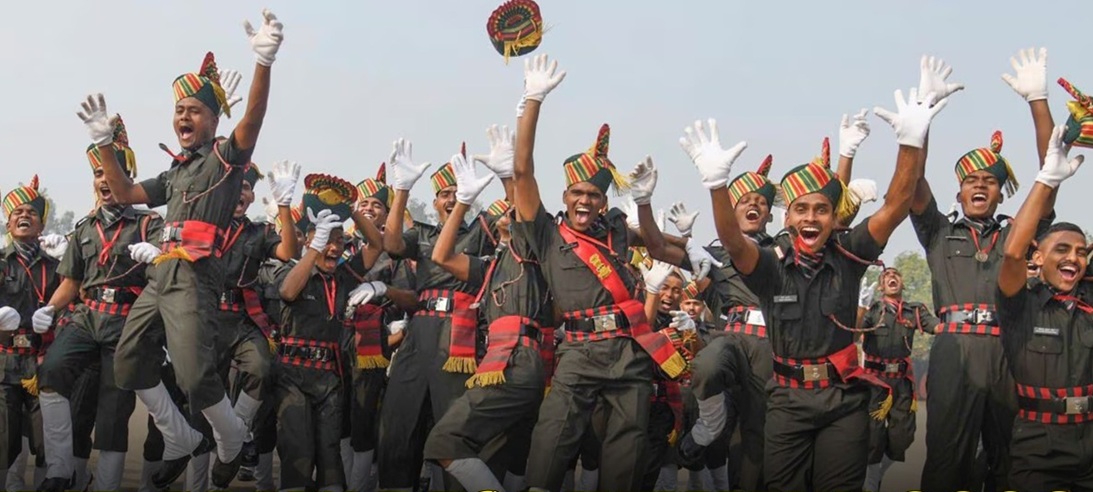
Title Image courtesy: Indian Army
Disclaimer: The views and opinions expressed by the author do not necessarily reflect the views of the Government of India and the Defence Research and Studies.


Bibliography
- Bowen, G. A. (2009). Document analysis as a qualitative research method. Qualitative Research Journal, 9(2), 27–40.
- Creswell, J. W., & Creswell, J. D. (2018). Research design: qualitative, quantitative, and mixed methods approaches (5th ed.). SAGE Publications.
- Defence Research and Development Organisation (DRDO). (2024). Securing the supply chain: Rules of engagement for private defense contractors and associated industrial bases. DESIDOC.
- French Foreign Information Bureau. (2018). The evolution of the identity declaration protocol (Declaration de fausse identité) and recruitment mechanics in modern asymmetric fronts. Bureau de la Légion Étrangère.
- Manohar Parrikar Institute for Defence Studies and Analyses (MP-IDSA). (2023). Leveraging military human capital: A blueprint for rehabilitating short-service veterans into private strategic sectors (IDSA Task Force Report). MP-IDSA.
- Ministry of Defence, Government of India. (2022). The Agnipath scheme for youth enlistment in the Indian armed forces: Operational manual and post-release transition guidelines. MoD Press.
- Ministry of Electronics and Information Technology (MeitY), Government of India. (2020). Digital India: Transforming India into a digitally empowered society and knowledge economy. National Informatics Centre.
- National Security Council Secretariat (NSCS). (2022). Physical access compromise and counter-espionage protocols in decentralized digital intranets. Prime Minister’s Office.
- NITI Aayog. (2021). Decentralized employment models and digital infrastructure expansion in Tier-2 and Tier-3 regions of India (Government of India Policy Brief). NITI Aayog.
- Sinha, C. S. K. (2025). Weaponising influence: Navigating the impact of social media on Indian armed forces. The Journal of the United Service Institution of India, 155(621), 117–128.
- Stewart, D. W., & Kamins, M. A. (1993). Secondary research: Information sources and methods (2nd ed.). SAGE Publications.
- Viano, E. C. (Ed.). (2016). Cybercrime, organized crime, and societal responses. Springer International Publishing.
References
[1] Secure Remote Kiosks (SRKs) function as physically hardened, air-gapped intranet nodes isolated from commercial internet service providers (ISPs) to eliminate remote endpoint vulnerabilities.
[2] This model mirrors selective medical waivers utilized by global volunteer forces for cyber commands, separating the physical kinetic evaluation parameters from cognitive and technical competency metrics.