The recent depreciation of the Indian rupee should not be viewed as an isolated currency event. It is a signal that India is contending simultaneously with three interconnected pressures: a sharp oil shock, strain in the banking system’s liability structure, and a fiscal framework that still responds to external shocks in a largely ad hoc manner. The rupee’s performance in FY26, including its sharp weakening during the recent escalation in West Asia, reflects these broader structural vulnerabilities. The central question, therefore, is no longer whether the Reserve Bank of India should respond. It already has. The more important question is whether the RBI and the Union government can respond in a coordinated and credible manner.
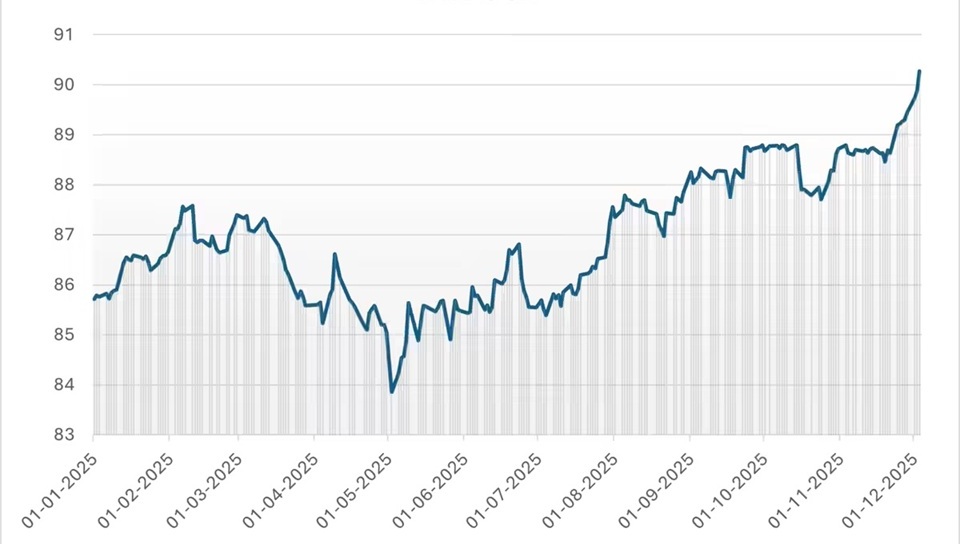
INR Vs USD Year 2025 PC: ET
International experience offers a clear lesson. Major currencies under pressure have rarely been stabilised by central-bank action alone. When the U.S. dollar came under severe strain in 1978, the response was not confined to the Federal Reserve. The United States adopted a broader state-led strategy combining tighter monetary policy, strengthened foreign-exchange intervention capacity, expanded swap arrangements, and Treasury action to restore confidence. The underlying principle remains relevant: when markets begin to question currency stability, they respond more positively to an integrated policy framework than to isolated institutional action.
The British experience reinforces this conclusion. The sterling crisis of 1976 demonstrated that exchange-rate stability cannot be restored if markets have lost confidence in the broader macroeconomic policy mix. At the same time, Britain’s ERM crisis in 1992, and Sweden’s failed defence of the krona in the same period, illustrate the danger of trying to defend an exchange-rate level that markets no longer consider sustainable. For India, the implication is straightforward. The RBI should aim to preserve market order, prevent disorderly speculation, and contain excessive volatility. It should not, however, be forced into defending an implicit exchange-rate target at the cost of policy credibility.
South Korea’s experience during the 2008 global financial crisis offers a third, and particularly relevant, lesson. Korea’s challenge was not simply exchange-rate weakness; it was a deterioration in access to dollar liquidity. The response included a temporary swap arrangement with the U.S. Federal Reserve and the onward provision of dollar liquidity to domestic institutions. India confronted a related issue in 2013, when the RBI opened the FCNR(B) swap window at a concessional rate in order to attract foreign-currency funding. The lesson from both episodes is that when exchange-rate pressure is partly a symptom of stress in external funding channels, reserve sales alone are insufficient. A well-designed liquidity backstop is often more effective.
It is important to recognise that Indian policymakers have already taken several sensible measures. The RBI has capped banks’ net open rupee foreign-exchange positions, thereby forcing an unwinding of large arbitrage books that had developed between onshore and offshore markets. It has also extended export-credit relief in response to disruptions arising from the West Asia crisis. The government, for its part, has reduced excise duty on petrol and diesel in order to moderate the domestic impact of higher crude prices, and it has launched a credit-guarantee programme to support microfinance lending. These are significant interventions. However, they still appear as discrete measures rather than elements of a coherent macro-financial framework.
What India now requires is an integrated INR Stability Compact, jointly anchored by North Block and Mint Street. The first element of such a compact should be a formal oil-shock sharing mechanism. Rather than adjusting fuel excise duties on a discretionary basis each time crude prices spike, India should establish an oil-shock stabilisation framework under which tax adjustments and buffer financing operate through a transparent rule. When oil prices rise above a specified threshold, excise duties could be reduced within pre-defined limits, with the resulting fiscal gap partly financed by windfall levies and partly through a dedicated stabilisation account. When prices fall, the buffer could be rebuilt. Such an approach would reassure markets that imported inflation will not be left entirely to monetary policy and that fiscal discipline will be preserved even under geopolitical stress.
This approach would also be consistent with the government’s medium-term fiscal objectives. The Union Budget for 2026-27 envisages a continued reduction in the debt ratio over time, and the FRBM statement projects a modest decline in central government debt between 2025-26 and 2026-27. A rule-based oil buffer would strengthen the credibility of this trajectory by demonstrating that the fiscal framework is capable of absorbing external shocks without repeated improvisation.
The second element should be a bank liability resilience package. India’s banking challenge today is no longer defined primarily by legacy bad loans. It is increasingly a liability-side issue characterised by rising short-term funding costs, liquidity volatility, pockets of stress in microfinance and trade-linked credit, and a broader external vulnerability linked to developments in West Asia. That vulnerability extends beyond direct loan exposure. It includes trade-finance disruption, sensitivity in NRI-linked deposits, pressure on shipping and payment channels, and treasury losses arising from abrupt currency movements. India should therefore consider creating a medium-term retail deposit instrument designed to encourage stable household savings, alongside a temporary RBI liquidity facility linked to incremental stable deposit mobilisation. At the same time, the resolution of microfinance stress should become faster and more creditor-led, so that pressures at the edge of the financial system do not spread more widely.
The third element should be a prepared but conditional external-liquidity backstop. There is no need for India to launch such a mechanism immediately. However, it would be prudent to prepare an FCNR/NRI Window 2.0 with clearly defined activation triggers linked to volatility, reserve depletion, import stress, or disruption in external funding conditions. In parallel, the RBI and the finance ministry should design a temporary trade-finance and oil-import refinancing facility for sectors most exposed to geopolitical disruptions in West Asia. The existence of such instruments would not signal weakness; rather, it would signal preparedness. The historical record repeatedly shows that when governments prepare credible backstops in advance, they often reduce the need for more disruptive interventions later.
The issue of subsidies and so-called freebies must also be addressed, but with seriousness and precision. The appropriate response is not indiscriminate austerity. It is better targeting and greater fiscal clarity. Food support during a period of elevated oil prices and inflation is not the appropriate place for abrupt retrenchment. At the same time, the Union Budget’s Expenditure Profile shows the large and continuing fiscal burden of food and fertiliser subsidies, while poorly designed state-level power subsidies remain a significant drain on public finances. The case for reform is therefore strong, but reform should be guided by the principle of lifeline support, not unlimited subsidy. Every eligible household or farmer should receive a capped basic level of assistance, but subsidies beyond that point should be rationalised. This would protect vulnerable groups while reducing wasteful consumption and fiscal leakage.
India already possesses the administrative infrastructure to move in this direction. The expansion of Direct Benefit Transfer has demonstrated that substantial savings can be achieved through better targeting and reduced leakage. The next step should be to strengthen beneficiary identification, expand direct and digital transfers where appropriate, ensure that subsidy commitments are fully reflected in the budget, and create stronger incentives for states to reduce distribution losses and disclose quasi-fiscal liabilities honestly. Such reforms are not anti-welfare. On the contrary, they improve the capacity of the state to deliver support where it is genuinely needed while strengthening macroeconomic credibility.
The larger conclusion is straightforward. The rupee does not require a dramatic or symbolic defence. It requires a credible and coordinated state response. The RBI should continue to manage disorder and contain market dysfunction, but it should not be left to bear the full burden of adjustment. The finance ministry must share the responsibility for absorbing the oil shock, reinforcing fiscal credibility, and rationalising poorly targeted subsidies. Above all, both institutions must use the current episode to address the more fundamental weaknesses that the recent depreciation has exposed: a fiscal system that remains insufficiently shock-resilient and a banking system whose liability structure is more fragile than headline asset-quality indicators suggest.
If India responds in this manner, the result will not merely be a more stable rupee. It will be a more resilient macroeconomic framework, a stronger financial system, and a better-prepared state.
Title Image Courtesy: ET
Disclaimer: The views and opinions expressed by the author do not necessarily reflect the views of the Government of India and the Defence Research and Studies.


References
Bank of England (1976) Economic commentary. Quarterly Bulletin, Q4.
Business Standard (2026a) ‘Rupee hits a fresh low amid surge in crude prices and West Asia tensions’.
Business Standard (2026b) ‘Rupee rises 23 paise to 94.95 against US dollar during early trade’.
Federal Reserve Board (1978) Records of Policy Actions of the Federal Open Market Committee, 21 November 1978.
Federal Reserve Board (2008) ‘Federal Reserve, Banco Central do Brasil, Banco de Mexico, Bank of Korea, and Monetary Authority of Singapore announce the establishment of temporary reciprocal currency arrangements’, press release, 29 October.
Federal Reserve Board (2010) Bernanke, B.S., The Policy Response to the Crisis in Korea and Other Emerging Market Economies, speech, 30 May.
Government of India, Ministry of Finance (2026a) Budget Speech 2026–2027.
Government of India, Ministry of Finance (2026b) Statements of Fiscal Policy as required under the FRBM Act.
Government of India, Ministry of Finance (2026c) Expenditure Profile 2026–2027, Statement 7: Statement on Subsidies and Subsidy Related Schemes.
Mint (2026a) ‘RBI’s forex gamble may steady the rupee but weigh on investor sentiment’.
Mint (2026b) ‘RBI brings offshore INR derivatives into reporting net to aid price discovery’.
Mint (2026c) ‘Crude oil prices fall for second day amid US-Iran peace talks hopes’.
Press Information Bureau (2025) ‘India’s DBT: Boosting Welfare Efficiency’.
Press Information Bureau (2026a) ‘Government introduces Credit Guarantee Scheme for Microfinance Institutions-2.0 (CGSMFI-2.0)’.
Press Information Bureau (2026b) ‘Government slashes excise duty on petrol and diesel to reduce burden on consumers’.
PRS Legislative Research (2025) Punjab Budget Analysis 2025–26.
Reserve Bank of India (2013) Swap Window for attracting FCNR(B) Dollar funds: FAQs.
Sveriges Riksbank (2026) ‘Interest rate 500% – the krona floats’.
The Economic Times (2026a) ‘Rupee tops Asia’s worst performers list with 9.9% slide in FY26’.
The Economic Times (2026b) ‘Rupee crashes past 95/$, logs worst annual fall in 14 years’.
The Economic Times (2026c) ‘RBI extends export credit window to June 30 amid West Asia disruptions’.