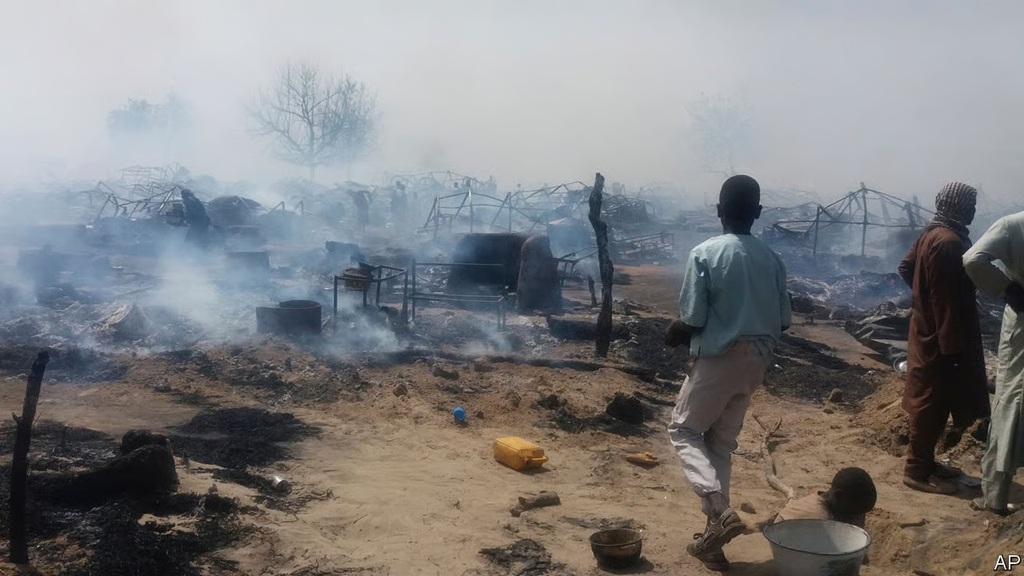
Boko Haram is a Sunni jihadist militant organisation based in northeastern Nigeria, also active in Chad, Niger and Cameroon. The group aims to overthrow the Nigerian government, abolish secular education and impose strict Sharia law, targeting civilians, schools and even military forces.
Understanding Boko Haram
Nigeria has had a long and unfortunate history of communal conflicts and ethnoreligious violence. For example, in Plateau state, in Nigeria’s “middle belt,” there have been many outbreaks of bloody violence between different communities since the return of democracy in 1999. There have also been riots in the urban centres of Kaduna and Kano, and for several decades, there has been a simmering conflict in the Tafawa Balewa district of Bauchi.
When viewed from the outside, these conflicts can appear to boil down to religious differences and tensions between blocs of Muslim and Christian inhabitants. When one looks more closely, however, one finds that control of government patronage is the primary cause of many of these conflicts. Election disputes have also led to breakdowns along Muslim and Christian lines, as was seen in the most recent polls in 2011, when youths went on the rampage in southern Kaduna state. When violence erupts in these circumstances, the genesis is usually in one group asserting control of the apparatus of government over another group or groups in a very heterogeneous and ethnically diverse part of Nigeria.
There is also a history of Muslim sects growing in northern Nigerian cities. In the 1980s, for example, the Maitatsine sect, which heretically claimed Muhammad was not the messenger of Allah, established itself in the slums of Kano. The sect was wiped out very brutally, with women and children of the sect attacking heavily armed military and police forces with bows and arrows and knives. The group scattered and was fully eliminated over the course of a decade.
A weakness in the institutions of politics and the security services has created a political situation where such threats to stability are not dealt with until violence is a certainty. Only when a politician in control of a state is convinced that such a threat cannot be bent to his advantage will he order any action to be taken against it. Such is the weakness of security institutions; their only method of dealing with any such threat is with violence. Boko Haram was created under these circumstances.
Boko Haram is an Islamic sect that believes northern politics has been seized by a group of corrupt, false Muslims. It wants to wage a war against them, and the Federal Republic of Nigeria generally, to create a “pure” Islamic state ruled by sharia law. Since 2009, it has been driven by a desire for vengeance against politicians, police, and Islamic authorities for their role in a brutal suppression of the group that year. But the group has proved itself to be very adaptable, evolving its tactics swiftly and changing its targets at the behest of a charismatic leadership. The group leapt onto the world’s agenda in August 2011, when it bombed the United Nations compound in Abuja, killing twenty-three people. Some observers say Boko Haram has reached out to find allies in other global jihadist movements in the Sahel. The speed at which the group developed the capability to produce large and effective improvised explosive devices and enlist suicide bombers to deliver them suggests outside help. But thus far, there is no evidence that the group intends to confront or attack Western interests inside or outside Nigeria.
Origin And History
- Early Years (2002-2009)
Boko Haram is the organisation founded by Mohammed Yusuf in 2002 in Maiduguri, Nigeria. Initially, the stage was called “Jama’atu Ahlis Sunna Lidda’awati wal-Jihad” (People Committed to the Propagation of the Prophet’s Teachings and Jihad). Yusuf preached Anti-Western, Anti-modernization, and Anti-government ideology. The group gained popularity among disillusioned youth and poor communities.
- Mohammed Yusuf’s Leadership (2002-2009)
Mohammed Yusuf, a charismatic leader, drew inspiration from Salafism and Wahhabism. Emphasised the need for pure Islamic practice and rejection of all Western influence. And established a mosque and Islamic school in Maiduguri. From 2002 to 2009, this was the starting phase of Boko Haram.
- Radicalisation and Violence (2009-2010)
In July 2009, Clashes between Boko Haram and Nigerian security forces. Yusuf was killed in police custody, sparking widespread violence. Abubakar Shekau took over leadership, escalating violence. And it is a second phase of Boko Haram. From 2009 to 2010
- Post-Yusuf Era (2010-2015)
Shekau expanded Boko Haram’s reach, targeting churches, schools, and markets. Introduced suicide bombings and kidnappings. Pledged allegiance to al-Qaeda and ISIS.
- Notable Attacks and Events
- 2011: Bombing of UN Headquarters in Abuja.
- 2014: Kidnapping of 276 Chibok schoolgirls.
- 2015: Massacre in Baga, killing over 2,000 civilians.
- Tactics and Strategies of Boko-Haram
When we talk about any terrorist organisation, the most important their tactics and strategies of attacks. Boko Haram, the North-eastern Nigerian terrorist group use the EDs and suicide attacks to propagate fear and disrupt both community cohesion and military efforts. These tactics must be tackled head-on to prevent a resurgence and return of the terrorist factions. The interconnectedness of insecurity across the region also poses risks. Terrorist attacks and bombings, Kidnappings and hostage-taking. They also use child soldiers and forced recruitment.
Impacts on Regional and International
The impacts of the Boko Haram organisation on the regional and international levels. The following points focus on Impacts.
Humanitarian Crisis and Displacement
Humanitarian Displacement & Boko-Haram in Nigeria, a book by Medinal Abdulazeez Malefakis, describes the crisis in Nigeria. In [chapter Nigeria: Conflict, Conflict Management & Humanitarian], Nigeria is an ethnically diverse country. The country is also ‘Islamo-Christian’, implying an almost even number of Christians and Muslims living side by side. Due to its large population and diversity, major political, economic, and social issues are vigorously or violently contested along the lines of the complex ethnic, religious, and regional divisions. From colonialism and even after independence, struggles for ethnic, political, and religious legitimacy have dotted Nigeria’s conflict landscape, culminating in a civil war in 1967 (amongst other violent conflagrations). The civil war marked the beginning of international humanitarian aid interventions in Nigeria. The internal displacement caused by the activities of Boko Haram’s terrorist insurgency in Nigeria. With over 3.1 million persons displaced, the humanitarian crisis is at teeter ends with acute malnourishment, inadequate wash and non-relief materials, improper hygiene facilities, and lack of access to basic relief aid for displaced persons.
Regional Stability and Security Threats
Boko Haram, a violent Islamist insurgency in Nigeria, has terrorised communities around West Africa’s Lake Chad Basin for years, creating new hardships and compounding existing ones for millions of people in northeast Nigeria, Cameroon, Chad, and Niger, many of them still displaced and struggling to survive. Children have been abducted, killed, and used as suicide bombers. Villages have been attacked, and if not burned to the ground, left stripped of all resources. Safe water, adequate health care and huge impacts on human life, medical problems arise due to drug consumption.
Global jihadist connections and inspiration
Global Jihadist connections and inspiration of Boko Haram. Since carrying out its first attack under Abubakar Shekau’s leadership in September 2010, Boko Haram has unleashed a wave of violence in northern Nigeria, mostly targeted against government personnel and security officers, Muslim politicians and traditional Muslim religious leaders, and Christians.1 Although the insurgency began as a local movement in northeastern Nigeria’s Borno State, since August 2011, there have been increasing signs of international collaboration between Boko Haram and militants outside Nigerian territory, such as in Borno State’s border region, northern Mali, the Sahel, Somalia and other countries in the Muslim world. As a result of these international connections, Boko Haram, which in 2009 was known as a “machete-wielding mob,” has now matched—and even exceeded—the capabilities of some al-Qaida affiliates, while also incorporating al-Qaida ideology into the locally driven motives for the insurgency in northern Nigeria.
Other connections and influence of Boko Haram are emulating the Taliban. Boko Haram has long drawn inspiration from the Taliban and was called the “Nigerian Taliban” by outsiders from 2003 until 2009. Some Boko Haram members have reportedly trained in Afghanistan, and in northern Nigeria, Boko Haram appears to have adopted tactics like the Taliban. Boko Haram in Mali. In November 2012, the Movement for Unity and Jihad in West Africa (MUJAO) and al-Qaida in the Islamic Maghreb (AQIM) captured Menaka in Mali’s Gao region from the secular Tuareg-led militia, the National Movement for the Liberation of Azawad (MNLA). An MNLA spokesman said that MUJAO, AQIM and Boko Haram prevented the local population from leaving the city so that they could be used as human shields. Several sources corroborate the spokesman’s claim that Boko Haram fighters are present in Mali.
Challenges
Boko Haram is a radical Islamist movement shaped by its Nigerian context and reflecting Nigeria’s history of poor governance and extreme poverty in the north. The movement is unique in that it combines a sectarian, radical Islamic agenda with violence. Its stated goal is the establishment of a sharia state, but it shows little interest in governing or implementing economic development. It is based on the fundamentalist Wahhabi theological system and opposes the Islam of the traditional northern Nigerian establishment, which is broadly tolerant.
When we talk about the challenges of Boko Haram. Challenges are arms running, illegal drugs smuggling in the part of Nigeria, and neighbour country. Its impact on maritime security. Maritime security challenges arise in front of other countries. Other challenges are radicalisation in the part of north-eastern Nigeria. Human rights violations, Human Trafficking, and human body parts trafficking. Etc. Countering these challenges includes addressing the root causes of extremism, improving regional security cooperation and protecting human rights and civilians
To manage ethnic, regional, and religious divisions, at the end of military rule in 1998, the competing and cooperating elites in the ruling People’s Democratic Party established a pattern of alternating the presidency between the predominantly Muslim north and the mostly Christian south.
This system was essentially dismantled in 2011 when southern Christian Goodluck Jonathan successfully won the presidential campaign for re-election, with the support or acquiescence of some of the northern Islamic establishment, who were probably bribed. Jonathan’s failure to replace the system of alternate Christian and Muslim presidents with a new balancing structure during a period of accelerating political appeals to ethnic and religious identities has been an important driver of northern marginalisation and a catalyst for the current wave of conflicts there. On the streets, the traditional Islamic establishment is seen as having sold out to secularism, making room for Boko Haram.
The Government’s response to Boko Haram is to see it as a terrorist movement in isolation from any environment that may have fostered it, and state security forces have reacted with violent repression. The government’s seemingly indiscriminate killing of alleged Boko Haram members and many others who were simply in the wrong place at the wrong time appears to be a driver of popular support for or acquiescence to Boko Haram.
The International Response to Boko Haram
The U.S. and British governments designated Boko Haram and Ansaru as terrorist organisations in 2013, while the United Nations designated Boko Haram an al-Qaeda affiliate in 2014. In the aftermath of the Chibok schoolgirls’ kidnapping, several Western countries offered to help Nigeria find and liberate the captives. However, the government has done little to take advantage of these offers. Moreover, credible reports of human rights abuses by the Nigerian security forces create difficulties for outside involvement by democratic states committed to furthering human rights.
Role of the United Nations
The United Nations responded to Boko Haram. Recognising this threat and the need for Nigeria to adopt a whole-of-government approach to defeating it, over the past two years, the United States has made a concerted effort to assist Nigeria in its counter-Boko Haram efforts. specially UN take a step on the activities of BOKO HARAM.UN adopting the resolution 2349 (2017), the Council strongly condemned all terrorist attacks, violations of international humanitarian law and human rights abuses by Boko Haram and Islamic State in Iraq and the Levant (ISIL/Da’esh) in the region, including killings, abductions, child, early and forced marriage.
Establishing Counter Terrorism Committee (CTC)
The UN Counter Terrorism Committee (CTC) was established by Security Council resolution 1373 after the September 11th attacks. It consists of all fifteen members of the Security Council and is responsible for ensuring that all States follow the resolution. The Committee also works to increase the capacity of States to fight terrorism. The Executive Directorate (CTED), as per resolution 2349, focuses on the threat of terrorism in the Lake Chad Basin by Boko Haram.
Actions Initiated by the UNSC CTC
- Countering the financing of terrorism.
- Border security and arms trafficking, Drugs Trafficking.
- Law enforcement.
- Human rights.
- Countering violent extremism and terrorist narratives.
- Comprehensive and integrated counter-terrorism strategies.
- Information and communication technologies.
- Counter-Terrorism strategies.
Conclusion
Boko Haram has evolved and sustained against external forces, and is currently focused on localising terrorism and regional instability, despite significant leadership losses. The group has evolved into a more decentralised, resilient insurgency, with factions like ISWAP [Islamic State West Africa Province] continuing to pose a severe threat in the Lake Chad Basin by exploiting weak governance and poverty. While there have been mass defections (around 160,000 people associated with the group by 2024), the long-term reintegration of these individuals poses a challenge to the stability of the region. The ultimate future of the insurgency depends on addressing the underlying issues in Northern Nigeria.
Title Image Courtesy: The Economist
Disclaimer: The views and opinions expressed by the author do not necessarily reflect the views of the Government of India and the Defence Research and Studies.


References
- (Abdulazeez Malefakis, 2022; Centre, 2013) Abdulazeez Malefakis, M. (2022). Nigeria: Conflict, Conflict Management, and Humanitarian Aid. In M. Abdulazeez Malefakis (Ed.), Humanitarian Displacement and Boko Haram in Nigeria (pp. 1–18). Springer International Publishing. https://doi.org/10.1007/978-3-030-99784-7_1
- Centre, C. T. (2013, January 14). Boko Haram’s International Connections. Combating Terrorism Centre at West Point. https://ctc.westpoint.edu/boko-harams-international-connections/
- (Başkanlığı, n.d.; Boko Haram | History, Meaning, Insurgency, & Facts | Britannica, 2024; FIGHT AGAINST BOKO HARAM, 2021; Full Article: “Framing” Contentious Activism: A Sociological Analysis of Boko Haram’s Ideology, through Its Discourse (2008 – 2016), n.d.; Ogbondah & Agbese, 2017) Başkanlığı, İ. Ü. B. İ. (n.d.). The Relationship Between ISIS, Boko Haram and the United Nations in The Context of the Responsibility to Protect Principle. Retrieved November 13, 2024, from https://iupress.istanbul.edu.tr/en/book/the-united-nations-and-its-conflict-resolution-role/chapter/the-relationship-between-isis-boko-haram-and-the-united-nations-in-the-context-of-the-responsability-to-protect-principle
- Boko Haram | History, Meaning, Insurgency, & Facts | Britannica. (2024, November 11). https://www.britannica.com/topic/Boko-Haram
- FIGHT AGAINST BOKO HARAM: SPECIAL REPRESENTATIVES LOUNCENY FALL AND MAHAMAT ANNADIF BEGIN A JOINT HIGH-LEVEL VISIT TO CAMEROON AND CHAD. (2021, October 18). UNOWAS. https://unowas.unmissions.org/fight-against-boko-haram-special-representatives-lounceny-fall-and-mahamat-annadif-begin-joint-high
- Full article: “Framing’ contentious activism: A sociological analysis of Boko Haram’s ideology, through its discourse (2008 – 2016). (n.d.). Retrieved November 13, 2024, from https://www.tandfonline.com/doi/full/10.1080/17539153.2024.2319737
- Ogbondah, C. W., & Agbese, P. O. (2017). Terrorists and Social Media Messages: A Critical Analysis of Boko Haram’s Messages and Messaging Techniques. The Palgrave Handbook of Media and Communication Research in Africa, 313. https://doi.org/10.1007/978-3-319-70443-2_18