
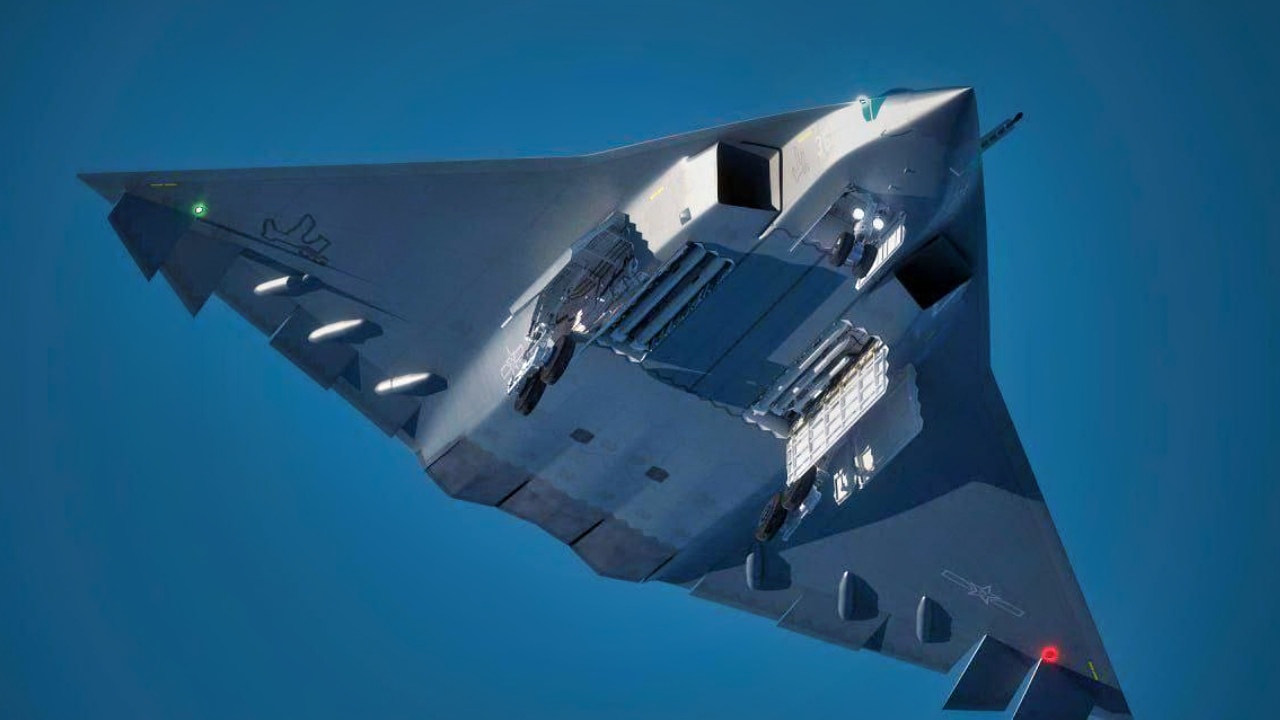
Iran claimed to have detected and damaged a US F-35 stealth fighter over its airspace last month using Infra-Red Search and Track (IRST) systems rather than conventional radar. The incident has raised questions about how much stealth fighters can remain obscure from IRST sensor arrays. Can India’s AMCA overcome the challenges from this stealth buster?
Introduction
While stealth technology makes aircraft nearly invisible to traditional radar, Infra-Red Search and Track (IRST) systems can detect the heat signatures of engines and atmospheric friction on airborne stealth platforms, making them a key technology for countering 5th-generation fighters and UAVs. IRST systems serve as a critical counter-stealth capability by exploiting the inherent thermal signatures of aircraft, which radar-absorbing materials and geometric shaping cannot fully mask. Unlike traditional active radar, which emits signals that can be detected or jammed, IRST systems operate passively to locate and track threats without alerting the adversary. This article explores the implementation and capabilities of IRST against stealth airborne platforms.
How IRST Works Against Stealth
IRST are passive systems that scan for thermal emissions from engine exhaust, aerodynamic friction and other sources without emitting energy. This makes the detecting platform “silent”; unlike radar, it cannot be easily jammed, detected, or homed on. Radar stealth aircraft design achieves a massive reduction in RCS (Radar Cross Section), often by 1,000x or more, through shaping and RAM (Radar Absorbent Material) coatings. IR signature reduction is far more limited than radar signature reduction. IR Stealth can typically achieve 2-5x RCS via exhaust shielding, cooling, or coatings, since hiding heat from jet engines and friction is nearly impossible. Under favourable conditions, IRST can detect fighters at 50–100+ km. Claims of even longer ranges against high-speed or hot targets exist. These sensors can be fitted on a 4.5 Gen aircraft to make it more lethal against the stealth aircraft.
Strategic Advantages
The integration of these systems offers several key benefits for air combat. It exploits fundamental design weaknesses in stealth platforms that remain unavoidable regardless of radar cross-section reduction. It can be a tactical surprise for the enemy’s view of silent detections since adversary pilots will be unaware of being monitored. High-resolution electro-optic and infrared imagery sensors facilitate identification and classification with superior angular resolution compared to radar. Multi-band IRST systems are immune to jamming and external weather conditions. Multi-sensor integration can provide a shield for a larger area and airspace.
Against Suicide Drones
IRST excels at spotting small, slow-moving or hovering suicide drones up to 10-20 km, leveraging infrared contrasts that radars often miss due to low radar cross-sections. Multi-sensor fusion with radar enhances reliability against low-flying and autonomous swarm drones, though they have low heat signatures. Since drones’ speed is very less compare to stealth fighters, the system gets adequate time to mitigate the threat. In real-world deployments like Ukraine’s IRIS-T SLM, IRST-guided missiles have achieved near-perfect intercepts.
Multi-Sensor Integration
Modern defence strategies emphasise “sensor fusion,” combining IRST with advanced radar technologies to create a more resilient detection network. In many contemporary applications, IRST is used to provide initial passive detection and target tracking without triggering the enemy’s radar warning receivers. The system works quite like passive radar detectors (ESM systems) and can be integrated into an existing ESM system for data fusion. Once a potential threat is identified through thermal signatures, active systems like Active Electronically Scanned Array (AESA) radars can be engaged for precise tracking and weapons guidance. Sensor and data fusion from multiple aircraft sensors using high-speed data links can use triangulation and the TDOA (Time-Difference of Arrival) technique to fix the stealth target’s position accurately. This could help the mission computer to iterate the range to the target besides bearing/direction. Multisensory fusion linking data from multi-static ground sensors enables quality tracking without switching the active radars ‘on’. IRST sensor and data fusion can facilitate an air defence or shield against airborne stealth platforms over a large area, including sea and can be integrated with existing air defence and missile shield systems.
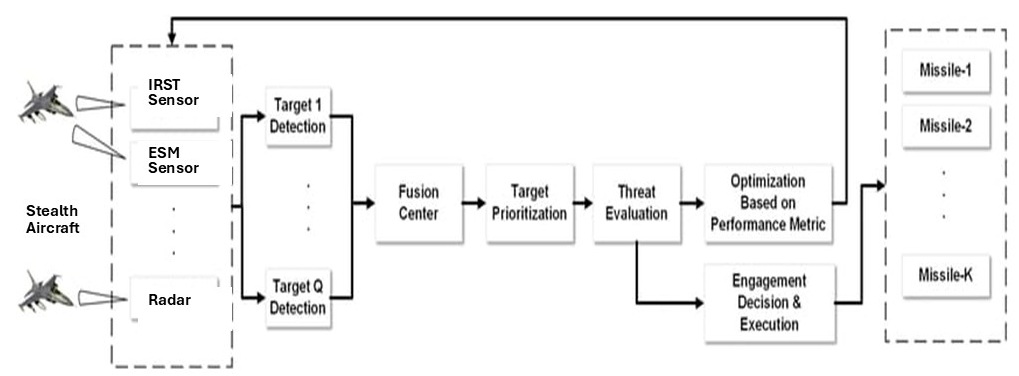
Fig 1: IRST Sensor Integration- Air Defence
Adoption of Technology
Both Russia and China have heavily invested in IRST on frontline fighters. NATO is currently retrofitting legacy platforms like Super Hornet and Typhoon with advanced IRST. All future 5th-gen and 6th-gen aircraft will include IRST as a core sensor.
India is also developing and testing an advanced, indigenous, long-range, dual-band passive Infrared Search and Track (IRST) system to counter stealth threats. They are tailored for fitment to the existing Su-30MKI and for Tejas Mk2 and AMCA fighters. These systems operate in both Mid-Wave Infrared (MWIR) and Long-Wave Infrared (LWIR) spectra to detect, track, and identify stealthy aircraft, naval vessels and ground vehicles against challenging background signatures. Probably, this system has played a role in the scrambling and grounding of F-35 belonging to the Royal Air Force in Thiruvananthapuram recently, but we are yet to receive any confirmation from the MoD in this regard.
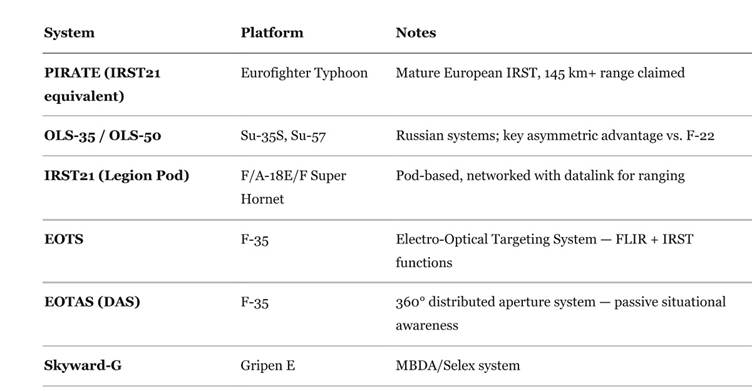
Table 1: Courtesy: Claude AI
Land-Based and Naval IRST Systems
On land and ships, they enable silent surveillance, early warning, and cueing for missile launchers without emitting detectable signals. Ground-based IRST networks use elevated sensors for wide-area coverage, detecting low-flying or stealthy aircraft up to 20-50 km in ideal conditions. The system can be integrated with very short-range air defence (VSHORAD) for fully passive operations, delivering precise azimuth/elevation data to tip and cue incoming stealth platforms and projectiles. Shipborne networked IRST excels against deck-borne stealth platforms as well as against sea-skimming anti-ship missiles, providing 360° horizon surveillance.
IR Spectral Bands
MWIR (3-5 μm) excels for high-temperature detections like jet engines or drone motors, offering better resolution in humid conditions. LWIR (8-14 μm) handles ambient-temperature targets and performs well through haze, though it’s more affected by precipitation. Dual-band systems fuse both for all-weather, day/night performance. Sensors could handle frequencies of both bands given below.
| Band | Wavelength | Frequency Range | Typical Use infratec+1 |
|---|---|---|---|
| MWIR | 3-5 μm | 60-100 THz | Hot exhaust, missiles |
| LWIR | 8-14 μm | 21-37.5 THz | Airframes, cold drones |
Table 2: IR Bands
Immune to Anti-Radiation Missiles and Electronic Warfare (EW) Systems
IRST is immune to radar jamming and decoys because it operates in the infrared spectrum. Conventional electronic countermeasures can’t spoof heat in the same way they do radio waves of radar and ESM systems. Since these sensors are passive, the system can remain immune to anti-radiation missiles/ weapons.
Limitations
IRST doesn’t replace radar but complements it, forming a powerful counter-stealth layer. Unless paired with a laser rangefinder or network triangulation, IRST can’t accurately judge distance to a stealth target on its own. Clouds, humidity, and background heat can degrade sensor performance. Nowadays, stealth aircraft come with reduced IR emissions by using cooling measures, exhaust shielding, and low‑emissivity coatings. IRST systems are high-cost, being an advanced military sensor system, and currently M/s Lockheed Martin is a leading player in this market.
Conclusion
IRST is a proven and growing “anti-stealth” tool that shifts the balance by enabling passive detection of heat signatures that radar stealth largely ignores. It acts as a strong complementary shield in modern air combat but faces physical, environmental, and technical limits. Stealth remains valuable (especially when combined with low IR signatures, EW, and tactics), but it is no longer as dominant against well-equipped opponents. Real-world effectiveness depends heavily on specifics like altitude, speed, weather and system quality. However, billions of dollars spent on designing and developing stealth fighters, bombers, and UAVs need to be justified in the coming years. AMCA, the stealth aircraft being developed by India, should cater for the challenges being posed by the enemy IRST systems.
Title Image Courtesy: https://nationalsecurityjournal.org/
Disclaimer: The views and opinions expressed by the author do not necessarily reflect the views of the Government of India and the Defence Research and Studies.