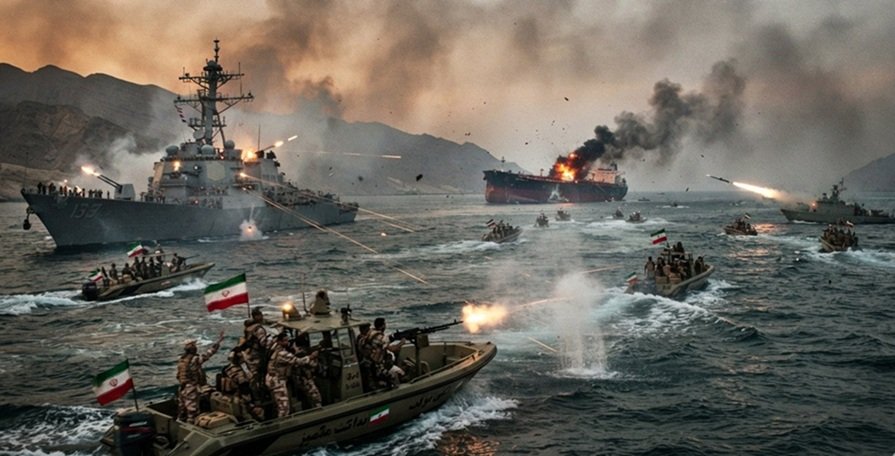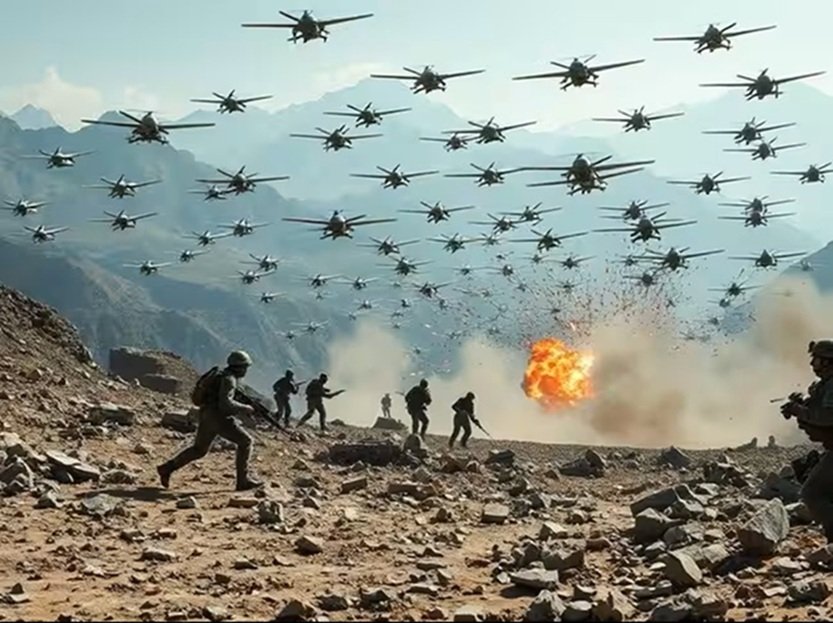
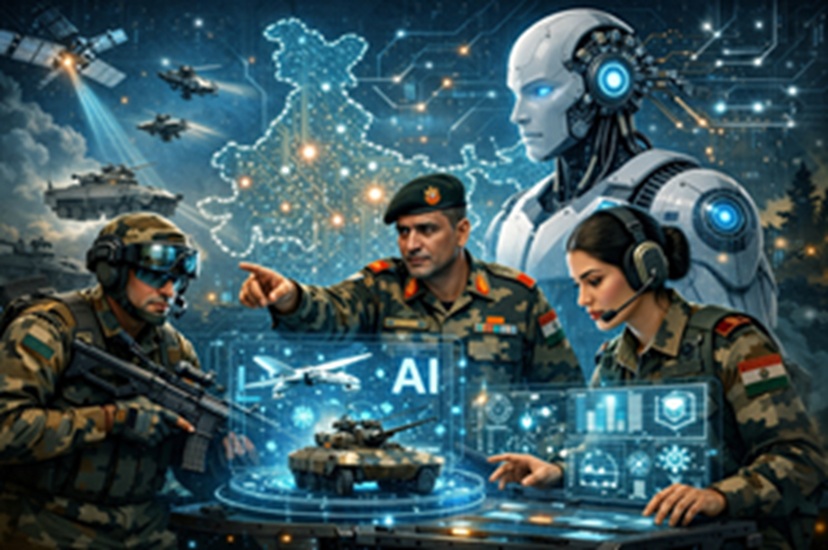
Artificial Intelligence (AI) and Autonomous Systems (AS) are fundamentally transforming the character of modern warfare by enabling data-driven decision-making, multi-domain integration, and increased operational autonomy. This article examines the implications of AI-enabled warfare for India’s defence strategy within a comparative context involving China and Pakistan. Using a multi-dimensional analytical framework encompassing technological capability, operational integration, doctrinal orientation, institutional capacity, and adaptability, the study identifies a critical “capability-integration gap” in India’s defence ecosystem. While India possesses strong technological potential and human capital, structural and institutional constraints limit the effective integration of AI into military operations. The article argues that future military advantage depends not merely on technological acquisition but critically on effective integration across data, doctrine, and institutions. It concludes with policy recommendations and a phased roadmap to guide India’s transition toward an AI-enabled defence strategy.
Introduction
Artificial Intelligence (AI) and Autonomous Systems (AS) are reshaping the conduct of warfare by altering how military power is generated, deployed, and sustained. Unlike earlier technological revolutions that enhanced individual platforms, AI operates across the entire military ecosystem, integrating intelligence, decision-making, and operational execution into a unified framework.1 This transformation is driving a shift from platform-centric warfare toward system-of-systems operations, where effectiveness is determined by the ability to integrate sensors, networks, algorithms, and command structures in real time.
For India, this transformation unfolds within a complex regional security environment defined by strategic competition with China and persistent tensions with Pakistan. China’s rapid advancement in AI-enabled military capabilities and Pakistan’s selective adoption of autonomous technologies create a dynamic and evolving threat landscape. Although India possesses significant technological capabilities and a strong talent base, it faces challenges in translating these advantages into integrated military effectiveness. Consequently, the central issue is not whether India should adopt AI, but how it can embed AI into a coherent and effective defence strategy that enhances its strategic position.
Methodology and Analytical Framework
This study employs a multi-dimensional analytical framework to assess and compare the AI-related defence capabilities of India, China, and Pakistan. The framework draws on Revolution in Military Affairs (RMA) theory, systems theory, and network-centric warfare literature to provide a theoretical anchor for empirical comparison. Five dimensions structure the analysis: (1) technological capability, (2) operational integration, (3) doctrinal orientation, (4) institutional capacity, and (5) adaptability.
The framework operationalises each dimension through specific indicators drawn from open-source data, including official government reports, academic literature, and assessments from established defence research organisations such as SIPRI, CNAS, and IISS. Table 1 presents the analytical framework in full.
Table 1: Multi-Dimensional Analytical Framework
| Dimension | Indicators Assessed | Data Sources |
| Technological Capability | SIPRI, NITI Aayog, and DRDO reports | SIPRI, NITI Aayog, DRDO reports |
| Operational Integration | Doctrine-technology alignment; C2 digitisation; ISR deployment | IISS Military Balance; CNAS |
| Doctrinal Orientation | Formal AI strategies; exercise doctrine; procurement signals | Official government documents |
| Institutional Capacity | Governance structures; civil-military integration; coordination mechanisms | Ministry of Defence reports |
| Adaptability | Organisational culture; innovation adoption rate; training programmes | iDEX reports; academic literature |
Source: Author’s compilation drawing on SIPRI, IISS, CNAS, and Government of India reports.
The study acknowledges important limitations. Analysis relies exclusively on open-source data, and classified operational details necessarily remain beyond its scope. Quantitative scores used in comparative figures represent structured analytical estimates informed by the literature rather than precisely measured values. Findings should be interpreted accordingly.
Evolution of AI in Warfare
The evolution of AI in warfare can be broadly understood in three phases: automation, digitisation, and intelligentisation.2 Early automation involved mechanised systems and computational tools that supported specific military functions. The digitisation phase introduced network-centric warfare, enabling real-time communication and coordination across forces. The current phase, often described as intelligentisation, is characterised by AI-driven decision-making, autonomous platforms, and predictive analytics.
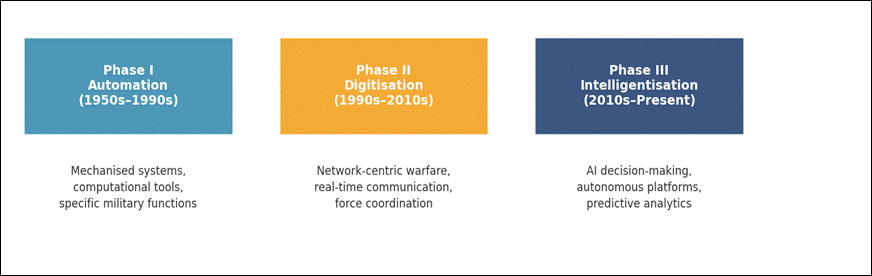
Figure 1: Evolution of AI in Modern Warfare – Three Developmental Phases (Author’s compilation)
Figure 1 illustrates the sequential nature of AI’s development in the military domain. Each phase builds upon the previous: intelligentisation is not a replacement of digitisation but its logical extension, amplifying network-centric capabilities through autonomous learning and algorithmic decision-support. For India, currently bridging phases two and three, this trajectory defines both the opportunity and the urgency of its modernisation challenge.
Global defence spending patterns underscore this urgency. Military expenditure reached approximately USD 2.24 trillion in 2022, with an increasing share directed toward emerging technologies, including AI and autonomous systems.3 The United States Department of Defence has invested heavily in AI research, while China has pursued a state-driven approach integrating AI development with military modernisation.4
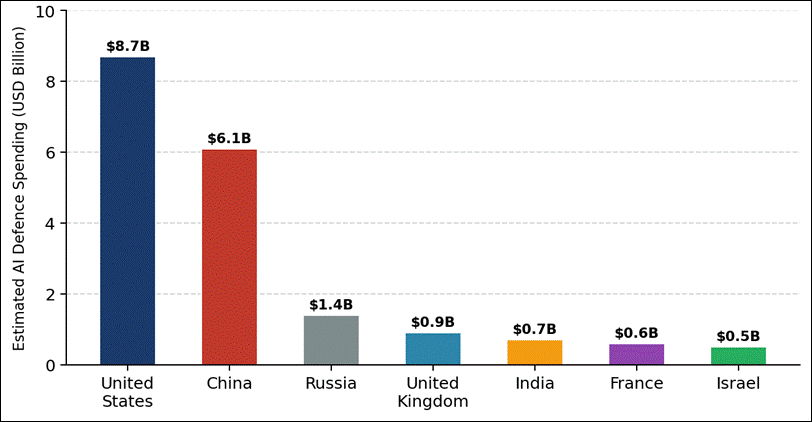
Figure 2: Estimated Military AI Expenditure by Major Powers (2023). Source: SIPRI; CNAS estimates.
Figure 2 reveals the scale of the resource asymmetry confronting India. The United States and China dominate AI defence investment by a considerable margin. India’s estimated allocation of USD 0.7 billion, while growing, remains significantly below that of its primary strategic competitors. This disparity reinforces the argument that India must achieve disproportionate efficiency through integration rather than attempting to match rival expenditure levels outright.
AI-enabled systems are increasingly employed in Intelligence, Surveillance, and Reconnaissance (ISR), autonomous drones, cyber operations, and command-and-control systems. These developments have compressed decision-making timelines and enhanced operational precision, while simultaneously introducing new risks related to reliability, cyber vulnerability, and inadvertent escalation.
India’s AI Ecosystem and Defence Context
India possesses several structural advantages in the domain of AI. It has a large pool of skilled engineers and data scientists, supported by a vibrant information technology sector. Estimates suggest that India’s AI workforce exceeds 400,000 professionals, though figures vary across sources.5 Government initiatives, such as the National Strategy for Artificial Intelligence developed by NITI Aayog, emphasise the role of AI in national development and strategic capability.
In the defence sector, tangible progress is visible in specific domains. The Innovations for Defence Excellence (iDEX) initiative has catalysed AI-focused startups developing applications in drone surveillance, logistics optimisation, and battlefield analytics. The Defence Research and Development Organisation (DRDO) has explored autonomous systems for border surveillance, while the Indian Air Force has invested in AI-assisted mission planning tools. However, these efforts remain largely siloed and have not yet coalesced into an integrated system-of-systems architecture.
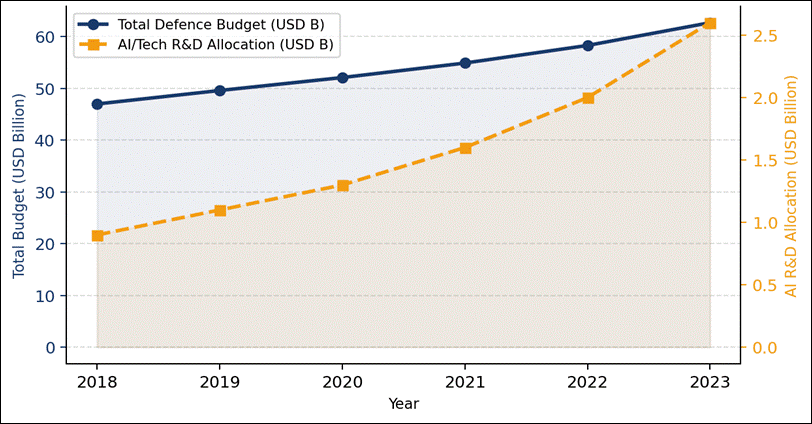
Figure 3: India’s Defence Budget and AI R&D Allocation Trend (2018-2023). Source: Ministry of Defence; Author estimates.
Figure 3 illustrates a consistent upward trend in both India’s total defence budget and its AI-related R&D allocation. However, the gap between the two lines highlights a persistent shortfall: AI and technology R&D remains a modest fraction of total defence expenditure. For meaningful AI integration, a rebalancing of this ratio is essential, directing greater resources toward data infrastructure, algorithm development, and civil-military technology transfer.
These structural challenges highlight a key issue: while India has the potential to develop advanced AI capabilities, it faces persistent difficulties in integrating these capabilities into operational and strategic frameworks. Institutional fragmentation across service branches, insufficient data-sharing standards, and limited joint-doctrine development collectively constitute what this study terms the capability-integration gap.
Comparative Strategic Context: China and Pakistan
China represents India’s most significant strategic competitor in the domain of AI-enabled warfare. Its doctrine of “intelligentised warfare” emphasises the integration of AI across all aspects of military operations, including command, control, intelligence, and logistics.7 China benefits from large-scale data availability rooted in its digital economy, strong state support, and a legally mandated civil-military fusion framework that facilitates technology transfer from commercial to defence applications (Lee, 2018; Allen, 2019). This structural alignment enables a high degree of coherence between technological innovation and military application.
Pakistan adopts a more selective but consequential approach, concentrating on asymmetric capabilities. Its acquisition of Turkish Bayraktar TB2 loitering munitions, development of indigenous surveillance drones, and investment in AI-enabled ISR systems reflect a deliberate strategy to offset conventional disadvantages.8 Although limited in scale, this approach exploits specific operational vulnerabilities and can generate strategic effects disproportionate to investment. The incorporation of AI into Pakistan’s cyber operations further complicates India’s threat calculus.
The comparative assessment of India, China, and Pakistan provides the basis for the following key findings. Taken together, the three cases illustrate that strategic advantage in AI-enabled warfare is not determined solely by total technological investment but by the coherence with which technology, doctrine, and institutions are aligned.
Table 2: Comparative AI-Defence Capability Assessment
| Dimension | India | China | Pakistan |
| Technological Capability | High (IT talent pool, iDEX startups) | Very High (state-led, civil-mil fusion) | Moderate (selective procurement) |
| Operational Integration | Partial (siloed structures) | High (system-of-systems doctrine) | Moderate (asymmetric focus) |
| Doctrinal Orientation | Evolving (no formal AI doctrine) | Intelligentised Warfare doctrine | Hybrid/Asymmetric doctrine |
| Institutional Capacity | Fragmented (multi-service gaps) | Centralised, coordinated | Limited but mission-focused |
| Data Infrastructure | Developing (interoperability gaps) | Advanced (large-scale data access) | Basic |
| Adaptability | High latent potential* | High (operationalised) | High (within limited scope) |
* India’s adaptability score reflects high latent potential attributable to human capital, despite current institutional constraints. Source: Author’s assessment.
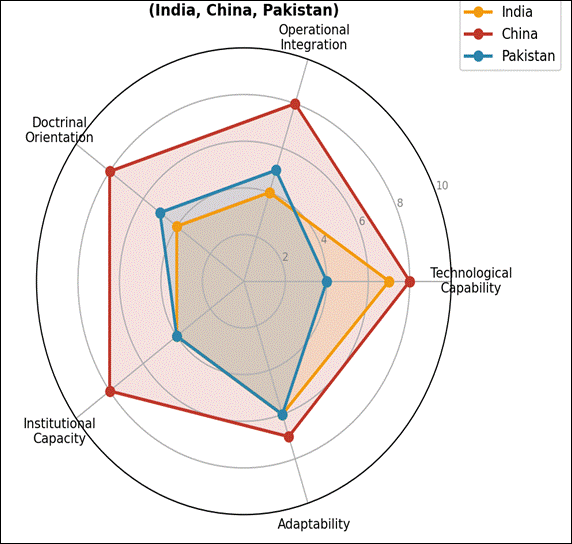
Figure 4: Comparative Multi-Dimensional Radar Chart – India, China, and Pakistan (Author’s assessment, scale 0-10).
Figure 4 makes the comparative capability profile visually explicit. China demonstrates the most balanced and operationalised profile across all five dimensions. India, by contrast, shows pronounced asymmetry: high technological capability scores alongside significantly lower integration and institutional capacity scores. Pakistan occupies a narrower but more coherent profile, reflecting a deliberate focus on its selected domains. This pattern directly underpins the capability-integration gap argument central to this study.
Key Findings
The capability-integration gap refers to the disconnect between a state’s technological capacity and its effective operational, doctrinal, and institutional utilisation of that capacity. For India, this gap is the central strategic challenge. Its dimensions are both structural – reflecting inherited institutional arrangements – and dynamic, amenable to deliberate policy intervention.
The analysis demonstrates that AI functions as a systemic enabler of military power rather than a discrete technological addition. It integrates sensors, networks, decision-support systems, and operational platforms into a unified architecture, transforming how military power is generated and applied.9 This systemic character shifts the focus from individual platform acquisition to the effectiveness of holistic incorporation across multiple organisational levels.
A second key finding concerns the strategic primacy of data. China’s advantage in the data domain is not merely a function of volume but of governance: its legal and institutional structures ensure that commercially generated data flows into defence applications. India, despite generating large volumes of digital data, lacks the interoperability standards, secure sharing protocols, and institutional frameworks necessary to transform this raw resource into operational intelligence.
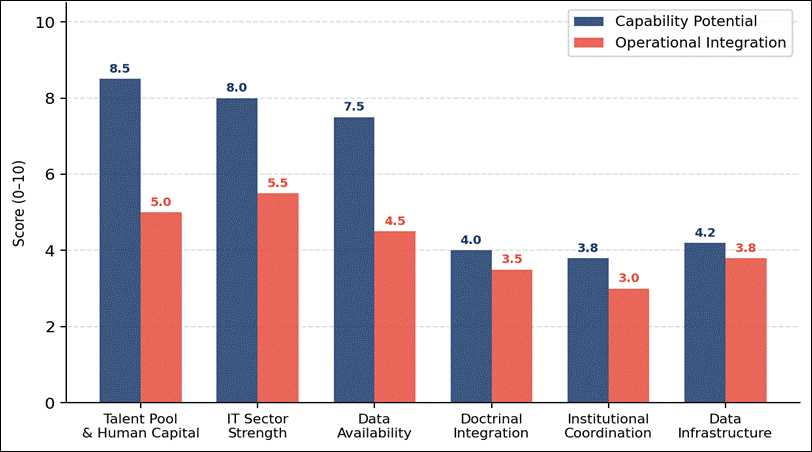
Figure 5: India’s Capability-Integration Gap Across Key Dimensions (Scale 0-10). Source: Author’s assessment.
Figure 5 quantifies the capability-integration gap across six specific dimensions. The divergence between capability potential (navy blue) and operational integration (red) is consistently large, particularly in doctrinal orientation and institutional coordination. This pattern is analytically significant: it confirms that India’s modernisation deficit is not primarily one of talent or technology but of systemic organisation. Closing this gap demands institutional reform and doctrinal investment at least as much as additional procurement.
Strategic Challenges
Ethical and Legal Dimensions
The integration of AI into military systems raises foundational questions of accountability, human control, and compliance with International Humanitarian Law.10 The delegation of targeting or engagement decisions to autonomous algorithms complicates traditional frameworks of responsibility, particularly for the use of lethal force. For India, developing a principled and legally grounded position on autonomous weapons will be essential both for domestic legitimacy and for participation in emerging international norm frameworks.
Operational Vulnerabilities
AI systems are structurally dependent on data integrity, network connectivity, and algorithmic reliability. These dependencies introduce vulnerabilities, including susceptibility to cyber attacks, adversarial data poisoning, and cascading system failures. India’s defence ecosystem, still developing an integrated data infrastructure, carries particular exposure. The 2020 Galwan crisis, which demonstrated the operational importance of real-time intelligence, underscores the cost of these gaps in contested environments.
Escalation and Deterrence Dynamics
At the strategic level, AI has the potential to alter nuclear deterrence dynamics by compressing decision timelines and reducing the window for human intervention. In a region where China, India, and Pakistan all maintain nuclear capabilities, AI-induced compression of crisis decision-making cycles creates heightened miscalculation risk.11 The dual character of AI – simultaneously a force multiplier and a source of strategic instability – demands an explicit risk management framework embedded within India’s AI defence doctrine.
Implications for India’s Defence Strategy
The foregoing analysis yields a set of structurally grounded implications for India’s defence strategy. First, the shift from platform-centric to networked architecture must be doctrinal, not merely technological. AI tools embedded in isolated service branches cannot generate the systemic advantage that integrated deployment would provide. Joint-domain integration across the Indian Army, Navy, and Air Force – supported by a common data infrastructure – is therefore a strategic prerequisite rather than an aspirational goal.
Second, data must be formally recognised as a strategic asset. This recognition should be institutionalised through a Defence Data Governance Policy that establishes standards for interoperability, secure sharing, and civil-military data transfer. Without this foundation, the performance of AI systems – which are ultimately defined by the quality and scale of the data on which they are trained and operated – will remain chronically constrained.
Third, institutional reform and human capital development are coequal priorities. The integration of AI is as much an organisational challenge as a technological one. India’s defence institutions must develop the internal capacity not only to procure AI systems but to assess, adapt, and extend them. This demands sustained investment in specialist training, AI literacy for senior commanders, and educational reform within the defence services.
Policy Recommendations
Institutional Governance
Establishing a centralised AI Defence Governance Body with cross-service representation and civilian scientific expertise would reduce fragmentation and improve strategic alignment. This body should have statutory authority to coordinate AI strategy across DRDO, the services, and the Ministry of Defence. Specific actions include:
- – Establish an Integrated AI Defence Command with cross-service representation and civilian expertise.
- – Formulate a National AI Defence Policy aligned with the National Security Strategy.
- – Create dedicated AI Research Centres under DRDO with structured civil-military access frameworks.
- – Strengthen iDEX with increased funding, streamlined procurement, and mandatory joint-service participation.
Technology and Data Infrastructure
Strengthening indigenous technological capability is essential for strategic autonomy. Increased R&D investment in machine learning, autonomous systems, and secure communications will reduce external dependency. A unified defence data architecture, supporting real-time analysis and secure sharing, should be treated as critical national infrastructure.
Doctrine, Ethics, and Human Capital
The formulation of an AI-centric military doctrine must address human-machine interaction protocols, escalation management, and ethical boundaries for autonomous systems. Simultaneously, sustained investment in AI literacy across all service ranks – from data-literate field commanders to specialist algorithm engineers – will ensure that India’s considerable human capital is oriented toward defence applications.
Table 3: India’s AI-Defence Transformation Roadmap (2024-2034)
| Phase | Timeline | Priority Focus | Key Actions |
| Phase I (Foundation) | 0-2 Years | Institutional & Data Infrastructure | Establish AI Defence Governance Body; build unified defence data architecture; launch AI talent pipeline; expand iDEX funding |
| Phase II (Integration) | 2-5 Years | Capability Integration & Scaling | Embed AI in ISR and C2 systems; promulgate AI-centric doctrine; civil-military technology transfer; interoperability standards |
| Phase III (Transformation) | 5-10 Years | Full Transformation & Strategic Leadership | System-of-systems warfare architecture; AI-enabled autonomous platforms; regional deterrence posture; international norm leadership |
Source: Author’s strategic recommendations.
Limitations and Directions for Future Research
This study is subject to several important limitations. The analysis relies exclusively on open-source data; classified operational intelligence necessarily falls outside its scope, which may affect the granularity of capability assessments. The quantitative scores used in comparative figures represent structured analytical estimates derived from the literature rather than independently verified metrics, and should be treated as indicative rather than definitive.
The three-country comparative framework, while analytically productive, does not capture the full range of actors shaping India’s strategic environment. Future research would benefit from extending the framework to include additional regional powers and from longitudinal tracking of capability development over time. Primary empirical data collection – through interviews with serving and retired defence personnel – would substantially enrich the institutional analysis. The normative dimensions of AI in warfare, including human-machine interaction ethics and international humanitarian law compliance, also warrant dedicated scholarly attention.
Conclusion
Artificial Intelligence and Autonomous Systems are transforming modern warfare by redefining how military power is generated and applied. This study has demonstrated that success in AI-enabled warfare depends not merely on technological acquisition but critically on the effective integration of technology, data, doctrine, and institutions into a coherent strategic framework.
For India, the central challenge is bridging the capability-integration gap. This gap is not primarily a function of technological deficit – India possesses the talent, the industrial base, and the institutional foundations for an advanced AI defence capability. It is, rather, a function of organisational and doctrinal fragmentation that prevents existing strengths from being operationalised. Addressing this gap requires strategic investment in data infrastructure, institutional reform, and doctrinal development at least commensurate with investment in AI platforms themselves.
Ultimately, India’s ability to adapt to digitally integrated warfare will determine its strategic position in an increasingly contested regional and global security environment. The window for establishing this foundation is narrowing as China’s lead in operational integration deepens. A comprehensive, phased, and institutionally grounded response – along the lines of the roadmap proposed here – offers the most credible pathway toward sustained strategic advantage.
Title Image Courtesy: Copilot AI
Disclaimer: The views and opinions expressed by the author do not necessarily reflect the views of the Government of India and the Defence Research and Studies.


Acknowledgements
The author acknowledges the support of HoD Dr Ramesh I Raut and the Faculty of the Department of Defence and Strategic Studies, Bhonsala Military College, Nashik. The author is grateful to anonymous reviewers whose comments substantially improved the manuscript. The views expressed in this article are those of the author alone and do not represent the official position of any government or military institution.
Notes
Notes use short-form citation. Full references are provided in the Bibliography.
1. Russell and Norvig, Artificial Intelligence: A Modern Approach (2010).
2. Scharre, Army of None (2018).
3. SIPRI, Military Expenditure Database (2023).
4. U.S. DoD, Artificial Intelligence Strategy (2018).
5. NITI Aayog, National Strategy for Artificial Intelligence (2018). Workforce figures vary by source: 350,000–500,000.
6. Ministry of Defence, Government of India, Annual Report (latest edition).
7. Kania, Battlefield Singularity (CNAS, 2017).
8. IISS, The Military Balance 2023 (2023).
9. Horowitz, “AI and the Balance of Power,” Texas National Security Review 1, no. 3 (2018): 37–57.
10. Taddeo and Floridi, “How AI Can Be a Force for Good in War,” Science 361 (2018): 751–752.
11. Payne, “Artificial Intelligence: A Revolution in Strategic Affairs?” Survival 60, no. 5 (2018): 7–32.
Bibliography
Allen, Gregory C. Understanding China’s AI Strategy: Clues to Chinese Strategic Thinking on Artificial Intelligence and National Security. Washington, DC: CNAS, 2019.
Boulanin, Vincent, and Maaike Verbruggen. Mapping the Development of Autonomy in Weapon Systems. Stockholm: SIPRI, 2017.
Horowitz, Michael C. “Artificial Intelligence and the Balance of Power.” Texas National Security Review 1, no. 3 (2018): 37-57.
International Institute for Strategic Studies. The Military Balance 2023. London: IISS, 2023.
Kania, Elsa B. Battlefield Singularity: Artificial Intelligence, Military Revolution, and China’s Future Military Power. Washington, DC: CNAS, 2017.
Lee, Kai-Fu. AI Superpowers: China, Silicon Valley, and the New World Order. Boston: Houghton Mifflin Harcourt, 2018.
Ministry of Defence, Government of India. Annual Report. New Delhi: MoD, latest edition.
NITI Aayog. National Strategy for Artificial Intelligence. New Delhi: Government of India, 2018.
Payne, Kenneth. “Artificial Intelligence: A Revolution in Strategic Affairs?” Survival 60, no. 5 (2018): 7-32.
Russell, Stuart, and Peter Norvig. Artificial Intelligence: A Modern Approach. 3rd ed. New York: Pearson, 2010.
Scharre, Paul. Army of None: Autonomous Weapons and the Future of War. New York: W.W. Norton, 2018.
Stockholm International Peace Research Institute. Military Expenditure Database. Stockholm: SIPRI, 2023.
Taddeo, Mariarosaria, and Luciano Floridi. “How AI Can Be a Force for Good in War.” Science 361, no. 6404 (2018): 751-752.
U.S. Department of Defence. Artificial Intelligence Strategy. Washington, DC: DoD, 2018.