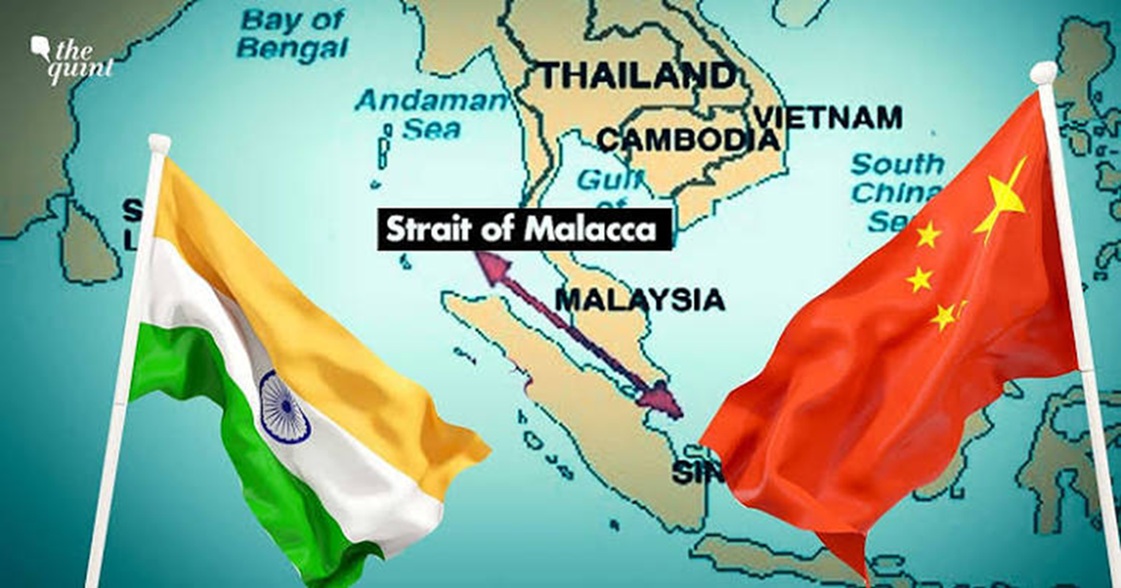
India talks a lot about the Indo-Pacific. We talk about China, the Indian Ocean, ASEAN, trade routes, naval power and national security. But one place connects all these issues: the Strait of Malacca. The Strait of Malacca is a narrow sea route between Malaysia, Indonesia and Singapore. It connects the Indian Ocean with the Pacific Ocean. This makes it one of the most important sea routes in the world. For India, Malacca is not just a waterway. It is a trade route, an energy route, a security route and a diplomatic route. If India wants to become a serious Indo-Pacific power, it cannot ignore Malacca. A huge amount of global trade passes through this strait. Oil, gas, containers, electronics, coal, palm oil, minerals and many other goods move through this route. Ships coming from the Middle East and Europe use Malacca to reach East Asia. Ships from China, Japan, South Korea and Southeast Asia also use it to reach the Indian Ocean.
This is why Malacca is so important. It is not just a local issue for Malaysia, Indonesia and Singapore. It affects China, India, Japan, the United States, Australia and many other countries. For India, the biggest point is simple: Malacca is the bridge between India’s Act East policy and the Indo-Pacific economy. India cannot only focus on the Arabian Sea, the Gulf and the western side of the Indian Ocean. Those areas are important, but India must also focus on the eastern side. The Bay of Bengal, the Andaman and Nicobar Islands, Indonesia, Singapore and the Malacca region should all be seen together. This is where India has a natural advantage. The Andaman and Nicobar Islands are located close to the western side of the Strait of Malacca. This gives India a very important position. India can watch important sea routes from there. It can also build better naval, coast guard, logistics and trade links from there.
But India must be careful. India should not behave as if it wants to control the strait. That would make Indonesia, Malaysia and Singapore uncomfortable. These countries are very protective of their sovereignty. They do not want outside countries acting like policemen in their waters. So India’s strategy should be smart and calm. India should not say, “We will control Malacca.” Instead, India should say, “We want to keep sea routes open, safe and free for everyone.”
Indonesia is very important in this strategy too. It is a large island country and a major ASEAN power. It sits near Malacca, Sunda and Lombok, which are all important sea routes. India and Indonesia are already moving closer in defence, trade, maritime safety and supply chains. India and Indonesia have also discussed better links between the Andaman and Nicobar Islands and Aceh in Indonesia. Sabang, a port in Indonesia, is very important here. India should look at Sabang not as a military base story, but as a trade and maritime services story. India can work with Indonesia on ports, ship repair, shipbuilding, marine tourism, logistics, coastal infrastructure and offshore energy services. This is a practical way to build influence. It looks less threatening and more useful. India’s defence relationship with Indonesia is also becoming stronger. India is now becoming a supplier of defence equipment, not just a buyer. The possible supply of BrahMos missiles and Astra missiles to Indonesia is important. It shows that India is slowly becoming a security partner in the Indo-Pacific. But defence should be only one part of the story. The bigger story should be trade, ports, maritime safety and regional trust.
India also needs to understand the role of Singapore and Malaysia. These countries are directly connected to the Strait of Malacca. Singapore is one of the most important maritime hubs in the world. Malaysia is also a key littoral state. Indonesia, Malaysia, Singapore and Thailand already work together through the Malacca Straits Patrol. This means India should not try to replace them. India should support them. India can help through information sharing, training, coast guard cooperation, anti-piracy work, search and rescue, pollution control and maritime domain awareness. But India should always respect the leadership of the countries around the Strait.
China is the biggest strategic reason why Malacca matters. China depends heavily on this route for oil and trade. A large part of China’s energy imports from the Middle East and Africa pass through the Strait of Malacca. This is often called China’s “Malacca dilemma.” This means China knows that Malacca is a weakness. If this route is blocked or disrupted, China’s economy and energy security can be hurt. This gives India some leverage. But India should not talk openly about blocking China at Malacca. That would be a mistake. It would scare ASEAN countries and make India look aggressive.
India should instead quietly build strength. It should improve surveillance, naval presence, airfields, ports, logistics, undersea awareness and maritime intelligence around the Andaman Sea and Bay of Bengal. India should be ready, but it should not speak carelessly. The best strategy is quiet strength. The United States also cares about Malacca because it is part of the wider Indo-Pacific balance. America wants open sea routes and a free Indo-Pacific. It sees India, Indonesia, Singapore and Malaysia as important partners.
Japan also cares deeply about Malacca. Japan depends on sea trade and energy imports. For Japan, open sea routes are a matter of economic survival. This is why Japan supports maritime security, anti-piracy work and better connectivity in the region.
Australia also sees Malacca as part of the larger Indo-Pacific security system. If the Indian Ocean and Pacific Ocean are connected, then Australia has an interest in keeping these routes open and stable.
Russia’s role is different. Russia is not a major player in Malacca directly. But Russia matters because of defence technology and energy. BrahMos is a joint India-Russia missile system. If India exports BrahMos to countries in Southeast Asia, it gives India a stronger defence role in the region.
For the Indian Navy, the strategy should have many layers. The first layer should be the Andaman and Nicobar Islands. India should improve airfields, ports, surveillance systems, logistics, drones, repair facilities and naval infrastructure there. But India should present this as maritime security and connectivity, not as an anti-China military fortress. The second layer should be Indonesia. India should build stronger links with Sabang, Aceh and other parts of Indonesia. It should work on ports, ship repair, coast guard cooperation, disaster relief, maritime data sharing and defence ties. The third layer should be Singapore and Malaysia. India should build trust through exercises, information sharing, anti-piracy cooperation and respect for their sovereignty. The fourth layer should be trade protection. Malacca is not only about the Navy. India must ask a basic question: what happens if this route is disrupted? What happens to India’s energy, electronics, imports, exports and shipping costs?
If Malacca is blocked or delayed, ships may have to take longer routes through other Indonesian passages. That would increase time and cost. So India must plan for alternate routes, shipping insurance, energy reserves, stronger ports, a better merchant fleet and more ship repair capacity. The fifth layer should be diplomacy. India should work through ASEAN. It should not make Southeast Asian countries feel that India is bringing a China-versus-Quad fight into their region. India should use the language ASEAN prefers: maritime cooperation, connectivity, blue economy, freedom of navigation, safety, trade and stability. This is important because ASEAN countries do not want to choose sides openly between India, China and the United States. They want balance. India should respect that.
The main lesson is – Malacca is too important to be treated only as a military chokepoint. It is also an economic lifeline. The countries around it want trade, openness, safety and stability. India should help strengthen those goals. India should not behave like an outside policeman. It should behave like a responsible regional partner. Because the Andaman and Nicobar Islands, India is not far away from Malacca. It is already a natural stakeholder.
India’s Malacca strategy should be based on three simple words: presence, partnership and preparedness. Presence means India should remain active in the Bay of Bengal, the Andaman Sea and the eastern Indian Ocean. Partnership means India should work with Indonesia, Singapore, Malaysia, Thailand and ASEAN. Preparedness means India should quietly build the ability to protect its trade, watch hostile movements, respond to crises and keep its sea routes open. In the long run, India’s Indo-Pacific strength will not only be decided by speeches, summits or military exercises. It will be decided by whether India can protect the sea routes where real trade happens – Malacca is one of those routes.
If India handles Malacca properly, it can strengthen its Act East policy, improve ties with ASEAN, protect its energy security, grow its maritime industry, expand defence exports and become a stronger Indo-Pacific power. If India handles it badly, it may look either weak or too aggressive. The better path is clear – India should not try to dominate the Strait of Malacca. India should help keep it open, safe and useful for trade. At the same time, India should build enough naval and maritime power around it so that no hostile country can ignore India’s position. That is the real importance of Malacca for India.
Title Image Courtesy: The Quint
Disclaimer: The views and opinions expressed by the author do not necessarily reflect those of the Government of India or the Defence Research and Studies.