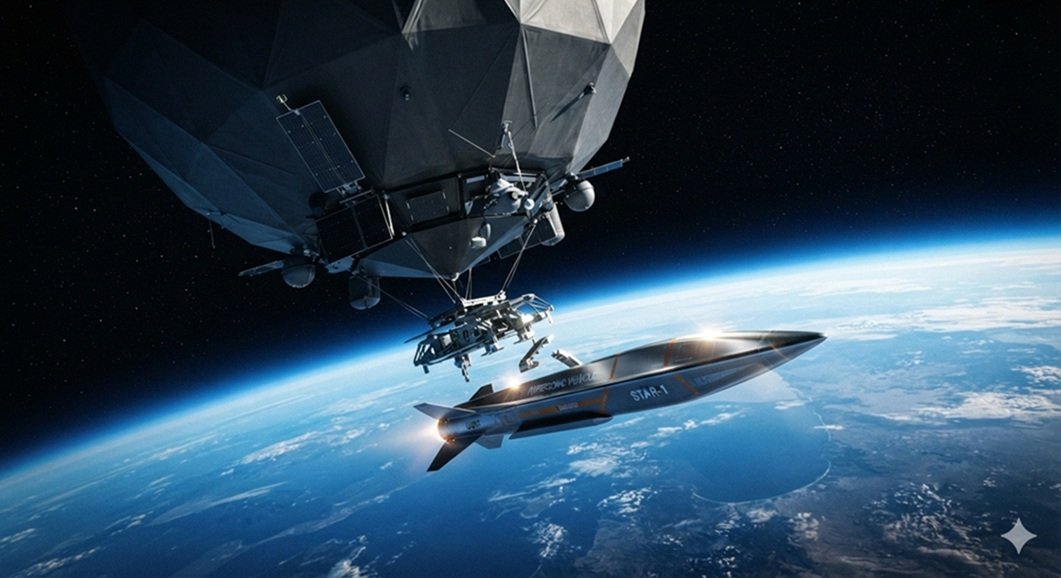
Near-space balloons operate in the stratosphere between high-altitude aircraft and low-Earth-orbit (LEO) satellites. This layer will become a strategic space for air-launched hypersonic weapons.
Introduction
Balloon-Launched Hypersonic Vehicles (BLHVs) are an emerging aerospace and defence concept that could offer a new way to deploy high-speed weapons from the edge of space. By lifting a vehicle into the stratosphere before releasing it, the technology seeks to reduce dependence on conventional launch systems while potentially offering greater operational flexibility and a less conspicuous launch signature.
A vehicle travelling at Mach 5 or faster can compress an adversary’s response time, complicate interception and challenge conventional missile-defence architectures. A balloon-assisted launch could add another dimension to this equation.
Strategic Advantage
A conventional hypersonic weapons programme must contend with the considerable energy and infrastructure required to propel a vehicle to the necessary altitude and speed. A balloon-launched architecture attempts to simplify the initial stage. A high-altitude balloon carries the vehicle into the stratosphere, allowing it to bypass much of the denser lower atmosphere. Once the designated altitude is reached, the vehicle is released and must use its own propulsion or a secondary acceleration mechanism to achieve hypersonic velocity.
The potential advantage lies in reducing the need for a heavy first-stage rocket booster. This could lower launch-system costs and provide greater flexibility in deployment. Operating from the stratosphere may also produce a different launch signature from that of conventional ground-based missile systems, potentially complicating an adversary’s surveillance and early-warning calculations.
China appears to be among the countries most actively exploring the military possibilities of near-space platforms. Reports have described tests involving balloon-launched hypersonic and near-space glide vehicles, including experimental platforms associated with the D18 series. Beijing’s broader aerospace programme also includes concepts such as the MD-22 hypersonic military aircraft and the MD-19 and MD-25 near-space vehicles.
The MD-19 has reportedly been described as an experimental hypersonic drone launched from a balloon near the edge of space, with a claimed capability of reaching Mach 7. The MD-25 is another near-space aircraft concept. China has recently released footage of these vehicles.
The United States, too, has explored high-altitude platforms and near-space technologies through military agencies and research programmes, including DARPA. Balloon-based systems operating at altitudes of approximately 60,000 to 90,000 feet could eventually complement the Pentagon’s broader surveillance and communications architecture and potentially support the tracking or deployment of hypersonic systems.
US budget documents have reportedly indicated expenditure of about $3.8m on balloon-related programmes over recent years, with further developmental spending envisaged. These initiatives should not, however, be mistaken for evidence that operational balloon-launched hypersonic strike weapons have entered the American arsenal.
Canada offers another interesting example of experimentation. Landing Zones Canada has announced the completion of flight tests for its Eagle Advanced Payload Delivery System (APDS), which the company describes as the world’s first high-altitude balloon-launched system of its kind. Designed for military drone applications, Eagle is intended to operate in demanding operational and climatic environments, with varying degrees of autonomy and human control.
India’s entry into this emerging field is particularly interesting. Aminuteman Technologies, a Pune-based defence start-up, has proposed a contemporary BLHV architecture that would use a high-altitude balloon to carry a hypersonic vehicle into the stratosphere before releasing it for powered flight.
The concept follows the broad principle of balloon-assisted deployment. By transporting the vehicle above the denser layers of the atmosphere, the balloon would reduce the energy required for the initial climb. Once released, the vehicle would have to engage its onboard propulsion system or another acceleration mechanism to attain speeds exceeding Mach 5.
The proposed system could reduce dependence on expensive and cumbersome rocket boosters. Secondly, a stratospheric launch could potentially offer a less conspicuous deployment profile than conventional ground-based missile systems. A reduction in the complexity of the initial launch infrastructure could translate into lower manufacturing and operational costs.
India’s military-industrial ecosystem needs precisely this kind of experimentation to reduce dependence on imported platforms and systems. However, the Aminuteman proposal remains at the developmental stage.
Key Challenges
The most fundamental challenge is propulsion. A balloon can lift a vehicle to considerable altitude, but it cannot provide the forward velocity necessary for sustained hypersonic flight. Achieving and maintaining Mach 5 or higher requires a powerful and reliable propulsion arrangement. Developing such a system, while keeping the vehicle sufficiently compact and lightweight, is no trivial undertaking.
Thermal management presents another formidable obstacle. At hypersonic speeds, aerodynamic friction generates extreme temperatures, placing enormous stress on the vehicle’s structure, materials and control surfaces. Advanced thermal protection systems will be essential to prevent structural damage and ensure reliable performance.
The mechanics of releasing a vehicle from a floating balloon platform also demand careful attention. Safe mid-air separation, stability immediately after release and the management of unpredictable stratospheric winds will require specialised engineering. Even minor deviations during separation could compromise the subsequent flight. There are also unanswered questions about the relationship between Aminuteman’s proposed BLHV and its hypersonic glider vehicle (HGV). A hypersonic glide vehicle is designed around a particular flight architecture, whereas a balloon-launched system describes a method of transporting and releasing a vehicle at altitude.
The larger significance of the Aminuteman initiative is an indication of the increasingly important role that younger entrepreneurs and private enterprises could play in expanding the country’s indigenous defence capabilities.
Conclusion
The government has made considerable efforts to encourage domestic defence manufacturing and private-sector participation. But an ecosystem capable of producing genuinely advanced systems needs sustained research funding, collaboration with established scientific institutions and a willingness to accept failure as part of technological progress. French physiologist Claude Bernard once observed that “Observation is a passive science, experimentation an active science.” In the hypersonic race, India cannot afford merely to watch from the sidelines. It must experiment, innovate and build.
Title Image Courtesy: Nano Banana
Article Courtesy: Perfect Voice
Disclaimer: The views and opinions expressed by the author do not necessarily reflect those of the Government of India or the Defence Research and Studies.