
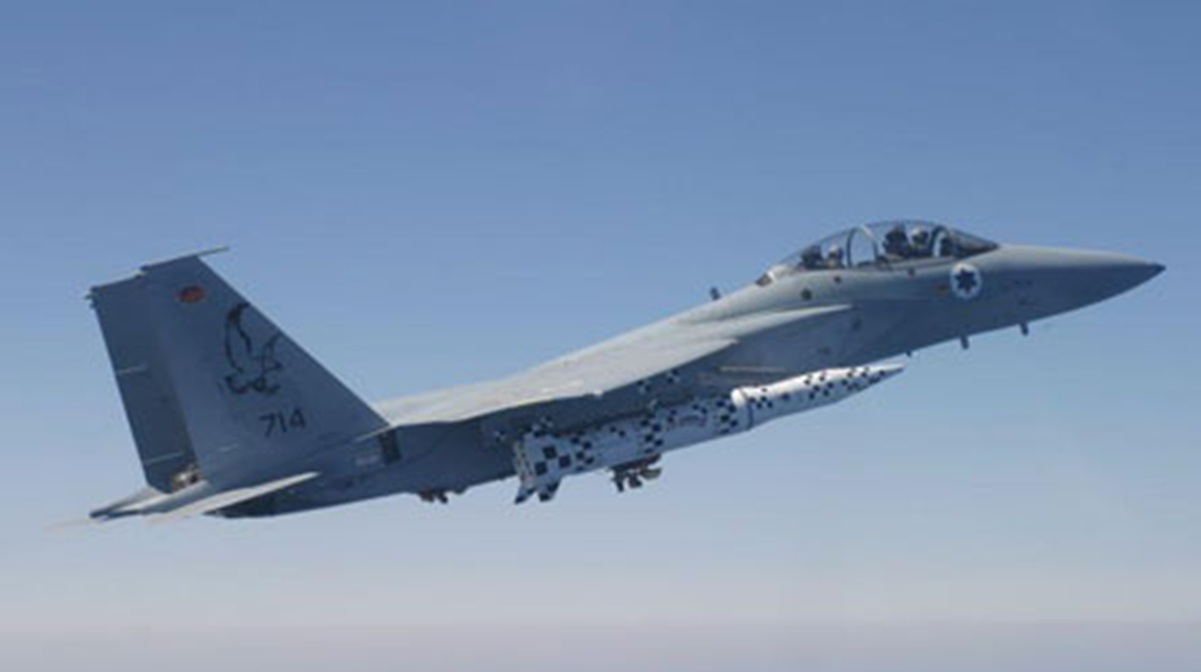
The Blue Sparrow is an advanced air-launched ballistic missile (ALBM) developed by Israel’s Rafael Advanced Defence Systems. It was originally designed to simulate enemy ballistic missiles for defence drills but has since been adapted into an operational, long-range strike weapon capable of reaching targets up to 2,000 km.
Introduction
Israel’s Blue Sparrow missile grabbed attention worldwide when, according to several reports, it killed Ayatollah Khamenei by striking his compound on Pasteur Street in Tehran. This missile is created by Israel and is manufactured by Rafael Advanced Defence Systems and other collaborators. It is a member of Israel’s “Sparrow” family, which also includes Black and Silver Sparrows that mimic the dangers of Soviet-designed Scud missiles. This missile has an impressive range of 1,240 miles. Additionally, it exits Earth’s atmosphere before making an impact, which makes it a perfect option for an attack on a highly guarded target. This armament could evade Iran’s defence systems because it can exit and re-enter the Earth’s atmosphere, making it almost impossible to intercept. It has a quasi-ballistic flight path that could be modified to increase its lethality during an attack. As this missile travels both through air and outer-space, this weapon system is a perfect example of modern-day air and space power projection in warfare.
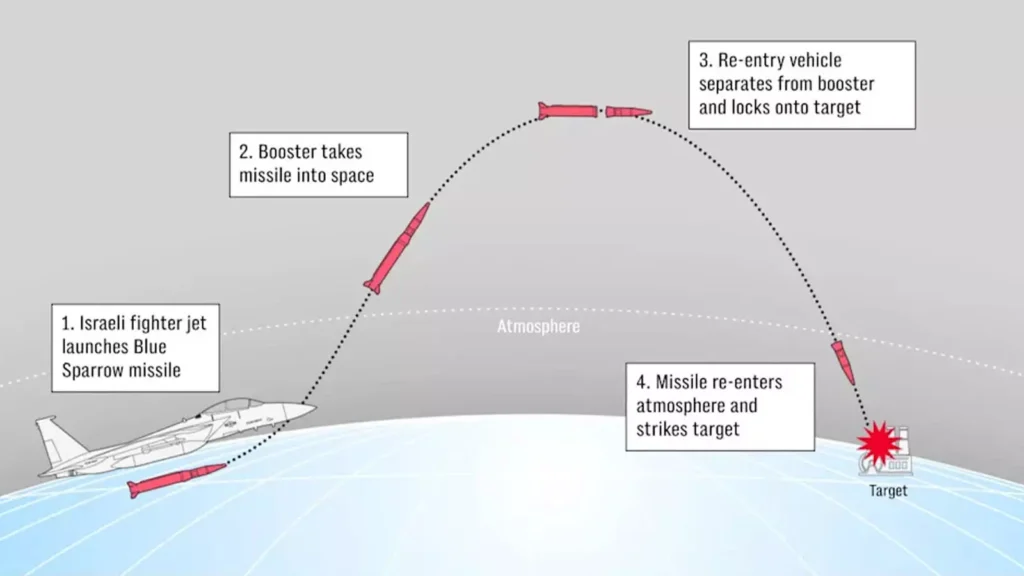
Flight Path PC: The Federal
Features of Blue Sparrow Missile
Blue Sparrow missile was originally used as a target missile by Israel. It can carry a highly explosive payload and features a modular warhead part. It mimics different ballistic missile trajectories, re-entry techniques, and signatures. In addition to providing a thorough response to BMD sensor and interceptor test and training requirements, Sparrow targets provide medium to high fidelity threat portrayal. They offer versatility for test scenarios because they can be launched both over land and over sea. The target systems’ customisable trajectories, telemetry, radar transponders, and flight termination mechanism make it simple to alter them to test range requirements. Shihab, SCUD-C/D, and other unitary and separable medium to long-range theatres are simulated by Blue and Silver Sparrow. Both targets make use of the same Re-entry Vehicle (RV), which has a three-axis attitude control system and a redundant autonomous flight termination system. Blue Sparrow has completed all of its missions without a hitch. Its navigation system is guided by Global Positioning System (GPS) and dual Inertial Navigation System (INS).
An essential component of this missile system is integration with combat aircraft on the front lines. Official test announcements for Silver Sparrow specifically refer to F-15 platforms as launch aircraft, and publicly available images from previous test campaigns depict Israeli Air Force F-15D and F-15C fighters carrying Blue Sparrow missiles on centreline stations. This demonstrates that Israeli F-15s, including upgraded F-15I strike variants, are capable of carrying and launching the Sparrow family missiles, providing the Israeli Air Force with an air-launched ballistic capability that can be used from stand-off distances well beyond the borders of prospective rivals. Doctrinally speaking, such an ALBM permits F-15 operators to launch their weapons from airspace that is less vulnerable to long-range ground-based air defences while enabling deep strikes against guarded strategic sites.
Launch Mechanism
Blue Sparrow missile is an air-launched ballistic missile (ALBM) and is usually launched from fighter aircraft like the McDonnell Douglas F-15 Eagle. It is around 6.5 meters long and 1.9 tonnes in weight. Following launch, the missile is propelled towards the edge of space by a booster rocket before splitting apart and rapidly re-entering the atmosphere to land on its target. The missile can strike well-protected targets with minimal notice because of its steep trajectory, which drastically shortens the reaction time for air defence systems and makes interception very challenging. The warhead separation from the booster rocket and target acquisition and locking process happens outside the atmosphere. The missile has an independent flight termination mechanism and can re-enter in a ballistic, barrel roll, or manoeuvre manner. The Blue Sparrow, which Israel used during the 2024 attack on Iran, was initially built to avoid air defences due to its rapid speed.
ALBM Advantages
Extended range, short flight time, unexpected launch angles, and precision accuracy are four outstanding features of ALBMs. From almost anywhere in the air, these missiles may strike an air-defence battery in a matter of minutes. ALBMs are superior to gravity bombs and cruise missiles for mobile air defences and high-value targets. Additionally, because ALBMs are air-launched, they are more accurate and survivable than the ground-launched intermediate-range ballistic missiles (IRBMs) utilised by China, Iran, and Russia. Not only do Israelis use ALBMs, but China and Russia also have them. For instance, Kinzhal and other hypersonic missiles are actually manoeuvrable ALBMs. Kinzhal allows Russia to carry out precise strikes from deep within Russian territory and is proving difficult for the Ukrainian air defences to intercept.
Due to ALBMs’ low plume density and space-edge trajectory, which shortens decision times and complicates tracking, early warning and midcourse tracking pose significant issues for Ukraine. Chinese and Russian ALBMs are dual-purpose weapons that can contain a conventional or nuclear warhead. In the event of a launch against American or North Atlantic Treaty Organisation (NATO) forces, intelligence analysts face a challenging task due to the short time between discovery and impact. Attribution is especially challenging because of these systems’ mobility. In contemporary combat, ALBMs have become one of the most disruptive systems. Many nations don’t have a comparable prompt-strike option, and adversaries can now execute accurate, quick strikes from unexpected launch angles.
Limitations of ALBMs
The size and payload capacity of the aircraft carrying ALBMs place physical limitations on them. Compared to land-based or submarine-launched ballistic missiles, they are often lighter and smaller, which limits their range and the amount of the warhead they can carry. The bomber or fighter aircraft acts as a big, valuable, and vulnerable target before launch. To deploy the missile, carrier aircraft must fly close enough to the target region, putting it at danger of being discovered and intercepted by advanced, long-range air defence systems. An initial boost in altitude and speed is provided by launching from an aeroplane, but silo-based missiles have substantial, multi-stage, ground-boosted phases. Therefore, unless the carrier aircraft goes dangerously deep beyond hostile airspace, the maximum feasible range of an ALBM is intrinsically smaller. It takes significant, costly structural and software changes to enable military aircraft to carry, target, and successfully launch a ballistic missile. ALBMs are totally dependent on the availability and preparedness of the particular carrier aircraft, which may be grounded by weather, mechanical problems, or runway damage, in contrast to ground-mobile launchers that can function independently.
ALBM prospects for India
As per some reports, India has reportedly been given an offer by Israel of an export version of the Blue Sparrow missile, which has a 2,000-kilometre range. If we observe the disadvantages of the ALBMs, then some of them could be resolved if we refine the engineering and force projection policies. Depending upon the mission and the target value, lighter ALBMs could be mounted on aircraft, while heavier ALBMs could be carried on heavier bombers. The lift capacities of bombers could definitely be increased if improvements in engine and design is made. The carrier aircraft can fly at higher altitude and with escort fighter-jets for SEAD / DEAD missions if the target is heavily guarded by air defence systems and has a well-equipped air force. The range of ALBMs could be further extended if the carrier aircraft flies to the edge of space. For missiles to be launched from outer-space zone, the use of Reusable Launch Vehicles (RLVs) could be utilised in future, which has never been done before. All these possibilities depend on the kind of technological, financial, engineering and skilled scientific efforts the Indian government is ready to implement and execute if they consider it to be worthwhile in investing in military applications of air and space power.
Title Image Courtesy: Flight Global
Disclaimer: The views and opinions expressed by the author do not necessarily reflect the views of the Government of India and the Defence Research and Studies.