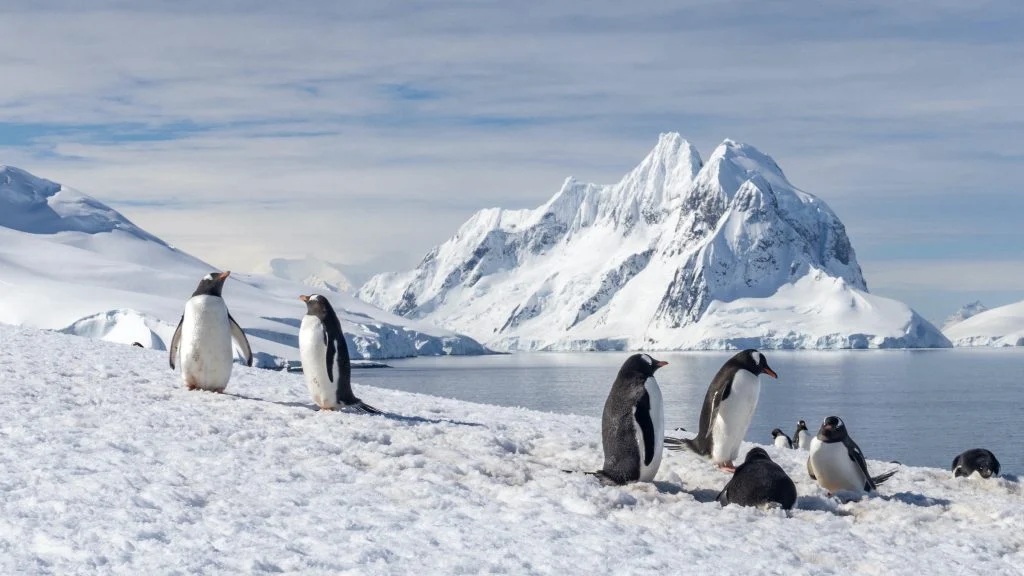
Conservation of Antarctica is governed by the Antarctic Treaty System and the Environmental Protocol (Madrid Protocol), which designate the continent as a natural reserve dedicated to peace and science. It bans mining, protects native flora and fauna, and manages marine life through international frameworks.
In September 2025, in Kerch, located in occupied Crimea, a man, Leonid Pshenichnov got arrested by the Russian authorities on charges of high treason. And for good reason: this 70-year-old Ukrainian scientist is said to have supported research aimed at reducing krill fishing quotas. The timing is hardly coincidental since, the following month, the event specifically devoted to these issues was due to take place: the 44th annual meeting of the Commission for the Conservation of Antarctic Marine Living Resources (CCAMLR). Spoiler alert: Leonid Pshenichnov would never make it there.
A fine cold snap for Antarctic cooperation: arresting those who propose exploiting it less… This would indeed be the first time that one State had arrested the delegate of another State Party to the Treaty precisely for carrying out the work expected of him. A clarification is also required from a legal standpoint: how can Russia prosecute a Ukrainian citizen for high treason? In reality, like tens of thousands of residents of occupied Crimea, Pshenichnov was forced to accept a Russian passport following the 2014 annexation, without ever renouncing his Ukrainian nationality. Holding both passports, he therefore continued to represent Ukraine at CCAMLR. And it is this dual status, imposed by Moscow itself, that now allows him to be tried as a “traitor” in the name of a State whose nationality he never chose. But beyond the diplomatic irony, the paradox deepens: because, on closer inspection, Russia is no longer even among the leading krill-fishing countries. Why, then, arrest a scientist whose work no longer directly threatens its fishing interests? And more broadly, one question arises, can we sincerely believe in the protection of Antarctica by those who also intend to profit from it?
A One-gram Crustacean, The Pillar of an Entire Continent
Before going any further into disputes over quotas, vetoes and hydrocarbons, it is first necessary to understand what makes this tiny crustacean so strategic. Because, behind a few centimetres and barely one gram, a significant part of the Antarctic balance is at stake. Antarctic krill does not look like much. It measures between 4 and 6.5 centimetres, weighs around one gram, and generally lives for between five and seven years, sometimes up to ten years in laboratory conditions. Taken individually, nothing very impressive. Taken collectively, the matter changes scale: its total biomass is thought to amount to hundreds of millions of tonnes. How much exactly? This is where certainty already begins to fall apart. Depending on the study, estimates range from around 100 to more than 500 million tonnes. The figure most commonly put forward is between 300 and 500 million tonnes. If the margin is so wide and krill biomass so difficult to establish, it is precisely because the animal moves in compact, mobile and sometimes gigantic swarms. In other words, depending on the place and time of the survey, scientists may come across a veritable cloud of krill or, a few kilometres further on, almost nothing. On a large scale, counting them therefore resembles less a straightforward census than a delicate underwater treasure hunt.
And if krill occupies such a disproportionate place in the Antarctic ecosystem, it is because it feeds almost everyone. It feeds mainly on phytoplankton, before itself becoming food for whales, seals, penguins, seabirds, squid and fish. It therefore transforms a microscopic resource into food available to large predators. In other words, taking krill does not simply amount to removing one more tiny shrimp; it means putting pressure on the food supply of almost the whole of Antarctica. This is precisely why its possible decline is a source of concern. Especially since krill no longer feeds only Antarctic animals. It also supplies aquaculture, animal feed and the market for omega-3 dietary supplements. In other words, the same crustacean must now feed whales, farmed salmon and consumers of capsules alike.
Fishing, Whales, Sea Ice: Who is to Blame?
Should fishing alone be blamed, then? Some industry representatives point out that catches are thought to account for only around 1% of the total estimated biomass of Antarctic krill. Presented in this way, the amount harvested appears almost negligible. But that would first require knowing the precise size of this biomass. Yet, as we have seen, estimates vary considerably, and krill movements remain difficult to measure. Added to this is the concentration of catches. Because harvesting a small share of the total biomass means very little if fishing is concentrated, at the same time, in the very areas where whales, seals and penguins come to feed. One percent across the Southern Ocean can therefore represent a great deal when it is taken from the wrong place.
The equation becomes even more complicated with the return of the whales. During the twentieth century, industrial whaling decimated their populations. Around 300,000 blue whales and several hundred thousand fin whales are thought to have been killed. Today, some of these populations are gradually recovering. Excellent news, certainly, but it also means more consumers of krill. How much krill will these predators need to consume in order to rebuild sustainable populations? And how much can then be harvested by industry without jeopardising their recovery? On this point, scientists still do not have sufficiently precise answers, or, failing that, a unanimous one. Krill fishing cannot therefore necessarily be described as fishing blindly. But it rests on calculations that remain largely incomplete: a biomass that is difficult to measure, predators whose populations are recovering and ecological needs whose scale remains uncertain. In short, we know the quantity being caught far better than the exact consequences of these catches.
But although fishing constitutes a genuine source of pressure, it cannot, on its own, explain the changes being observed. Another factor regularly put forward is the retreat of sea ice. For krill larvae, the ice serves both as a refuge and as a source of food. They shelter beneath the sea ice and feed on the algae that grow there. When the ice forms later or disappears earlier, their chances of surviving the winter may therefore become more uncertain. Here again, caution is required. These different hypotheses are essential to understanding the complexity of the debate, without necessarily constituting definitive certainties.
CCAMLR: The Safeguard that was Meant to Protect Antarctica
Now that the scientific uncertainties have been laid out, let us return to our starting point. If the decline of krill can weaken the entire Antarctic ecosystem, it seems fairly logical to seek to protect it. That is precisely the role of the Commission for the Conservation of Antarctic Marine Living Resources, more conveniently known as CCAMLR. Created in 1982 in response to the rise of Soviet krill fishing, CCAMLR now brings together twenty-six States and the European Union. Russia, China, Norway, the United States and Australia therefore all sit around the same table. On paper, everyone is there to preserve the Antarctic marine ecosystem. In practice, some have also brought their nets, but we shall come back to that… The Commission operates according to one central principle: decisions on substantive matters must be adopted by consensus. Originally, this mechanism was intended to prevent the major powers from imposing their interests on the other members. A kind of diplomatic safeguard, in short, but once again, we shall come back to that…
Krill did not therefore wait for the current controversies before becoming subject to regulation. Since 1991, catches in Area 48 (where most fishing takes place) have been subject to a trigger level set at 620,000 tonnes per year. In other words, 620,000 tonnes does not correspond to the maximum amount of krill that may be caught, but to the threshold beyond which any increase must be governed by new rules. But it was also necessary to prevent those 620,000 tonnes from being taken from the same place. In 2009, Conservation Measure 51-07 therefore distributed catches among several subareas. The objective was relatively simple: to prevent vessels from concentrating their nets near penguin colonies, seals or whale feeding grounds. Because, as we have seen, a small catch on the scale of the entire ocean can become far less insignificant when it locally empties the food supply. The measure nevertheless had to be renewed regularly. From 2021 onwards, in the absence of an agreement on a new arrangement, it was extended from year to year. Until October 2024, when Russia and China refused to renew it. Conservation Measure 51-07 then expired, without any replacement being adopted. The overall threshold of 620,000 tonnes remained, but its distribution among the different subareas did not. In other words, the limit remained, while the spatial safeguard disappeared.
And the consequences were not long in coming. In 2025, the threshold of 620,000 tonnes was reached, and even slightly exceeded, with 624,918 tonnes reported, for the first time in the history of this fishery. The fishing season therefore had to be brought to an end several months earlier than usual. All the more so because, in the absence of spatial distribution, catches became concentrated in the most productive areas, which are also the areas where krill predators come to feed. For a measure intended to prevent the concentration of fishing, its expiry therefore provided a fairly effective demonstration of its usefulness.
The Wolf in the Sheepfold: Who decides, Who profits?
And this is where our central question returns. The annual meeting held in Hobart, in Australia, from 20 to 31 October 2025, the very meeting Leonid Pshenichnov was supposed to attend, could have provided an opportunity to set things right. But it mainly resulted in yet another exercise in paralysis. No agreement was reached on the four marine protected area (MPA) projects then under discussion. Nor was any mechanism adopted to replace Measure 51-07. Russia and China once again blocked several proposals. And more than that, Norway proposed raising the catch limit to around 1.1 million tonnes and removing the 620,000-tonne threshold. The proposal, however, likewise failed to secure consensus. It would nevertheless be dishonest not to mention that the meeting was not entirely fruitless. New transparency rules concerning transshipments at sea were adopted, and a scientific cooperation agreement was signed with Peru. Genuine progress, certainly, but fairly modest in view of the main issues left unresolved.
And this is where the problem with consensus takes on its full meaning. Because if States are unable to reach an agreement, it is not merely because of diplomatic differences. It is also, and perhaps above all, because some have a direct interest in ensuring that the rules do not become too restrictive. All officially sit around the table in the name of Antarctic conservation. Yet not all of them arrive with the same intentions. Some primarily defend scientific research and environmental protection. Others represent countries whose fleets and companies make their living precisely from krill fishing. On paper, they draw up the rules; in practice, some will then have to apply them to their own industries. The deadlock therefore becomes almost logical. How can unanimity be achieved on a measure intended to reduce fishing when those required to approve it are also those who stand to lose from it? Norway and China now dominate this activity, while Aker QRILL, a Norwegian company, remains the world’s leading operator. The Norwegian State therefore helps to set the limits of a sector in which one of its own companies occupies a major position.
And even when a State no longer derives any immediate benefit from fishing, its interests may lie elsewhere. The question then almost asks itself: why would Russia, which no longer has any active vessels in this fishery, have had an interest in prosecuting Leonid Pshenichnov? In reality, his work did not relate solely to the regulation of continuous pumping. He had also supported the creation of a marine protected area (MPA) near the Antarctic Peninsula. In other words, a measure liable to restrict access to certain resources in the long term. And this is precisely where the case takes on another dimension: behind the protection of krill, another issue may also be emerging, that of access to the resources beneath the Antarctic seabed. According to the first Russian indictment, seen by the Daily Maverick and ABC Australia, Pshenichnov’s work risked depriving Russia of “ the opportunity to develop hydrocarbon resources […] on the continental shelf of Antarctica”. The case would therefore no longer concern fishing alone, but possible long-term strategic interests. It should nevertheless be noted that this particularly revealing reference has disappeared from the public version of the indictment. The case file, now sealed, officially focuses on krill fishing.
Conclusion
From that point on, the issue would no longer be simply about fishing today, but about avoiding being prohibited from doing so tomorrow. Consensus is therefore no longer merely a safeguard: for some, it has also become a tool for obstruction. It gives those who profit, or may one day profit, from the exploitation of Antarctica the power to decide for themselves how far that exploitation should be restricted. And so we ultimately return to our original question: can the protection of an environment essential to the planet’s balance really be entrusted to those who also have an interest in profiting from it? The benefits remain national and immediate. The ecological consequences will, as so often, be collective and long-lasting.
The problem therefore no longer lies solely in a consensus that has become synonymous with paralysis. It becomes considerably more troubling when, unable to dismiss the scientific arguments, a State chooses instead to remove the person carrying them. Silencing Leonid Pshenichnov will not make the uncertainties surrounding krill, the effects of fishing or the ambitions emerging around Antarctic resources disappear. It merely removes from the debate one of the voices responsible for documenting them. Just as the disappearance of whales did not mechanically benefit krill, removing a dissenting voice restores no balance: it weakens the system a little further. In October 2026, CCAMLR members will meet again to discuss quotas and protected areas. Pshenichnov, meanwhile, remains in detention. One question therefore remains: what is a system of scientific governance still worth when unanimity can be used to block decisions and repression can be used to silence those who inform them?
Title Image Courtesy: https://www.swoop-antarctica.com/
Disclaimer: The views and opinions expressed by the author do not necessarily reflect those of the Government of India or the Defence Research and Studies.


References
❖ The Guardian, « Russia arrests Ukrainian biologist for backing curbs on Antarctic krill fishing » https://www.theguardian.com/environment/2025/oct/26/russia-ukrainian-biologist-leo nid-pshenichnov-arrest-treason-antarctic-krill-overfishing
❖ ABC News (Australia), Jano Gibson, « Russia’s interest in Antarctic oil exposed after Ukrainian scientist’s arrest », 28 octobre 2025 (republié par RNZ)
https://www.rnz.co.nz/news/world/577104/russia-s-interest-in-antarctic-oil-exposed-af ter-ukrainian-scientist-s-arrest
❖ Daily Maverick, « Antarctica’s first political prisoner? Russia jails Ukrainian biologist for posing a threat to oil ambitions », 30 octobre 2025
https://www.dailymaverick.co.za/article/2025-10-30-antarcticas-first-political-prisoner-r ussia-jails-ukrainian-biologist-for-posing-a-threat-to-oil-ambitions/
❖ Daily Maverick, « Antarctica case tightens: scientist still held as ‘treason’ charges shift from oil to krill », 24 avril 2026
https://www.dailymaverick.co.za/article/2026-04-24-antarctica-case-tightens-scientist-stil l-held-as-treason-charges-shift-from-oil-to-krill/
❖ Kungl. Vetenskapsakademien (Académie royale des sciences de Suède), « Appel à la libération du biologiste marin Leonid Pshenichnov»
https://www.kva.se/en/news/appeal-for-the-release-of-marine-biologist-leonid-pshenich nov/
❖ Lowy Institute, « Is a fundamental governing principle of the Antarctic Treaty System under threat? »
https://www.lowyinstitute.org/the-interpreter/fundamental-governing-principle-antarcti c-treaty-system-under-threat
❖ Oceanographic Magazine, « Krill or be ‘QRILLed’: Who governs the Antarctic Ocean? », 17 mai 2026
https://oceanographicmagazine.com/features/krill-or-be-qrilled-who-governs-the-antarc tic-ocean/
❖ Arte, « Krill: le secret de la banquise » , 2015
❖ Mongabay, « Antarctic conservation summit closes with stalemate on MPAs & krill fishing rules », 4 novembre 2025
https://news.mongabay.com/2025/11/antarctic-conservation-summit-closes-with-stale mate-on-mpas-krill-fishing-rules/
❖ RadioFrance, « La guerre du krill en Antarctique », 25 mars 2026