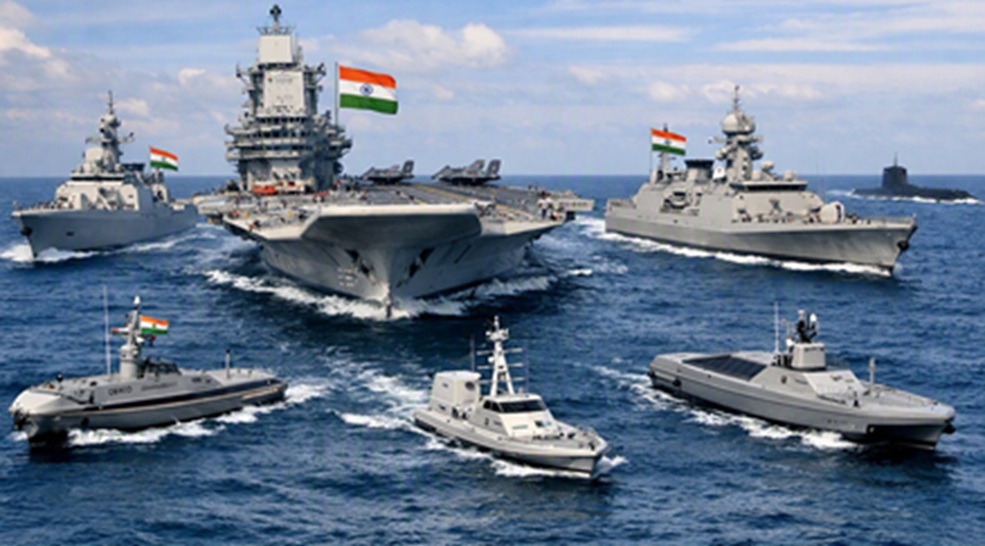
The Indian Navy is actively inducting indigenously developed weaponised Unmanned Surface Vessels and autonomous fast interceptor craft for harbour defence, surveillance, and anti-swarm operations. These unmanned systems are built domestically under the government’s Aatmanirbhar Bharat initiative
There is an enduring question in naval strategic planning, one that resurfaces with each major shift in the character of warfare: are we building the right fleet for the war ahead, or the best possible version of the fleet we already know how to build? The question is not new, and it is not a criticism. It is the essential discipline of force planning. It is also, as India commissions warships at the fastest pace in its modern naval history, a question worth examining with some care.
As of mid-2026, the Indian Navy has 45 warships under construction, with in-principle approval secured for a further 195 platforms encompassing surface combatants, submarines and fast interceptor craft. The trajectory is well established: one new warship every six weeks through 2026, a fleet of 175 ships by 2035, and, since the commission of INS Tamal in July 2025, every hull that follows will be indigenously built. These are substantial achievements, reflecting the maturation of India’s defence industrial base and the sustained strategic commitment to maritime power. The question this article raises is not whether this build-up is necessary, but whether the fleet’s composition is keeping pace with the evolving character of naval warfare.
The Changing Character of Naval Warfare
Recent conflicts have demonstrated, with considerable force, that the future of naval warfare is not exclusively a contest between large, crewed surface combatants. In the Red Sea, Houthi forces employed relatively inexpensive unmanned aerial and surface systems to impose disproportionate costs on some of the world’s most capable navies. In the Black Sea, unmanned surface vessels conducted attacks on major warships at a fraction of the cost of the platforms they targeted. In Operation Sindoor 2025, the utility of unmanned systems in the maritime domain was demonstrated closer to home. The pattern across these conflicts is consistent: unmanned systems, namely aerial, surface and subsurface systems, are not a supplement to conventional naval power. In certain mission sets, they are supplanting it.
The implications for force planning are significant. A fleet structured primarily around expensive, crewed surface combatants faces growing vulnerability to low-cost, high-volume unmanned threats that can saturate air-defence envelopes, conduct persistent surveillance across vast maritime spaces, and execute strike missions without placing personnel at risk. This is not to suggest that large surface combatants have become obsolete. They remain essential for power projection, command and control, sustained operations in contested environments, and the full range of tasks that require human judgement and adaptability at sea. The argument, rather, is that a modern fleet requires both: crewed platforms providing the backbone of combat power, and unmanned systems extending its reach, multiplying its sensors, and presenting an adversary with a targeting problem of a fundamentally different order.
Where India Stands in Unmanned Systems Development
India’s unmanned maritime programmes are progressing, but they remain at an early stage of maturity relative to the pace of conventional procurement. DRDO’s High Endurance Autonomous Underwater Vessel, developed with Cochin Shipyard Limited, is among the most advanced indigenous unmanned underwater systems under development, with trials having progressed from surface runs to lake trials in 2025. The Indian Navy has issued requests for information on Naval Ship-borne Unmanned Aerial Systems. Indigenous unmanned surface vessels, including platforms showcased at recent exercises, are demonstrating basic autonomous capability. The gap lies between the demonstration of individual platforms and their integration into a coherent, doctrine-driven unmanned capability that can operate alongside and in support of the conventional fleet.
The challenge is not primarily technological. It is doctrinal and organisational. Unmanned systems deployed in isolation offer limited operational value. Their potential is realised when they are conceived as an integrated layer of the fleet: extending the sensor horizon of a frigate, screening approaches that would expose a destroyer to unacceptable risk, conducting persistent surveillance in areas where the sustained presence of a crewed ship is neither feasible nor cost-effective. Achieving this requires not merely the procurement of platforms but the development of doctrine, command and control frameworks, and crew training that treats unmanned systems as an organic element of the fleet rather than an adjunct to it.
The Case for a Composite Fleet
The concept of a composite fleet, one that deliberately integrates crewed and uncrewed platforms across the air, surface and subsurface domains under a unified command architecture, is gaining currency in leading navies. The United States Navy’s Task Force 59, established in the Arabian Sea in 2021 and subsequently expanded, has operationally demonstrated how unmanned surface and aerial systems can be integrated with conventional warships to extend maritime domain awareness across areas that no surface combatant could cover continuously. China’s Type 076 amphibious assault ship, currently undergoing sea trials, is explicitly designed to operate fixed-wing unmanned combat aircraft alongside crewed aviation, landing craft, and special operations forces as a unified mission system. The direction of travel in advanced naval forces is unambiguous.
For India, the case for a composite fleet rests on three considerations. First, strategic geography. The Indian Ocean Region encompasses vast maritime spaces that no conventionally structured fleet can monitor or respond to continuously. Unmanned systems, particularly long-endurance aerial and surface platforms, offer the persistent presence that this geography demands, at a fraction of the cost of sustained ship deployments. Second, the threat environment. As adversary navies develop and field their own unmanned systems in growing numbers, India’s fleet will increasingly operate in an environment where threats originate from platforms that are inexpensive to produce, difficult to detect and capable of operating in swarms. A fleet designed solely around conventional engagement envelopes is not optimally positioned for this environment. Third, cost-effectiveness. The defence budget, however growing, is finite. Unmanned systems, properly integrated, allow the Navy to achieve greater presence, wider sensor coverage and enhanced layered defence at a cost per unit that is qualitatively lower than that of crewed platforms.
Way Ahead
The Indian Navy’s Maritime Doctrine 2025 has articulated the importance of unmanned and autonomous systems to future naval operations. The task now is to translate that doctrinal recognition into an acquisition and integration strategy that keeps pace with the conventional build-up. Three priorities suggest themselves.
The first is to establish a clear force structure target for unmanned systems, analogous to the fleet size targets that currently drive surface and submarine procurement. A specific goal, in terms of numbers, mission types and integration timelines, would give unmanned programmes the institutional priority and resource allocation they require to mature alongside, rather than after, the conventional fleet.
The second is to develop and exercise a composite fleet concept at the operational level. This means conducting exercises in which unmanned and crewed platforms operate under a unified command framework, so that the doctrinal and procedural questions around authority, tasking and deconfliction are answered in training rather than on first operational deployment. Existing platforms and the unmanned systems already in trial provide sufficient capability to begin this work without waiting for the next generation of hardware.
The third is to ensure that the unmanned systems procured across different programmes, covering aerial, surface and subsurface systems, are designed from the outset for interoperability under a common architecture. Systems that cannot communicate with each other, or that require separate command and control structures, do not constitute a composite fleet. They constitute a collection of separate capabilities. The integration requirement should be specified at the procurement stage, not addressed after each platform has individually matured.
India is building a formidable fleet. The opportunity before the Navy is to ensure that it is also building the right one, a fleet whose strength lies not only in the number and quality of its ships, but in the coherence with which crewed and uncrewed systems are woven together into a single, integrated fighting force. The age-old question of whether we are building the right fleet for the war ahead is one that every generation of naval planners must answer for itself. For India, in 2026, the answer requires both the conventional and the unmanned to be developed with equal seriousness.
Title Image Courtesy: Copilot AI
Disclaimer: The views and opinions expressed by the author do not necessarily reflect those of the Government of India or the Defence Research and Studies.