Prime Minister Narendra Modi’s push for exports centres on transforming India into a global manufacturing and commercial powerhouse through aggressive policy overhauls and strategic trade agreements. This export-oriented vision aims to multiply India’s export target to $7.9 trillion by 2047.
India’s trade policy is at an important moment. The country has signed or concluded several trade agreements, including with the UAE, Australia, EFTA, the UK, Oman, New Zealand and the EU. These agreements can open new doors for Indian exporters. But trade agreements alone will not make India an export power. They only create access. India must still build the domestic strength to use that access.
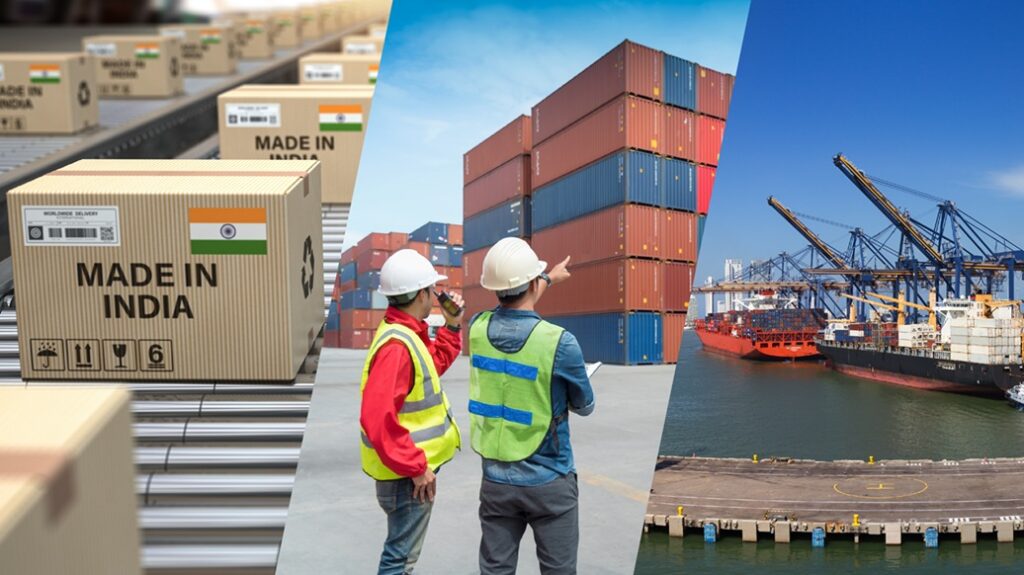
PC: Invest India
India’s recent trade numbers show both progress and pressure. Total exports of goods and services are now large, but imports remain even larger. India’s services exports are strong and continue to support the external account. But the merchandise trade deficit remains high because India imports large amounts of crude oil, gold, electronics, machinery, chemicals, fertilisers, edible oils, and high-value components. This means India needs a two-sided strategy: increase exports and reduce avoidable imports through domestic production.
The right goal should not be import substitution in the old closed-economy sense. India should not try to produce everything at any cost. The better goal should be “Make in India for India, and Make in India for the World.” This means building domestic capacity in sectors where India has demand, talent, scale, and export potential. If done well, the same factory that reduces imports can also become a global export base.
The first major priority should be electronics. India has made real progress in mobile phone assembly and electronics exports. But a large part of the value still comes from imported components. India now needs to move from assembly to deeper manufacturing. Printed circuit boards, displays, camera modules, sensors, batteries, chargers, semiconductor packaging, and telecom equipment should become priority areas. This will reduce dependence on imports and also help India export higher-value electronics.
Semiconductors should be treated as a foundation industry. India cannot become fully self-reliant in advanced chips immediately, but it can build strength in chip design, packaging, testing, power chips, automotive chips, sensors, and mature-node manufacturing. Semiconductors are not just one sector; they support electronics, defence, automobiles, telecom, data centres, artificial intelligence and industrial machinery. A strong chip ecosystem will reduce import dependence across many industries.
Pharmaceuticals are another major opportunity. India is already respected globally for affordable medicines and generics. But the country still depends on imported APIs, key starting materials, medical devices and diagnostic equipment. India should build stronger API parks, medical device clusters, testing labs and regulated-market export capacity. The next stage of pharma exports should include complex generics, biosimilars, vaccines, speciality drugs, diagnostic devices and hospital equipment.
Engineering goods and machinery must also be at the centre of the strategy. Engineering goods are already one of India’s biggest export categories, but India still imports many types of capital equipment, machine tools, electrical machinery, robotics, industrial automation systems and high-end manufacturing equipment. A practical step would be to identify the top imported machinery items and build a domestic production plan for them. India should not only import machines to build factories; it should also build the machines that build factories.
The automobile sector gives India another strong base. India has built scale in vehicles and auto components. But the shift to electric vehicles can create a new import problem if batteries, cells, motors, controllers, power electronics and charging systems are mainly imported. India should build domestic capacity in EV components, battery cells, battery management systems, power electronics, recycling and charging equipment. This will protect India’s existing auto strength and create new export opportunities.
Renewable energy equipment is equally important. India wants to expand solar, wind, battery storage and green hydrogen. But if solar cells, wafers, modules, inverters, electrolysers and storage systems are imported at scale, the clean energy transition will increase import dependence. India should build domestic supply chains for solar equipment, wind components, batteries, grid equipment and green hydrogen systems. This will support energy security and create green exports.
Textiles, garments, leather and footwear deserve special attention because they create large employment. India has the raw material, labour force and design base, but it has lost some export share to countries such as Bangladesh, Vietnam and China. Recent trade agreements can help Indian exporters if the domestic production system becomes faster and more reliable. India needs large integrated textile and footwear parks with fabric processing, design, testing, logistics, worker housing and customs support. These sectors can create jobs for MSMEs, women workers and small manufacturers.
India should also focus on toys, sports goods, furniture, home products, ceramics, stationery and lifestyle goods. These are labour-intensive sectors where India can reduce imports and grow exports at the same time. Many of these products are still imported from China and Southeast Asia. India can compete if it improves design, quality testing, packaging, branding and cluster-level production.
Chemicals and speciality chemicals are another large opportunity. Global companies are looking for alternatives to China, and India already has a strong chemical base. The country should focus on speciality chemicals, agrochemicals, pharma intermediates, textile chemicals, battery chemicals, semiconductor chemicals, engineering plastics and performance materials. To grow this sector, India must provide well-planned chemical parks, common effluent treatment plants, safety systems, faster clearances and strong export standards.
Defence and aerospace should be treated as strategic export sectors. India has started increasing defence exports, but the potential is far bigger. Drones, anti-drone systems, ammunition, radar, communication systems, aerospace components, avionics, ship systems and maintenance services can all become export areas. Reducing defence imports is important for national security, but defence exports can also support high-skill manufacturing.
Food processing is another area where India has not used its full strength. India is a major producer of rice, spices, tea, coffee, fruits, vegetables, marine products and millets. But too much value is lost because exports remain raw or low-value. India should export more processed foods, frozen foods, ready-to-cook products, branded foods, health foods, organic products and marine value-added products. This will require cold chains, testing labs, traceability, packaging, food safety compliance and better port-level systems.
Edible oils and pulses are important from an import-reduction point of view. India imports large quantities of vegetable oils and some pulses. This cannot be solved by sudden import restrictions because that can increase food inflation. The better answer is a five-year domestic production mission. India should raise oilseed productivity, improve mustard, soybean, sunflower and groundnut yields, expand processing capacity and give farmers more predictable incentives.
Critical minerals will decide future industrial strength. Lithium, cobalt, nickel, copper, rare earths and graphite are needed for EVs, batteries, defence, electronics and renewable energy. India may not have enough domestic resources, so it must secure overseas supplies. But value addition should happen in India. Refining, processing, recycling, rare-earth magnets, battery recycling and electronics recycling should become national priorities.
Services exports must remain a core strength. India’s services sector is already a major foreign exchange earner. The next stage should go beyond traditional IT services. India should grow exports in artificial intelligence services, cybersecurity, fintech, cloud operations, engineering design, legal and accounting services, healthcare, education, animation, gaming and global capability centres. Trade agreements should be used not only for goods but also for professional mobility and access to services.
India’s free trade agreements should be used in a more targeted way. The UK agreement can help textiles, leather, marine products, gems and jewellery, toys, engineering goods, chemicals and auto components. The UAE agreement can support jewellery, food, pharmaceuticals, engineering goods and re-exports to West Asia and Africa. EFTA can support investment, precision manufacturing, medical devices, clean technology and services. Australia, Oman, New Zealand and the EU also open opportunities for labour-intensive exports, processed foods, services, engineering goods, chemicals and professional mobility.
But exporters need more than tariff cuts. They need standards support, testing labs, lower logistics costs, faster customs, working capital, export credit, branding help and market intelligence. India should create export clusters linked to specific FTA markets. For example, textile clusters can be linked to the UK and EU, food processing clusters to the Gulf and Oceania, engineering clusters to Europe and Africa, and pharma clusters to regulated markets.
The government should also prepare a “Top 100 Import Reduction List.” This list should identify products where India imports heavily and where domestic production is practical. It should include electronics components, machinery, solar equipment, APIs, medical devices, chemicals, fertilisers, edible oils, EV components, batteries, telecom equipment and consumer goods. Each product group should have a clear plan for investment, technology, skills, standards and exports.
India does not need a closed economy. It needs a stronger production economy. Trade policy, industrial policy, FDI policy and export promotion must work together. FTAs will matter only if Indian firms are ready to supply the world at the right quality, price and scale.
The simple message is this: India should not only sign trade agreements; it should build the domestic capacity to win from them. If India can connect FTAs with manufacturing, services, standards and logistics, it can reduce avoidable imports, increase exports, create jobs and become a much stronger player in global trade. India already has demand, talent, entrepreneurs and global trust. The next step is to turn these strengths into production power. That is how India can move from being a large market to becoming a large export nation.
Title Image Courtesy: TOI
Disclaimer: The views and opinions expressed by the author do not necessarily reflect the views of the Government of India and the Defence Research and Studies.


References
Directorate General of Commercial Intelligence and Statistics (DGCI&S) (n.d.) Official foreign trade statistics of India. Available at: https://www.dgciskol.gov.in/
European Free Trade Association (EFTA) (n.d.) India–EFTA Trade and Economic Partnership Agreement. Available at: https://www.efta.int/trade-relations/free-trade-network/india
Press Information Bureau (PIB) (2022) India–UAE CEPA enters into force; first consignments flagged off under the agreement. Available at: https://www.pib.gov.in/PressReleasePage.aspx?PRID=1821785
Press Information Bureau (PIB) (2025) Year-End Review 2025: Department of Commerce. Available at: https://www.pib.gov.in/PressReleasePage.aspx?PRID=2201284
Press Information Bureau (PIB) (2026) India’s foreign trade: FY 2025–26 export and import estimates. Available at: https://www.pib.gov.in/PressReleasePage.aspx?PRID=2252272&lang=1®=3
Press Information Bureau (PIB) (n.d.) India–UK Comprehensive Economic and Trade Agreement: key details and sectoral benefits. Available at: https://www.pib.gov.in/PressNoteDetails.aspx?ModuleId=3&NoteId=154945
Press Information Bureau (PIB) (n.d.) India–EFTA Trade and Economic Partnership Agreement comes into force. Available at: https://www.pib.gov.in/PressReleasePage.aspx?PRID=2173968
Press Information Bureau (PIB) (n.d.) India–EFTA TEPA: investment and job creation commitments. Available at: https://www.pib.gov.in/PressReleasePage.aspx?PRID=2173138
Press Information Bureau (PIB) (n.d.) India–Oman Comprehensive Economic Partnership Agreement: key market access details. Available at: https://www.pib.gov.in/PressNoteDetails.aspx?ModuleId=3&NoteId=156893
Press Information Bureau (PIB) (n.d.) India–New Zealand Free Trade Agreement: duty-free access and key provisions. Available at: https://www.pib.gov.in/PressNoteDetails.aspx?ModuleId=3&NoteId=158370&lang=1®=3
Reuters (2025) Key facts about India–UK free trade deal, 23 July. Available at: https://www.reuters.com/world/uk/key-facts-about-india-uk-free-trade-deal-2025-07-23/
Reuters (2026) India, New Zealand trade pact cuts fruit tariffs, boosts exports and visas, 27 April. Available at: https://www.reuters.com/world/asia-pacific/india-new-zealand-trade-pact-cuts-fruit-tariffs-boosts-exports-visas-2026-04-27/
Reuters (2026) India’s trade deficit at $20.98 billion in March, 15 April. Available at: https://www.reuters.com/world/india/indias-trade-deficit-2098-billion-march-2026-04-15/