The 23rd Shangri La Dialogue at Singapore, a security-related annual event led by the London-based Institute of Strategic and International Studies (ISIS), was held in the backdrop of intense geopolitical challenges arising from a four-year-old Russia-Ukraine conflict, the ongoing US-Israel war against Iran, China’s growing military capabilities, including assertiveness, and uncertainty of the US’ long-term commitment to the Indo-Pacific.
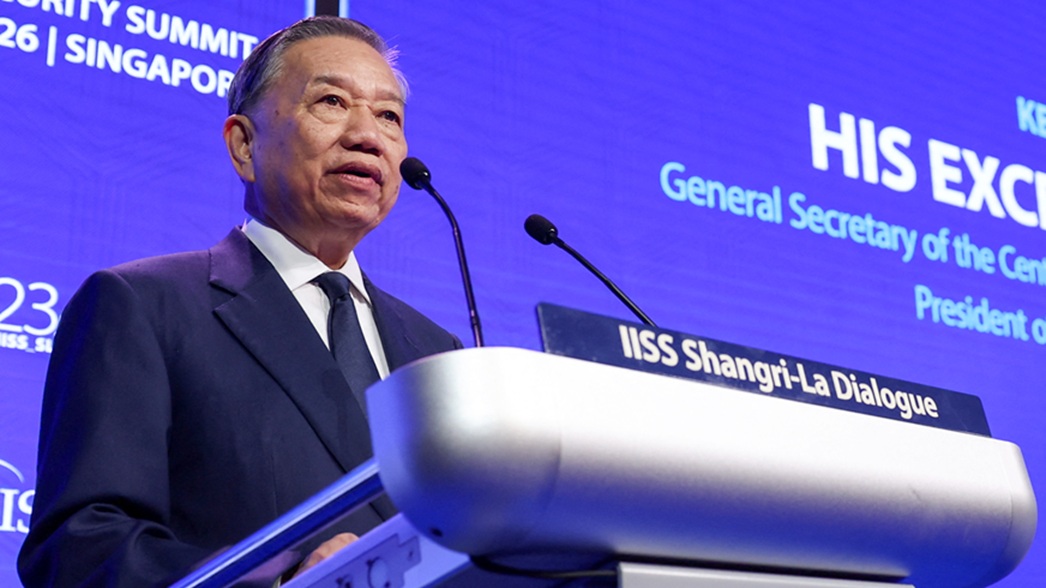
Two contrasting speeches, i.e. the Keynote Address by His Excellency Tô Lâm, General Secretary of the Central Committee of the Communist Party of Viet Nam and President of the Socialist Republic of Viet Nam, and the other speech by US Secretary of War Pete Hegseth, are representative of the fragility of the security environment in the Asia Pacific region.
First, President To Lam, through his Keynote Address titled “Proactively building peace, stability, and development in a volatile world” advocated the critical need to “to unify and implement a common, minimum, and essential vision to ensure peace, trust, and development for humanity in the 21st century”.
President To Lam identified three converging global crises, namely:
- “Crisis of international order” wherein he reflected on the changing nature of the global security and emphasised the need for “rules, dialogue, sharing, and self-restraint”. Above all he cautioned against “coercion, imposition, threats of force, or creating faits accomplis”. He also stressed ‘commitments’ and ‘consistency’ in support of “principles of international law” which must be prioritised over the “use of power” and called on nations to abhor and abandon the “big fish eats small fish” mindset. Further, the big nations must ensure that their actions do not “compel small and medium nations” to “choose sides”; besides, coercion through “economic, technological, financial, and security” threats should be avoided.
- “Crisis of strategic trust” by building an “open, inclusive, and ASEAN-centric regional structure” wherein interests converge, mistrust is reduced, and these result in “complementing existing mechanisms”. President To Lam is sanguine about welcoming “initiatives that contribute to peace, stability, and development” as long as they are “transparent, respect international law, complement each other” and do not “undermine ASEAN’s central role” as well as preclude Southeast Asia turn into a “space for confrontation between blocs”. He urged ASEAN to pursue “solidarity, strategic autonomy, and the capacity to create a common agenda”.
- “Crisis of development models” is about disruptions in development that impinge on human security and social resilience. President To Lam’s focus was on “sustainable security” through “open and diversified supply chains, seamless infrastructure connectivity, cooperation in finance, technology, and human resources; and practical cooperation in disaster relief, healthcare, water security, food security, energy security, cyber security, protection of critical infrastructure, and search and rescue” which can “ensure the safety, livelihoods, and improved living standards of the people, strategic trust will be strengthened and nurtured”.
Vietnamese President To Lam thought provoking keynote address at Shangri La was followed by US Secretary of War Pete Hegseth (the first plenary session of the 2nd day), who laid bare the strategic vision of his country for the Indo-Pacific region, which seeks “genuinely stable equilibrium” and works for both “Americans as well as for our allies”. Hegseth called out China’s “historic military buildup and the expansion of its military activities in the region and beyond.” His warnings to China were that “a Pacific dominated by any hegemon would unravel the regional balance of power and undermine the equilibrium we all seek to preserve.”
Hegseth also identified nine countries (South Korea, the Philippines, Japan, Australia, Singapore, Malaysia, Thailand, Vietnam and India) with whom the US has defence commitments through “shared industrial muscle” but did not hesitate to warn “Allies who refuse to step up and carry their own weight for our collective defence will face a clear shift in how we do business.”
Be that as it may, the Shangri La Dialogue was an opportunity for Vietnam to articulate its views on their understanding of the current state of the global and regional security environment, including the centrality of ASEAN. Perhaps what was significant about Address was that President To Lam sought to promote the idea of “culture of strategic trust”, wherein the regional countries act as responsible stakeholders and remain committed to ASEAN centrality as well as not succumbing to any great power (China or the US) contestation.
It merits mention that in recent years, Vietnam has accrued enormous international diplomatic goodwill and is respected as a responsible stakeholder. In this context, since taking over as the President, To Lam has travelled to China, India, and Sri Lanka, which by all accounts have been very successful visits.
Title Image Courtesy: Nikkei Asia
Disclaimer: The views and opinions expressed by the author do not necessarily reflect the views of the Government of India and the Defence Research and Studies.