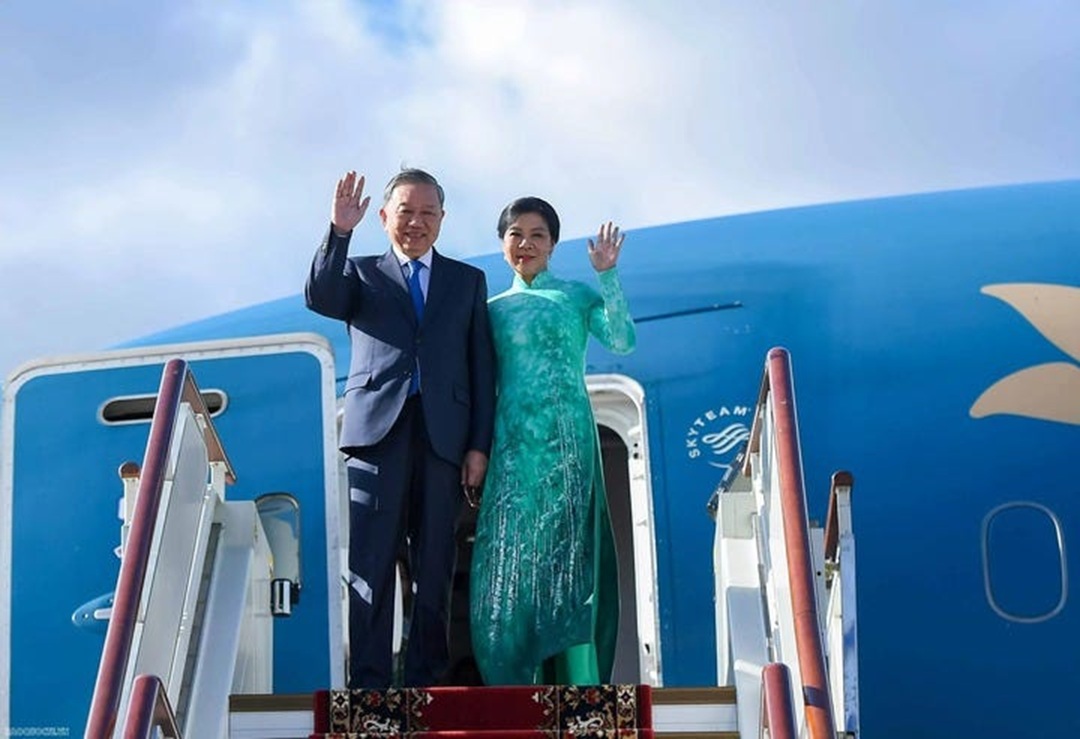
Vietnamese President To Lam concluded historic state visits to both countries in August 2026 to cement economic, defence, and technological alignment. Vietnam has made deep inroads in diplomatic ties with Australia and New Zealand and has now reached a historic high point.
Vietnam’s unrelenting pursuit to broaden the portfolio of diplomatic partners is moving at a fast pace. The political leadership has proactively travelled overseas, i.e. “9-13 visits per year through most of the decade” and “increasing to 18 in 2024 and 22 in 2025”. Vietnam’s Communist Party head and President To Lam made “12 trips overseas, Prime Minister Phạm Minh Chính undertook 10 on the economic and multilateral track before Lê Minh Hưng stepped into the PM role”. These initiatives have resulted in up gradations of bilateral relations to Comprehensive Strategic Partnership, particularly with “France, Malaysia, New Zealand, Indonesia, Singapore, Thailand, the UK and the European Union all elevated since late 2024”.
President To Lam visited ‘Down Under,’ i.e. Australia and New Zealand, in August 2026 to ensure the continued success of “bamboo diplomacy” (safeguarding sovereignty, avoiding formal alignment and keeping every door open). Hanoi enjoys cordial relations with both Canberra and Wellington, and the visit was to stimulate the 2025 Comprehensive Strategic Partnership and explore new opportunities. It also showcases Hanoi’s widening diplomatic as well as economic relationships with diverse countries across different geographies to balance the ongoing great-power competition between Washington and Beijing, and the Trump administration’s tariff policy.
First, the visit to Australia. The Joint statement on deepening the comprehensive strategic partnership between Viet Nam and Australia “reaffirmed the strength of the Viet Nam-Australia Comprehensive Strategic Partnership (CSP) built on mutual strategic trust and understanding over more than 50 years”, and both leaders noted with satisfaction the “ substantial progress in deepening the CSP, reflecting the increasing convergence of strategic interests and agreed that cooperation should be ambitious and forward-looking”.
This 29 para statement broadly covers five domains and is focused on building bilateral relations and explore vitas for cooperation across sectors i.e. (a) deepening political, defence, security and justice cooperation; (b) enhancing economic engagement; (c) harnessing knowledge and connecting people; (d) strengthening climate, environment and energy cooperation; (e) supporting science, technology, innovation and digital transformation’ and (f) reinforcing regional and international cooperation.
Significantly, the joint statement has carefully avoided any reference to the Russia-Ukraine war; the US-Israel and Iran conflict; and the Strait of Hormuz crisis but has referenced the “critical role that straits play in international navigation and sea lanes of communication”. Further, the South China Sea has been duly mentioned, highlighting their commitment to “upholding peace, security, stability, freedom of navigation and overflight, unimpeded lawful commerce” in “accordance with international law, particularly the 1982 UNCLOS”. Similarly, there is a call for “full and effective implementation” of the 2002 Declaration on the Conduct of the Parties in the South China Sea.
In the context of the latter, media comments on the visit have focused on a “China threat” narrative. Bloomberg observed that both sides have “expanded maritime-security cooperation” in light of Chinese assertiveness in the South China Sea, and The Strait Times noted that the bilateral military cooperation is in response to the Chinese forays in the Pacific and the South China Sea. Unlike Australia, Vietnam is not a member of QUAD or any other such groupings, but both sides promote “a peaceful, stable and prosperous Indo-Pacific region” and have endorsed that the region needs to be “managed responsibly”.
Second, President To Lam’s visit to New Zealand is equally important as that to Australia, and was aimed at giving impetus to the Vietnam-New Zealand Comprehensive Strategic Partnership for 2025 – 2030 and translating it into more concrete cooperation. The Viet Nam-New Zealand Joint Statement is focused on (a) Advancing the Comprehensive Strategic Partnership; (b) Trade and Economic Integration; (c) Defence and Security; (d) Regional and International Cooperation; (e) Development and Climate Cooperation; and (f) Education and People-to-People Ties.
South China Sea, the 2002 Declaration on the Conduct of the Parties in the South China Sea (DOC) and the 1982 UNCLOS (COC) feature in the Statement, clearly suggesting that any disorder in the region would impact both countries. There is also no reference to China or the ongoing wars in West Asia and Eurasia. Interestingly, the Indo-Pacific does not find reference in the statement, given that New Zealand is part of the minilateral grouping (Australia, Japan, New Zealand, and South Korea) that establishes a formal framework for cooperation between NATO and its key Asia-Pacific partner nations. Instead, the two sides have endorsed cooperation in areas of mutual interest between ASEAN and the Pacific Islands Forum (PIF).
President To Lam’s visit to ‘Down under’ is a testament to the growing importance of Vietnam as a regional middle power. It is also emblematic of its proactive foreign policy choices of multi-alignment, wherein Vietnam pursues independent ties across the globe, maintains cordial and constructive relations with major powers, and precludes joining any bloc or camp, thereby protecting its national sovereignty and interests.
Title Image Courtesy: https://www.asiasentinel.com
Disclaimer: The views and opinions expressed by the author do not necessarily reflect those of the Government of India or the Defence Research and Studies.