In the modern global economy, a “one-size-fits-all” product strategy is obsolete. Instead, the most successful multinationals practice glocalisation by adapting their products to the cultural, religious, and sensory preferences of each Nation.
Last May, Starbucks found itself at the heart of a scandal in South Korea following a questionable marketing promotion. The American coffee giant, through a lack of consideration, if not outright overconfidence, launched a campaign on 18 May, a day of commemoration marking the 1980 repression. This might have passed without incident if the company had not named its campaign “Tank Day”, promoting the sale of its Tank tumblers (high-capacity reusable bottles) with the slogan “Put it on the table with a sound of Tak”. The promotion was a complete failure, sparking outrage and leading to a boycott of the brand. Seen as an insult to the victims of 18 May, a day commemorating a bloody and sorrowful uprising in South Korea’s history, this promotion was perceived as a reference to the military tanks present during the repression and the slogan to the martyrs who died under torture.
As a result, Starbucks withdrew its campaign after a few hours, the CEO was replaced, and the company faced legal action over a defamation claim.
This cannot be regarded as a marketing failure, as Starbucks is one of the market leaders in South Korea. Nevertheless, the incident reflects a combination of managerial irresponsibility and a lack of cultural sensitivity. Although the campaign was generated by AI and not vetted by senior executives, the issue also stems from a disregard for the country’s history.
Consequently, this recent case raises the question of how multinationals such as Starbucks can struggle with such obvious issues as history, customs and culture. The problem does not lie in the expertise of these global giants, but in their ability to address what really matters: the needs of their customers. After all, Starbucks is far from being an isolated case. When Western giants expand their markets in Asia (or other regions of the world, Asia being a good case in point), or extend their influence there, it is often noted that they frequently come up against cultural barriers. Whether it be their marketing, logistics or product strategy, the conclusion is always the same: culture impacts every aspect of business; dismissing it would, at best, slow down the business’s expansion, and, in the most pessimistic scenarios, derail it and bring it to a full stop. In this article, we will look at the cases of Facebook in Japan, Carrefour in China, McDonald’s in Vietnam, IKEA in India, and 7-Eleven in Indonesia, all of which have been affected by and have responded differently to this issue of cultural adaptation.
Facebook – When a Global Strategy Needs to Become Local
Today, Facebook has around 26 million users in Japan, positioning itself as a professional platform aimed at an older audience. And although it is one of the most widely used foreign platforms (behind YouTube, X and Instagram), and one of the first to have made its breakthrough in the sector, its development in the Japanese market has been challenging. Facebook operates on a globalisation strategy, standardising its offering and services. In most markets, this strategy works well within the social media sector; however, Facebook’s entry into Japan was a failure. Facebook entered the Japanese market in 2008, a market already structured around several local players, such as Mixi, Gree and Mobage. However, after three years in Japan, Facebook had only 2 million users (less than 2 per cent of the Japanese population in 2011), while local networks had over 20 million. For Facebook, this represented an entry strategy failure. As mentioned above, its approach relies on standardising its offer: linguistic adaptation, translation of the interface by volunteers, and services still limited to computers. That said, as its competitors were Japanese, adapting and localising its business was crucial to securing market share. Local players already had mobile versions and offered services that resonated with their audiences. Another problem was that Facebook promotes an American conception of online identity, whereas the Japanese concepts of hierarchy, social relationships and privacy remain very different: a ‘friend’ is neither a colleague, nor an acquaintance, nor a family member. Consequently, sharing the same content with every follower’s profile seems strange and disturbing, and having to share one’s online identity also raises data security concerns. Whereas its competitors were miles ahead in understanding the market, Facebook is slowing down its development by mixing up translation with localisation, and by ignoring the fundamental concept of culture. By failing to understand the various dimensions surrounding culture, such as Power Distance, Collectivism and Uncertainty Avoidance, Facebook jeopardised its market entry and its long-term reputation.
Carrefour – When the Giant is Overtaken by Modernity
Unlike Facebook, Carrefour did not face any barriers to entry. It even managed to establish itself rapidly in China, entering the market as a pioneer in 1995 and achieving a turnover of 33.82 billion RMB (over 4 billion EUR) through 300 stores across the country by 2008. Carrefour did not face immediate failure, but it failed to maintain a profitable business in the long term. By 2018, the French group had only 210 supermarkets left, with turnover down 10 per cent over the year. Unlike Facebook, Carrefour adapted its business to Chinese culture, embracing decentralisation and utilising the art of guanxi (a social and professional pillar comparable to the concept of ‘networking’). Its business model successfully adapted to the Chinese market, offering a wide range of products at competitive prices through an extensive network of hypermarkets. However, from 2018, Carrefour began to see its business decline, with profitability accounting for less than 2 per cent of its turnover. Carrefour’s mistake lay in the performance gap between what the company wanted to achieve and what it actually delivered. Carrefour was a pioneer in a market considered difficult not only to penetrate but also to sustain in the long term. The Chinese market is growing very rapidly, and as a consequence, demand is becoming increasingly competitive in terms of technological advancement. Although Carrefour had understood China’s initial needs, the brand stuck to a brick-and-mortar strategy, optimising the number of its shops but failing to digitalise and modernise its business. Its offer became obsolete, lacking speed, digital transparency and omnichannel capabilities.
In a country in continuous expansion, where digitalisation has become a cornerstone of the economy, Carrefour found itself struggling to keep up the pace.To get back on track, Carrefour decided to partner with two Chinese entities: Tencent and Yonghui. However, faced with fierce local competitors that had already digitalized their operations, the group ended up sold off, losing 80% of its shares in 2019 to the retail giant Suning.com, and has been subsequently withdrawing from the market since 2023. While Facebook failed to adapt early to the market, Carrefour, despite having understood the Chinese model, made the mistake of relying on its past successes, overlooking the need to modernise its business in a rapidly expanding environment.
IKEA – When Adaptation Impacts Competivity
Let us now consider the case of IKEA in India, which, strictly speaking, has not failed, but whose ambition to enter a market that puts its entire offering into question is open to debate. IKEA’s vision, “to improve the everyday lives of as many people as possible”, is well-suited to a model of globalisation, as it can be adapted to all markets. However, it is more the product range on which IKEA has built its brand and set itself apart that clashes with India’s culture of furniture and interior design. While IKEA has built its reputation on a minimalist and modern aesthetic, and based on the DIY (Do-It-Yourself) culture, India furnishes its homes with traditional installations, tapestries and furniture, characterised by opulence and colours that stimulate the senses. Accordingly, when the Swedish giant entered the Indian market in 2018, it faced a challenge from local trends: how to sell its furniture at competitive prices in a market where the DIY movement is still in its early stage? In itself, the gap with the market is reflected in price, product and distribution, which is not significantly different from other cases. If market adaptation is poorly executed, IKEA would incur losses by slowing its growth in the market. However, the multinational quickly realised how to adapt its offering to the Indian market. Yet, by reinventing its brand in India to meet local expectations, the company also lost some of its identity and its unique selling points. The company expanded, but was neither sufficiently profitable nor did it grow fast enough. The investment made in the brand’s distribution and marketing was not sustained by the profit and recognition generated in India. The brand has failed to become competitive against local rivals, and the value chain remains costly.
However, this does not mean that the Indian market is entirely lost to IKEA. The brand remains present in India despite its low profitability over the past seven years. The Swedish brand continues to expand its development strategy, making long-term investments to develop its omnichannel approach, and hopes to turn a profit from its operations within five years. So IKEA’s expansion in India may not necessarily be a failure yet; nevertheless, its ambition to enter a market where the necessary investments and adaptation efforts are impacting the company’s competitiveness does leave some room for question.
McDonald’s – When a Model Can’t Fit a Market
Finally, let’s take a look at McDonald’s in Vietnam. It would be incorrect to claim that McDonald’s has been a complete failure; however, relative to the group’s expectations and in comparison with its other markets, in the space of 10 years, barely 45 restaurants had opened (compared with its initial target of 100). The issue lies not only in the brand’s international development strategy, but also in its business model. A model that does not align with Vietnamese consumer habits and fails to win people over. McDonald’s arrived in Ho Chi Minh City in 2014 with a spectacular launch and caught a lot of interest from Vietnamese people. However, the reality turned out to be different from the brand’s expectations: the American fast-food model did not meet consumers’ expectations.
The basic problem lies in the West’s perception of fast food, which is seen as a quick, filling and relatively affordable meal compared to Asia. Besides, McDonald’s was not competing against other burger chains; it was competing against the local food ecosystem. In Vietnam, the food culture is centred on street food, offering a wide choice of meals that are warm, nutritious (not just filling), very affordable and made with fresh ingredients. Consequently, the burger menu is very often regarded as an occasional treat, mainly due to its price. Another issue linked to consumer behaviour is the concept of sharing. In Vietnam, a dish is meant to be shared. Consequently, it is clear that the idea of sharing a burger amongst several people would not cross anyone’s mind. It is therefore understandable that the problem does not stem from the product itself, as Vietnamese people do eat at McDonald’s, but rather from the business model surrounding it: the target customer base is not right, the price is too high, and the distribution or the way it is consumed is not suited to the local context. Consequently, compared to Carrefour or Facebook, the problem does not lie only in a failure to adapt to cultural factors (such as Collectivism), but also in the product’s mismatch with market expectations ( a situation that brings to mind the Product-Market Fit approach).
Conclusion
To summarise, these various cases show that even multinationals as powerful as Starbucks or McDonald’s can come up against an aspect of business management that seems obvious but is very often overlooked: cultural understanding. Whether a company is an SME or a multinational, a lack of consideration or overconfidence regarding a country’s consumer habits, customs, history or level of development often leads a company to face losses, crises or even bankruptcy in the worst case. The recent Starbucks scandal demonstrated that a lack of interest in a country’s history, as revealed by a simple marketing campaign, can tarnish a brand’s reputation. Facebook’s obvious mistake of entering a market simply by translating its website, rather than genuinely localising its offering, can create barriers to entry. Carrefour’s failure in the Chinese market, despite having been a pioneer there, demonstrates the constant need to adapt and modernise one’s offering to local development. Finally, the cases of IKEA and McDonald’s raise questions about the wisdom of attempting to enter a market that is inconsistent with their business model or competitiveness. Culture can therefore be regarded as a cornerstone of a company’s development strategy: it influences pricing, the product, distribution, communication and consumption in equal measure.
Finally, these cases also prove that humility and curiosity are at the root of success. These five brands did not fail in their expansion due to a lack of expertise, but, like Icarus, they burned (or risk burning) their wings through ambition or overconfidence. The market should not be made to adapt to your business model before you have understood whether your business model deserves to be there. Ultimately, international business is not about exporting what already works: it is about understanding why it works. Because the cost is not merely financial. It also involves wasted investment, loss of market share, reputational damage, loss of trust and, at times, significant human consequences.
Title Image Courtesy: YouTube
Disclaimer: The views and opinions expressed by the author do not necessarily reflect those of the Government of India or the Defence Research and Studies.


Appendix A: General information about appendices
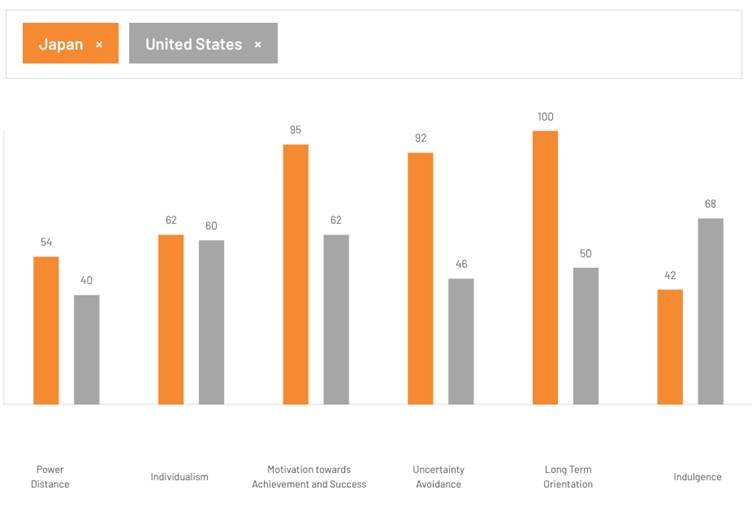
Hofstede Cultural Dimensions: Comparison between Japanese and American cultural differences. Quoted in “ Facebook – When a Global Strategy Needs to Become Local” Source: Country comparison tool.
References
Starbucks:
(2026, May 26). Ko Dong-Hwan. Starbucks Korea crisis blamed on historical ignorance, approval chain failure . The Korean Times.
(2026, May 18) Kim Eun-Jung. Starbucks Korea apologizes over promotion linked to democracy movement memories | Yonhap News Agency . Yonhap News Agency.
(2026, May 18) Kim Eun-Jung. (LEAD) Starbucks Korea chief fired over ‘Tank Day’ event on pro-democracy anniv. | Yonhap News Agency . Yonhap News Agency.
(2026, July 23) Karen Stollznow. Starbucks’ big marketing blunder in South Korea shows how cultural blind spots can put global brands in a bind . The Conversation.
Facebook:
(2026, September 2) Karen Onuma. Facebook’s Failure in Japan. Global Deal.
(n.d). What Companies Can Learn From Facebook’s Failure in Japan. Carter JMRN.
Carrefour:
(2025, June 26) Morris Cai. Suning Dumps Carrefour China for ¥4, Marking End of a Retail Era – Vino Joy News . Vino Joy News.
(2018, January 23) Carrefour annonce un partenariat transformant en Chine. Carrefour.
(2023, February 19) Sarah. Le sauvetage de Carrefour en Chine voué à l’échec . Le Vent De La Chine.
(2019, June 23). Carrefour cède le contrôle de ses activités en Chine. Challenge.
(2019, June 25) Wang Zhuoqiong. Suning to ramp up retail presence with Carrefour deal. China Daily
Global.
IKEA:
(2018, June 22) ‘For IKEA, pricing is No. 1 challenge here’. The Times of India.
(2026, February 4) Anushruti Singh. Is IKEA failing in India? Losses deepen, but growth signals tells different story. SME Futures.
(2024, July 30) Nucleus_AI. Why IKEA Failed in India: What Global Brands Can Learn from IKEA’s Journey. Your Story.
McDonalds:
(2026, May 16). American burger chains struggle to adapt in Việt Nam’s price-sensitive market. Viêt
Nam News.
(2025) Yash Kushwaha. McDonald’s Couldn’t Sell Burgers in Vietnam. LinkedIn
(2015, February 26). McDonald’s faces challenges in Vietnam. Vietnam Net.
Sources given by Open AI:
Number of Restaurants in Vietnam .Restaurant by Markets 2025 . McDonald’s Corporate.
McDonald’s objective versus reality contrast. (2024, September 18). McDonald’s kinh doanh ra sao ở Việt Nam sau 10 năm?. VTC News.