Traditional military aviation is becoming unsustainable due to high manufacturing costs and ‘biological constraints’. Developing advanced engines requires decades of research into ‘material science’ to handle extreme heat. This ‘web article’ proposes that the Indian defence sector should pivot towards Unmanned Combat Aerial Vehicles (UCAVs) to bypass these limits. By removing the pilot, India can reduce safety-related engineering costs and build platforms that outperform manned jets. Instead of chasing expensive new hardware, India can use ‘lateral thinking with withered technology’—pushing older, proven tech to its limit through superior software. This allows for a ‘Software Defined Sky’ and a ‘Software-as-a-Service’ (SaaS) export model. India can sell affordable drone hardware at a ‘loss’ while securing long-term revenue through AI and security updates.
Introduction
Aviation ‘modernisation’ is bleeding money. For decades, building a modern air force meant mastering extreme material sciences. To manufacture a reliable fighter jet engine, engineers must create turbine blades capable of withstanding heat higher than the melting point of the metal itself. However, the true financial drain in modern combat aircraft is not just the propulsion system; it is the human pilot. Keeping a human alive at high altitudes requires heavy ejection seats, pressurised cockpits, and thick ‘armoured shielding’. By removing the pilot from the aircraft, militaries can finally bypass both human biological limits and the staggering engineering costs of life support.
The Biological Timeline vs. Machine Production
The most significant weakness of manned aviation is the ‘biological timeline’. Building a standard fighter aircraft takes roughly three to five years on an assembly line. In contrast, selecting, educating, and training a combat-ready fighter pilot requires decades of state investment [1]. In a ‘high-attrition’ scenario, a destroyed aircraft is a financial loss, but a lost pilot is an irreplaceable strategic disaster.
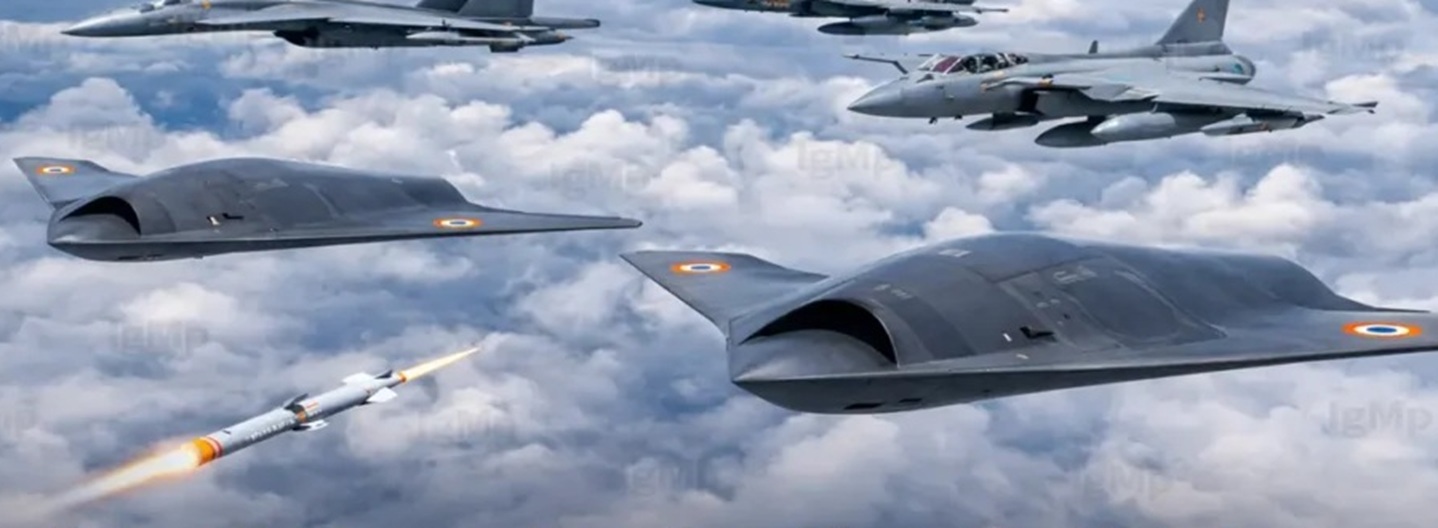
Furthermore, human biology caps a pilot’s physical endurance at around ‘9G’ (nine times the force of gravity) before they succumb to gravity-induced loss of consciousness, or a blackout [2]. Unmanned Combat Aerial Vehicles (UCAVs) do not have this problem. Without a fragile human inside, UCAVs can pull ’15G’ manoeuvres, completely outperforming traditional jets in contested airspace. The Indian defence sector is adapting to this shift through the ‘CATS Warrior’ programme, designed to use unmanned ‘loyal wingmen’ to fly alongside traditional jets without risking human casualties[3].
The AI Nervous System: Beyond Simple Controls
The removal of the pilot creates a technical vacuum that only ‘Artificial Intelligence’ (AI) can fill. Controlling an unmanned jet at supersonic speeds is significantly harder than traditional remote piloting. Because these airframes are designed for extreme agility, they are often aerodynamically unstable. The AI acts as the ‘nervous system’ of the aircraft, performing thousands of micro-adjustments every second to stabilise the flight path. This ‘active flight control’ is too fast for a human operator to manage via remote link. This makes the software the most critical component of the entire platform. The AI does not just follow orders; it manages the ‘real-time physics’ of the flight, ensuring the aircraft remains stable even during high-speed combat turns that would tear a manned jet apart. This shifts the focus from ‘heavy hardware’ to ‘intelligent code’.
Lateral Thinking with Withered Technology
Instead of competing in a trillion-dollar race for expensive, next-generation hardware, India can adopt an engineering strategy known as ‘lateral thinking with withered technology’ also called ‘jugad’. This philosophy involves taking older, cheaper, and well-understood physical hardware and pushing it to its absolute operational limit by pairing it with vastly superior modern software.
By deliberately avoiding the bleeding edge of experimental material science, defence manufacturers can utilise mature, readily available components. This allows India to build UCAVs significantly faster and cheaper than adversaries who are still struggling with complex supply chains for rare metals. In this new paradigm, the true ‘cutting edge’ of the weapon is no longer the titanium frame, but the AI algorithms that allow that frame to perform complex combat tasks. This approach reduces the risk of ‘industrial stagnation’ and allows for rapid mass production.
The SaaS Export Framework
Focusing on AI creates a unique economic loop that mirrors commercial tech strategies. Instead of trying to sell massively expensive, one-off hardware, exporting nations can adopt the ‘Razor and Blade’ model, similar to ‘Software-as-a-Service’ (SaaS) architecture[4]. Under this model, India can export the physical UCAV airframe built from standard composites at a very low cost, or even at a financial ‘loss’.
This aggressive pricing strategy guarantees rapid market penetration among allied foreign buyers who cannot afford expensive stealth fighter jets. However, the hardware is completely useless without its ‘AI core’. The real profit is generated exclusively through the software. Because electronic threats change rapidly, the purchasing nation is forced to sign mandatory, high-margin subscription contracts. These recurring payments secure essential algorithmic optimisations, electronic threat registries, and AI model updates. Over a 15-year lifecycle, the exporting nation generates significantly more revenue from software patches than it ever did from the initial drone sale.
Strategic Leverage and the Digital ‘Kill Switch’
Beyond just making money, this subscription framework provides absolute ‘geopolitical leverage’. The UCAV’s operational capability is entirely dependent on its onboard AI algorithms. By controlling the cloud infrastructure and the cryptographic keys required for these AI updates, the supplier retains a digital ‘kill switch’.
If a purchasing nation suddenly turns hostile or violates a diplomatic treaty, the supplier does not need to deploy military force to stop them. They can simply revoke the software licence or push a corrupted firmware update, instantly grounding the entire exported fleet. Consequently, any future diplomatic sanctions would no longer just mean financial stagnation; they would trigger an immediate, hard military stop. The existence of this capability creates an unbreakable deterrent.
Cyber Security and Autonomous AI Processing
The software-first approach brings a major technical vulnerability: ‘hacking’. If an autonomous drone relies entirely on external signals from a human operator, adversaries will naturally attempt to jam the connection or hijack the data link. This is where the AI becomes the primary factor. When a drone is ‘hacked’ or jammed, it is the onboard AI and not the distant human user that must process the crisis.
To counter signal loss, the AI must take total control. Integrating ‘Visual SLAM’ (simultaneous localisation and mapping) allows the AI to navigate autonomously by using optical cameras to read the ground topography, making it immune to satellite jamming. Furthermore, strict ‘hardware firewalls’ must be implemented to isolate the flight-control processors from communication receivers. This ensures that even if an enemy manages to breach the data link, they cannot access the engine controls. Finally, ‘machine vision’ allows the AI to identify and lock onto targets independently. This ensures the drone can complete its mission even if all communication with the home base is completely severed.
Conclusion
The shift towards software-defined UCAVs is the most critical change in 21st-century ‘defence economics’. The Indian government has recognised this urgency through an all-time high allocation of ‘₹7.85 lakh crore’ to the Ministry of Defence, with a massive percentage reserved for domestic industries[5]. This capital must be aggressively directed towards ‘AI superiority’ rather than just traditional hardware.
If a nation fails to build its own autonomous AI infrastructure, it will end up on the losing side of this SaaS model—paying heavy software subscriptions to foreign powers just to keep its own military flying. However, by mastering the software layer and exporting affordable hardware tied to digital subscriptions, a country can secure permanent revenue streams and total diplomatic control.
Title Image courtesy: IGMP
Disclaimer: The views and opinions expressed by the author do not necessarily reflect the views of the Government of India and the Defence Research and Studies.


References
- Singh, C. M. (2025, December 31). Pilot Training Cost Comparison: India Vs Abroad. FMS Aviation Academy – DGCA Ground Classes in Ahmedabad & Noida. https://www.fmsaviationacademy.com/pilot-training-cost-comparison/ [1]
- Sky Combat Ace. (2021, September 22). How Much G-Force Can The Human Body Withstand? Www.skycombatace.com. https://www.skycombatace.com/blog/human-body-g-force [2]
- admin. (2026, March 23). HAL’s CATS Warrior Loyal Wingman: IAF Eyes Up to 100 Units of 2.2-Ton Combat Drone for Future Air Superiority – idrw.org. Idrw.org. https://idrw.org/hals-cats-warrior-loyal-wingman-iaf-eyes-up-to-100-units-of-2-2-ton-combat-drone-for-future-air-superiority/ [3]
- SaaS Business Model: Key Strategies, Metrics & Trends 2025. (2025, September 5). Right Left Agency. https://rightleftagency.com/saas-business-model-strategies-metrics-trends/ [4]
- “Defence in Union Budget 2026–27,” Press Information Bureau, February 3, 2026, https://static.pib.gov.in/WriteReadData/specificdocs/documents/2026/feb/doc202623778301.pdf [5]