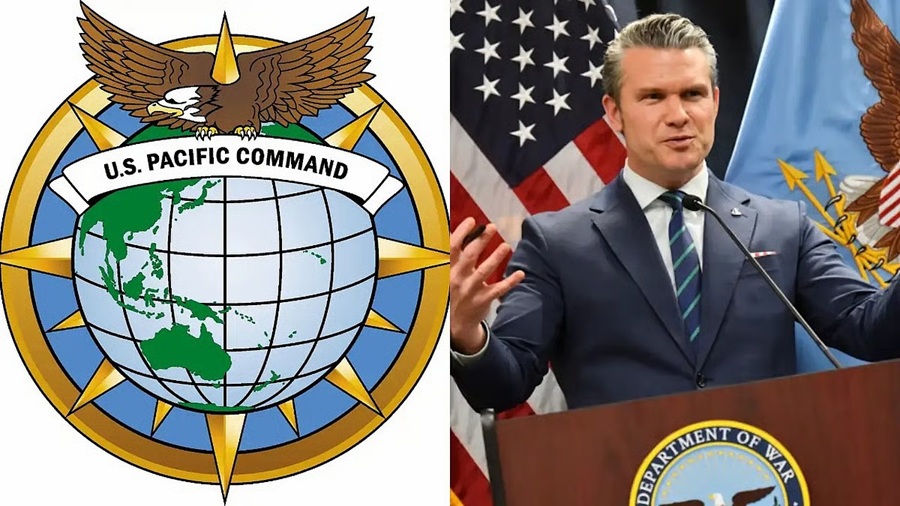
By dropping “Indo” from Indo-Pacific Command, Washington has reignited questions about the role and strategy of US Command in the Indian Ocean.
The Pentagon’s decision to restore the historic title of the US Pacific Command (USPACOM) by replacing the US Indo-Pacific Command (USINDOPACOM), may appear at first glance to be little more than bureaucratic housekeeping. Officially, Washington insists that the command’s responsibilities, operational boundaries and strategic priorities remain unchanged. But in international politics, symbols often reveal as much as strategy papers.
The removal of “Indo” has inevitably sparked questions about America’s regional priorities and the future of its partnerships in Asia. To understand why the decision has generated attention, one must revisit the history of the command itself. Established in 1947 under President Harry Truman, the US Pacific Command became one of America’s most important military institutions. For more than seven decades it oversaw American military operations and alliances across a vast region stretching from the western shores of the United States to the waters of Asia. It played pivotal roles during the Korean and Vietnam Wars and helped underpin the security architecture that emerged in Asia after the Second World War.
Profound Shift
For most of that history, the command’s name remained unchanged. Then, in 2018, during Donald Trump’s first term, Defence Secretary James Mattis announced that the Pacific Command would henceforth be known as the US Indo-Pacific Command. The move was not merely cosmetic. It reflected a profound shift in American strategic thinking.
By inserting “Indo” into the title, Washington formally acknowledged a reality that strategists had increasingly come to accept: the Indian and Pacific Oceans had become a single, interconnected strategic theatre. Trade routes, supply chains, naval deployments and geopolitical competition linked the two oceans more tightly than ever before.
The renaming also carried a clear political message. It recognised India’s growing importance in American foreign policy and defence planning. As Chinese power expanded across Asia and beyond, the United States sought stronger partnerships with like-minded democracies. India became central to that effort.
At the time, American officials openly acknowledged the significance of the shift. Alex Wong, then Deputy Assistant Secretary of State, argued that the term “Indo-Pacific” reflected both historical and contemporary realities, recognising India’s growing role in East Asia, Southeast Asia and the broader Pacific region. More importantly, the terminology signalled that the United States was prepared to contest China’s expanding influence westward through the Indian Ocean, including its ambitious Belt and Road Initiative.
The phrase “Indo-Pacific” soon evolved into more than a geographical description. It became a strategic concept. Alongside arrangements such as the Quadrilateral Security Dialogue, or Quad, involving India, America, Japan and Australia, and later the AUKUS security partnership, it formed part of a broader effort to balance China’s rise. Unsurprisingly, Beijing viewed these developments with considerable suspicion. Why, then, has Washington chosen to reverse course?
Historical Continuity
The most benign interpretation is that the administration simply wishes to restore historical continuity. Under this view, the return to the Pacific Command title honours the institution’s origins and its long contribution to regional stability. Given the Trump administration’s broader emphasis on tradition and institutional heritage, such reasoning cannot be dismissed entirely.
A second explanation lies closer to the personality-driven politics of the current administration. Recent months have witnessed efforts by Defence Secretary Pete Hegseth to emphasise military tradition and historical identity within the Pentagon. His public remarks have frequently described the United States as fundamentally a Pacific power. During recent appearances, including at the Shangri-La Dialogue, references to the Pacific substantially outnumbered mentions of the broader Indo-Pacific framework. The renaming may therefore reflect a broader attempt to align military institutions with an older, more traditional conception of American power.
A third possibility is strategic rather than symbolic. The administration may believe that America’s primary military competition with China will be decided largely in the western Pacific rather than across the wider Indo-Pacific region. If so, emphasising the Pacific could be intended to sharpen strategic focus rather than dilute regional engagement.
Officially, Washington insists that none of this changes the substance of American policy. The command’s mission, area of responsibility and strategic objectives remain intact. India, American officials stress, remains a vital partner. But perceptions matter almost as much as realities.
Viewed from New Delhi, the decision is unlikely to be welcomed enthusiastically. The term “Indo-Pacific” had symbolised India’s arrival as a central player in regional security. The concept helped institutionalise defence cooperation between India and the United States through military exercises, intelligence sharing, maritime coordination and strategic dialogue.
The renaming therefore risks creating an impression that India’s prominence in American strategic thinking has diminished. Even if no practical changes follow, the symbolism is difficult to ignore. Questions may also arise regarding the future trajectory of the Quad, whose very rationale is rooted in the Indo-Pacific framework.
China is likely to interpret the development differently. Beijing objected strongly to the adoption of the Indo-Pacific concept in 2018, viewing it as part of an American-led effort to constrain Chinese influence through networks of alliances and partnerships. The disappearance of “Indo” from the command’s title may therefore be welcomed as a rhetorical victory. Yet Chinese policymakers would be unwise to celebrate prematurely. A return to the Pacific Command name does not necessarily signal reduced American commitment to balancing China’s power.
America’s allies face their own dilemma. Countries such as Japan and Australia have invested considerable diplomatic capital in promoting the Indo-Pacific concept. A shift back to a Pacific-centred framework risks generating uncertainty about whether Washington and its partners are operating from the same strategic map.
Conclusion
Ultimately, the debate is not really about a name. It is about narratives. The Indo-Pacific concept emerged because it captured an important geopolitical reality: the Indian and Pacific Oceans are strategically inseparable. Renaming a military command cannot alter that fact. Nevertheless, perceptions shape policy. If America’s allies begin to doubt Washington’s commitment to the broader Indo-Pacific vision, China will be quick to exploit those doubts. The challenge for the United States is therefore not merely to reassure India and its partners but to demonstrate through actions that the principles underpinning the Indo-Pacific strategy remain intact.
Title Image Courtesy: Metro Vaarta
Disclaimer: The views and opinions expressed by the author do not necessarily reflect the views of the Government of India and the Defence Research and Studies.
Article Courtesy: Perfect Voice