India’s increasing reliance on hydrocarbons has heightened energy security as a vital national issue. Ongoing instability in West Asia and disruptions at major maritime chokepoints such as the Strait of Hormuz and the Bab el-Mandeb have exposed weaknesses in India’s energy supply network. Since a significant portion of India’s oil and gas imports pass through these routes, it is now more important than ever to diversify energy sources and supply routes. In this context, the African littoral has become an increasingly important strategic region. The continent holds substantial oil and natural gas reserves, with growing LNG prospects and plentiful critical minerals. Its position along key Indian Ocean sea routes also opens up possibilities for enhanced maritime collaboration and strategic partnerships.
Meanwhile, China’s growing involvement in Africa through infrastructure, port development, and energy investments has added a geopolitical dimension to the region’s significance, intensifying competition for influence and access to resources. This article explores the connections between India’s energy security, maritime interests, and Africa’s strategic significance. It highlights how African hydrocarbons contribute to India’s diversification efforts and emphasises the need for India-Africa collaboration in the Indian Ocean Region. The study suggests that India’s relationship with Africa should extend beyond energy imports to include maritime cooperation, infrastructure projects, and strategic connectivity.
Introduction
Energy has historically been a central factor in national growth and prosperity. From the coal era of the Industrial Revolution to the oil-fueled economies of today, reliable energy resources have influenced economic progress and national strength. Although investments in renewable energy are increasing, oil and gas still dominate transportation, industry, trade, and military sectors. For a fast-developing country like India, guaranteed energy access is crucial for ongoing development and preserving strategic independence. i
The energy consumption patterns of major economies, illustrated below, emphasise this point. China and the United States still heavily depend on coal, oil, and natural gas, despite large investments in alternatives. India’s energy needs are also increasing steadily, driven by industrialisation, urbanisation, and economic growth, with coal constituting a significant part of its energy mix. Even advanced economies like Japan, France, and the United Kingdom continue to rely on traditional energy sources, though to different extents.
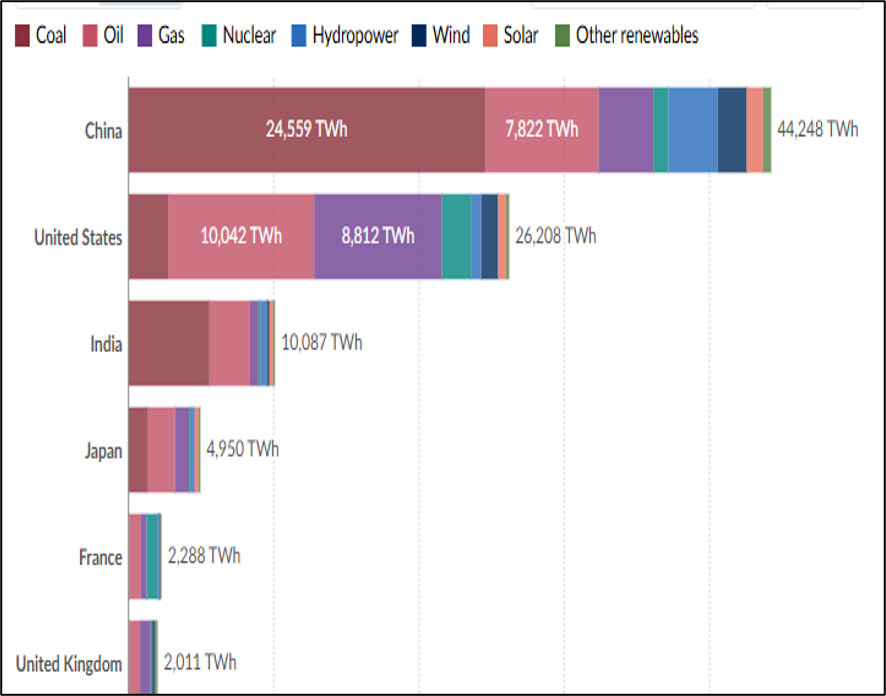
India’s Energy Consumption ii PC: Energy – Our World in Data
The general trends indicate that the transition to cleaner energy is advancing, but hydrocarbons are likely to continue to play a significant role in the near future. Consequently, energy security continues to be a key aspect of national security and economic stability.
In India, rising energy demand has been observed due to a growing economy, rapid urbanisation, growing industrial sector. While renewable energy sources have improved, oil and gas continue to be an important part of the country’s energy profile. India is importing around 85% of its crude oil requirements, which makes it vulnerable to external supply disruptions. The domestic production and consumption gap is increasing, which is a critical issue for energy diversification. iii
Strait of Hormuz, Bab el-Mandeb and the Strait of Malacca are all important maritime chokepoints through which a significant proportion of India’s energy imports transit. These are vulnerable to conflicts, piracy, and security threats in the region. In recent years, maritime and energy security have been closely intertwined, especially in the Red Sea. Any disturbances in these pathways can impair supplies, increase costs, and restrict economic development.
The proximity to West Asia and availability of energy resources have made the region a critical source of imported hydrocarbons for India for decades. Furthermore, the region’s constant instability, including the Israel-Hamas conflict, attacks on shipping in the Red Sea, and tensions in the Strait of Hormuz, poses a danger of relying extensively on a single area. These events highlight the need to diversify India’s energy sources and strengthen the security of its maritime supply routes.
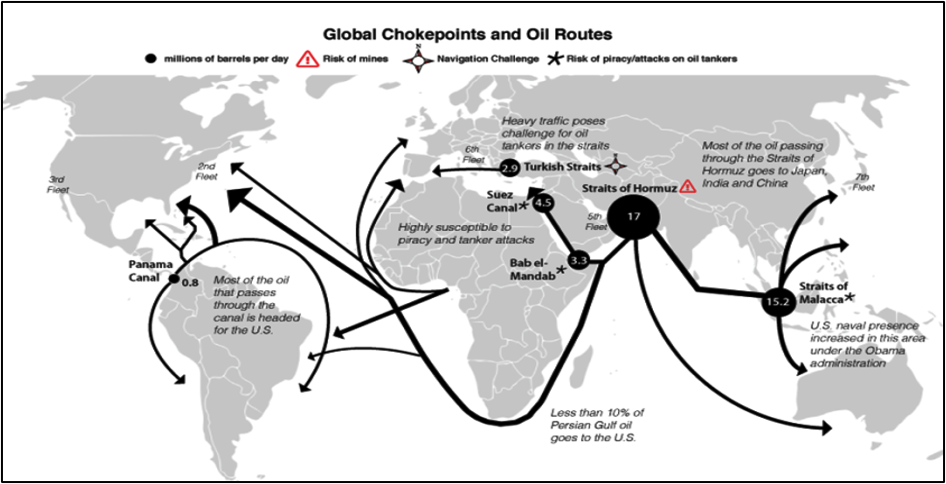
Importance of Geography and Choke Points PC: Global Security. Org
Africa has emerged as a significant strategic partner for India. It’s also growing significantly in the world’s energy market.iv The continent has substantial oil and gas deposits as well as necessary minerals for future technologies. With increased oil and gas production by several African countries and recent gas discoveries in Mozambique and Tanzania, the significance of gas as a crucial energy source for import-dependent nations such as India has also become evident.v
Moreover, Africa has drawn greater attention from major powers. China has intensified its presence through investments in infrastructure and ports, and energy projects throughout the continent.vi This growing influence has improved the strategic importance of Africa and impacts India’s interests in the Indian Ocean Region. vii
During such development, India-Africa relations need to be further expanded and strengthened. viii There should also be focus on improving maritime connectivity and trade, infrastructure and defence cooperation in addition to energy collaboration. Further, India’s historical and commercial relationships with Africa create a sizable Indian community in Africa, which can be of significant strength for India’s interaction within the region.ix
India’s Energy Vulnerability and Maritime Risk
Since economic liberalisation reforms of the 1990s, India’s energy consumption has increased significantly. Industrialisation, development of transportation infrastructure, urbanisation and enhancing living standards in India have been major energy consumers in the world. Yet, domestic hydrocarbon reserves are still limited. The production of indigenous crude oil accounts for a small portion of demand in the country, while natural gas production is limited due to growing demand.
The graphs below show India’s energy dependency on imports for hydrocarbons, highlighting inherent strategic vulnerabilities for India. LNG import profile reveals that Qatar accounts for 42% of total LNG imports, followed by the US (16%), UAE (13%), Nigeria (6%), Oman (5%) and Angola (5%). Likewise, most of crude oil imports primarily come from Iraq (26.11%), Saudi Arabia (19.35%), UAE (13.28%), which account for nearly 60% of total imports.
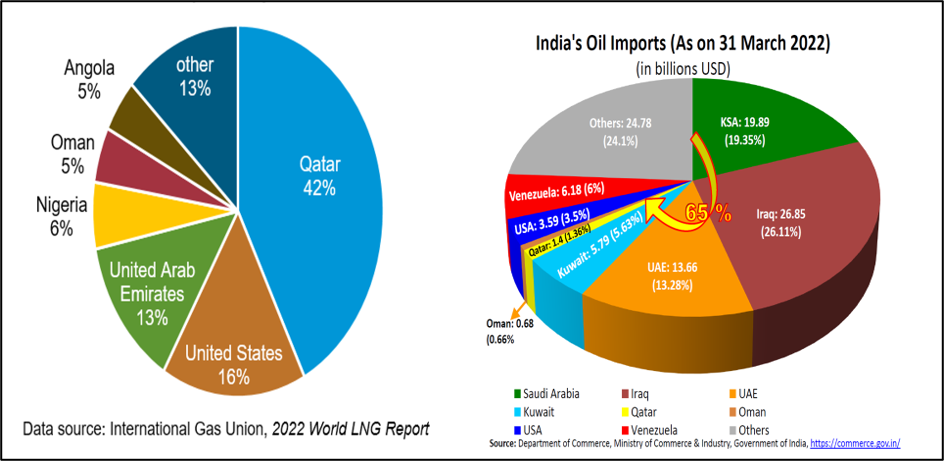
India Oil and Gas Import Diversification Status PC: GoI
The significance of 2022 data is present in its indication of India’s energy import baseline prior to disruptions caused by other global events such as the Russia-Ukraine conflict, the Israel-Hamas struggle, and instability in the Red Sea region. Although India has increased its crude oil source options over the last several years, including importing from Russia after 2022, this trend is primarily a result of present geopolitical and market factors. It doesn’t necessarily imply a permanent shift in India’s long-term energy sourcing. As global factors change, it is likely that the pattern of India’s crude oil imports will change. Thus, it is critical for India to continue its efforts to diversify its import sources and secure its maritime supply routes. Given that the majority of world energy imports are transported by sea, energy security is closely associated with maritime security and the continuous, unobstructed operation of sea lines of communication.
Another issue is the increasing strategic alignment between China and Pakistan. The capacity for monitoring as well as influencing the region is vital for energy imports from China’s growing presence at Gwadar Port, close to the Persian Gulf. India’s maritime energy routes could face conventional as well as unconventional threats during rising tensions or conflict. Such variations emphasise the significance of diversifying energy sources and routes by improving maritime security and resilience.
Africa as an Emerging Energy Frontier
The charts below describe variations between India’s emerging energy demand and hydrocarbon resources, compared to Africa and West Asia and the world as a whole. India comprises only 0.3% of the world’s proven oil deposits, and domestic oil consumption is significantly higher than oil production. Similarly, India holds just 0.8% of the world’s natural gas reserves, while production has been unable to meet demand. About 47% of the world’s oil reserves and 42% of natural gas reserves are found in West Asia, which poses dominant share of hydrocarbon resources globally. It maintains production levels well above domestic demand, strengthening its role as the world’s top energy exporter. There are also significant hydrocarbon reserves in Africa, accounting for 7.6% of global oil and gas reserves, with many countries producing far more than they consume.
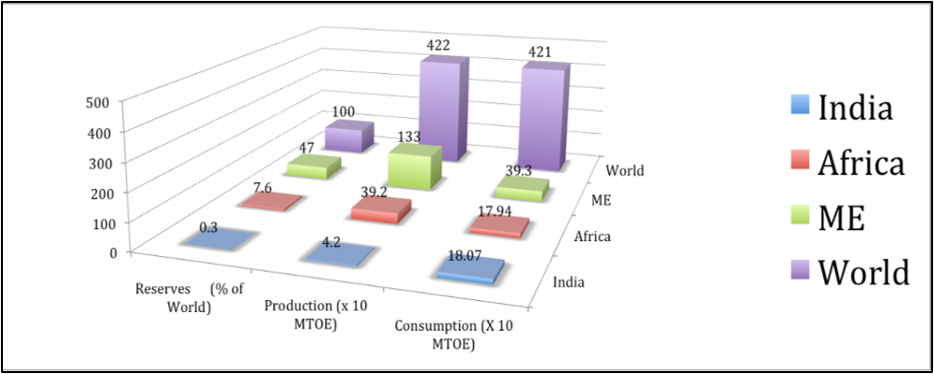
Comparative Oil Figures of India, Africa, West Asia and the World–Global Oil Analytics 2022 -30
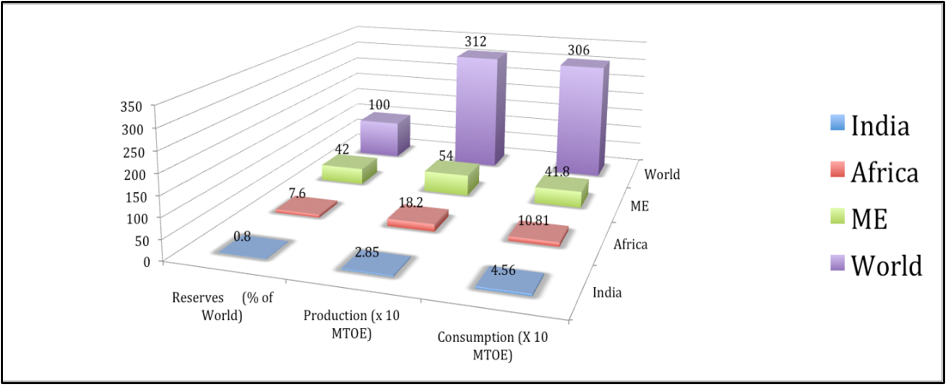
Comparative Natural Gas Figures–Global Gas Analytics Market Size Report, 2022 – 2030
Such figures reflect India’s continued dependence on imported crude oil and gas to facilitate economic growth and energy security. Despite West Asia’s continued importance as a supplier, geopolitical uncertainty, regional conflicts, and vulnerabilities at key maritime chokepoints, including the Strait of Hormuz and Bab-el-Mandeb, highlight the risk of being overly dependent on a single area.
Africa is an important component of India’s long-term energy diversification strategy in this context. Concurrently, the continent’s oil and natural gas reserves are present in West, North, and Southern Africa, and there are significant export surpluses in most oil and natural gas producing countries, which offer significant opportunities for stimulating more energy collaboration. Energy partnerships with African countries would allow India to diversify its energy sources, enhance energy supply security, reduce geopolitical risks, and help achieve a secure and sustainable energy future.
The importance of hydrocarbons in Africa has grown considerably over the past 2 decades, with the continent becoming a key emerging energy hub after large discoveries of oil and gas offshore. The map below highlights the rising position of East Africa, particularly Mozambique and Tanzania, as a natural gas development region and how it would significantly impact global energy markets and potentially diversify India’s energy sources. Mozambique’s Rovuma Basin is one of the largest recent offshore gas discoveries, with more than 100 trillion cubic feet of natural gas and key projects such as Mozambique LNG, Rovuma LNG, and Coral South FLNG. At present, three Indian companies (OVL, OIL and BPCL) hold 30% stakes in the Rovuma Basin LNG Area 4. However, TotalEnergies, France, is a lead player in the consortium.
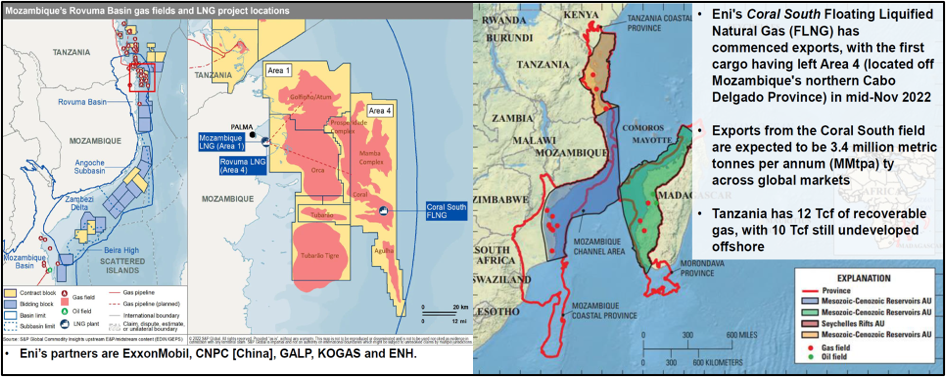
Rovuma basin off Mozambique x PC: S&P Global.com
The start of LNG exports from the Coral South project in 2022 marked a key milestone in commercialising these resources, positioning Mozambique as a leading LNG exporter globally. Similarly, these reserves of natural gas are estimated to be about 12 Tcf, with a substantial share situated offshore and yet to be developed, and thus offer considerable potential for production and export. Such finds and others on the continent have strengthened the continent’s share in the global energy market and relate to its growing role as an alternative natural gas supplier to traditional West Asian sources.
India could benefit from deeper association with emerging East African producers, given the growing gap between gas supply and demand. This would contribute to diversification of imports, enhance energy security, reduce dependence on traditional import routes exposed to geopolitical uncertainty, and strengthen long-term energy strategy resilience.
African crude oil is commercially and strategically significant for India’senergy security and diversification. In general, African crudes are light and sweet; that is, they have higher API gravity and lower sulphur content than many West Asian grades, as shown in the table below:- xi
| Name of Crude | Origin | API Degree | Sulphur Content |
| Brent Blend | UK | 38.7 | 0.31 |
| WTI Blend | USA | 38.7 | 0.45 |
| Arabia Light | Saudi Arabia | 33.4 | 1.80 |
| Name of Crude | Origin | API Degree | Sulphur Content |
| Arabian Heavy | Saudi Arabia | 28.7 | 2.8 |
| Barah Light | Iraq | 30.2 | 2.6 |
| Iran Heavy | Iran | 30 | 2 |
| Iran Light | Iran | 33.4 | 1.6 |
| Kuwait | Kuwait | 31 | 2.63 |
| Bonny Light | Nigeria | 34.3 | 0.15 |
| Cabina | Angola | 37 | 0.17 |
| Saharan Blend | Algeria | 47 | 0.11 |
Besides these commercial advantages, African crude oil provides unique strategic advantages. In contrast, African energy shipments typically go through more open sea routes with fewer chokepoint-related vulnerabilities, while Persian Gulf imports rely on the Russian isthmus of Bab el-Mandeb as their primary choke point and the Strait of Hormuz. This improves India’s operational flexibility, minimises the risk of energy disruptions caused by geopolitical events and strengthens energy supply chain resilience. Therefore, importing this African crude can facilitate profitability of refineries, reduce dependency on foreign energy supplies, and ensure energy security for India in the long term.
The map below illustrates Africa’s vast hydrocarbon resource base and its increasing role in the global energy scene, emphasising its potential as a strategic partner for India’s long-term energy security and diversification. As mentioned earlier, Africa has about 7.6% of the world’s proven oil reserves, particularly in countries such as Nigeria, Angola, Uganda, Ghana, the Republic of Congo, and Mozambique. The continent’s substantial and widespread energy resources provide opportunities for diversified sourcing and help reduce dependence on a few suppliers.
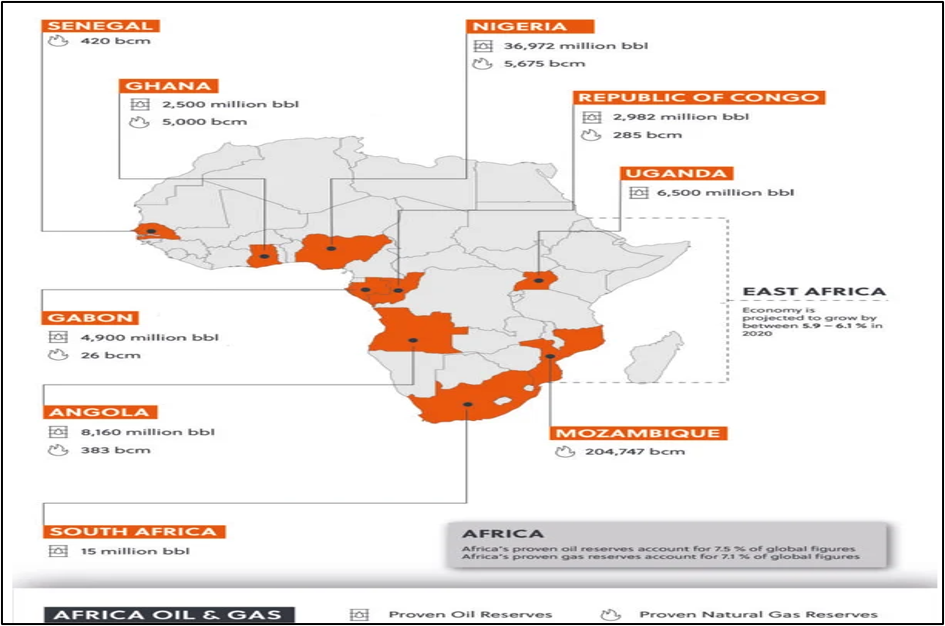
Africa Oil and Gas xii
The appeal of Africa is becoming more receptive since more countries are open towards allowing foreign investment in their hydrocarbon exploration, extraction, refining and energy infrastructure. This provides significant scope for companies like ONGC Videsh, Indian Oil Corporation and Bharat Petroleum to validate their long-term persistence among overseas investments, joint ventures, and strategic alliances. In addition to traditional hydrocarbons, Africa possesses large reserves of critical minerals vital for new clean-energy technologies, such as cobalt, lithium, phosphates, and rare-earth elements.
As India advances its energy transition and expands its renewable and electric mobility sectors, access to these resources will become increasingly important. Therefore, strengthening ties with Africa provides India with a way to improve energy security through a more diverse supply of oil and gas, and also offers a chance to obtain vital mineral resources crucial to its sustained economic growth and its commitment to clean energy.
Strategic Competition and China’s Expanding Footprint
According to the China–Global South Project, Chinese entities have carried out 82 energy projects in Africa, valued at around US$53 billion. These projects cover oil, natural gas, hydropower, solar, wind, coal, and other energy sectors. xiii These investments are supported by significant. Over the last twenty years, China has considerably expanded its presence through infrastructure funding, energy ventures, industrial growth, and port construction under the Belt and Road Initiative (BRI). xiv
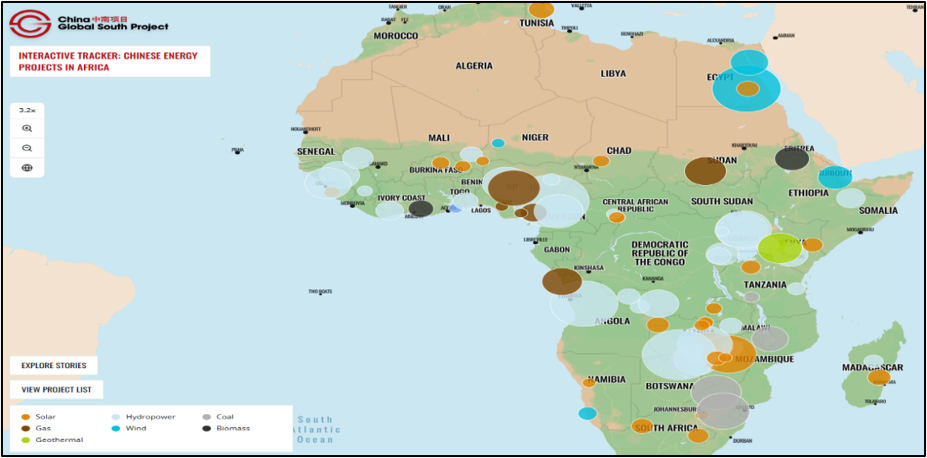
82 Projects worth 53 Bn Dollars of Chinese Energy Investment in Africa PC: China-Global South Project
Chinese investments also cover railways, highways, ports, industrial zones, and energy infrastructure throughout resource-rich regions in West, Central, East, and Southern Africa. Although officially commercial, many projects have significant strategic importance.xv Ports and maritime facilities financed by China along the western Indian Ocean coast have dual-use capabilities that could support future naval and logistical operations. xvi Simultaneously, the increasing debt of several African countries to Chinese lenders raises concerns about debt-trap diplomacy and Beijing’s potential to transform economic power into strategic influence. xvii
As far as India is concerned, Nigeria and Angola are among India’s major sources of crude oil, supplying crude worth nearly US$4 billion and US$3.6 billion respectively in 2024. Indian companies such as Indian Oil Corporation (IOC), Oil India Limited (OIL), and ONGC Videsh Limited (OVL) have also established a presence on the continent through investments and exploration projects, including stakes in Nigerian oil assets and participation in major energy ventures across Africa. As global energy markets become increasingly volatile, India’s reliance on West African crude has grown. In 2026, IOC purchased around 5 million barrels of crude oil from West Africa, including premium Nigerian and Angolan grades, underscoring the region’s growing role in India’s energy diversification strategy. xviii
The relationship is no longer confined to crude oil imports. India has emerged as a major supplier of refined petroleum products to African markets, with exports to the continent rising sharply to about 370,000 barrels per day in May 2026, more than double the previous month’s level. xix This growing two-way energy trade demonstrates the increasing complementarity between African resource producers and India’s refining capabilities. Beyond hydrocarbons, Africa’s vast reserves of critical minerals such as cobalt, lithium, manganese, and rare earth elements are becoming increasingly important for India’s ambitions in clean energy, electric mobility, and advanced manufacturing.
At the same time, China’s expanding footprint across Africa through investments in ports, transport corridors, mining projects, and energy infrastructure has enhanced its economic and strategic influence. Hence, India must move beyond a purely transactional approach and build broader partnerships based on trade, investment, development cooperation, capacity building, digital connectivity, and maritime security.xx By building on its existing energy ties with countries such as Nigeria, Angola, and Mozambique, India can secure reliable access to vital resources, support Africa’s development aspirations, and strengthen its own strategic position in Africa.
India’s Strategic Levers for Policy Priorities in Africa
India’s relationship with Africa has evolved, rooted in a shared history, strong people-to-people ties, development cooperation, and expanding economic ties. A major strength of this partnership is the goodwill cultivated through decades of engagement and shared experiences. Indian communities in East and Southern Africa have also played a vital role in strengthening business collaborations, investment flows, and cultural ties between the regions. Some of the strategic levers are tabulated below:-
| Strategic Lever | Key Strengths |
| Shared Vision and Political Partnership | • Convergence between Viksit Bharat 2047 and Agenda 2063. • Support for the African Union’s G20 membership. |
| Strategic Lever | Key Strengths |
| • Cooperation through BRICS and Global South platforms. | |
| Diplomatic Reach and Institutional Engagement | • 46 Indian Missions across Africa (including 17 new Missions) • Regular high-level visits; India–Africa Forum Summit. • Engagement with African regional organisations. • South–South Cooperation Model with emphasis on local ownership, capacity building, affordability and mutual benefit, generating considerable goodwill across Africa.xxi |
| Trade, Investment and Development Cooperation | • Major supplier of affordable medicines and vaccines, including vaccine diplomacy through Mission Vaccine Maitri during Covid19. xxii • Cooperation in digital public infrastructure, digital payments, e-governance and information technology capacity building. |
| Energy, Minerals and Sustainable Developmentxxiii | • Partnerships in crude oil, phosphates, bauxite and other critical minerals. • Cooperation through the International Solar Alliance, Global Biofuels Alliance and Coalition for Disaster Resilient Infrastructure. |
| Defence and Maritime Security | • Military training, defence exchanges, anti-piracy operations, naval cooperation and maritime capacity-building across the Indian Ocean region. (exercises like IBSAMAR, AKIYME, FoGG, etc.) |
| Diaspora and People to-People Tiesxxiv | • A three-million-strong Indian diaspora spread across 46 African countries serves as a bridge for trade, investment, entrepreneurship, cultural exchanges and political engagement. • In countries such as Mauritius, South Africa, Kenya, Tanzania and Uganda, diaspora communities have played an important role in economic development and bilateral relations. • Deep civilisational links across the Indian Ocean, shared historical connections, educational exchanges, cultural institutions and strong demand for Indian education, healthcare and cultural engagement. • 50,000+ African professionals trained under the Indian Technical and Economic Cooperation Programme. |
| Strategic Lever | Key Strengths |
| • Thousands of scholarships in institutions such as the Indian Institute of Technology Zanzibar and the National Forensic Sciences University, Uganda Campus. |
Policy Recommendations for India’s Engagement with Africa
As Africa’s importance in global energy markets, critical mineral supply chains, and maritime trade continues to grow, India should adopt a more focused and regionally driven approach towards the continent, as the region has a large number of regional bodies for shared interests. While bilateral partnerships will remain important, greater engagement with African regional organisations can help India advance its energy, economic, and strategic interests more effectively. This engagement should be guided by six broad pillars: energy security, maritime cooperation, trade and connectivity, capacity building, strategic partnerships, and domestic energy resilience.
The first pillar, Energy Security and Resource Diversification, should focus on securing reliable energy supplies and access to critical minerals. Through the Economic Community of West African States (ECOWAS), India can strengthen oil partnerships with countries such as Nigeria and Ghana, while engagement with the Southern African Development Community (SADC) can support liquefied natural gas (LNG) imports from Mozambique and Angola and provide access to minerals such as lithium, cobalt, copper, and platinum. Cooperation with the Economic Community of Central African States (ECCAS), including Gabon, Equatorial Guinea, and the Republic of the Congo, can further diversify India’s energy imports. Alongside hydrocarbons, India should expand investments in mining, renewable energy, and green hydrogen projects across Africa.
The second pillar, Maritime Security and Strategic Access, should strengthen India’s role in safeguarding key sea routes that connect Africa and the Indian Ocean. Under the Security and Growth for All in the Region (SAGAR) framework, India should expand naval cooperation, anti-piracy initiatives, maritime domain awareness, hydrographic assistance, and training programmes with African partners. Particular attention should be given to the Gulf of Guinea, the Red Sea, the Gulf of Aden, and the Mozambique Channel, all of which are critical for India’s trade and energy flows. Strengthening defence diplomacy through dedicated Defence Attachés in strategically important countries would further support these efforts.
The third pillar, Trade, Infrastructure and Connectivity, should focus on improving economic linkages between India and Africa. India should work more closely with the Common Market for Eastern and Southern Africa (COMESA) and leverage opportunities created by the African Continental Free Trade Area (AfCFTA) to expand trade and investment. Investments in ports, logistics networks, energy infrastructure, and industrial projects can improve connectivity and strengthen supply chains. Gateway economies such as Morocco, Mauritius, and Djibouti can serve as important hubs for Indian commercial engagement across the continent.
The fourth pillar, Diaspora, Soft Power and Capacity Building, should build on India’s longstanding social and cultural connections with Africa. The Indian diaspora, particularly in East and Southern Africa, can act as an important bridge for business and investment. Expanding scholarships, technical training, healthcare cooperation, digital partnerships, and capacity-building programmes under the Indian Technical and Economic Cooperation (ITEC) programme would strengthen human resource development and deepen people-to-people ties. Greater academic and research collaboration can further support long-term engagement.
The fifth pillar, Strategic Partnerships and Institutional Engagement, should focus at the continental level; the African Union (AU) should remain the principal platform for India’s engagement with Africa. India should deepen cooperation with the AU on energy security, climate action, economic integration, sustainable development, digital public infrastructure, healthcare, and renewable energy while strengthening coordination on Agenda 2063, AfCFTA-related initiatives, and reform of global governance institutions.
The sixth pillar, Domestic Energy Resilience, recognises that external partnerships must be supported by domestic preparedness. Expanding Strategic Petroleum Reserves (SPR), including in partner countries in Africa, increasing private-sector participation, and investing in energy infrastructure will strengthen India’s ability to withstand external supply disruptions. Continued diversification of the energy mix through renewable energy, natural gas, nuclear energy, and other emerging technologies will further enhance long-term energy security.
Taken together, these six pillars provide a practical roadmap for India’s engagement with Africa. A stronger partnership with African regional organisations will not only help India diversify its energy sources, secure critical minerals, and expand trade, but also contribute to maritime security, economic development, and deeper India – Africa cooperation in the years ahead.
Conclusion
The rapid economic growth of India and its efforts to achieve its strategic objectives mostly depend on energy availability. However, due to increasing reliance on imported hydrocarbons, limited domestic reserves and continuing instability in the West Asian region, weaknesses in the Indian energy supply system have been revealed. Recent disruptions in the Red Sea, continued tensions at key maritime chokepoints, and extensive geopolitical instability have reinforced the conclusive association between energy and maritime security.
Africa is becoming a key partner in India’s diversification plans. Its large reserves of oil, natural gas, and critical minerals, combined with its position along key Indian Ocean sea routes, offer considerable prospects for enhancing India’s energy security. Increased LNG output in countries like Mozambique and Tanzania, along with Africa’s deposits of lithium, cobalt, and rare-earth elements, further increases Africa’s strategic importance for India.
Meanwhile, Africa has turned into a hotspot of rising geopolitical rivalry. China’s growing investments in infrastructure, ports, and energy initiatives have introduced a strategic aspect to the region. Consequently, India needs to pursue a more comprehensive strategy that combines energy collaboration with maritime activities, development projects, capacity-building efforts, and enhanced economic ties.
India holds numerous advantages in this area. Its longstanding diaspora, development partnership approach, educational exchanges, and maritime cooperation under the SAGAR vision have fostered significant goodwill throughout Africa. xxv Additionally, the expanding presence of the Indian Navy in the western Indian Ocean enhances the security of sea routes that are crucial to India’s trade and energy imports.
Africa cannot substitute for West Asia as India’s main hydrocarbon source, nor is such a change advisable. Nonetheless, Africa can significantly contribute to diversifying India’s energy sources and strengthen the resilience of its supply chain. Therefore, India’s involvement with Africa should be regarded not just as an energy partnership but as a strategic long-term alliance that supports energy security, maritime priorities, and national goals in the Indian Ocean Region.
Title Image Courtesy: Discovery Alert
Disclaimer: The views and opinions expressed by the author do not necessarily reflect those of the Government of India or the Defence Research and Studies.


References
i Khashimwo, Pamreihor. (2020). India’s Quest for Energy Security: Understanding the Trends and Challenges. Journal of Asian and African Studies. 1- –18. 10.1177/0021909620972443.
ii IEA (2023), World Energy Outlook 2023, IEA, Paris https://www.iea.org/reports/world-energy-outlook-2023, Licence: CC BY 4.0 (report); CC BY NC SA 4.0 (Annex A)
iii Ministry of Petroleum and Natural Gas, Government of India, Annual Report 2019–20 (New Delhi: Government of India, 2020), para. 2.2.2, 16.
iv Nisha Shukla, India’s Energy Security: Role of Africa, 1st ed. (New Delhi: Shivalik Prakashan, 2015), pg 37 v Dharmendra Pradhan, “Africa Can Play Central Role in India’s Oil Diversification,” ET EnergyWorld, March 25, 2021.
vi Li, Mingjiang. “Soft Power: China’s Emerging Strategy in International Politics,” 2009. doi:10.1080/09700161.2011.531000.
vii Alex Lawler, “Africa Must Use Its Gas Reserves to Drive the Economy, Industry Officials Say,” Reuters, November 1, 2022, Reuters.
viii Beri, Ruchita, and U. K. Sinha, eds. Africa and Energy Security: Global Issues, Local Responses. New Delhi: Academic Foundation, 2009.
ix Kugiel, Patryk. (2017). India’s Soft Power: A New Foreign Policy Strategy. 10.4324/9781315272139.
x Alessandro Piccoli, Ian Conway, Justin Cochrane, Kelli Krasity, Keryn Tsimitakopoulos, and Roderick Bruce, “Is Floating LNG the Key to Unlocking the Rovuma Basin’s Full Potential?” S&P Global Commodity Insights
xi TotalEnergies, “Crude Assays,” TotalEnergies Crude Assays Database. PricewaterhouseCoopers (PwC), Africa Oil & Gas Review: From Promise to Performance (Johannesburg: PwC, 2013). https://www.pwc.com/ng/en/pdf/pwc-africa-oil-and-gas-review.pdf
xiii Jean-Pierre Cabestan, “The Belt and Road Initiative and China’s Hegemony in Africa,” Orbis 67, no. 4 (2023): 544–564, https://doi.org/10.1016/j.orbis.2023.08.005
xiv Garrison, Jean. (2008). TURNING ON THE CHARM Joshua Kurlantzick: Charm Offensive: How China’s Soft Power is Transforming the World. The Review of Politics. 70. 10.1017/S0034670508000521.
xv Shelton, Garth. (2001). China and Africa: Building an economic partnership. South African Journal of International Affairs. 8. 111-119. 10.1080/10220460109545365.
xvi Hanauer, Larry, and Lyle J. Morris. Chinese Engagement in Africa: Drivers, Reactions, and Implications for U.S. Policy. Santa Monica, CA: RAND Corporation, 2014.
xvii Raj Verma, India and China in Africa: A Comparative Perspective of the Oil Industry (London: Routledge, 2018)
xviii Reuters, “Indian Oil Corp Buys 5 Million Barrels of Crude from West Africa, Middle East, Sources Say,” May 29, 2026, https://www.reuters.com/business/energy/indian-oil-corp-buys-5-million-barrels-crude-west africa-middle-east-sources-say-2026-05-29/.
xix Angel One, “India’s Petroleum Product Exports to Africa Surge 110% in May 2026; Overall Shipments Decline 3.6%,” Angel One, June 2026, https://www.angelone.in/news/economy/india-s-petroleum-product exports-to-africa-surge-110-in-may-2026-overall-shipments-decline-3-6.
xx Ministry of External Affairs, Government of India. “Fourth India-Africa Forum Summit.” Press Release, April 23, 2026. https://www.mea.gov.in/press-releases.htm?dtl/41073/Fourth+IndiaAfrica+Forum+Summit=.
18 xxi Latika Adlakha, “Future Prospects of India-Africa Energy Ties,” 5 September 2022, https://www.cppr.in/articles/future-prospects-of-india-africa-energy-ties
xxii Beri Ruchita, “India’s Vaccine Maitri with Africa,” IDSA Comments, 11 March 2021.
xxiii Daniel Evans, Gary Clark, and Samira Mensah, “Bridging the Gap: Advancing African Energy Infrastructure Projects,” in Look Forward: Energy Futures (S&P Global, 19 March 2026), S&P Global Research & Insights
xxiv Neha Sinha, “An Overview of Indian Diaspora in Africa: Implications for India,” Vivekananda International Foundation, 12 March 2019, Vivekananda International Foundation article
xxv Jain, Amit & Tripathi, Upendra Nabh & Katiyar, Vinita. (2017). An Overview on Indian Diaspora in Africa. Educational Quest- An International Journal of Education and Applied Social Sciences. 8. 17. 10.5958/223